On November 13, 2026, PNC announced a partnership with ADP that embeds payroll and HR functions into the bank's digital banking platform, American Banker reported. For finance leads running crypto payroll for global teams — stablecoin salary, split fiat-and-token wages, or cross-border contractor pay — the move redraws the map for how wages are originated, settled, and accounted for.
Table of Contents
- The Embedded Payroll Shift: What PNC and ADP Just Announced
- Why This Maters for Companies Paying Teams in Crypto
- Background: How Crypto Payroll Works Today
- Three Implications Every Finance Lead Should Watch
- Where a Hybrid Platform Like OneSafe Fits Into a Converging Landscape
- Open Questions and What to Watch Next
- Quick Answers to Common Crypto Payroll Questions
- Key Takeawys
The Embedded Payroll Shift: What PNC and ADP Just Announced
The November 13, 2026 Partnership at a Glance
On November 13, 2026, American Banker's John Adms reported that PNC has partnered with ADP to combine salary disbursements and human resources inside PNC's digital banking channels. Dave Shorten, PNC's head of SMB Treasury Management, told American Banker that payroll is "usually the largest and most time-sensitive recurring expense a small business manages, and it's often the most significant cashflow consideration."
What the reporting shows: PNC is not building a payroll company. It is adopting ADP's embedded payroll capability and folding it into its open-banking strategy, giving business customers a payroll workflow next to their deposit accounts. Cornerstone analyst Jessica Pinkston said the PNC-ADP collaboration "could be the start of a new trend if other national and regional banks follow suit."
My analysis: This is not a crypto announcement, but it lands in the crypto payroll lane. Banks are moving payroll into the core account at exactly the moment wages are due — the same moment a crypto payroll platform typically executes a fiat-to-stablecoin conversion. I wrote earlier about what crypto payroll gets right in embedded payments; PNC's move is the incumbent response.
Why Banks Are Treating Payroll as the Next Embedded Payments Battleground
Embedded payroll means payroll infrastructure living inside another product — an HR suite, a bank account, an ERP — rather than a standalone pay run. ADP markets embedded payroll to software platforms, and API-first vendors such as Check's payroll infrastructure and Gusto Embedded Payroll have spent years building this category for vertical SaaS. The mechanics are detailed in Paycor's guide to embedded payroll.
The business case for payroll embedded banking is straightforward: the bank already holds the deposit, so origination and settlement can happen inside the same regulated perimeter. PNC's move signals that banks now see payroll as the next embedded payments surface because it gives a deposit-taking institution daily visibility into a company's cash position and a stronger reason to hold operating balances.
Why This Maters for Companies Paying Teams in Crypto
Closing the Gap Betwen Traditional Payroll Infrastructure and On-Chain Wages
Most employers still run payroll in fiat. Crypto payroll has historically been an edge case: a company either pays a third-party provider to convert fiat to USDC, BTC, or ETH at payout, or runs a direct on-chain salary flow. The gap that protected crypto-native tools — bank payroll was slow, siloed, and hard to integrate — is narrowing now that ADP's embedded payroll sits inside PNC.
The implication: crypto payroll providers can no longer win on "banks can't do this." They must win on what on-chain rails do structurally beter — immediate finality, global reach, and the ability to split a paycheck across a bank account and a walet without manual reconciliation.
Cash Flow, Timing, and the Stablecoin Advantage When Payroll Gets Embedded
Pnc's pitch is cash-flow visibility. Stablecoin payroll inverts that problem: a cross-border salary settled in USDC can arrive in minutes rather than the days correspondent banks require. That maters most for contractors in countries where local banking delays erode take-home value. The settlement-speed argument for stablecoin payroll has only sharpened as bank payroll embeds.
But cash-flow visibility is not settlement. A bank can see when payroll moves; it still settles through legacy rails. Stablecoin payroll keeps a structural edge in finality and cross-border speed, at least until a bank adds on-chain settlement to its embedded payroll flow.
Background: How Crypto Payroll Works Today
Common Models: Fiat-to-Crypto Conversion vs. Direct On-Chain Salary
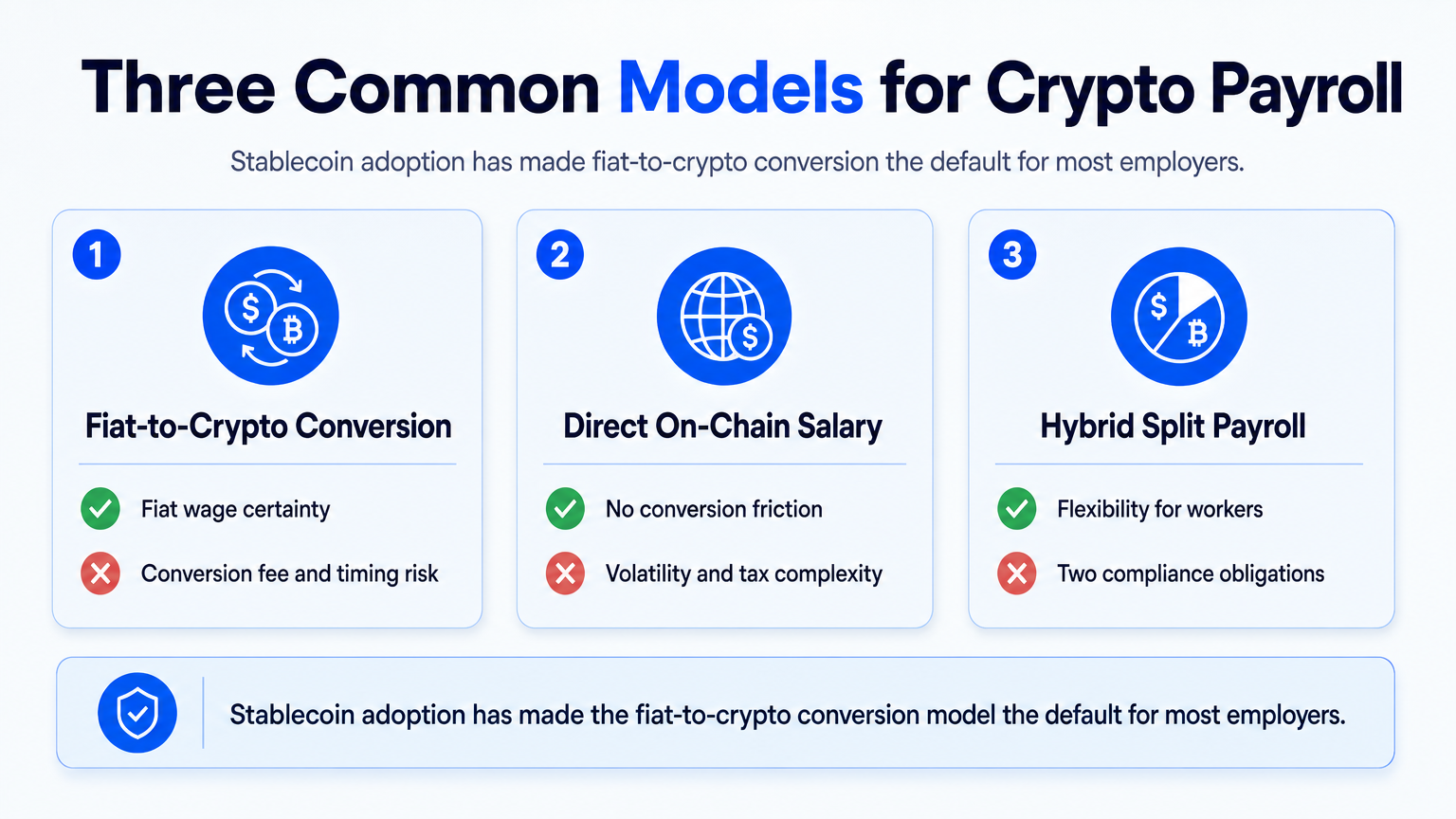
Two models dominate. First, fiat-to-crypto conversion: the employer holds fiat and a payroll platform converts a fixed fiat amount to a stablecoin at payout, preserving a stable wage in fiat terms. Second, direct on-chain salary, where the employment agreement denominations pay in a token — rarer, and legally messier. A third, growing model is the hybrid split: part of the wage goes to a bank account, part to a walet.
| Model | How it works | Key trade-off |
|---|---|---|
| Fiat-to-crypto conversion | Employer pays fiat; platform converts to stablecoin at pay time | Fiat wage certainty; adds conversion fee and timing risk |
| Direct on-chain salary | Agreement pays in a token; funds settle on-chain | No conversion friction; volatility and tax complexity |
| Hybrid split payroll | Portion to bank account, portion to walet/stablecoin | Flexibility for workers; two compliance obligations |
Stablecoin adoption has made the conversion model the default for most employers: stablecoin payments have moved mainstream as businesses increasingly use USDC and USDT for settlement.
Legal and Tax Esentials Across Jurisdictions
Legality varies by jurisdiction. Most countries allow wages in crypto if the employer withholds and reports taxes in the local fiat equivalent and records the fair market value at the payment date. Some restrict it. In the US, crypto wages are ordinary income subject to payroll tax withholding and FICA; if an employee later sells the tokens, capital gains can apply on any change in value. The legal burden sits with the employer, not the payroll tool.
Three Implications Every Finance Lead Should Watch
1. Embedded Payroll Could Bypas Third-Party Payroll Providers
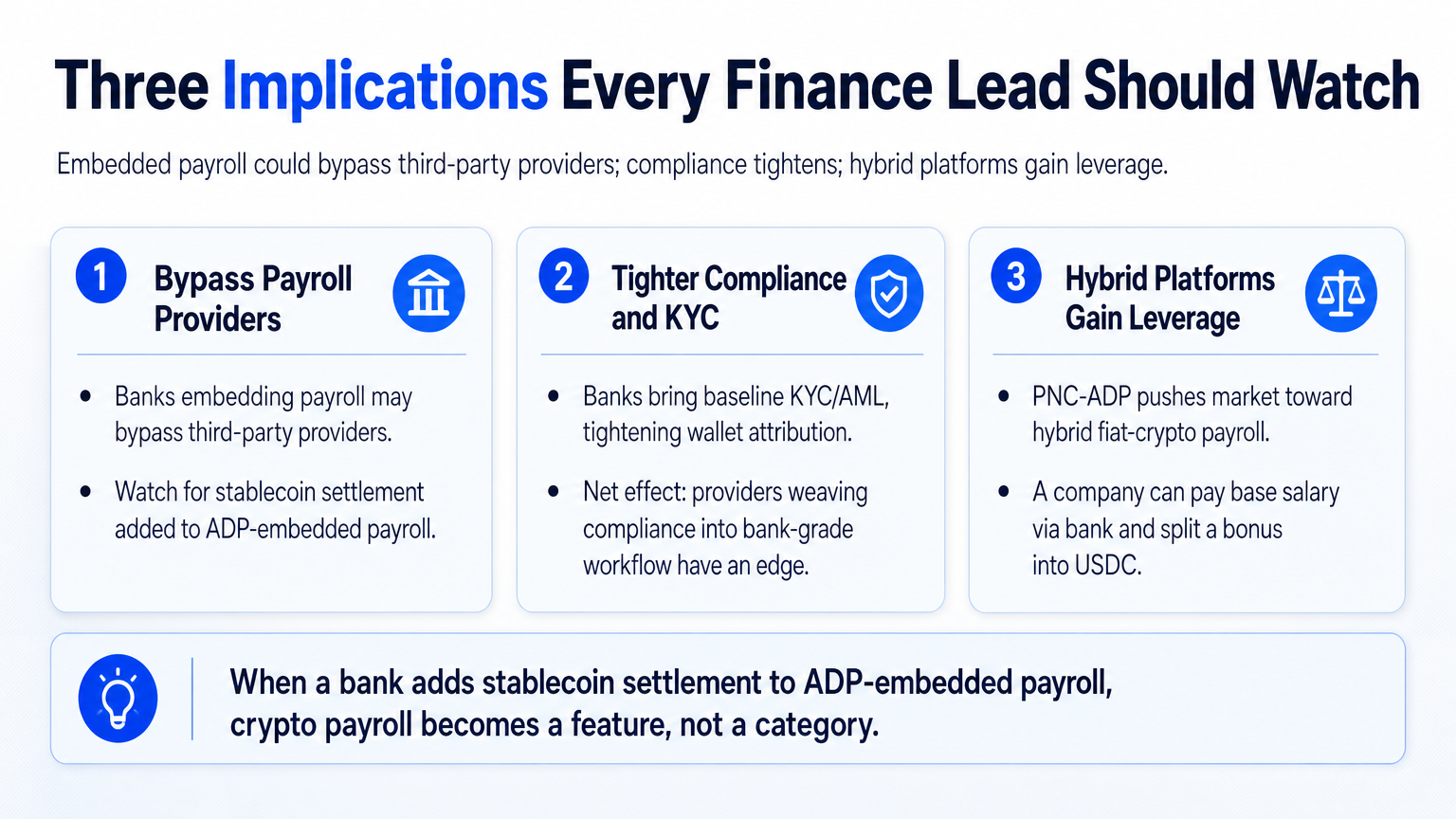
If a bank can originate salary inside a business's primary deposit account, the standalone payroll provider loses one reason to exist. For crypto payroll, the risk is sequense: a bank adopts embedded payroll first, then adds a crypto gateay later, routing a portion of wages to a stablecoin without a separate crypto payroll vendor.
The decision rule: watch for the first bank to add stablecoin setlement to an ADP-embedded payroll flow. That is the moment crypto-native payroll becomes a feature rather than a category.
2. Compliance and KYC Integration Will Become Tigher
Banks bring baseline KYC/AML discipline to payroll — something crypto payroll compliance has had to build independently. When wage payments embed in a bank, payroll inherits the bank's identity-verification and sanctions screening. That tightens the floor for walet attribution and sanctions checks on the on-chain leg.
The fiat leg, however, may get easier for employers paying in stablecoins because the bank already KYC'd the distributing account. The net efect: providers that weave crypto payroll compliance into a bank-grade fiat workflow will have an edge.
3. Hybrid Platforms That Bridge Fiat and Crypto Gain Leverage
The PNC-ADP move pushes the market toward hybrid fiat crypto payroll. A company that pays base salary through bank-hosted embedded payroll, then splits a contractor retention bonus into USDC, gets the best of both worlds. PNC's earlier USDC treasury experiment shows the bank already understands stablecoin settlement — the payroll layer is a logical extension, even if PNC hasn't announced one. I won't overstate: no bank has announced stablecoin settlement inside ADP payroll as of November 14, 2026. But the pattern is now visible.
Where a Hybrid Platform Like OneSafe Fits Into a Converging Landscape
Unified Fiat and Crypto Payroll Without Fragmented Accounts
OneSafe, a financial technology company whose banking services are delivered through partners, is built for exactly the convergence the PNC-ADP deal signals. Rather than running a bank account for fiat payroll and a separate walet for token salary, a company can operate hybrid fiat crypto payroll from one ledger: pay an employee's base salary in USD via ACH or wire, then convert a portion to USDC for a cross-border contractor — without moving funds betwen fragmented accounts.
The platform supports ACH, domestic and international wires, bill payments, and crypto on/of-ramps, with USDC deposits and withdrawls free. That maters when stablecoin payroll runs on a weekly or biwekly schedule and fees compound.
Simplified Compliance and Multi-Curency Reporting for Global Teams
For finance leads weighing the PNC ADP crpto payroll shift, the practical question is whether bank-embedded payroll can replicate the multi-curency and multi-entity reporting a crypto-friendly platform offers. OneSafe's setup is compliance-first: mandatory MFA at signup, digital asset custody through Fireblocks, and segregated global accounts in USD, Euro, and CAD, with automated payment workflows that support payroll and reimbursements.
The point is not to replace ADP or a bank. It is to give a business one interface where fiat payroll rails and on-chain salary flows meet — the operational gap the PNC deal just narrowed on the incumbent side.
Open Questions and What to Watch Next
Will Other Major Banks Follow PNC?
The biggest variable. If regional banks follow PNC into ADP-style embedded payroll within twelve months, standalone crypto payroll providers will face a choice: become crypto rails for banks or build full-stack payroll themselves. Cornerstone's Pinkston called the PNC-ADP collaboration "the start of a new trend if other national and regional banks follow suit." Watch whether a top-20 US bank announces an embedded payroll partnership in the next two quorters. The broader pattern fits PNC's crypto banking trajectory.
How Might Regulators Respond to Embedded Crypto Payroll?
If a bank's embedded payroll eventually includes stablecoin settlement, regulators will ask hard questions about sanctions screening, walet attribution, and the boundary betwen deposit-taking and stablecoin issuance. A bank-hosted payroll that converts to USDC would sit at the intersection of payroll law, the bank charter, and stablecoin regulation. No regulator has ruled on that combination as of November 14, 2026. The most likely first mover is the FDIC or a state money-transmiter framework, given the custody questions involved.
For finance teams tracking crypto payroll news November 2026, the pace is quick. Teams that publish internal updates can automate part of the research with Joyrise: grow organic traffic while you sleep: Joyrise analyzes your site, then writes and publishes SEO articles to Webflow, WordPress or Shopify every day. Your first article is written before you pay.
Quick Answers to Common Crypto Payroll Questions
Is it legal to pay wages in crypto, and how is it taxed?
Legality varies by jurisdiction. Most countries permit wages in crypto if taxes are withheld in local fiat terms and the employer reports the fair market value at the payment date. As ordinary income, the employee owes income and payroll taxes on the fiat-equivalent value at the time of payment; the employer typically withholds and reports those amounts. Capital gains may apply if tokens are sold later.
What does the PNC-ADP partnership mean for crypto payroll?
It changes no crypto payroll law today. It signals that incumbent banks and payroll providers view embedded payroll — the exact wage-distribution moment crypto payroll targets — as core territory, which will pressure crypto payroll providers to integrate with bank payroll flows or differentiate on settlement speed, global reach, and stablecoin utility.
How can a business handle both fiat and crypto payroll in one workflow?
By using a hybrid fiat crypto payroll platform that holds fiat accounts and crypto walets under one dashboard. The employer pays base salary via ACH or wire and issues stablecoin or token salary from the same interface, then reports both on a single ledger rather than aggregating bank and walet statements.
How does embedded banking affect payroll compliance?
It tends to raise the compliance bar. When payroll is embedded in a bank, KYC/AML checks, wage withholding, and reporting inherit the bank's identity-verification infrastructure, which can reduce duplicate compliance work on the fiat leg. The on-chain leg still requires walet screening and sanctions checks.
Which tokens are supported for payroll?
Varies by provider. Most crypto payroll platforms support USDC and USDT for stablecoin payroll; many also support BTC and ETH. Hybrid platforms may support additional tokens for payments and custody. Employers should confirm token support directly, because it changes by jurisdiction and platform.
Key Takeawys
- The PNC-ADP partnership moves embedded payroll into a major bank, raising competitive pressure on standalone crypto payroll providers.
- Hybrid fiat crypto payroll platforms that manage fiat and stablecoin wages from one ledger are best positioned as banking and crypto rails converge.
- Stablecoin payroll keeps a structural edge in cross-border salary settlement speed, but that edge shrinks if banks add on-chain rails to embedded payroll.
- Crypto payroll compliance will tighten as payroll inherits bank-grade KYC, raising the floor for walet screening and sanctions checks.
- Finance leads should evaluate any payroll partner by one test: can it pay fiat wages and settle crypto wages from the same workflow without fragmented accounts or manual exports?
If you're ready to run fiat and crypto payroll from one secure platform, sign up for OneSafe.