On November 9, 2026, PNC Bank launched a limited pilot that lets eligible corporate clients receive Ethereum-based USDC payments and have them automatically converted one-for-one into U.S. dollars. The news, broken by NewsBTC via TradingView on November 13, 2026, challenges a foundational assumption in crypto treasury management: that accepting digital assets means building a treasury that holds them. For finance leads weighing stablecoin acceptance, the pilot offers a live blueprint for accepting crypto without ever touching it.
Table of Contents
- What Just Happened: PNC’s USDC-to-Dollar Pilot
- Why This Matters for Crypto Treasury Management Now
- Crypto Treasury Management 101: What Every Finance Lead Should Know
- How This Pilot Changes Your Treasury Playbook
- What to Watch Next and Open Questions
- Key Takeaways
What Just Happened: PNC’s USDC-to-Dollar Pilot

NewsBTC reported on November 13 that PNC’s Corporate & Institutional Banking clients can now receive USDC and have it instantly converted to U.S. dollars in their PNC deposit account. Coinbase provides the payments infrastructure. No crypto wallet is needed on the recipient side; no stablecoin sits on the balance sheet. The sender pays in USDC over Ethereum; Coinbase instantly converts to dollars at a 1:1 rate, and PNC credits the account. The recipient sees a completed receivable like any wire or ACH credit. PNC’s crypto banking pilot signals a new era for businesses by decoupling the method of payment from the asset held.
Why This Matters for Crypto Treasury Management Now
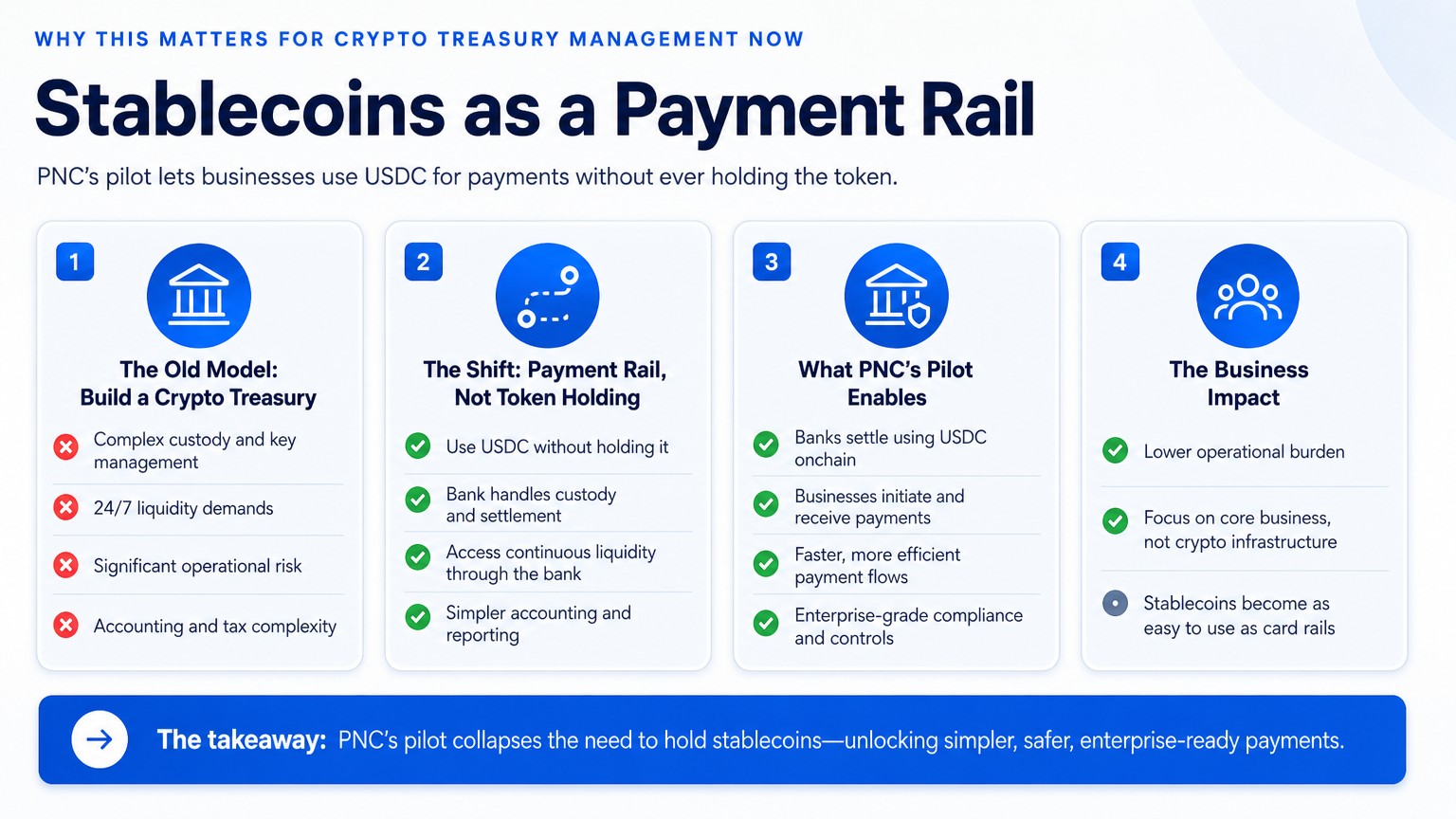
For years, accepting USDC meant building a crypto treasury—custody, key management, 24/7 liquidity, and accounting complexity. The PNC pilot collapses that assumption. Businesses can treat stablecoins as a payment rail—like a card network—without ever holding the token. This shifts crypto treasury management from asset-allocation to payments-operations. The orchestration shift in stablecoin payments now enters the commercial banking layer.
Immediate beneficiaries are U.S.-based suppliers invoicing in dollars but catering to clients who prefer stablecoins. A manufacturer selling to Web3 companies can accept USDC business payments without altering its treasury policy. The mid-market firm that once rejected crypto now has a bank-endorsed path. The question “Do we accept stablecoins?” no longer leads to “Do we have a crypto treasury policy?” For many, the answer is a simple yes.
Crypto Treasury Management 101: What Every Finance Lead Should Know
What is crypto treasury management?
Crypto treasury management is the set of policies, tools, and controls for receiving, holding, converting, and disbursing digital assets—stablecoins, cryptocurrencies, and tokenized assets—alongside fiat. As Stripe’s resource on the topic explains, it covers digital asset cash flows including custody, liquidity, and risk management. Core components include custody (how keys are stored), wallets and access controls (hot/warm/cold, multi-sig), liquidity (on/off-ramps, stablecoin-to-fiat conversion), and compliance (blockchain analytics, travel-rule). These basics underpin any digital asset treasury, whether tokens are held on-chain or instantly off-ramped.
Traditional vs. crypto treasury: differences that still matter
Traditional treasury operates during banking hours, settles T+1 or T+2, and relies on intermediaries. Crypto treasury runs 24/7, settles in minutes with on-chain finality, and can be programmable—conditional payments, automated splits. The speed and elimination of intermediary risk are offset by smart contract vulnerabilities, private key theft, and irreversible transactions. Both demand different tooling and oversight cadences, even as they converge on visibility, security, and cost control. The Allium guide for finance teams offers a deeper dive into these operational differences.
How This Pilot Changes Your Treasury Playbook
How does the PNC Coinbase pilot change how businesses manage crypto?
The PNC Coinbase pilot separates payment acceptance from asset holding. A company can choose to convert immediately to dollars and keep its treasury completely fiat-based, or hold stablecoins for yield, governance, or operations. The pilot makes the first option possible entirely within a traditional banking relationship—no crypto sub-account, no new custodian, no general ledger changes. For businesses that only want the payment benefit, crypto treasury management becomes nearly invisible. The Bottomline USDC transfer earlier this year hinted at this direction; PNC makes it concrete.
Accepting crypto without holding it: the operational upside
A buyer funds a wallet with USDC, scans a QR code or enters a receiving address (generated via Coinbase’s infrastructure on behalf of PNC), and signs. Seconds later, the supplier’s dollar account is credited. There’s no need to track cost basis, mark-to-market, or worry about peg risk. AR aging works as normal. The bank handles conversion and accounting; Coinbase manages the Ethereum side. For the first time, a major U.S. bank offers crypto-to-fiat conversion at settlement, turning stablecoins into a cross-border B2B payment rail that moves faster than a wire.
When a crypto-native platform like OneSafe fits better
The bank-led instant conversion model works best when the receiver never needs to use the stablecoin for anything beyond payment acceptance. But if a business operates in both fiat and crypto—needs to hold a float of USDC for payroll, supplier payments, or DeFi—or wants a single dashboard for multi-currency accounts and crypto wallets, a crypto-native neo-banking platform offers more utility. OneSafe, for example, provides a unified environment: hold USDC, convert to fiat or vice versa, pay bills, issue corporate cards, and manage cross-border wires—all with segregated global accounts and digital asset custody on Fireblocks. The decision turns on whether you need crypto as a treasury asset or just a momentary payment rail.
What does this mean for DAO treasury management?
DAOs often hold governance tokens and stablecoins for operations. The PNC pilot doesn’t directly serve DAOs because it requires a traditional corporate banking relationship. Yet its architecture reinforces an operational pattern: segregate the stablecoin war-chest used for payments from long-term assets held for governance. One approach: keep a core treasury in self-custody or institutional-grade multisig, while routing operational stablecoins through a neo-banking platform that handles payroll, grant distributions, and vendor payments in fiat without liquidating governance positions. OneSafe’s DAO-specific roles, smart contract-controlled payment rules, and instant off-ramping enable automation similar to the PNC model, but with flexibility to hold and deploy on-chain assets. Instant conversion is an operational tool, not a complete treasury strategy.
Should my business hold crypto or convert it immediately?
The choice depends on your billing and payment needs. Use this decision framework:
| Scenario | Recommended approach | Rationale | Implementation path |
|---|---|---|---|
| You bill in USD and accept stablecoins as an alternative payment method | Convert immediately via a bank-led pilot or a provider that offers instant fiat settlement | Eliminates volatility, custody burden, and accounting complexity | PNC’s pilot (if eligible) or a partner that converts stablecoins to fiat before settlement |
| You regularly pay vendors, freelancers, or DAO contributors in stablecoins or need a float for DeFi | Hold a stablecoin balance in a secure, insured environment | Keeps liquidity without multiple conversion hops; reduces wire delays and fees | A crypto-native neo-banking platform with multi-currency accounts and free USDC transfers |
| You want exposure to digital asset appreciation or yield, or your business model relies on token-governed protocols | Hold selected crypto assets as part of a formal treasury policy, segregate from working capital | Aligns treasury with strategic objectives while controlling operational risk | Qualified custodian plus institutional-grade wallet infrastructure; consider a service that integrates custody with spend management |
| Your organization is a DAO with both operational and governance treasuries | Split the treasury: convert stablecoins for payments automatically, self-custody governance tokens | Separates high-frequency spend from long-duration assets; simplifies compliance | Platform that supports custody and automated conversion, plus role-based access |
Convert immediately if crypto is solely a payment rail; hold only with a strategic reason.
What are the risks of accepting stablecoins for business payments?
Even with instant conversion, businesses must acknowledge the risk stack:
- Pre-conversion stablecoin risk: A sudden de-peg could affect the dollar value received if the conversion infrastructure falters, though the 1:1 guarantee reduces this.
- Smart contract and blockchain risk: Network congestion or a smart contract exploit on the integration could delay settlement. The settlement layer introduces technical risk not present in ACH.
- Compliance uncertainty: Accepting stablecoins may trigger new regulatory reporting. The pilot operates under existing KYC/AML, but evolving standards are a concern. An Illinois crypto tax case shows frameworks are still being tested.
- Counterparty concentration: The service depends on Coinbase’s infrastructure; a disruption could freeze payments.
The PNC model reduces the most salient corporate risks—volatility and custody—by making the crypto leg transitory. For many businesses, that trade-off is acceptable.
What to Watch Next and Open Questions
Will other banks follow PNC and Coinbase?
If the model scales, other large U.S. banks will likely strike similar partnerships with stablecoin infrastructure providers like Circle or Fireblocks. The $270 million stablecoin consortium moves earlier this year suggest bank consortia are exploring shared settlement rails. A follow-the-leader pattern would make stablecoin acceptance a commodity feature of corporate banking within 18–24 months.
Stablecoin regulation and corporate treasury
A pending U.S. stablecoin bill will define permissible issuers, reserve requirements, and bank-integration rules. A clear framework that explicitly allows banks to interface with regulated stablecoins would solidify the pilot’s legality. Restrictive legislation could force banks to abandon such programs. Treasury teams should monitor the bill closely; a regulatory green light could make stablecoin-settlement services routine.
Does the future of treasury management require support for crypto assets?
Even if a business never holds crypto, the ability to process crypto payments will become a competitive necessity. Major banks are building the plumbing, ISVs are embedding stablecoin settlement in ERPs, and international B2B buyers increasingly ask to pay in digital dollars. Any corporate treasury system that cannot ingest, reconcile, and automatically convert stablecoin payments will be seen as incomplete. The future is modular: a base layer of stablecoin treasury accounts that can accommodate any tokenized payment, with configurable rules to hold or off-ramp.
The role of neo-banking in a bank-driven rails future
As banks build the settlement infrastructure, neo-banking platforms that already unite fiat and crypto under one roof will differentiate on automation, multi-jurisdiction support, and programmability. Rather than competing on rails, they’ll compete on the experience: enabling a DAO to pay 100 contributors in multiple stablecoins and fiat currencies with a single approval flow. The PNC model validates the desire for simplicity. Tools that automate content about these shifts, like Joyrise—which analyzes your site and publishes daily SEO articles—may help teams keep stakeholders informed.
Key Takeaways
- The PNC-Coinbase pilot proves businesses can accept USDC payments and settle instantly in dollars without holding any crypto on their balance sheet.
- Crypto treasury management now splits into two pragmatic paths: instant-conversion payment rails for pure acceptance, and crypto-native treasury accounts for those who need to hold and use digital assets.
- For most suppliers invoicing in fiat, the pilot makes stablecoin acceptance operationally trivial—a bank-integrated crypto-to-fiat conversion replaces the need for crypto custody.
- DAOs and crypto-operating companies should still maintain a crypto treasury for strategic needs, but they can use neo-banking platforms to automate off-ramping of operational stablecoins.
- Regulatory tailwinds and bank adoption are accelerating; finance leads should evaluate stablecoin payment acceptance now to avoid being caught flat-footed.
Ready to future-proof your treasury with a single platform that handles both fiat and crypto—backed by secure custody and instant conversion? Start your onboarding with OneSafe today.