On October 14, 2026, Evernorth took a step that reconfigures how enterprises think about crypto treasury management. According to a report from Pluang that day, the firm has enlisted Ripple, Kraken, Coinbase, and BitGo as institutional partners to oversee and deploy strategies for its 473 million XRP treasury. The move isn’t just another large-cap digital asset purchase—it’s a deliberate shift toward a multi-custodian model that institutional treasuries have used for decades in the fiat world, now imported directly into on-chain finance. For any finance leader mapping crypto treasury operations, the lesson is clear: diversification is moving from an option to an operating standard.
Table of Contents
- What Just Happened: Evernorth's Multi-Partner XRP Treasury Move
- Why This Matters for Crypto Treasury Management
- Crypto Treasury Management 101: What Newcomers Need to Know
- The Multi-Custodian Advantage: Adjudicating a Key Debate
- Recommended Actions for Finance Leads
- What to Watch Next
- Key Takeaways
What Just Happened: Evernorth's Multi-Partner XRP Treasury Move
Evernorth, a player with significant XRP holdings, is spreading its operational and custodial dependencies across four distinct institutional partners: Ripple, Kraken, Coinbase, and BitGo (Pluang, October 14, 2026). Instead of parking all 473 million XRP with a single custodian or cold-wallet arrangement, the company is distributing responsibilities. The exact allocation of duties—who will custody the assets, who will execute trades, and who will handle liquidity—hasn’t been fully detailed publicly, but the structure points to a sophisticated multi-custodian treasury framework: counterparty risk is diluted, no single partner becomes a point of catastrophic failure, and the treasury can tap best-in-class execution from specialized providers.
This is a rare, concrete example of a large enterprise operationalizing crypto treasury management across multiple institutional-grade custodians in one coordinated strategy. Earlier in 2026, Standard Chartered’s RLUSD move signaled that legacy institutions see stablecoin treasuries as viable, but Evernorth’s plan stands out because it involves a native crypto asset (XRP) and a deliberate multi-partner design.
Why This Matters for Crypto Treasury Management
For years, crypto-native firms and DAOs have debated whether to consolidate assets with a single trusted custodian or to fragment across multiple venues. Evernorth’s decision weighs heavily in favor of diversification, and it arrives at a moment when the institutional custody market has matured enough to support such a strategy. By selecting providers that compete on different strengths—Kraken and Coinbase bring deep exchange liquidity, BitGo offers regulated cold-storage trust services, and Ripple provides native XRP infrastructure—Evernorth is constructing a treasury architecture that mirrors the best practices of large corporate fiat treasury departments, which routinely split cash across multiple banks and money-market funds to mitigate bank-specific risk.
The implications ripple downward. Mid-market firms and DAOs often assume that a single custodian or a hardware wallet is sufficient. But as crypto-to-fiat operations scale and regulatory scrutiny deepens, a multi-custodian model becomes more than a luxury—it is a discipline that separates professional treasury operations from ad hoc holding. A concentrated crypto treasury concentrates not only market risk but also custodial, operational, and jurisdictional risk. Evernorth’s move validates that large holders see the cost of managing multiple relationships as worth paying for resilience.
Crypto Treasury Management 101: What Newcomers Need to Know
A crypto treasury is the pool of digital assets an organization holds—be it cryptocurrencies like XRP, stablecoins, or tokenized real-world assets—to fund operations, meet obligations, or pursue yield. Crypto treasury management encompasses the policies, processes, and technologies used to ensure an organization’s digital assets are liquid, secure, compliant, and deployed efficiently. It covers cash forecasting, risk assessment, counterparty selection, private key governance, and performance reporting. As the Schwab primer Understanding Bitcoin Treasury Companies notes, corporate crypto holdings force finance teams to adapt traditional treasury skills to a volatile, always-on market.
Traditional treasury management operates within banking hours, relies on ACH and wire networks, and assumes a stable unit of account. Crypto treasury management introduces 24/7 markets, near-instant settlement, and a fundamentally different custody paradigm—private keys instead of account numbers. There is no centralized deposit insurance; security depends on cryptographic controls and institutional-grade custody like Fireblocks. A Natixis analysis, Navigating a New Era of Corporate Finance: Bitcoin Treasury Companies, highlights that these dynamics force treasury functions to evolve from periodic reconciliation to continuous, blockchain-aware cash management.
The toolset spans multi-signature wallets, institutional custody platforms from BitGo and Fireblocks, treasury management dashboards like Coinshift and Parcel, and on-chain accounting connectors. For organizations that need to bridge fiat and crypto seamlessly, a neo-banking platform like OneSafe provides a unified interface with built-in crypto-to-fiat conversions, corporate cards, and automated payments—all with Fireblocks-secured custody. This reduces the manual work of moving value between on-chain and off-chain environments, a critical need for teams managing both payroll and token allocations. Similarly, the Polygon-Coinme stablecoin payments deal demonstrates how custody and payments are converging, making it easier to operate a crypto treasury without building everything in-house.
Security begins with key management. Options include hardware wallets kept in physical vaults, multi-signature schemes with geographically distributed signers, and delegated custody with regulated institutions. For most organizations, institutional custody—where a third party like BitGo or Fireblocks holds assets in segregated, insured accounts with multi-party computation (MPC) technology—offers the best balance of security and usability. Evernorth’s four-partner approach adds a layer of organizational security: even if one custodian were compromised, the entire treasury would not be at risk. This aligns with the principle that crypto risk management is as much about governance as it is about technology.
Market volatility is the most visible risk, but operational and regulatory risks can be equally damaging. Smart contract bugs, custodian insolvency, key mismanagement, and sudden legal reclassifications are all on the table. Concentration risk—relying on a single exchange or custody provider—has materialized repeatedly in the industry. A multi-custodian setup directly addresses counterparty concentration, though it introduces new reconciliation complexity. Any crypto treasury strategy must treat treasury diversification as a core pillar, not an afterthought.
Controls start with a written treasury policy that defines approval thresholds, multi-signature quorums, and segregation of duties. For DAOs, on-chain governance can enforce transparent, member-voted decisions for every significant treasury move. OneSafe’s platform offers customizable roles and permissions tailored to DAOs, which helps embed controls directly into the payment flow. Beyond governance, regular independent audits, automated transaction monitoring, and disaster recovery tests—including offline key shard backups—prevent single points of failure. A 2026 DWF Labs study on public company crypto strategies reinforces that robust controls, not just custody, are what distinguish mature crypto treasury management from playground finance.
The Multi-Custodian Advantage: Adjudicating a Key Debate
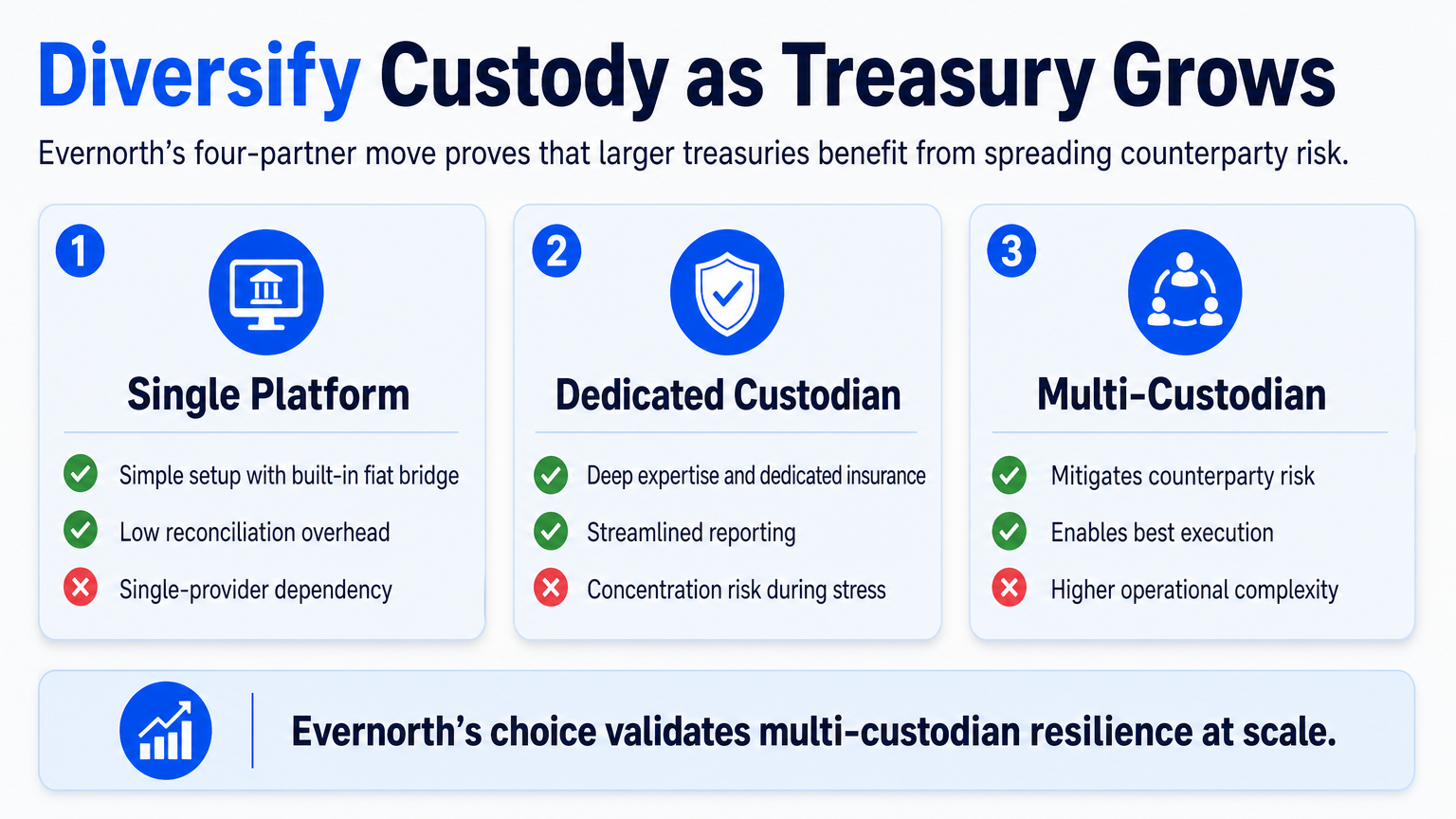
Industry guidance often splits on the single-vs-multi-custodian question. Some recommendations favor consolidating with one trusted custodian for simplicity, stronger legal recourse, and reduced reconciliation overhead. Evernorth’s move, however, is a high-profile counterexample: a $473 million XRP treasury is being managed across four partners, suggesting that at scale, the benefits of diversification decisively outweigh the operational burden.
The resolution is not one-size-fits-all. The case for a multi-custodian treasury strengthens as the custodial risk concentration rises, and weakens when a smaller treasury cannot justify the overhead of multiple relationships. A startup holding $500,000 in USDC may be best served by a single integrated platform that combines fiat and crypto services, while a mid-market company with $10 million or more in digital assets should begin evaluating two-custodian models to avoid a single point of failure. The table below distills the trade-offs.
| Custody Approach | Description | Advantages | Drawbacks | Best for |
|---|---|---|---|---|
| Single integrated platform | Neo-bank or fintech like OneSafe that unifies fiat/crypto ops with one custody backend (e.g., Fireblocks) | Simple, fast, low reconciliation cost; built-in fiat bridge | Dependency on a single technology provider; limited counterparty diversification | Startups, DAOs with <$5M crypto holdings |
| Single dedicated custodian | A sole regulated custodian (e.g., Coinbase Custody) for all digital assets | Deep expertise, dedicated insurance, streamlined reporting | Concentration risk; potential liquidity constraints during stress | Firms that value simplicity and can vet one partner rigorously |
| Multi-custodian delegation | Assets spread across 2–4 institutional partners for custody, trading, and yield | Mitigates counterparty risk, enables best execution, avoids single points of failure | Higher operational complexity, more reconciliation work, multiple fee structures | Large enterprises, treasuries >$10M, DAOs with significant assets |
Evernorth is clearly choosing the third path. For firms that cannot yet manage the operational complexity, a transitional step is to use a platform that can aggregate accounts across custodians, giving a centralized view without physically consolidating assets. Kraken’s bank deal earlier this year signaled that infrastructure to bridge banking and custody is becoming more mature, making multi-custodian operations easier to implement.
Recommended Actions for Finance Leads

Finance leaders should not wait for a crisis to reconsider custody architecture. Here is a concrete, phased checklist to move toward a resilient crypto treasury design.
Crypto Custody Readiness Checklist
- Map all current digital asset holdings, including their exact custodian(s) and signatory structure.
- Determine a risk tolerance ceiling for concentration: what percentage of total crypto assets are acceptable with any single partner?
- Evaluate a shortlist of regulated custodians (BitGo, Coinbase Custody, Fireblocks, Kraken) for insurance coverage, SOC 2 compliance, and jurisdictional fit.
- Draft a multi-signature governance policy that requires, for example, 3-of-5 approvals for any movement exceeding a set threshold.
- Integrate crypto treasury operations with fiat cash management—ideally through a neo-banking platform like OneSafe that provides real-time crypto-to-fiat conversions and segregated global accounts.
- Implement on-chain analytics and automated alerts to detect anomalous transactions immediately.
- Run a disaster recovery drill: simulate a custodian outage and test ability to shift liquidity to another partner without operational paralysis.
For organizations already at $5 million or more in crypto holdings, beginning a phased multi-custodian rollout is prudent. Start by onboarding a second custodian for a portion of assets—perhaps 20%—and build the reconciliation workflows over a quarter. Use the lessons to inform a full multi-partner structure. The stablecoin adoption shifts in LatAm show that treasury diversification is not just about risk; it can also unlock better on-ramp and off-ramp pathways across regions, turning custodian diversification into a business enabler.
What to Watch Next
The immediate question is whether Evernorth’s multi-custodian model proves replicable. If the arrangement operates smoothly, expect other large XRP and Bitcoin holders to announce similar diversification measures in the coming quarters. The EBA ruling on USDC in the European Union is already forcing custodians to up their compliance game, making multi-jurisdictional strategies both more complex and more necessary. Additionally, as DAOs grow their treasuries—some already holding hundreds of millions in tokens—the tools for DAO treasury management with delegated custody and on-chain governance will need to evolve to handle multi-custodian voting seamlessly. Watch for platforms that natively support multi-custodian aggregation, possibly within a single dashboard, as the next logical infrastructure layer.
Open questions remain: What operational gaps will Evernorth’s four partners expose? How will the firm handle tax reporting across different jurisdictions and custodians? And will XRP’s volatility force a rebalancing that tests the multi-partner model’s speed? Answers to these will shape best practices for the entire field of crypto treasury management.
Key Takeaways
- Evernorth’s selection of Ripple, Kraken, Coinbase, and BitGo to manage a 473M XRP treasury on October 14, 2026, makes a clear institutional case for multi-custodian crypto treasury management.
- For treasuries exceeding a few million dollars, diversifying across custodians mitigates counterparty risk and aligns with mature treasury practices.
- A phased approach—starting with a second custodian and building reconciliation muscle—allows mid-market firms and DAOs to adopt multi-custodian models without overwhelming operations.
- Controls, governance policies, and regular audits are as critical as custody technology; on‑chain automation and customizable role permissions can enforce them consistently.
- The convergence of fiat and crypto operations on a single platform reduces the friction of managing multiple custodians, so evaluate integrated neo‑banking solutions that can bridge both worlds.
For businesses that need to bridge fiat and crypto treasury operations in one secure, unified platform, explore OneSafe’s global accounts and multi‑currency capabilities.