

Crypto treasury management faces a real-world stress test as Bitcoin slid below $60,000 on November 20, 2026, marking its seventh consecutive weekly decline—the longest losing streak since 2022. For DAS and Web3 operators holding significant digital assets, a 14% weekly drop isn't just a chart; it's an immediate pressure on liquidity, vendor payments, and payroll. The fallout reveals which treasury tools and practices hold up and which buckle. Rather than abandon digital assets, the lesson is to build a treasury with instant fiat off-ramps, transparent reporting, and role-based controls that keep operations running when markets plunge.
Table of Contents
- What Happened: The Crypto Crush in Brief
- Crypto Treasury Management 101: A Quick Primer for Operators
- The Downturn's Immediate Impact on Crypto Treasuries
- Taking Action vs. Sticking to the Plan
- The Unknowns That Still Loom
- What is crypto treasury management?
- How is treasury management for crypto different from traditional treasury management?
- What are the biggest risks in running a crypto treasury?
- How do you manage liquidity during a crypto crush?
- Can my vendors still receive payments in traditional currency if my treasury holds crypto?
- How does a treasury team prove its onchain balances to an auditor during a volatile period?
- Do most companies hold volatile tokens in treasury, or just stablecoins?
- What changes for crypto treasury management after a major price drop?
- Key Takeways
What Happened: The Crypto Crush in Brief
On November 20, 2026, Bitcoin fell below $60,000 for the first time in four months, hitting an intraday low of $58,678.48 before recovering slightly, according to 파이낸新 (Financial News) on November 21, 2026. Ethereum plunged 6.5% to $1,643.60, and net outflows from U.S. spot bitcoin ETFs were cited as the immediate trigger. The same day, stablecoin market capitalization jumped $3.2 billion as traders fled to safety, CoinDesk reported.
Crypto Treasury Management 101: A Quick Primer for Operators
A definition for the uninitiated
Crypto treasury management is the practice of safeguarding, deploying, and accounting for an organization’s digital assets—often alongside fiat balances—to meet operational and strategic goals. It spans custody, liquidity management, risk controls, and compliance for on-chain and off-chain funds.
Why this matters now, more than ever
The crush underscores that even large-cap crypto assets can halve in value from their peaks (Bitcoin traded at half its October 2025 record of $126,210.50). For businesses that treated crypto reserves as long-term holdings, the sudden need to cover fiat liabilities exposes cracks in off-ramp infrastructure. Treasury teams that lack instant fiat off-ramps and real-time reporting find themselves making rushed, costly decisions.
The Downturn's Immediate Impact on Crypto Treasuries
Portfolio valuation swings and liquidity crunches
A 14% weekly drop can vaporize millions in notional value. For treasuries heavily weighted in native tokens or volatile assets, the paper loss hits liquid net worth immediately. The real operational pain, however, comes when bills must be paid: selling into a falling market to raise fiat forces a choice between locking in a loss or risking insolvency. Crypto volatility risk management becomes non-negotiable—a separate stablecoin buffer or pre-negotiated credit line is often the difference between a manageable dip and a crisis.
Counterparty risk when exchanges and lenders freeze
During downturns, centralized exchanges may halt withdrawls, and lending platforms can pause redemptions—as witnessed in past cycles. Even if you want to convert to stablecoins, you need operational, trusted rails that don’t depend on a single exchange. Using a platform that combines crypto banking shift: banks eye blockchain customers with direct custody reduces that third-party risk. Institutional crypto custody (via multi-party computation or hardware security modules) is table stakes, but it must be paired with immediate conversion capability so that assets don’t get trapped.
Operational continuity: paying bills and payroll in a falling market
For DAS and Web3 startups, payroll and vendor obligations are often denominated in fiat. When contributor salaries are priced in USD but the treasury holds ETH, crypto payroll volatility can delay payments or force contributors to accept steep discounts. To execute a cross-border crypto payment and land in a vendor’s bank account, a treasury must: (1) convert volatile assets to a stablecoin like USDC, (2) off-ramp the stablecoin to fiat, and (3) send a wire or ACH. Each step incurs fees and can slow to a crawl if network congestion or exchange spreads widen. Platforms that offer web3 payments: Visa’s stablecoin move and what it changes-like integration can compress these steps into a single interface, preserving liquidity.
Taking Action vs. Sticking to the Plan
Short-term moves: converting to stablecoins and securing off-ramps
When the market drops, a stablecoin off-ramp becomes the treasury team’s most important tool. A concrete checklist for the first 24–48 hours:
- Snapshot the treasury. Determine what percentage is in volatile tokens, stablecoins, and fiat.
- Convert just enough volatile assets to USDC to cover the next 30 days of fiat obligations—using a platform with tight spreads; avoid market orders that eat liquidity.
- Off-ramp USDC to fiat instantly on a platform that offers integrated crypto-to-fiat, then settle urgent payments via wire or ACH.
- Re-evaluate the allocation. Post-crush, the treasury’s risk profile may have shifted; update governance to mandate a larger stablecoin buffer.
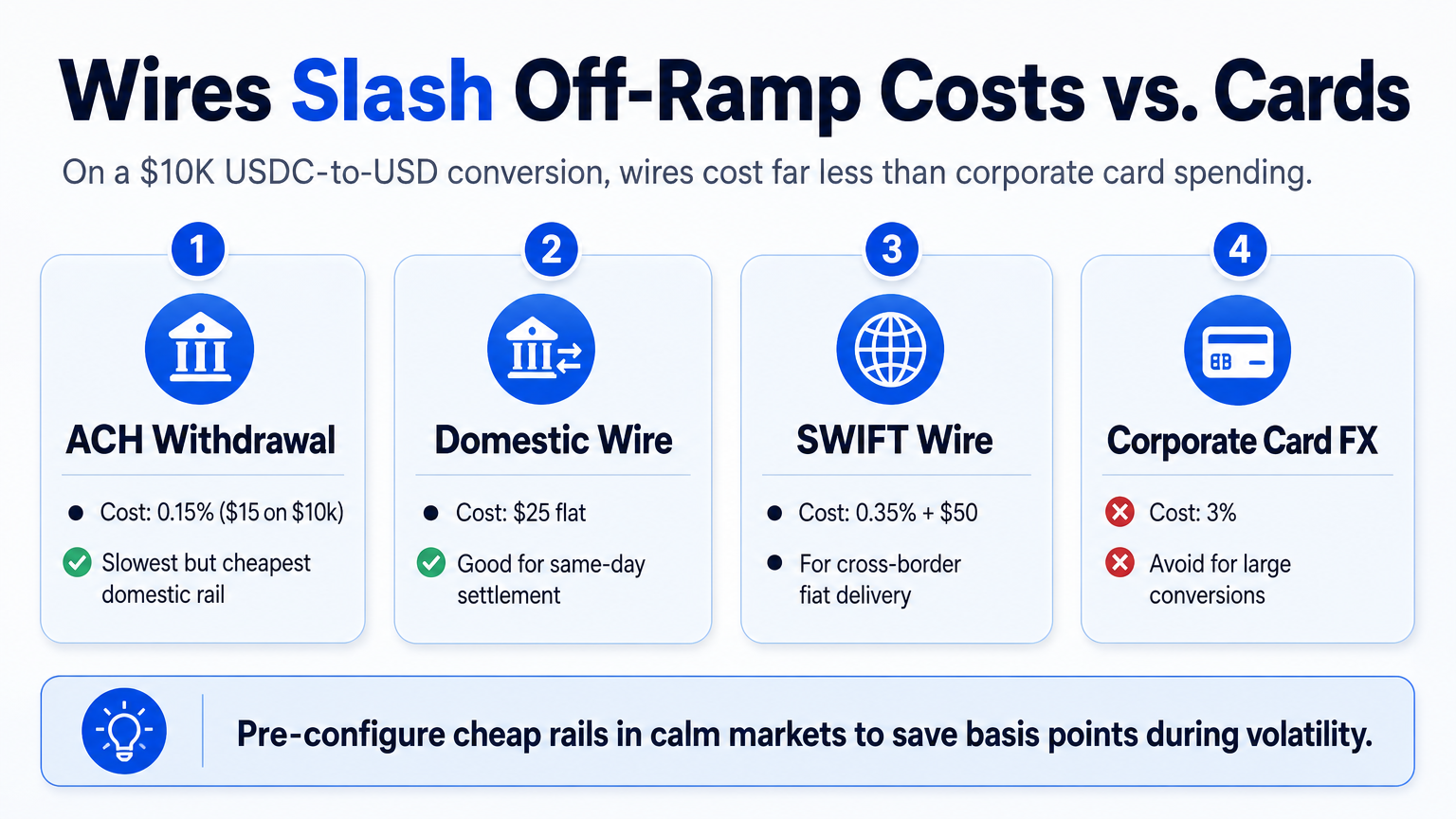
To illustrate the real cost of moving $10,000 from USDC to a USD wire during a panic, below are typical fees for a unified fiat-crypto platform (using publicly available pricing from OneSafe’s platform as of November 2026). Spreads and network fees will vary, but the table gives a baseline for planning.
| Transaction | Cost | Notes |
|---|---|---|
| USDC deposit | Free | On-chain gas only |
| USDC → USD conversion | 0.25% fee (or prevailing FX rate) | Spreads may widen under extreme volatility |
| ACH withdrawal (USD) | 0.15% ($15 on $10k) | Slowest but cheapest domestic rail |
| Domestic wire | $25 flat | Good for same-day settlement |
| SWIFT wire (international) | 0.35% + $50 | For cross-border fiat delivery |
| Corporate card FX spend | 3% | Avoid for large conversions; use wires instead |
These numbers show that a wire costs a fraction of a percent on a $10k conversion, while card-based off-ramps can become expensive in a hurry. Treasury teams that pre-configure their payment rails during calm markets save precious basis points when the pressure is on.
Long-term strategy: how diversified treasuries weather storms
Treasury diversification strategies that mix fiat, stablecoins, and a smaller slice of volatile assets provide a natural shock absorber. The crush reinforces a few crypto treasury management best practices: hold at least 6–12 months of operating expenses in stablecoins or fiat; segregate funds between a cold custody core and an operational hot wallet; and use role-based permissions. For DAS, the lesson is clearer: governance that requires a multi-day vote to authorize a conversion can’t move fast enough in a crush. Platforms that combine Fireblocks treasury management for custody with customizable roles allow a DAO to grant a small, trusted team the ability to execute emergency conversions without sacrificing overall multi-sig security.
The Unknowns That Still Loom
Will institutional outflows continue?
The current rout was triggered by ETF outflows; if institutional redemptions persist, further downside is possible. Treasuries should model a 30–50% drawdown scenario from here and ensure liquidity lines can withstand it.
How will regulators react to the volatility?
A sharp correction often brings fresh scrutiny of stablecoin reserves and consumer protection. The evolving regulatory landscape—explored in stablecoin regulation update: GOP regret signals shift—may accelerate, with implications for how treasuries hold and report stablecoin positions.
What new treasury tools will emerge from this test?
Expect automated rebalancing protocols, on-chain proof-of-reserves tools that update in near real-time, and more integrated fiat-crypto dashboards. The gap between pure DeFi and traditional banking will continue to narrow, and platforms that already bridge the two will likely see increased adoption. For teams that need to maintain a steady flow of updates about their treasury operations, a service like Joyrise—which analyzes a site, then writes and publishes SEO articles daily—can automate stakeholder communication without manual overhead.
What is crypto treasury management?
It’s the discipline of managing an organization’s digital assets—everything from Bitcoin and Ether to stablecoins like USDC—to meet cashflow needs, mitigate risk, and comply with financial reporting obligations. For a more detailed breakdown, crypto treasury management shifts to implementation: new EY data shows how firms are moving from theory to practice.
How is treasury management for crypto different from traditional treasury management?
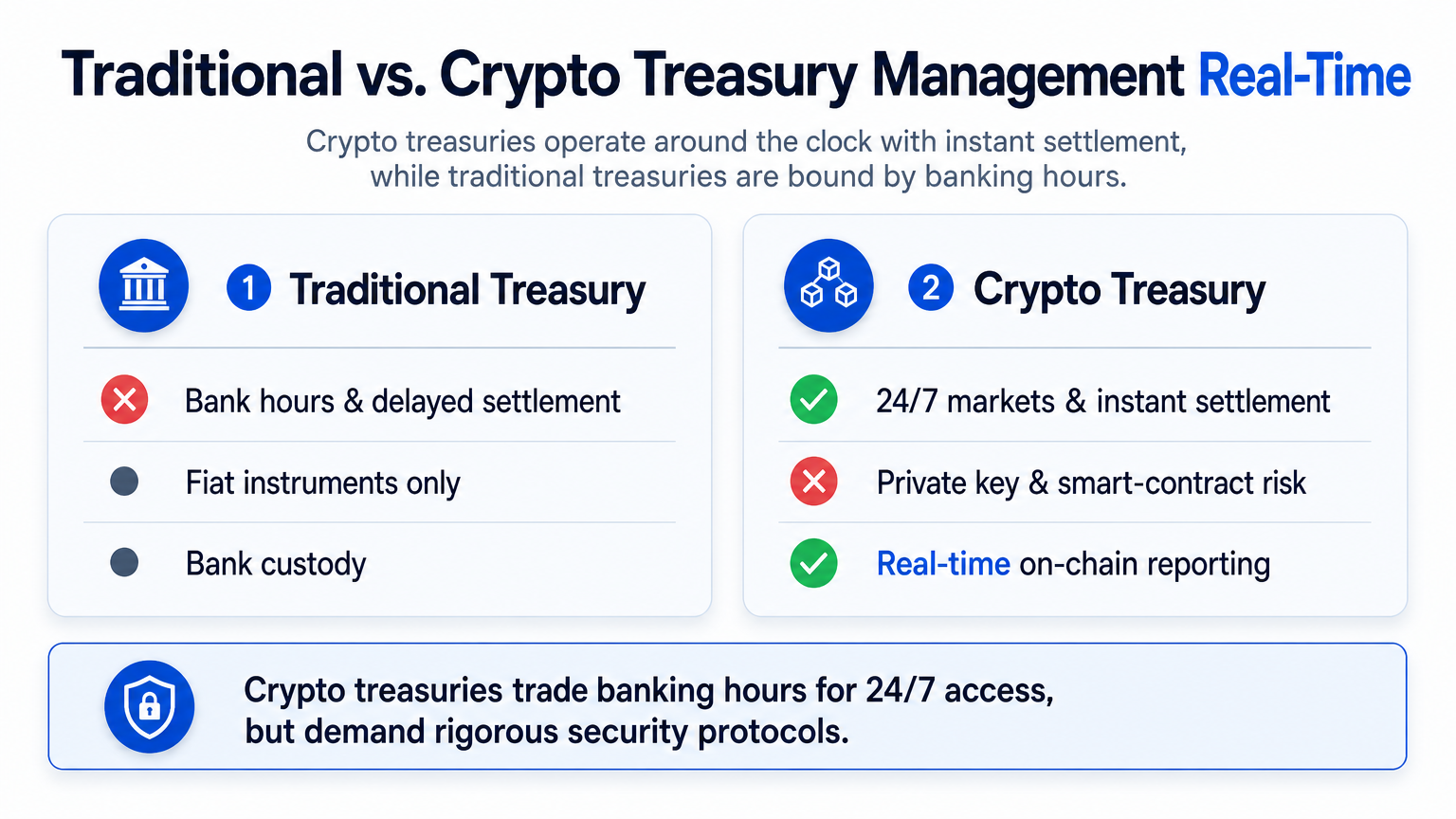 Traditional treasuries operate with bank hours, delayed settlement, and primarily fiat instruments. Crypto treasuries contend with 24/7 markets, instant on-chain settlement, private key security, smart-contract risk, and crypto payroll volatility. They also require real-time reporting of on-chain balances—something a bank statement can’t provide.
What are the biggest risks in running a crypto treasury?
Volatility of underlying assets, counterparty risk (exchanges freezing funds), regulatory uncertainty, and cyber-security breaches top the list. Institutional crypto custody—using multi-sig, MPC, or hardware modules—mitigates security risks, but doesn’t eliminate market risk. That’s where stablecoin buffers and pre-arranged off-ramps come in.
How do you manage liquidity during a crypto crush?
The priority is to avoid forced selling. Maintain a pre-positioned stablecoin reserve, use integrated platforms that offer instant stablecoin off-ramps, and pre-fund fiat accounts. The checklist in the Taking Action section above is a starting point. The core principle: only convert what you must, when you must, using the cheapest rail available.
Can my vendors still receive payments in traditional currency if my treasury holds crypto?
Absolutely. By converting crypto to stablecoins and then routing through a platform that handles fiat-crypto conversion rates and international wires, you can pay any vendor in their local currency. This works for both ACH domestic and cross-border crypto payments. For example, a DAO can off-ramp USDC to Eurs and pay a contributor via SEPA or wire, all within the same dashboard.
How does a treasury team prove its onchain balances to an auditor during a volatile period?
Auditors need assurance that balances reported at a specific timestamp are accurate and haven’t been double-counted. In a crush, manual spreadsheets break. Teams use on-chain analytic tools and platforms with integrated accounting feeds that snapshot balances and link them to off-chain records. Under crypto treasury management under the new U.S. stablecoin rules, such transparency is becoming expected. Real-time dashboards that pull directly from the blockchain and custodial records allow an auditor to verify, say, a wallet’s USDC balance as of 5:00 PM UTC on November 20, 2026, even while the market is still moving.
Do most companies hold volatile tokens in treasury, or just stablecoins?
Practice varies widely. DAS often hold significant positions in their native governance tokens, which can be highly volatile. Traditional businesses that dip into crypto tend to favor stablecoins for operational liquidity. The recent crush is likely to shift allocation—as seen in the growing adoption of stablecoins documented in crypto treasury management shifts to implementation: new EY data—toward a larger stablecoin cushion.
What changes for crypto treasury management after a major price drop?
The playbook hardens. Teams that weathered the storm with crypto treasury management best practices—solid off-ramps, role-based controls, transparent reporting—will double down on those tools. Those that struggled will revisit governance, increase stablecoin reserves, and adopt unified platforms that combine Fireblocks-grade custody with instant fiat conversion. The market drop becomes the catalyst for the operational maturity that separates a professional treasury from a speculative wallet.
Key Takeways
- A 14% weekly BTC drop is a liquidity stress test, not just a valuation dip; treasury teams must be able to convert to fiat within hours, not days.
- Stablecoin buffers and pre-established off-ramps are the operational backbone that keeps payroll and vendor payments flowing during a crush.
- Role-based controls and real-time reporting prevent governance paralysis and enable auditors to verify on-chain positions even under extreme volatility.
- Diversification and regular rebalancing across fiat, stablecoins, and volatile assets mitigate the worst of a downturn, but only if matched with immediate conversion rails.
- The next generation of treasury tools will combine institutional custody (Fireblocks), automated rebalancing, and integrated fiat-crypto accounts, narrowing the gap between traditional finance and crypto-native operations.
For a financial platform that unifies fiat and crypto treasury management with Fireblocks custody, instant off-ramps, and role-based permissions, sign up for OneSafe and build your multi-currency treasury in a single dashboard.



