The pace of US stablecoin regulation has entered a new phase of uncertainty after top Republicans privately conceded a tactical error that could delay comprehensive crypto market rules well into 2027. Former House Financial Services Committee Chairman Patrick McHenry’s admission—that splitting the stablecoin bill from a broader crypto market structure bill was a mistake—has immediate consequences for companies and DAOs that already route payroll, vendor payments, and treasury through stablecoins and need predictable legal footing.
Table of Contents
- What Happened: GOP Admits Spliting Stablecoin Bill Was a Mistake
- The Backgound: Stablecoin Regulation 101
- What This Means for Business Rellying on Stablecoins
- What Changes Now — and What Stays the Same
- What to Watch Next for Stablecoin Regulation
- Key Takeaways
What Happened: GOP Admits Spliting Stablecoin Bill Was a Mistake
Terrett reveals McHenry’s regret on ‘Crypto in America’ podcast
On November 20, 2026, Eleanor Terrett, host of the Crypto in America podcast, reported that Republican leaders now view their decision to advance a stablecoin bill separately from companion market-structure legislation as an error. According to Terrett, Patrick McHenry stated in an interview that he regrets his own role in the split, noting that the separate tracks reduced both bills’ chances of passage (bloomingbit, Nov. 20, 2026). The stablecoin bill—later signed into law as the GENIUS Act in July 2025—cleared Congress, but the broader crypto market structure bill stalled, leaving questions about digital-asset classification, exchange oversight, and SEC/CFTC jurisdiction unresolved.
Why this admission maters for stablecoin regulation’s timeline
McHenry’s candor signals a course correction. A combined bill in the next Congress—likely 2027—would bundle payment stablecoin provisions with rules on trading, custody, and decentralized finance. Businesses that planned their treasury infrastructure around the expectation that the US would soon deliver stablecoin regulatory clarity now face a longer wait. The episode highlights how political bargaining, not just policy design, determines the speed of rulemaking.
What does the GOP regret mean for crypto regulation and market structure?
McHenry’s regret means the comprehensive framework—defining which digital assets are securities, commodities, or payment tokens—is further away. The original strategy assumed a stablecoin-only bill would build momentum. Instead, the stalled market-structure bill left exchanges, DeFi protocols, and token issuers operating under ad‑hoc enforcement postures. A bundled bill would fix that, but not before 2028 at the earliest. For businesses, this means at least two more years of piecemeal guidance and state‑level variance.
Who is Patrick McHey and what did he say about stablecoin regulation?
Patrick McHenry (often referenced as “Patrick McHey”) is the former chairman of the House Financial Services Committee and a lead architect of the GOP’s digital-asset legislative strategy. After leaving Congress, McHenry told Crypto in America that the decision to advance the stablecoin legislation and the crypto market structure bill separately was a strategic misstep that weakened both. The Patrick McHey stablecoin regret, as it circulates in industry circles, underscores how internal sequencing battles can accidentally prolong the very uncertainty that businesses hoped the bills would resolve.
The Backgound: Stablecoin Regulation 101
Stablecoins defined and their role in modern business
Stablecoins are digital tokens pegged to a reference asset—most commonly the US dollar—and designed to maintain a stable value. They are used for cross-border settlements, e-commerce, payroll, and treasury management because they settle in minutes, cost less than traditional wires, and run on blockchains. For crypto-native startups and DAOs, stablecoins often serve as the default payment rail.
Why regulators have focused on stablecoins: risks and rewards
Regulators worry about run risk, consumer protection, money laundering, and systemic stability if a major stablecoin fails or loses its peg. At the same time, they recognize that properly regulated stablecoins can modernize payments, expand financial inclusion, and reinforce dollar dominance. The Congressional Research Service notes that the GENIUS Act was the first federal attempt to reconcile these tensions by creating a federal charter for issuers.
What risks do stablecoins pose to businesses and financial systems?
Businesses holding large balances face three concrete risks: reserve shortfalls that could break the peg and erode treasury value, custodial vulnerabilities if the issuer or its banking partner fails, and AML/KYB exposure because stablecoin flows can obfuscate counterparty identity. For the wider financial system, a run on a systemically important stablecoin could spill into traditional money markets. Meanwhile, the political landscape remains fluid; for instance, Dems Urge SEC to Reconsider Stablecoin Rules: Key Takeaways highlights ongoing pressure on the SEC to clarify its stance, adding another layer of uncertainty for treasury teams.
How does the GENIUS Act propose to regulate stablecoins?
The GENIUS Act, signed on July 11, 2025 (White House fact sheet), requires non‑bank issuers to hold one‑to‑one reserves in high‑quality liquid assets, provides a clear redemption right, and mandates regular reporting. It created a federal option alongside existing state regimes such as New York’s BitLicense. Because it did not address how crypto assets in general are classified—a gap the stalled market structure bill would have filled—the law left open the question of whether some stablecoins might be treated as securities, commodities, or a novel asset class.
Adjudicating classification tensions
Opinions diverge on the right classification. One camp argues that payment stablecoins resemble pre‑paid value and should sit outside securities law; another insists that any token with stable‑value features can meet the Howey test under certain circumstances. A practical reading of the legislative record and agency statements suggests that fiat‑backed, non‑interest‑bearing stablecoins used solely for payments are the least likely to be swept into SEC oversight, but no court ruling has yet settled the matter. For now, businesses must operate on assumption‑based compliance frameworks, which is both costly and fragile.
What This Means for Business Rellying on Stablecoins

How legislative fragmentation creates ongoing uncertainty for crypto-native companies
Without a unified federal market structure, companies that hold stablecoin balances, pay contractors in USDC, or run decentralized protocols confront conflicting signals. One regulator may treat a treasury function as money transmission while another views the same activity as dealing in unregistered securities. This patchwork forces compliance teams to over‑reserve and limits the types of institutional partners willing to serve the sector.
How can businesses use stablecoins for cross-border payments under current rules?
Under current rules, businesses can use stablecoins for cross‑border payments by maintaining strict compliance with state money‑transmitter requirements, screening wallets against OFAC sanctions lists, and holding only fiat‑backed, regulated‑issuer tokens (e.g., USDC). A DAO with contributors in 12 countries, for instance, might use USDC for payroll and vendor settlements to avoid SWIFT fees and FX slippage. Its DAO stablecoin treasury sits in gnosis safe wallets. When the market structure bill stalled, the DAO’s fiat off‑ramp tightened policies, forcing the DAO to keep more cash in fiat to reduce regulatory exposure. For a fast‑growing startup, the speed advantage of stablecoins must be weighed against crypto payment compliance—wallet screening, beneficiary identification, and record‑keeping that satisfies both state and international standards.
Practical steps to safeguard stablecoin activity while regulation lags
- Structure treasury carefully: Keep balances in fiat‑backed, regulated‑issuer tokens; avoid algorithmic stablecoins.
- Segregate wallet infrastructure: Use multi‑ig business wallets with role‑based controls and clear audit trails.
- Run real‑time compliance checks: Screen wallets with an on‑chain analytics provider before transactions clear.
- Document business rationale: Record the economic purpose, counterparty ID, and jurisdictional analysis for every stablecoin payment.
- Choose a platform that bridges both worlds: A unified financial technology layer that supports fiat accounts, stablecoin on/off‑ramps, and compliance workflows reduces the number of touchpoints carrying regulatory ambiguity.
For example, Crypto Treasury Management Under the New U.S. Stablecoin Rules outlines how businesses are adapting treasury operations to the latest federal guidance, emphasizing the same platform and documentation principles.
How platforms like OneSafe help business navigate fiat and crypto fluidly
For the startup and DAO examples above, a unified neo‑banking platform removes friction. OneSafe, a financial technology company that provides multi‑currency accounts and crypto services through banking partners, allows businesses to receive fiat, convert to USDC, pay vendors in stablecoins, and sweep excess back to fiat—all within a single interface that maintains KYP/KYB records and transaction monitoring. That integration reduces the compliance surface exposed to the patchwork of state‑level money transmission laws while global federal rules remain incomplete. (OneSafe is not a bank; banking services are provided by its partner institutions.)
What steps can a startup take to manage stablecoin AML/KYB compliance today?
- Classify your activity: Are you simply receiving stablecoins as payment, or issuing, exchanging, or custodying them? Each triggers different obligations.
- Map jurisdictions: Identify every country from which you receive or to which you send stablecoin value; different AML/KYB thresholds apply.
- Select a compliance stack: Combine on‑chain analytics for wallet screening with a traditional identity‑verification partner.
- Automate suspicious activity tracking: Set alerts for transactions above $10,000 and any touchpoints with high‑risk geographies.
- Choose a banking‑like interface that bakes in compliance: Platforms that offer fiat‑to‑crypto conversions, segregated business accounts, and automated reporting can embed KYP checks at onboarding and tie them to each transaction.
These steps preserve the speed and cost benefits of cross‑border stablecoin payments while building a defensible compliance narrative for when auditors or examiners appear.
Summary: Stablecoin risk-management cheat sheet
| Action area | Near-term step | Why it maters now |
|---|---|---|
| Token selection | Use only fiat-backed, regulated-issuer stablecoins (e.g., USDC) | Avoids peg risk and algo instability |
| Wallet architecture | Multi-ig business wallets with role-based controls | Creates audit trail and prevents internal fraud |
| Counterparty screening | Pre-transaction wallet checks with on-chain analytics | Satisfies AML obligations even without federal clarity |
| Documentation | Written business purpose for every stablecoin outflow | Defense against potential securities or money-transmission claims |
| Platform choice | Integrated fiat/crypto neo-banking service | Minimizes the number of mismatched regulatory regimes |
What Changes Now — and What Stays the Same
Clarity remains delayed, but state-level actions continue
While the GOP rethinks bundling, state regulators are not waiting. The New York Department of Financial Services continues to enforce its stablecoin guidance, and other states are considering their own frameworks. The OCC’s interpretative letter on national banks holding stablecoin reserves has provided piecemeal clarity, but it does not address non‑bank businesses that use stablecoins for operations. The crypto banking shift—with platforms like MoonPay seeking trust charters—indicates that the private sector is building compliance bridges even while Washington sorts out legislative sequencing.
The fundamentals of safe stablecoin use for compliant business remain unchanged
The core prudential principles are already in place: know your counterparty, verify reserve proof, avoid unbacked tokens, and maintain robust on‑chain forensic hygiene. The US crypto regulation 2026 landscape is still a quilt, but the threshold for enforcement has not risen; agencies continue to pursue cases where they see clear consumer harm or AML failings. Businesses that stay within the established guidelines—even if those guidelines are state‑level—face a manageable risk profile.
What to Watch Next for Stablecoin Regulation
Potential for a combined bill in 2027
McHenry’s statements increase the odds that the next Republican‑led House will package stablecoin rules with digital‑asset classification, exchange oversight, and DeFi parameters as a single GENIUS Act stablecoin‑plus‑market‑structure vehicle. If that happens, federal rulemakings could finalize by late 2028. Business planning a treasury move today should model that timeline and avoid committing to infrastructure that can’t be unwound if short‑term clarity vanishes.
Global regulatory trends US business should monitor
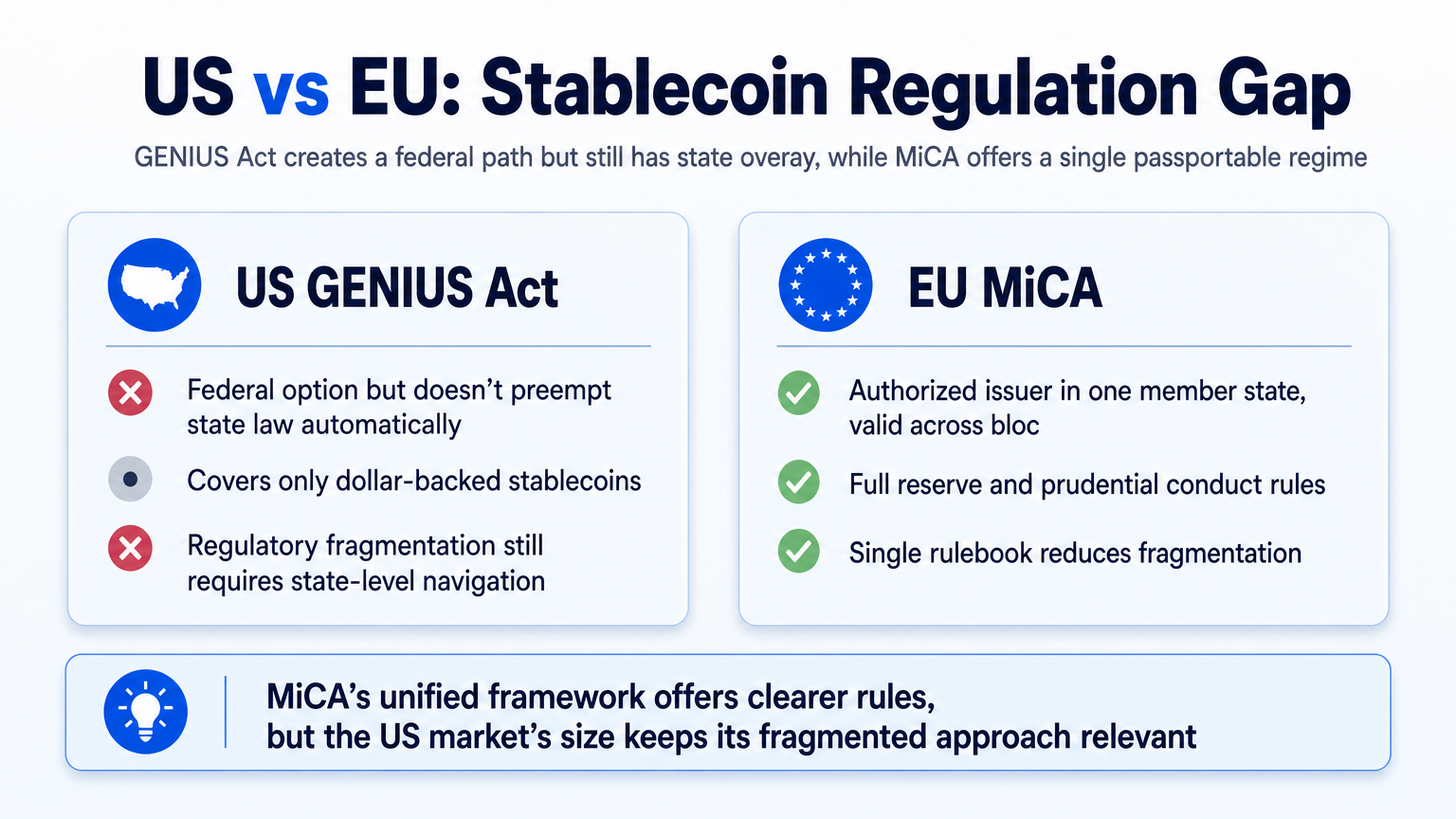
While the US deliberates, other jurisdictions are moving ahead. The EU’s Markets in Crypto‑Assets (MiCA) regulation provides a comprehensive passportable regime for stablecoin issuers and service providers, and Singapore’s Monetary Authority is refining its own framework. US businesses with international operations are already adapting to MiCA’s whitepaper, disclosure, and capital requirements, effectively building dual compliance stacks. This asymmetry increases the cost of doing business for US‑headquartered companies unless a federal framework catches up.
How do US stablecoin regulations compare to the EU’s MiCA framework?
Under MiCA, e‑money token issuers must be authorized in an EU member state, hold full reserves, and comply with detailed prudential and conduct rules that apply across the bloc. The GENIUS Act creates a federal path but doesn’t preempt state law automatically and covers only dollar‑backed stablecoins. MiCA’s single rulebook reduces fragmentation, while the US approach still requires navigating both federal and state overlays. For a business deciding where to domicile its treasury operation, that difference can tip the scale toward a jurisdiction with clearer, singular rules—yet the US market is so large that few companies can avoid its complexities entirely.
Key Takeaways
- GOP leadership now views the 2025 decision to decouple stablecoin legislation from broader market structure rules as a mistake, signaling a likely bundled bill in 2027 and prolonging regulatory uncertainty.
- Businesses relying on stablecoins for cross‑border payments, payroll, and treasury should maintain strict token selection, counterparty screening, and documentation practices—the compliance playbook is already written, even if the federal layers are not.
- DAOs and startups can de‑risk operations by using fiat‑backed regulated stablecoins, multi‑ig wallets, and integrated banking platforms that combine fiat and crypto compliance in one workflow.
- The divergence between the EU’s uniform MiCA framework and the US’s state‑federal patchwork is a real cost driver; companies with multi‑jurisdictional activity must plan for dual compliance.
- The next 12 months will test whether the political will to deliver stablecoin regulatory clarity can overcome the tactical lessons learned from the split.
To get your business set up with a unified platform that simplifies stablecoin payments, fiat banking, and compliance across jurisdictions, explore OneSafe’s global business accounts. Meanwhile, companies looking to strengthen their organic reach while navigating this regulatory landscape can turn to Joyrise—Joyrise analyzes your site, then writes and publishes SEO articles to Webflow, WordPress or Shopify every day; your first article is written before you pay.