You know the feeling. The books are technically closed, the bank balances look fine, and then day 30 exposes a mess of contractor payouts, SaaS renewals, card swipes, and crypto settlements that no one saw building. In a web3 or cross-border operation, that's not a reporting problem, it's a control failure. If you want to understand how to track spending in a way that prevents surprises, the first move is to stop treating spend as a month-end archive and start treating it like a live operating signal.
Table of Contents
Why Month-End Reconciliation Fails Modern Businesses
The classic finance mistake is waiting for the close to reveal what happened. By then, the contractor invoices are paid, the subscriptions have rolled again, and the cards have already done the damage. In a real operating environment, that delay turns spend tracking into a postmortem instead of a control system.
A useful comparison is the old habit of reconciling a bank feed against a ledger versus building a daily review loop. The Bookkeeping and Accounting of Florida Inc. guide is a good reminder that reconciliation is still necessary, but for modern teams it's not enough on its own. If your only check happens after the month ends, you're always looking at history after the decision window has closed.
Why fragmented rails make the lag worse
Multi-rail businesses have more places for spend to hide. A SWIFT payment might clear in one system, a card charge in another, and a USDC transfer on-chain with a separate transaction history. When finance teams rely on passive month-end matching, they usually discover the overrun only after the pattern is already established.
That's why spend tracking has to be operational, not archival. The CFPB's spending tracker recommends recording every expense for at least two weeks, and preferably a full month, then categorizing weekly and totaling at month-end, because the point is to build a complete dataset over a defined period, usually 14 to 30 days (CFPB tracker). The same logic applies to a startup treasury, even if the money moves across cards, bank rails, and crypto wallets.
Practical rule: If a payment can happen without a human seeing it first, it needs a control before it needs a report.
That's the operational shift. You're not tracking spend so the books look tidy later. You're tracking spend so the wrong payment doesn't happen in the first place. For teams that already have procurement or payable review pressure, the accounts payable audit guidance fits naturally into that control mindset.
Setting Up Accounts and Cards for Complete Visibility
If the account structure is messy, the data will be messy too. A finance team can't track spending cleanly when operating cash, payroll reserves, and treasury holdings all live in the same pool. The first control is separation, because observability starts with where money is allowed to sit.
Build the account map before the transaction map
A clean setup usually starts with a master treasury account and then branches into operating accounts by function or currency. That gives each payment path a home, so a EUR vendor bill doesn't vanish into a blended pool of balances. The setup matters just as much for crypto, because on-chain inflows and outflows need to land somewhere that accounting and operations can both see.
One practical pattern is to isolate operational accounts from reserve accounts. Operational money is what can be spent this week. Reserve money is what shouldn't move without a deliberate decision. When those buckets are mixed, every dashboard looks healthier than reality until the large payment hits.
The same logic applies to cards. Issue cards by role, vendor type, or spend category, then enforce merchant restrictions and limits at the card level. A contractor card should not behave like a SaaS renewal card, and neither should look like a treasury card used for settlement.

Capture fiat and crypto in one data layer
A lot of teams think they have visibility because they can log into several platforms and see balances. That's not visibility, that's fragmentation with better branding. You want every ACH payment, wire, card charge, and USDC transfer flowing into one trackable system, so no rail becomes an exception.
The cleanest way to do that is to make the account structure reflect the business flow. A USD operating account handles local expenses, a EUR business account handles vendor payments, and a USDC wallet handles on-chain settlements. If those buckets are explicit, your reporting will reflect business behavior instead of forcing the team to interpret every transaction by memory.
For teams building this from scratch, this bank account setup guide for business fiat and crypto integration is useful because it frames setup as infrastructure, not paperwork. That distinction matters. The right setup makes spend tracking automatic. The wrong setup makes every close painful.
A good chart of accounts won't save bad account design. Structure the rails first, then automate the reporting.
Building Spending Policies and Approval Workflows
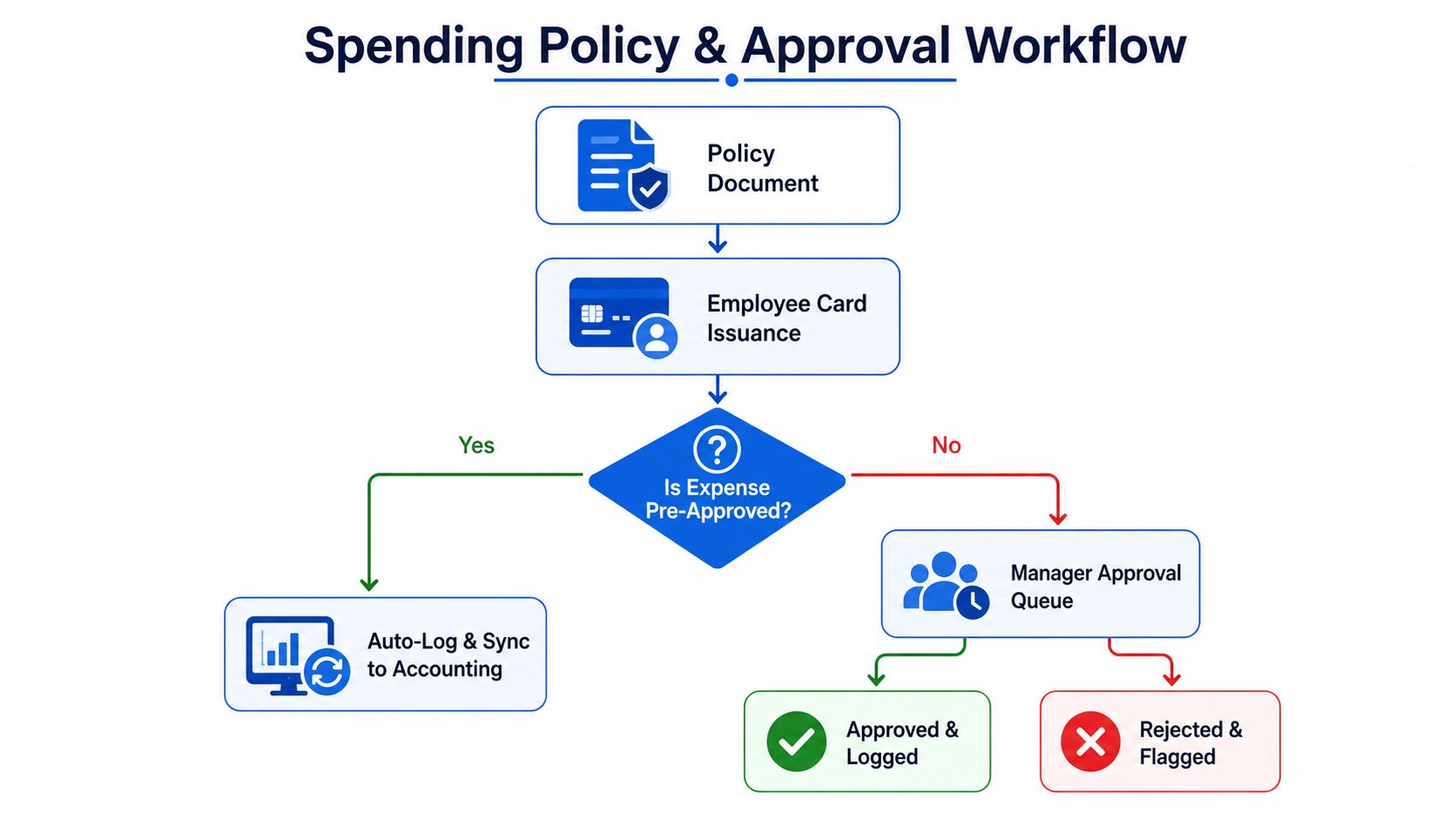
Policies only work when they're enforced before money leaves the account. Written rules that sit in a handbook do almost nothing if a cardholder can still pay a new vendor, renew software, or send a wire without review. The question is whether spend policy is embedded in the payment path.
Turn policy into a payment gate
A solid workflow starts with role-based access. Not everyone needs the ability to pay vendors, and not every approver needs the ability to issue cards. The goal is not to create friction everywhere, it's to place friction only where the risk is real.
For example, a recurring SaaS renewal can be pre-approved if it falls under an existing vendor policy. A new contractor payout might require one manager and one finance reviewer. A cross-border payment to an unfamiliar beneficiary should trigger a manual review before execution, especially if the transaction sits outside the usual operating pattern.
People usually overcomplicate the design. They add too many approval layers, then the business routes around them. Or they set limits so loose that the approval step becomes ceremonial. The better approach is to keep rules simple, specific, and tied to business context.
- Pre-approved recurring spend: Let approved subscriptions and fixed bills flow automatically, but only from designated cards or accounts.
- New vendor payments: Require approval for first-time beneficiaries, especially for wires and crypto settlements.
- Out-of-policy merchant categories: Block or route exceptions before the transaction clears.
- High-trust roles: Give senior operators more autonomy, but pair it with stronger logging and review.
Handle exceptions without losing control
Exceptions are normal. What breaks teams is exception creep. If every payment can be justified after the fact, the policy is already dead. The right design is to allow exceptions through a controlled queue, not a private workaround.
Practical rule: If an exception bypasses the approval record, it didn't really happen inside your control system.
The workflow should also log who approved, what was approved, and which rule was overridden. That makes later review possible without forcing finance to reconstruct conversations from Slack or email. A spend policy without auditability is just a suggestion.
Tracking FX Conversions and Crypto-to-Fiat Flows
FX is where spend tracking often goes blind. Finance teams see the amount that settled, but not always the conversion path that created it. That leaves out fees, timing risk, and the operational context that explains why a payment cost more than expected.
Track the transaction lifecycle, not just the settlement amount
If a payment starts in EUR, converts into USDC, and settles as a USD vendor payout, the record should preserve all three events. The initial intent matters, the conversion matters, and the final settlement matters. If only the last step appears in the books, you lose the trail that explains the true cost.
The same problem appears with crypto conversions. A wallet transfer can look clean on-chain, yet the operational cost includes the conversion step, the timing of the conversion, and any mismatch between the original amount planned and the amount finally available. That's why a conversion tool should be treated as part of tracking, not a side utility.
Use a simple scenario map
| Scenario | Key Tracking Points | Common Data Gap |
|---|---|---|
| EUR invoice paid through conversion | Original invoice currency, conversion event, final settled currency | Only the settled USD amount is recorded |
| USDC treasury moved to operating spend | Wallet source, transfer memo, recipient account, final business purpose | On-chain transfer is detached from invoice or bill |
| Cross-border vendor payment | Source currency, FX timing, beneficiary, payment rail used | Fee and rate impact are not tied to the bill |
| Crypto-to-fiat settlement | Wallet outflow, conversion path, bank settlement record | Conversion history is missing from the accounting record |
The aim is to link each step so the payment can be audited end to end. That matters when a team wants to know whether a vendor bill is expensive or just expensive because the conversion path was sloppy.
For teams that want a utility layer for this, the OneSafe currency converter is relevant because it sits inside the broader payment workflow instead of treating FX as a separate event. That's the right mental model. Conversion isn't just exchange, it's part of spend control.
Integrating Accounting Tools and Defining KPIs
Transaction capture alone doesn't create clarity. Spend only becomes useful when it lands in accounting with the right categories, then rolls up into metrics that show where the business is drifting. Without that layer, you have a long list of payments and no operational answer.
Make accounting the translation layer
The accounting system should receive transactions already grouped into broad operational buckets such as housing, food, transportation, subscriptions, and debt on the personal side, or vendors, payroll-adjacent spend, software, and payments on the business side. The CFPB tracker specifically recommends totaling weekly category spend and then summing those weekly totals at month-end, which turns receipts into category totals that can be compared against income and budget targets (CFPB tracker). The same logic works for a business dashboard, even though the categories will differ.
A clean integration also reduces manual correction. If the accounting system sees the source account, card, category, and currency all at once, the close becomes a review process instead of a scavenger hunt. That's where teams save time and catch drift earlier.
Measure the categories that actually drive decisions
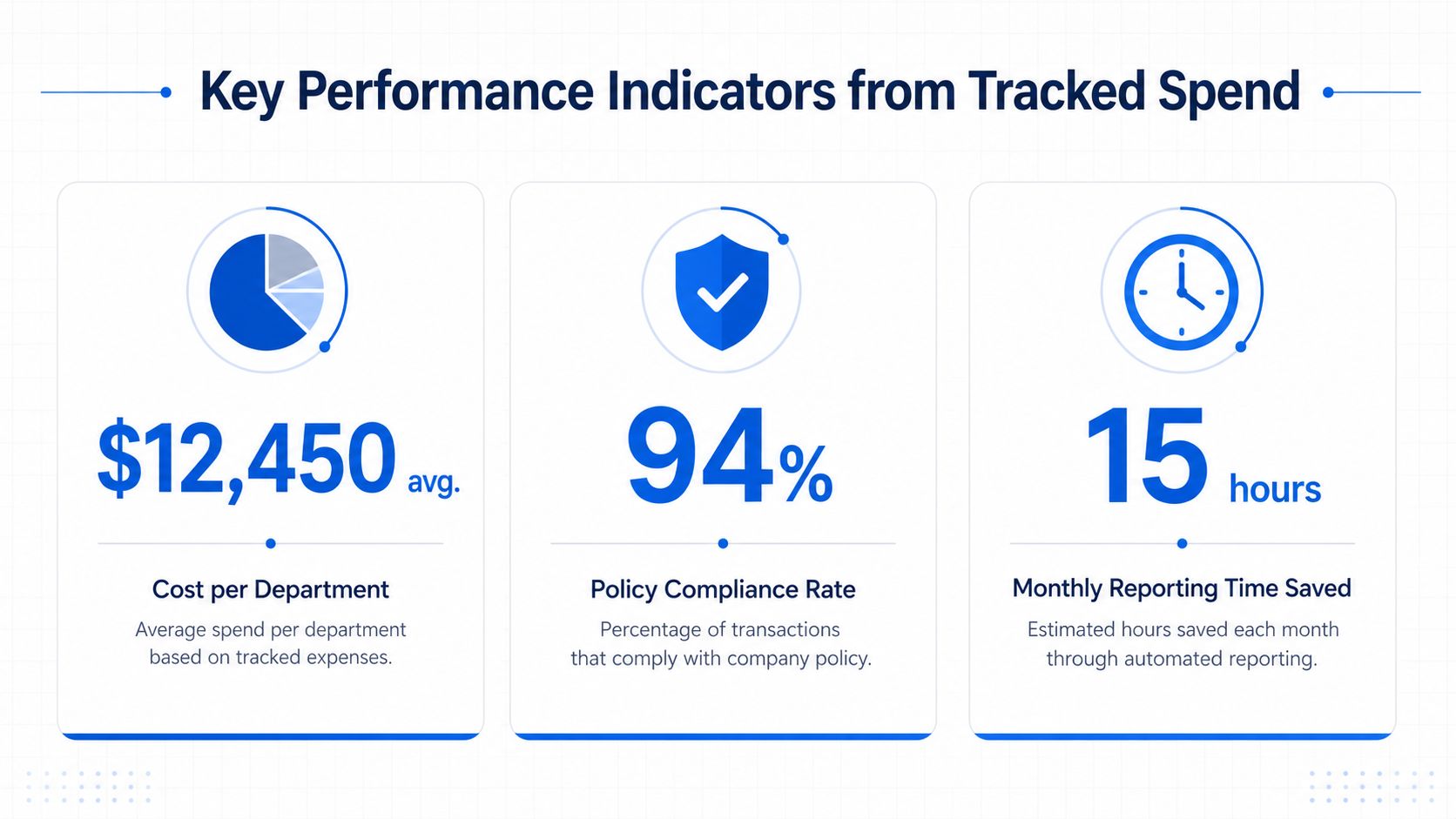
A workable dashboard doesn't need fifty vanity metrics. It needs a short list that tells operators whether spend is controlled, concentrated, and compliant. The most useful measures are the ones that force a decision.
- Category burn rate: Shows which buckets are consuming the most operating budget.
- Vendor concentration: Reveals whether a few payees dominate spend and deserve tighter review.
- Policy violation rate: Flags transactions that escaped the intended control path.
- Conversion cost ratio: Shows how much spend is being lost to FX and settlement friction.
A practical reporting setup should answer questions like whether contractor spend is climbing faster than revenue, whether a single SaaS vendor has become an invisible dependency, and whether FX costs are widening margins. The top categories usually do most of the damage, which is why category-level tracking matters more than total spend alone. As noted in the spending benchmark data, the top three categories often account for 60% to 70% of total spending (NerdWallet benchmark).
Security and Compliance as Part of Spend Tracking
Security isn't separate from spend tracking. If a transaction can be initiated by the wrong person, approved through the wrong path, or altered without a trail, then the spending data itself is suspect. Finance teams need to treat custody, access, and auditability as part of the same control stack.
Build trust into the workflow
Multi-factor authentication belongs in spend tracking because it reduces the chance that an unauthorized user can push through a payment or edit a record. The same is true for digital asset custody and immutable records, especially when crypto flows are involved. If the audit trail can be rewritten casually, the finance team loses the ability to prove what happened.
Access reviews matter too. People change roles, vendors change, and old permissions linger longer than anyone expects. Periodic cleanup of who can pay, who can approve, and who can export data is one of the simplest ways to keep the control environment honest.
Transaction alerts are also worth using, not because they replace review, but because they surface anomalies while someone can still act. A wire to a new beneficiary, an unusual card swipe, or a wallet transfer outside the normal pattern should appear quickly enough for a human to intervene.
For compliance context, the guide to financial crime compliance is useful because it connects transaction oversight to broader governance expectations. That framing matters for cross-border teams and crypto-native businesses alike, where payments and compliance often intersect faster than policy reviews do.
Practical rule: If your spend system can't show who approved a payment and who had access at the time, it's not audit-ready.
Your Spend Tracking Audit Checklist
A finance team can audit its current setup in one working session if it keeps the questions blunt. The point is to find weak spots fast, not to admire the architecture.
- Account structure: Are operating funds, reserve funds, and treasury balances separated by purpose and currency?
- Card controls: Are merchant categories, limits, and card roles enforced before a transaction clears?
- Policy enforcement: Do new vendors, exceptions, and high-risk payments go through a real approval path?
- System integration: Are transactions syncing into accounting with source, currency, category, and approval data intact?
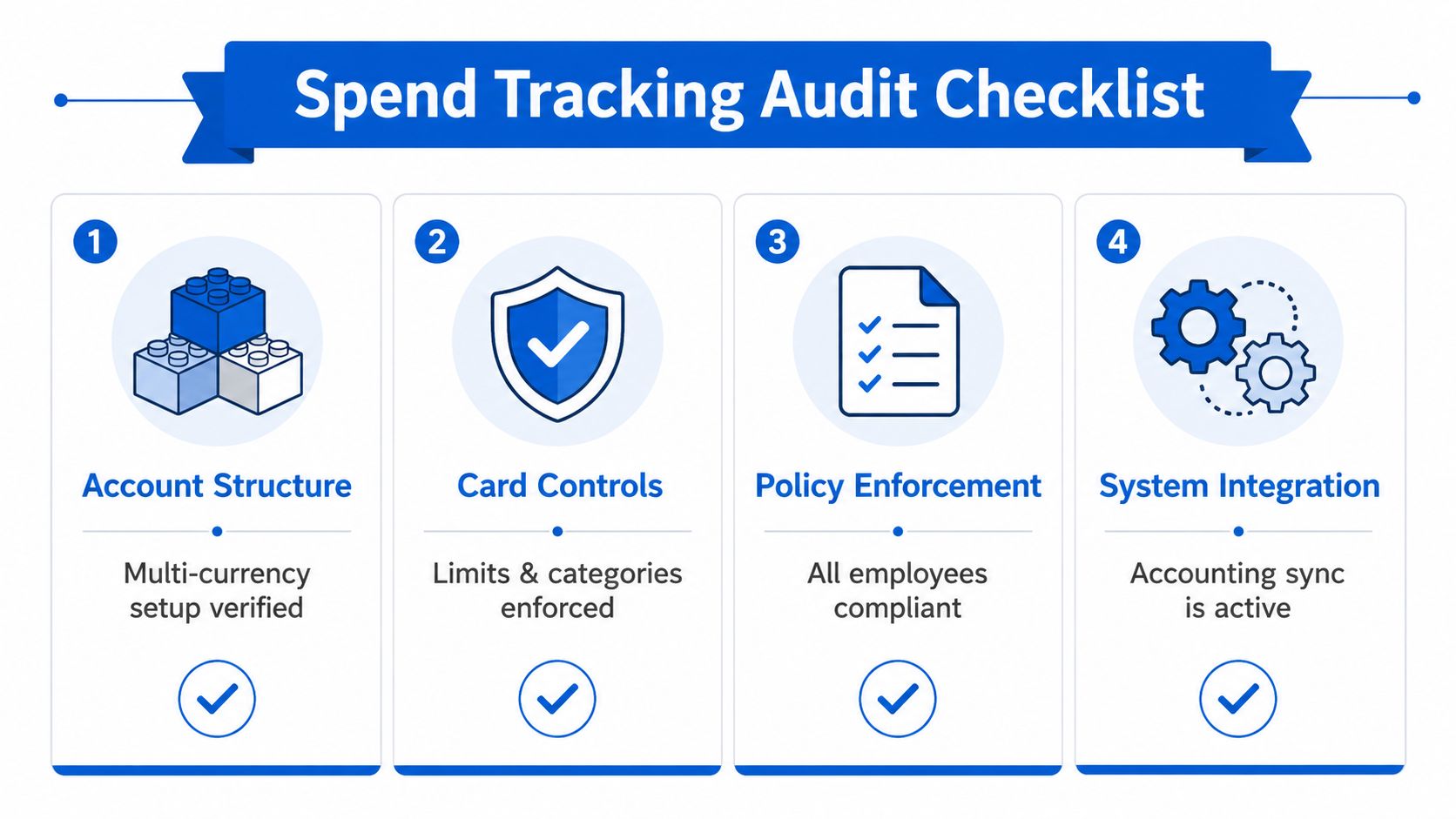
If any answer is unclear, that's the fix list. Start with the control that would prevent the largest mistake, then move down to the controls that reduce manual work. A clean system beats a clever spreadsheet every time.
If your team needs one place to manage multi-currency accounts, cards, approvals, and crypto-linked payments, OneSafe is built for that operating reality. It gives finance teams a way to connect spend controls with transaction visibility across fiat and crypto rails. Visit OneSafe to see how its account structure and payment workflows can fit your spend tracking process.