
Meta description: Sui Network's $500M institutional commitments on Oct 17, 2026 make defi compliance a must. Learn how DAOs and Web3 startups can adapt.
Institutional DeFi Compliance: What $500M Commitments Mean
When Sui Network disclosed on October 17, 2026 that institutional investors had committed more than $500 million to its DeFi protocols, the announcement redrew the boundaries of decentralized finance. The headline wasn’t a fundraising round — it was a signal that institutional capital now views defi compliance not as a checkbox but as the price of entry. For founders, DAO treasurers, and Web3 finance leads, October 17 2026 marks the moment when compliance strategy stopped being a back‑office afterthought and became a growth prerequisite.
Table of Contents
- Sui’s $500M Bet: The Development That Redefines DeFi Compliance
- Why This Matters Now for Global Businesses and DAOs
- DeFi Compliance Challenges in a Nutshell
- Concrete Implications for Web3 Startups and DAOs Building Web3 Financial Services
- What a Compliance‑Native Operating Model Looks Like Now
- Recommended Actions for Teams That Want to Stay Ahead
- Open Questions and What to Watch Next
- Quick Answers to Common Questions
- Key Takeaways
Sui’s $500M Bet: The Development That Redefines DeFi Compliance
What happened (October 17, 2026)
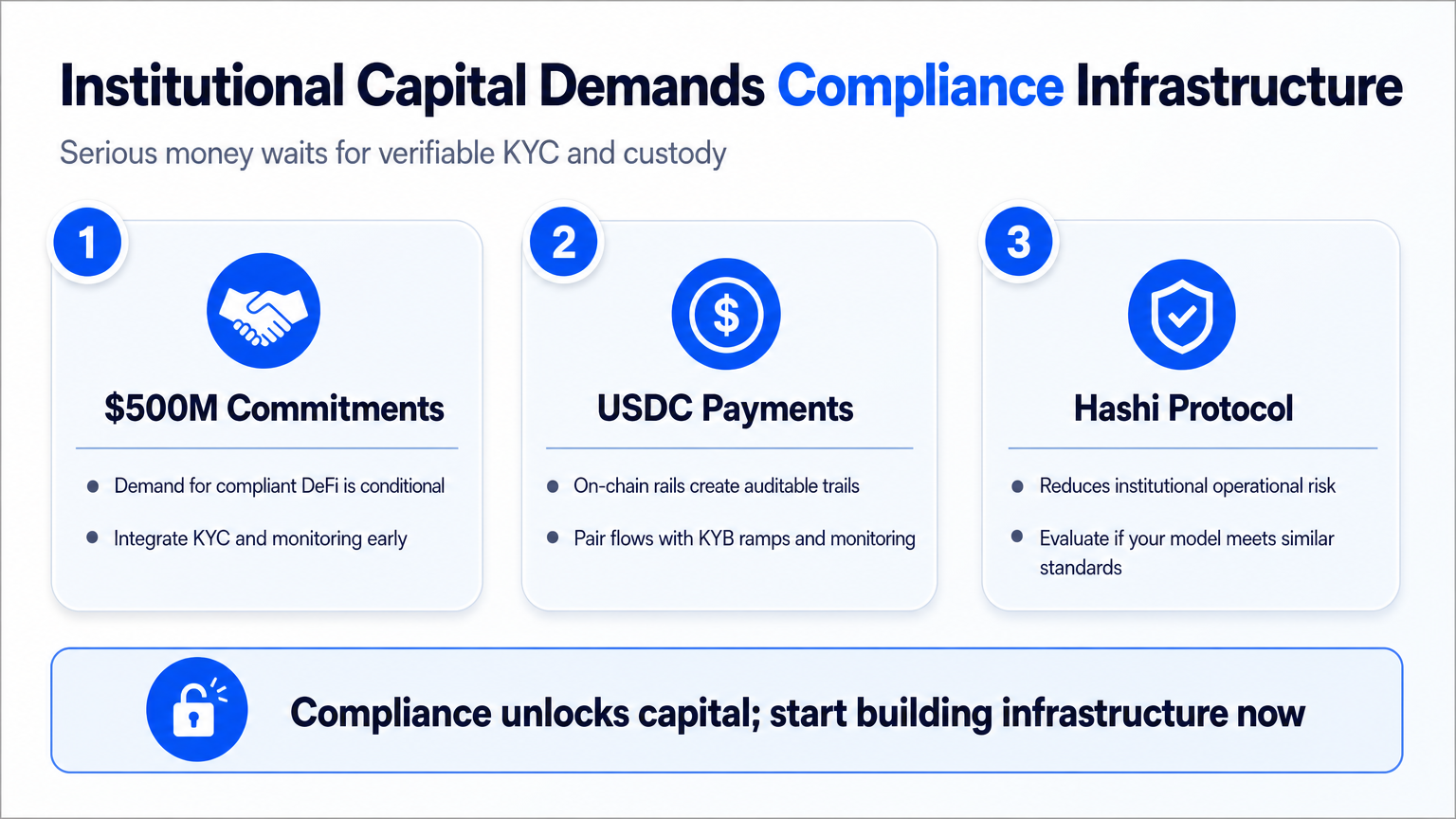
On October 17, 2026, according to a news release covered by Bitget (source), Sui Network reported more than $500 million in Sui Network institutional commitments across its DeFi protocols. The layer‑1 blockchain tied the commitments to two developments: the Hashi protocol, designed to lower operational barriers and build trust for institutional players, and expanded USDC payment capabilities that let autonomous agents settle on‑chain using a widely regulated stablecoin.
Why the commitment figure signals intent, not full deployment
The $500 million represents intended rather than active participation — a pledge of capital contingent on infrastructure, security, and compliance conditions being met. Serious money is waiting for protocols to prove they can handle institutional‑grade KYC, transaction monitoring, and custody.
Hashi protocol and USDC payments as trust‑building levers
The Hashi protocol minimizes trust assumptions across cross‑chain bridges, while USDC payment rails give institutions a stable, auditable settlement asset. Together they signal that compliance is part of the product, not a constraint. The message for other ecosystems: institutional DeFi capital flows where compliance infrastructure is visible.
| Aspect | What It Signals | Immediate Compliance Action |
|---|---|---|
| $500 M institutional commitments | Demand for compliant DeFi access is real, but capital is conditional | Integrate identity verification and transaction monitoring before gatekeepers ask |
| USDC stablecoin payments | On‑chain rails create auditable trails, but raise stablecoin payments AML obligations | Pair stablecoin flows with fiat on/off‑ramps that maintain KYB records and real‑time monitoring |
| Hashi protocol | Security‑focused infrastructure reduces institutional operational risk | Evaluate whether your protocol’s security model can meet similar trust standards for large counterparties |
Why This Matters Now for Global Businesses and DAOs
Institutional capital forces a compliance flywheel
A $500 million commitment tied to compliance infrastructure primes a flywheel: more capital requires stronger compliance, stronger compliance attracts more capital, and protocols that can’t meet the bar get left behind. For startups and DAOs, that means partners and liquidity sources will soon expect the same checks seen on centralized platforms.
The shift from “optional” to “hard requirement” for DeFi participants
Before October 2026, a DeFi protocol could argue that operating without KYC was a design choice. That argument is eroding. Institutional allocators now demand onchain monitoring, auditable payment trails, and clear governance accountability. Ignoring those demands means losing capital and network effects: deeper liquidity, lower slippage, and greater stability.
Regulatory tailwinds and the fear of being locked out
The SEC’s 2021 statement on DeFi risks already warned that projects cannot escape securities laws by being decentralized (source). Frameworks like the GENIUS Act have opened stablecoin‑focused rails, while France’s 31.4% stablecoin tax debate shows cross‑border friction is rising. Waiting to build a compliance posture until the next enforcement action lands is a bet many DAOs can’t afford to make.
DeFi Compliance Challenges in a Nutshell
The industry already knows the headwinds; here is the compressed backdrop.
- Pseudonymity vs. KYC: Most DeFi relies on wallet addresses, but institutional capital demands entity‑level due diligence. Mapping wallets to known entities is a hard stop (see ACAMS DeFi Compliance).
- Cross‑jurisdictional AML: DeFi’s borderless nature triggers AML obligations in multiple jurisdictions. USDC’s transparency creates a permanent audit trail — a double‑edged sword that must be managed.
- Smart‑contract risk and governance accountability: “Code is law” doesn’t satisfy fiduciary duties. Institutional partners expect identifiable, accountable parties — a theme explored by CIGI. This directly impacts DAO compliance frameworks.
Concrete Implications for Web3 Startups and DAOs Building Web3 Financial Services
Treasury management must evolve
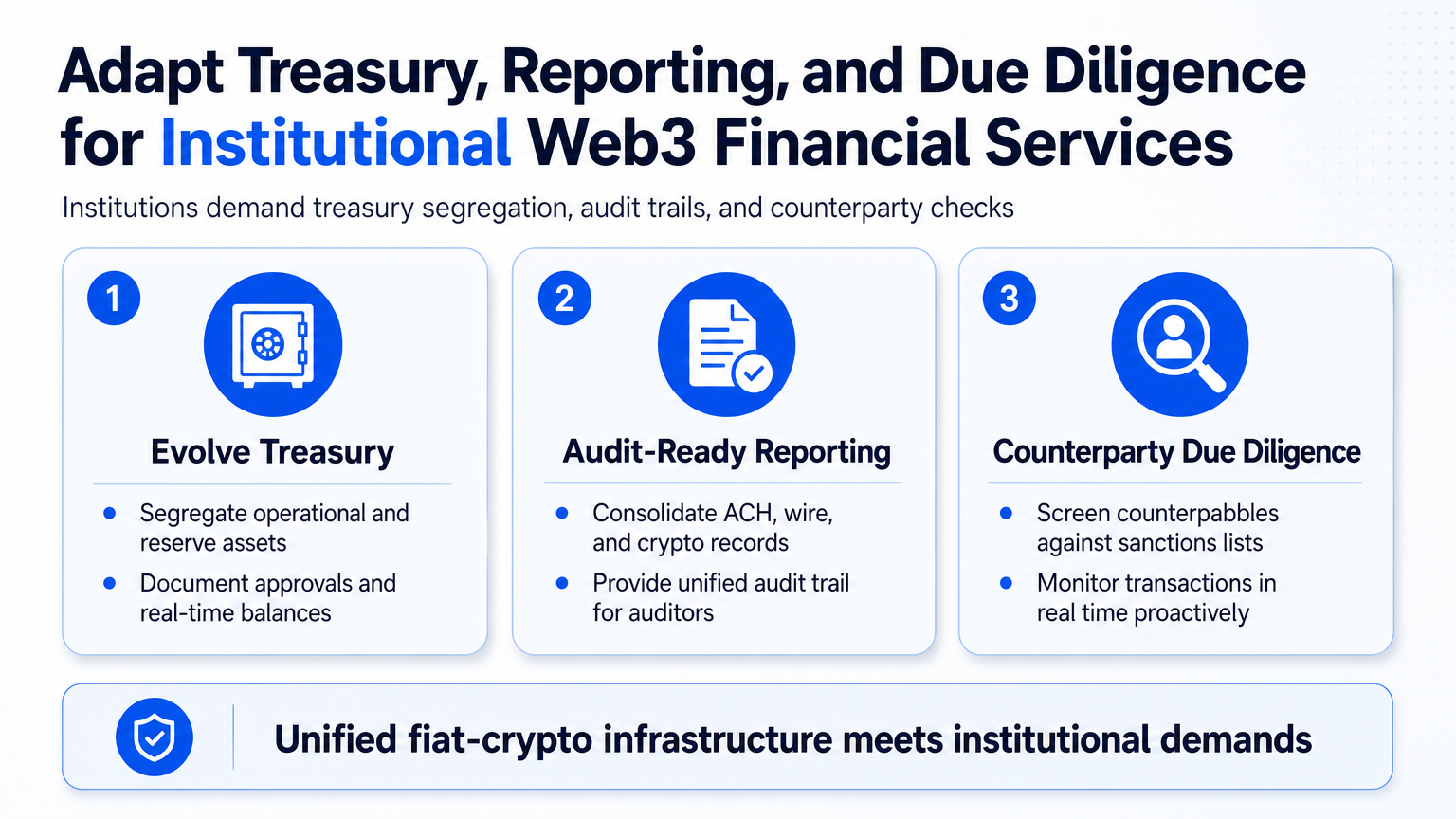
Holding a treasury in a bare multi‑sig wallet with no fiat‑backed reporting isn’t enough. Institutions will want treasury management practices that mirror those of a regulated fund: segregation of operational and reserve assets, documented transaction approvals, and real‑time balance sheets linking on‑chain positions to off‑chain fiat balances.
Blending onchain activity with audit‑ready reporting
The USDC rails Sui is expanding highlight a larger trend: stablecoin flows can be paired with off‑chain accounting for a continuous audit trail. The challenge is consolidating ACH, wire, and crypto records into a format an auditor can use. Unified fiat crypto integration solves this.
The new bar for counterparty due diligence
Every institutional partner will ask: Who are your counterparties? Are they screened against sanctions lists? Do you monitor transactions in real time? The AML step‑by‑step guide for DeFi projects shows that due diligence starts before the first transaction, not after a problem.
What a Compliance‑Native Operating Model Looks Like Now
Unified fiat‑crypto infrastructure as the missing piece
Teams that navigate institutional demands smoothly stop running separate fiat and crypto stacks. A single platform where both live under the same compliance controls eliminates reconciliation nightmares and repeated KYC processes.
A crypto compliance platform that bridges the gap
A crypto compliance platform like OneSafe combines multi‑currency fiat accounts, crypto on/off‑ramps, and digital asset custody in one interface. Its architecture — segregated global accounts, automated payment workflows, and custody secured through Fireblocks — gives a DAO or Web3 startup the ability to show institutional partners a clear chain of custody between off‑chain payments and on‑chain positions. Handling a $2 million USDC grant alongside vendor wire payments in euros becomes a feature of the banking layer, not a separate engineering project.
Virtual cards, segregated accounts, and on‑chain custody in one workflow
Virtual cards with spend limits protect treasury security. Segregated accounts isolate operational cash from long‑term holdings. Fireblocks‑backed custody with mandatory MFA avoids single‑signature hot wallet risks. All three capabilities live in one dashboard, turning a patchwork of services into an auditable workflow.
Recommended Actions for Teams That Want to Stay Ahead
Audit your on‑ and off‑ramp compliance posture
Map every touchpoint where crypto meets fiat. For each, ask: Is there a KYB‑verified entity behind the wallet? Is the transaction screened against sanctions lists? Is there a record locator linking the on‑chain transaction to a fiat‑side journal entry? Gaps are where an institutional partner will pause and walk away.
Adopt identity and transaction monitoring before you’re forced to
DeFi compliance automation tools are now production‑grade. Implementing onchain monitoring and wallet screening now gives you months to refine the process — and signals that you operate like a business, not a hobbyist collective.
Align your financial stack with institutional expectations without losing speed
Speed is still your advantage. A platform that handles fiat‑crypto integration natively — with customizable DAO roles, automated payouts, and invoice generation — replaces three or four separate services. It gives teams a place to hold USD and EUR alongside USDC, issue virtual cards, and generate institutional‑grade reports without slowing protocol development.
Open Questions and What to Watch Next
Will Sui’s model become a template for other Layer‑1s?
If the commitments turn into active liquidity over the next two quarters, expect other layer‑1s to copy the strategy. If capital stays on the sidelines, compliance alone won’t be enough without proven utility.
How will regulators respond to growing institutional DeFi stakes?
Watch for updated SEC guidance on DAO governance and DeFi‑specific provisions in MiCA 2.0. A new enforcement action before mid‑2027 would change the conversation overnight.
Are multi‑sig and DAO governance models ready for fiduciary scrutiny?
Most multi‑sig setups can’t answer: who is responsible for a bad transaction? Can you demonstrate sufficient controls were in place? Addressing that is the next frontier for DAO compliance innovation.
Quick Answers to Common Questions
Why does DeFi create compliance challenges?
DeFi replaces intermediaries with pseudonymous wallets and non‑custodial smart contracts, making traditional KYC and entity accountability difficult. It also spreads AML obligations across jurisdictions.
How is DeFi regulation evolving?
The US SEC has signaled that DeFi does not exempt projects from securities laws, and stablecoin bills like the GENIUS Act are clarifying compliant usage. The EU’s MiCA is beginning to address stablecoins, and France has debated a stablecoin tax — all trending toward entity‑level KYC and transaction monitoring.
What does $500M in institutional commitments mean for defi compliance?
The figure, reported October 17, 2026, signals that institutional capital is gating access behind verifiable compliance frameworks. For any protocol or DAO, compliance is now visible infrastructure — covering KYC on stablecoin payments, governance accountability, and stablecoin payments AML.
How can DAOs and startups prepare?
Map treasury flows against a compliance framework: entity‑level KYB on all fiat on/off‑ramps, onchain wallet screening, segregated auditable accounts, and governance with identifiable responsible parties. A unified platform reduces engineering overhead.
What role does a fiat‑crypto platform play?
A unified fiat‑crypto platform bridges fiat and crypto under one KYB umbrella, screening all flows and producing institutional‑grade reports. This gives Web3 financial services the compliance‑ready rails they need without stitching together multiple providers.
Key Takeaways
- Sui’s $500 million Sui Network institutional commitments, reported October 17 2026, show that defi compliance is a gatekeeper for institutional capital.
- Stablecoin rails like USDC create an auditable trail for AML, but only when paired with entity‑level KYC and off‑chain reporting.
- Startups and DAOs should adopt onchain monitoring and KYB at every fiat touchpoint now — before counterparties demand it.
- A crypto compliance platform that consolidates multi‑currency accounts, on‑chain custody, and virtual cards removes the friction that makes compliance feel like a growth drag.
- Waiting for a published rule before building compliance posture risks being locked out of institutional liquidity.
Ready to manage fiat and crypto operations from a single, compliance‑ready platform? Explore OneSafe’s neo‑banking tools for Web3 businesses and DAOs.



