A finance lead has a vendor deadline today, but the beneficiary is in a corridor the company hasn't paid before. The team can send a wire and accept higher costs and more manual checks, or try international ACH and risk discovering that the recipient's bank, currency route, or payout workflow doesn't support it cleanly.
That's the practical problem behind international ACH vs wire transfer. The cheaper rail isn't automatically the cheaper payment once foreign-exchange spread, intermediary deductions, failed instructions, and reconciliation work reach the profit and loss statement. Cross-border SMEs, web3 companies, DAOs, and teams paying contractors or vendors across several jurisdictions need a routing policy, not a slogan.
The straight answer is simple. Use international ACH for repeatable, lower-value payments in proven corridors. Use wires for urgent, high-value, unfamiliar, or final payments. Run both under the same approval and reporting controls, then measure the landed cost by corridor.
Table of Contents
- Why This Choice Matters for Cross-Border Teams
- What Each Rail Is
- Speed and urgency
- Cost and FX
- Reach and payment limits
- Security, reversibility, and reconciliation
- Recurring payments to U.S.-based contractors
- A one-off European vendor invoice
- An urgent same-day payment to an APAC supplier
- Batch payroll for a Cayman or BVI entity
Why This Choice Matters for Cross-Border Teams
A payment rail affects more than the moment money leaves the account. It determines how much beneficiary data your team must collect, how quickly the recipient can use the funds, whether the payment can be corrected, and how much work finance must do when something goes wrong.
For a recurring contractor payout, a wire can turn a routine process into an expensive manual task. Someone enters the instruction, another person reviews it, an intermediary bank may deduct a fee, and the recipient may receive less than the invoice amount. International ACH can be a better fit when the corridor supports it and the beneficiary details remain stable.
A new supplier creates the opposite problem. If your team has never used the corridor, the local bank may not support the relevant ACH-style route, or the payment may require information that your system doesn't capture. In that case, the wire's broader correspondent-bank reach can matter more than its sending fee.
Practical rule: Choose the rail only after checking the corridor, the deadline, and the recipient's expected net amount.
The scale of the underlying payment systems explains why both rails remain relevant. The first ACH began operating at the Federal Reserve Bank of San Francisco in 1972, and the network reached 34.2 billion total ACH transfers in 2021. By 2024, FedACH was facilitating more than $42 trillion in annual transfer value, according to the Federal Reserve's ACH service history. International ACH transactions were still a small subset of that network, even as early cross-border adoption grew quickly.
For teams building a repeatable payment operation, the right question isn't “Which rail is cheaper?” It's “Which rail reliably delivers the correct amount to this beneficiary, on the required date, with minimal exception work?” A clear view of international business payments helps frame that decision alongside account structure, currencies, controls, and payout destinations.
What Each Rail Is
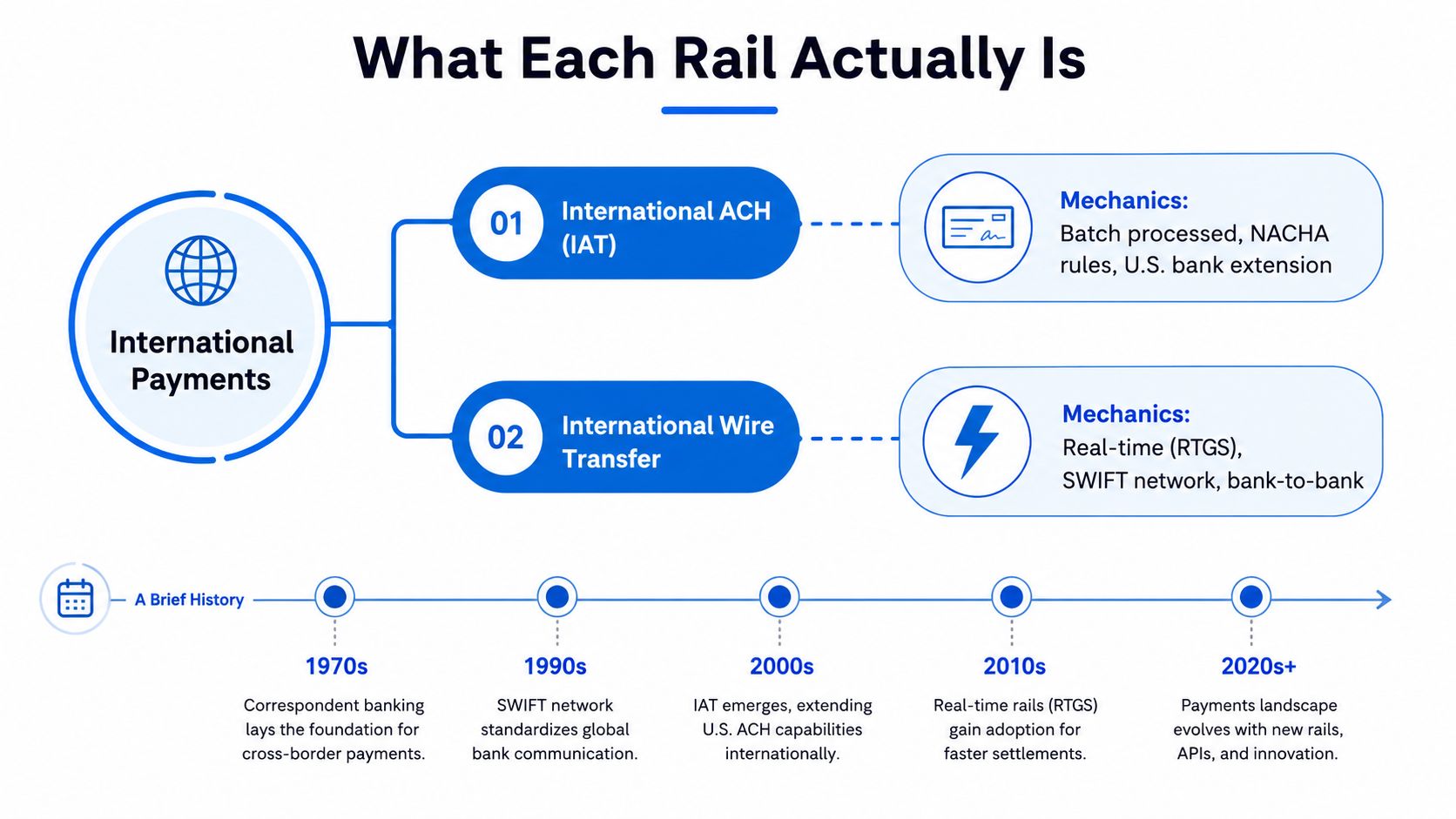
International ACH transactions, or IATs, extend the U.S. ACH model to cross-border payments. They run in batches rather than as individually processed instructions. A business submits payment data through a participating provider, ACH operators and banking partners route it, and the receiving institution credits the beneficiary under the corridor's rules. For a closer look at the workflow, see this international ACH payment processing guidance.
IATs fit repeatable payouts, including payroll-like disbursements, recurring contractor payments, and scheduled vendor runs. Use them only after confirming corridor support and required data. International ACH needs more beneficiary and correspondent information than domestic ACH, including the beneficiary's name and address and relevant bank identifiers. Missing fields create exception work, delay crediting, and can erase the apparent fee advantage.
The Federal Reserve reported that U.S. ACH operators processed more than 6 million IATs valued at $46 billion in 2010, less than 1% of ACH volume and value at that time. By 2012, IAT volume had reached 42.36 million transactions, with year-over-year growth of more than 50.8% from 2011 to 2012, according to the Federal Reserve's ACH history. Those figures establish early adoption, not universal corridor coverage. Check reach, FX spread, lifting fees, and the cost of handling failed or returned payments before choosing the rail.
International wires move through correspondent-bank networks, commonly using SWIFT messaging for international instructions. The sending bank passes structured payment information to the receiving bank, sometimes through intermediary institutions. The beneficiary's bank then applies its screening, processing, and crediting procedures. Visbanking bank intelligence on Swift provides a plain-language explanation of that messaging network.
Choose a wire for a unique, urgent, or high-value payment, or when the corridor lacks a dependable ACH route. Wires offer broader reach, but intermediary deductions, bank spreads, and investigation fees can reduce the recipient's final amount. A lower sending fee does not guarantee a lower landed cost.
Finality also separates the rails. An international ACH payment may be reversible or disputable in limited situations. A wire is typically irrevocable once sent and settled, so verify beneficiary details before release.
Side-by-Side Comparison Across Eight Criteria
The following table is the useful version of the international ACH vs wire transfer debate. It focuses on what the finance team has to manage, not just what the bank advertises.
| Criterion | International ACH (IAT) | International Wire |
|---|---|---|
| Speed | Typically 1 to 5 business days, batch-based | Commonly 1 to 3 business days, with faster handling for urgent instructions depending on banks and cutoffs |
| Cost | Usually under $10 per transaction | Often $45 to $65, plus possible intermediary lifting fees |
| Geographic reach | Corridor-dependent and narrower | Broad correspondent-bank reach, generally available across more countries |
| FX handling | Often tied to provider, bank relationship, and corridor availability | FX conversion may involve provider or bank spread, plus possible intermediary deductions |
| Transaction limits | Depends on provider, bank, corridor, and risk controls | Depends on sending and receiving institutions, with wires generally suited to higher values |
| Security and compliance | Requires detailed beneficiary and correspondent data, with ACH and IAT compliance checks | Uses bank-to-bank messaging and correspondent screening, with detailed payment instructions |
| Reversibility | Can be reversible or disputable in limited circumstances | Typically irrevocable once settled |
| Reconciliation | Efficient for standardized batches, but exceptions can be difficult in weak corridors | Easier to identify as an individual payment, but fees, FX, and intermediary deductions can complicate matching |
Speed and urgency
International ACH generally completes in 1 to 5 business days, while international wires commonly settle in 1 to 3 business days, according to NetSuite's international ACH comparison. Cutoff times, compliance review, weekends, holidays, and intermediary routing can extend either timeline.
If a supplier will stop work unless funds arrive today, choose the wire path if the recipient bank and provider can support the deadline. If the payment is scheduled several days ahead, ACH can reduce cost without creating operational stress.
Cost and FX
ACH usually wins on the visible transaction fee. Wires charge more because the instruction is individualized and may pass through several banks. That price difference can be justified for a high-value payment, but it's hard to defend for a stable batch of smaller payouts.
FX changes the analysis. A rail with a low sending fee can still produce a worse landed amount if the conversion rate is poor or the recipient's bank applies deductions. Finance should compare the recipient's net receipt, not just the fee shown before approval.
Reach and payment limits
Wire reach is the safer assumption for an unfamiliar country. ACH-style payments can be excellent in supported corridors, but a team shouldn't promise a date or amount until it has confirmed the beneficiary's bank, currency, account format, and route.
Limits also vary by provider and bank. Don't infer capacity from the rail's name. Set internal thresholds, then escalate payments that exceed them or require additional treasury approval.
Security, reversibility, and reconciliation
Both rails require strong beneficiary controls. IATs carry a richer data burden, which can improve structured processing but creates more opportunities for missing or mismatched information. Wires have stronger finality, so an incorrect account number or fraudulent instruction can become difficult to recover after settlement.
Reconciliation favors standardization. A recurring ACH batch with consistent references can post cleanly, while a wire may arrive with intermediary deductions that leave the recipient's receipt below the invoice amount. The best policy connects payment method, reference format, approval workflow, and expected net amount.
The Hidden Costs Most Comparisons Skip
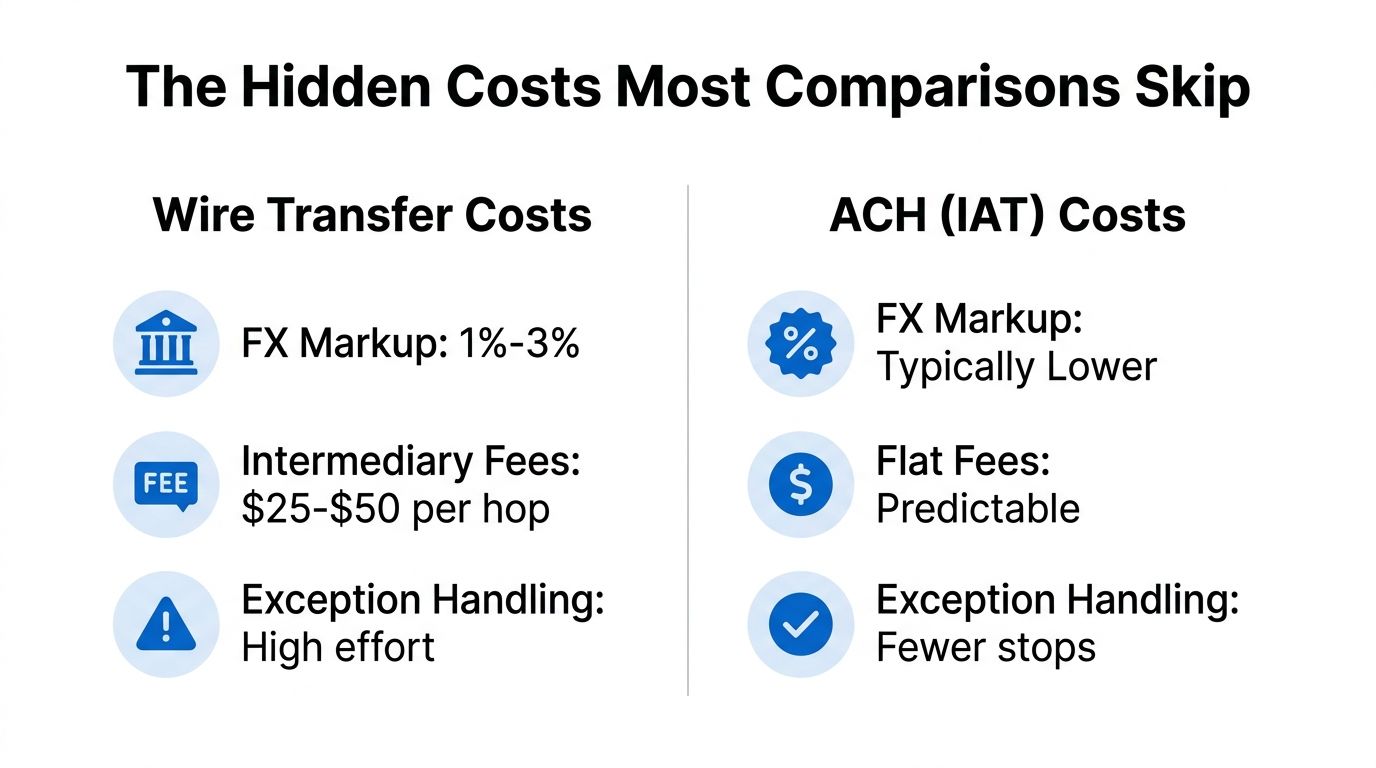
Headline fees are only the first line of the payment decision. The actual cost includes FX spread, intermediary lifting fees, recipient deductions, failed-payment handling, staff review, and reconciliation tickets.
International wire comparisons often cite FX markups of 1% to 3%, along with intermediary charges, as summarized in cross-border ACH and wire cost analysis. That spread can outweigh the sending charge on a large payment. A wire that appears to cost $25 can become roughly $90 in true cost when the sending fee, an FX spread, and intermediary deductions combine. That example is a calculation framework, not a universal quote, because the actual amount depends on the transaction and provider.
ACH has the opposite risk. A $2 transaction fee looks efficient until the corridor rejects the instruction, the beneficiary bank cannot credit the payment, or an operations analyst spends hours investigating a missing reference. In a reliable route, ACH's predictable structure can win decisively. In an untested route, the nominal fee tells you almost nothing.
Measure the landed cost
Run the comparison over a quarter, not one payment. For every transaction, record:
- Amount sent: Capture the instructed amount and currency.
- FX conversion: Record the quoted rate, benchmark rate used by your treasury process, and resulting spread.
- Bank deductions: Separate sending fees, receiving fees, and intermediary lifting charges.
- Exception work: Log failed instructions, recalls, manual repairs, beneficiary outreach, and reconciliation time.
- Recipient outcome: Confirm the amount and date the beneficiary received.
- Control cost: Include review and approval effort when a payment requires extra handling.
That ledger produces a corridor-level answer. You may find that ACH is cheapest for a recurring U.S. contractor batch but unsuitable for a particular overseas supplier. You may also discover that a wire's higher fee is acceptable when it prevents a missed production deadline or a prolonged exception investigation.
Finance teams should optimize for delivered value, not the lowest displayed fee.
A good provider should expose enough information to compare these outcomes. If you can't identify the FX rate, deductions, settlement status, and exception reason, you don't have a payment-cost model. You have an invoice from a bank.
Matching the Right Rail to Real Business Scenarios
Recurring payments to U.S.-based contractors
A company paying U.S.-based contractors on a predictable schedule should start with ACH where the account and payment instructions are eligible. The batch model fits repeatable payouts, and the finance team can standardize approval dates, references, and beneficiary records.
A wire adds little value when the contractor doesn't need immediate receipt and the payment doesn't require special handling. The team should still maintain a wire fallback for urgent corrections or a contractor whose account can't accept the ACH route.
Decision rule: Use ACH for stable, scheduled contractor payouts, then reserve wires for exceptions.
A one-off European vendor invoice
A European vendor invoice requires a corridor check before anyone chooses a rail. If the receiving bank, currency, and provider route support an ACH-style payment with clean beneficiary data, ACH may be economical. If the vendor expects a specific SWIFT instruction, needs a particular currency, or has a payment deadline tied to shipment, a wire is the safer operational choice.
The finance team should confirm whether the supplier's invoice amount is expected to arrive in full. That single question can expose intermediary deductions and FX assumptions before funds leave the account.
Decision rule: Choose the route that the vendor's bank can credit predictably, even when its headline fee is higher.
An urgent same-day payment to an APAC supplier
Urgency favors a wire. A same-day supplier payment often supports manufacturing, cloud infrastructure, liquidity, or another dependency that cannot wait for batch processing. International ACH's lower cost doesn't compensate for a delayed release when the supplier has paused delivery.
The operator should verify cutoff times, beneficiary details, intermediary requirements, and the expected receiving currency before sending. Because the payment is typically difficult to reverse after settlement, dual approval and out-of-band beneficiary verification are mandatory controls.
Decision rule: Use a wire when delay costs more than the rail's fees and the beneficiary instructions have passed verification.
Batch payroll for a Cayman or BVI entity
A Cayman or BVI entity paying a distributed team may need several payout routes at once. The right design can use ACH for eligible beneficiaries in supported corridors and wires for workers whose banks or currencies require correspondent routing.
The point isn't to force every recipient into one rail. It's to keep the payroll file, approval schedule, currency conversion, and reconciliation process consistent while routing each payment according to reach and urgency.
Decision rule: Build a tiered payout policy, ACH for proven repeatable corridors and wires for the rest, under one payroll approval run.

How OneSafe Supports Both Rails in One Workflow
A finance team shouldn't have to choose one rail for every payment. A unified multi-currency account can let the team route routine payments through ACH, escalate urgent instructions to wires, and use SWIFT when the corridor demands it, while keeping users, approvals, and reporting in one operating environment.
The workflow should be practical:
- Connect the operating account: Keep the currencies used for vendor, contractor, treasury, and card activity visible in one dashboard.
- Classify the payment: Tag each instruction by corridor, urgency, amount, beneficiary type, and required receipt currency.
- Route routine payouts: Send eligible, repeatable USD flows through ACH-style rails when the corridor has already passed testing.
- Escalate exceptions: Send urgent, high-value, or unfamiliar-corridor instructions by wire or SWIFT after enhanced review.
- Apply shared controls: Use consistent roles, spending limits, approvals, MFA, and payment references across both routes.
- Reconcile the outcome: Match the instructed amount against the recipient's net receipt, FX conversion, deductions, and settlement status.
OneSafe provides multi-currency business accounts, ACH transfers, domestic and international wires, SWIFT transfers, and corporate-card controls through one interface. Its published illustrative pricing includes $10 for wire deposits, $25 for wire withdrawals, SWIFT at 0.35% plus $50, fiat deposits and withdrawals at 0.15%, and FX pricing at 0.25% or the applicable FX rate, as listed in the platform brief. Finance teams can use those figures as inputs to a landed-cost model, while confirming the applicable price for their account and transaction.
The relevant business account for international payments is not a reason to eliminate wires. It's a way to give finance one control layer while the underlying payment route changes by corridor and use case. That's the operating model that works: route each payment to its best rail, but govern every rail through the same treasury process.
Decision Framework and Frequently Asked Questions
Ask three questions before approving the payment:
- Can the recipient's bank and corridor support the route?
- Does the deadline justify wire speed and finality?
- Which option produces the lower all-in landed cost after FX, deductions, and exception work?
Can ACH replace wires entirely? No. ACH is strong for supported, repeatable payouts, while wires remain necessary for urgent, high-value, unique, or poorly supported corridors. Test the route before making ACH the default.
What happens if the payment is wrong? Limited ACH reversibility can help with certain errors, but it isn't a guarantee. A settled wire is typically irrevocable, so verify beneficiaries and require dual approval before sending.
Which rail has lower FX exposure? Neither rail automatically wins. Compare the actual conversion rate, spread, recipient currency, and deductions for the corridor.
When does one platform help? It helps when the team needs ACH, wires, SWIFT, approvals, and reconciliation in one workflow. Start by measuring landed cost and exception rates by corridor.
OneSafe gives global and web3 finance teams a multi-currency account with ACH, wire, and SWIFT payment options, plus shared approvals and corporate spending controls. Visit OneSafe to evaluate a two-rail payment workflow that routes routine payouts efficiently without losing a controlled wire path for urgent or complex transfers.