Your finance lead has payroll due tomorrow. Half the team expects U.S. dollar payouts. A few contractors are in the U.S., your treasury sits partly in fiat and partly in crypto, and nobody wants a failed payment run because a file was formatted wrong or funds arrived later than expected. That's the moment organizations often start paying attention to ACH.
ACH payment processing looks simple from the outside. You upload a file, approve a batch, and money moves. In practice, operations teams have to manage timing, authorizations, returns, bank cutoffs, and the awkward gap between when a payment is initiated and when funds are fully settled. That gap matters even more for crypto-native and global businesses. If you need to convert assets before sending dollars, settlement delay becomes treasury risk, not just an admin detail.
This is why ACH remains central to U.S. business payments. The network handled 35.2 billion payments in 2025, marking 7.9% year-over-year growth and accounting for about half of U.S. commercial payment volume, according to Nacha's ACH Network volume and value statistics. For many teams, ACH is the default rail for payroll, vendor payouts, bill collection, and recurring business payments.
Table of Contents
- Introduction to ACH Payment Processing
- Who the main players are
- What files, batches, and SEC codes mean
- Credits and debits
Introduction to ACH Payment Processing
A good way to understand ACH is to start with a normal business day.
A startup owes monthly retainers to U.S. contractors, wants to collect subscription payments from customers, and needs a payment method cheaper than repeated wire transfers. The finance team doesn't need every payment to arrive instantly. It needs a repeatable process that's accepted across U.S. banks, works well for recurring transactions, and can be controlled through approvals and reporting. That's where ACH fits.
ACH stands for Automated Clearing House. It's the U.S. network banks use to move money electronically in batches. Direct deposit is ACH. Many bill payments are ACH. Many B2B disbursements and account-to-account transfers also run on ACH.
What confuses people is that ACH isn't one single action. It's a chain of actions. Someone authorizes a payment. A file gets created. A bank sends that file into the network. Another bank receives it. Settlement happens later. If you only focus on the button that says “send,” you miss the operational reality.
ACH is less like handing someone cash and more like dropping a stack of signed payment instructions into a scheduled clearing system.
For treasury teams, that difference shapes everything:
- Cash planning: You need enough liquidity before settlement completes.
- Controls: You need the right approval flow before file submission.
- Reconciliation: You need systems that track initiation, posting, and returns separately.
- Crypto conversion timing: If fiat must come from digital assets, the settlement lag can expose you to market movement.
Teams that treat ACH as a simple bank transfer often learn these lessons the hard way. Teams that treat it as an operating system for scheduled money movement usually avoid most of the pain.
Understanding Key Concepts of ACH
A treasury team at a crypto company may approve a vendor payout on Monday, convert digital assets to dollars that afternoon, and still face uncertainty about when the funds will settle through ACH. That gap between instruction and final availability is where ACH concepts stop being vocabulary terms and start becoming operating risks.
Who the main players are
Start with the three institutions involved in every ACH transaction.
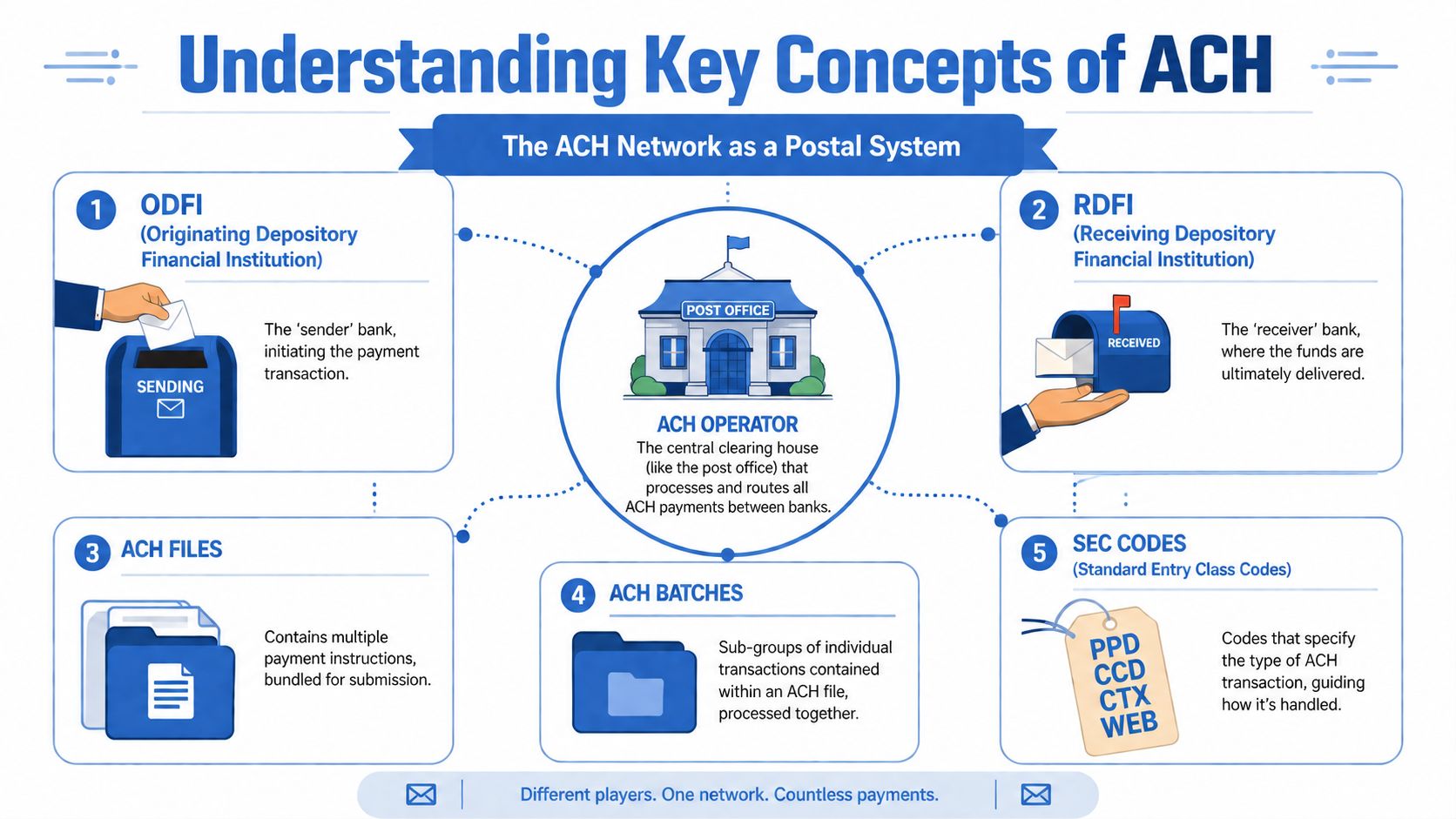
The ODFI is the Originating Depository Financial Institution. In plain terms, it is the bank or payments provider that accepts your company's ACH instructions and sends them into the network. If your AP team submits a batch of supplier payments, your bank is acting as the ODFI.
The RDFI is the Receiving Depository Financial Institution. It is the recipient's bank. If your company pays a freelancer, the freelancer's bank receives the ACH entry as the RDFI and posts it according to its own processing rules.
The ACH operator sits between them. The Federal Reserve explains that ACH operators receive entries from financial institutions, sort them, and make them available to receiving institutions through the ACH network in its overview of the Automated Clearing House service. For an operations team, the practical takeaway is simple. Your company is never sending funds straight into another account. You are sending instructions into a bank-to-bank system with intermediaries, schedules, and review points.
That matters more for global and crypto-native businesses than many guides admit. If your treasury workflow includes FX conversion, stablecoin off-ramping, or just-in-time funding, each institution in that chain adds timing exposure. A payment can be approved internally long before the receiving account is credited.
What files, batches, and SEC codes mean
An ACH file is the full transmission your system sends to the bank. Inside it are batches, which group similar transactions together. A payroll run might be one batch. Customer collections authorized as debits might be another. Grouping matters because different payment types often need different approval rules, effective dates, and return monitoring.
Then there are SEC codes, short for Standard Entry Class codes. NACHA uses these codes to identify the type of ACH entry and the context around it, such as whether it is a consumer debit, a business-to-business credit, or a web-initiated payment, as described in NACHA's ACH Network glossary. The code is not a small labeling detail. It tells banks how to interpret the transaction, what authorization standard applies, and which risk controls should surround it.
A simple example helps. If a company pays employee wages, that payment uses a different ACH classification than a business pulling a customer subscription payment. Both move through ACH, but the authorization trail, return exposure, and compliance handling are not the same.
Credits and debits
Two terms cause repeat confusion.
- ACH credit: your business sends money out
- ACH debit: your business pulls money in after receiving authorization
Payroll is a credit. A vendor refund is usually a credit. A customer autopay collection is a debit.
For operations teams, this distinction drives workflow design. Credit programs usually focus on file approval, funding, and release timing. Debit programs need stronger attention on authorization capture, return monitoring, and fraud controls because the business is initiating a pull from someone else's account.
For crypto-native firms, the credit versus debit choice also changes treasury planning. Credits often require prefunding before release. Debits can create the opposite problem. You may show incoming payment activity before funds are fully reliable. If your business converts expected ACH proceeds into crypto positions too early, timing assumptions can create liquidity stress.
Practical rule: Define your ACH use case by payment direction first. Then map the approval path, funding method, authorization record, and reconciliation process around that direction. That one decision shapes far more than the file format.
How ACH Payment Processing Works Flows and Timelines
This is the part teams need to get right operationally.
The five-step payment journey
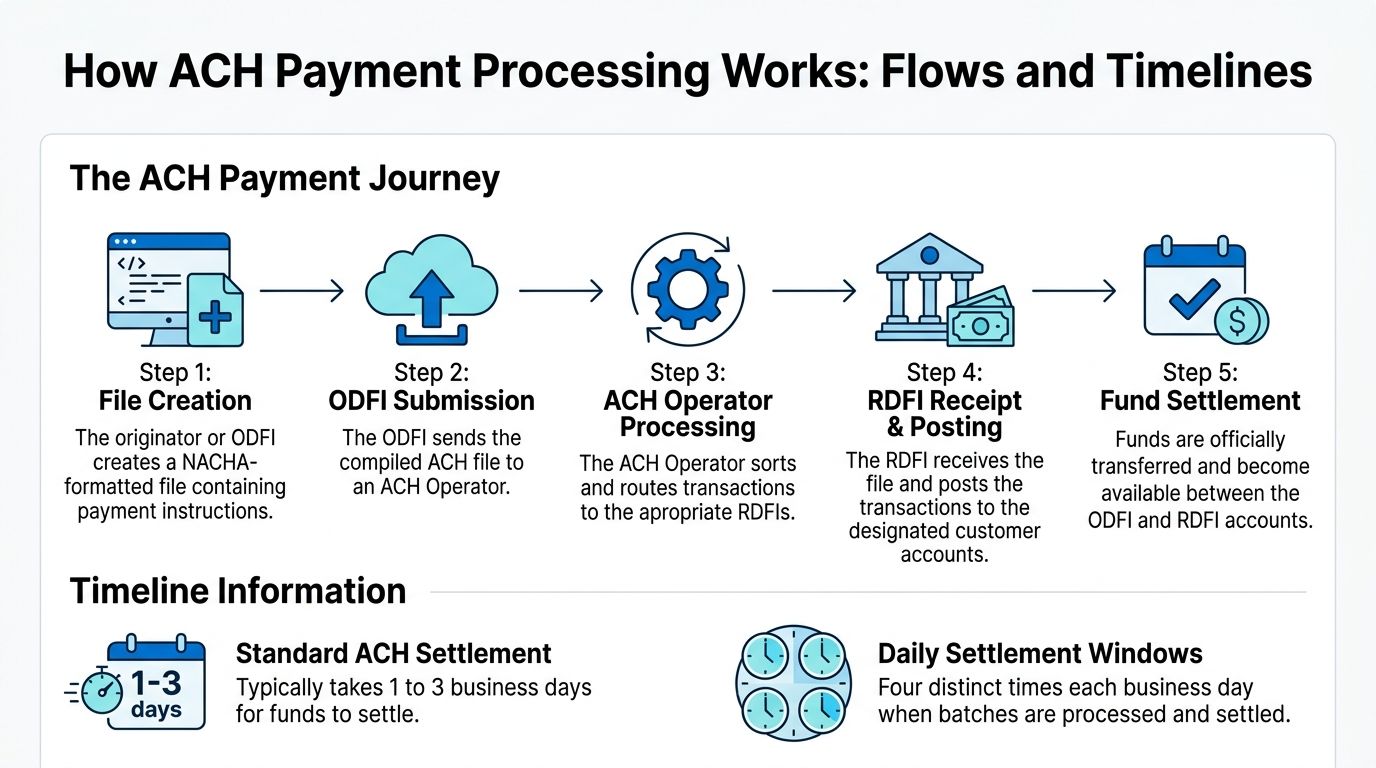
At a high level, ACH payment processing follows a batch model. According to Plaid's ACH payments guide, ODFIs submit files in batches, standard ACH settlement usually takes 1 to 3 business days, and Same Day ACH uses multiple settlement windows so payments can clear within hours.
Here's what that means in practice:
Your team creates the payment file.
This may happen in an ERP, payroll system, treasury platform, or bank portal. The file contains routing data, account information, amounts, and transaction type instructions.The ODFI accepts and submits the file.
Your originating bank or processor checks the file and forwards it to an ACH operator.The ACH operator sorts and routes entries.
The system determines which receiving banks should get which transactions.The RDFI receives the entry and prepares posting.
The recipient's bank validates the incoming data and applies its own handling rules.Interbank settlement completes.
Funds move between institutions through Federal Reserve accounts, and the receiving bank posts the credit or debit accordingly.
A key operational detail is that the network processes payments for 23.25 hours per business day and settles funds four times daily, according to Plaid's guide. That doesn't mean your file will move instantly. It means there are structured opportunities for movement during the day if your bank and workflow are aligned to those cutoffs.
To see the flow in a different format, this video gives a simple visual overview:
Where timing gets tricky
The hidden complexity is the float period. Chargebee explains in its overview of how ACH payments are processed that ACH files include standardized receiver bank information, the ODFI debits the originator when the file is submitted, and the RDFI credits the recipient only after settlement. That means funds can be “in motion” before the recipient can use them.
For normal businesses, this creates reconciliation work.
For crypto-native businesses, it creates market exposure. If you need to sell crypto, move into fiat, and then fund an ACH run, every hour between initiation and settlement becomes part of treasury planning.
A simple operating example:
- You promise contractor payouts on Friday.
- Treasury converts assets to dollars on Wednesday.
- The ACH file goes out on Thursday.
- A bank cutoff or return issue pushes final availability later than expected.
Nobody on the contractor side cares why it happened. They only know whether the money arrived.
Same Day ACH helps when urgency is real. It supports faster settlement windows and can clear within hours, but it isn't a cure-all. Teams still need cutoffs, approvals, and prefunding discipline.
Fees and Risk Controls in ACH
ACH often looks inexpensive on a pricing sheet. However, the true cost becomes apparent when timing slips, returns stack up, or a team has to stop and repair bad payment data.
That matters more for crypto-native and global businesses than many ACH guides admit. If your treasury desk converts assets into dollars to fund payroll, contractor payouts, or vendor batches, a low ACH fee does not protect you from a one-day delay. It only lowers the rail cost. The operating risk still sits with your team.
How ACH pricing usually shows up
Providers usually package ACH fees in one of three ways. Some charge a flat amount per payment. Some charge a percentage of the transaction value. Others bundle ACH into a broader payments product and apply blended pricing that can look small on low-value payments but expensive on larger transfers.
| Fee Type | How it works | Where it fits best |
|---|---|---|
| Flat fee | One fixed charge per transaction | Predictable B2B payouts and recurring vendor runs |
| Percentage fee | Cost rises with payment size | Lower-value customer debits or bundled processor setups |
| Blended fee | Base fee plus a percentage or platform charge | All-in-one payment stacks where ACH is one feature among many |
A simple way to evaluate pricing is to treat it like shipping. A cheap label is not really cheap if the package gets rerouted, delayed, or returned. ACH works the same way. You need to count the transaction fee, the labor to reconcile exceptions, the cost of failed payments, and the treasury impact of funds sitting in transit.
That is why operations teams should compare rails based on total workflow cost. If you are collecting rent, invoices, or subscription payments, this digital rent payment guide gives a useful view of how payment method choice affects collections work and follow-up effort. If you are comparing traditional bank rails with digital asset treasury paths, this comparison of bank wire transfer fees versus crypto costs helps frame when ACH's lower fee is worth the slower settlement pattern.
Where risk controls earn their keep
ACH risk control is less about stopping every failure and more about catching problems early, before they turn into returns, duplicate payments, or cash timing gaps.
Start with the controls that reduce operational mistakes:
- Dual approval for file release: One person prepares the batch, another approves it.
- Account validation or prenotes: Useful for new payees and any bank detail change.
- Velocity limits: Set caps by day, user, payment type, or payee group.
- Duplicate detection: Block the same amount, payee, and invoice combination from being sent twice.
- Return code monitoring: Route failed entries to finance or treasury the same day.
- Segregation of duties: Keep vendor bank detail maintenance separate from payment approval and file release.
One returned debit is a small issue. Fifty returns in a busy week can force a manual review cycle, delay payouts, and distort your cash position.
For global and web3 finance teams, the bigger control question is funding discipline. A domestic operating company may keep stable dollar balances ready for ACH. A crypto-native business may need to convert assets, move fiat into the right account, and hit a bank cutoff on time. In that setup, ACH risk starts before the file is even submitted.
A practical pattern looks like this:
- Lock the payout file early.
- Confirm required fiat balance against the approved batch.
- Add a buffer for returns, reversals, or same-day corrections.
- Release the file only after the funding account is fully positioned.
- Watch return and settlement activity until reconciliation is complete.
This approach helps treasury teams avoid a common failure point. The file is approved, but the account funding path is still in motion.
Manual ACH uploads with weak controls can appear inexpensive because the bank fee is low. The hidden bill arrives later in exception handling, support tickets, payment reversals, and missed payout commitments. Automated ACH flows work better when they validate bank details, flag duplicates, enforce approvals, and give treasury visibility into pending settlement exposure.
Regulatory and NACHA Requirements
ACH payment processing is governed by rules, not just bank preferences. If your file, authorization record, or originator setup is wrong, the payment may fail or create compliance problems later.
The compliance points teams miss most often
Start with authorization. ACH transactions need explicit approval before initiation. That approval can be written, electronic, or authenticated digital authorization, as described in Nacha's ACH payments fact sheet. Operations teams should be able to show where that authorization lives, who approved it, and which payee or customer account it applies to.
Then check file structure. NACHA formatting rules are strict. SEC code choice has to match the transaction type and authorization method. Identification fields need to be populated correctly. If your file generator is inconsistent, problems often appear only after submission.
A short checklist helps:
- Authorization record: Keep it in a retrievable system.
- SEC code alignment: Match the payment type to the proper class code.
- Originator details: Make sure company identifiers are correct and consistent.
- File controls: Validate formatting before upload or API submission.
- Return handling policy: Decide who reviews and acts on returns.
Extra care for offshore and web3 entities
Here, many guides stop too early.
Most ACH content assumes a domestic U.S. company with a standard U.S. bank account. That leaves out offshore holding companies, Cayman or BVI entities, and web3 teams that still need to pay U.S. vendors or contractors. HoneyBook's overview notes that many resources omit that non-U.S. entities often need to work through intermediary ODFIs and satisfy specific KYB requirements to originate ACH legally on U.S. rails, as discussed in this ACH processing overview for businesses.
If your entity structure is cross-border, don't assume ACH access is automatic. Banks and processors will ask who owns the company, where it operates, who its counterparties are, and how funds move between fiat and digital assets.
For web3 teams, this isn't admin overhead. It's part of payment design.
Integration and Implementation Options
The initial selection of ACH setup is often driven by habit. A bank offers a portal, a processor offers an API, and someone picks the option that seems fastest to launch. That works until volume increases or reconciliation gets messy.
Three ways teams usually go live
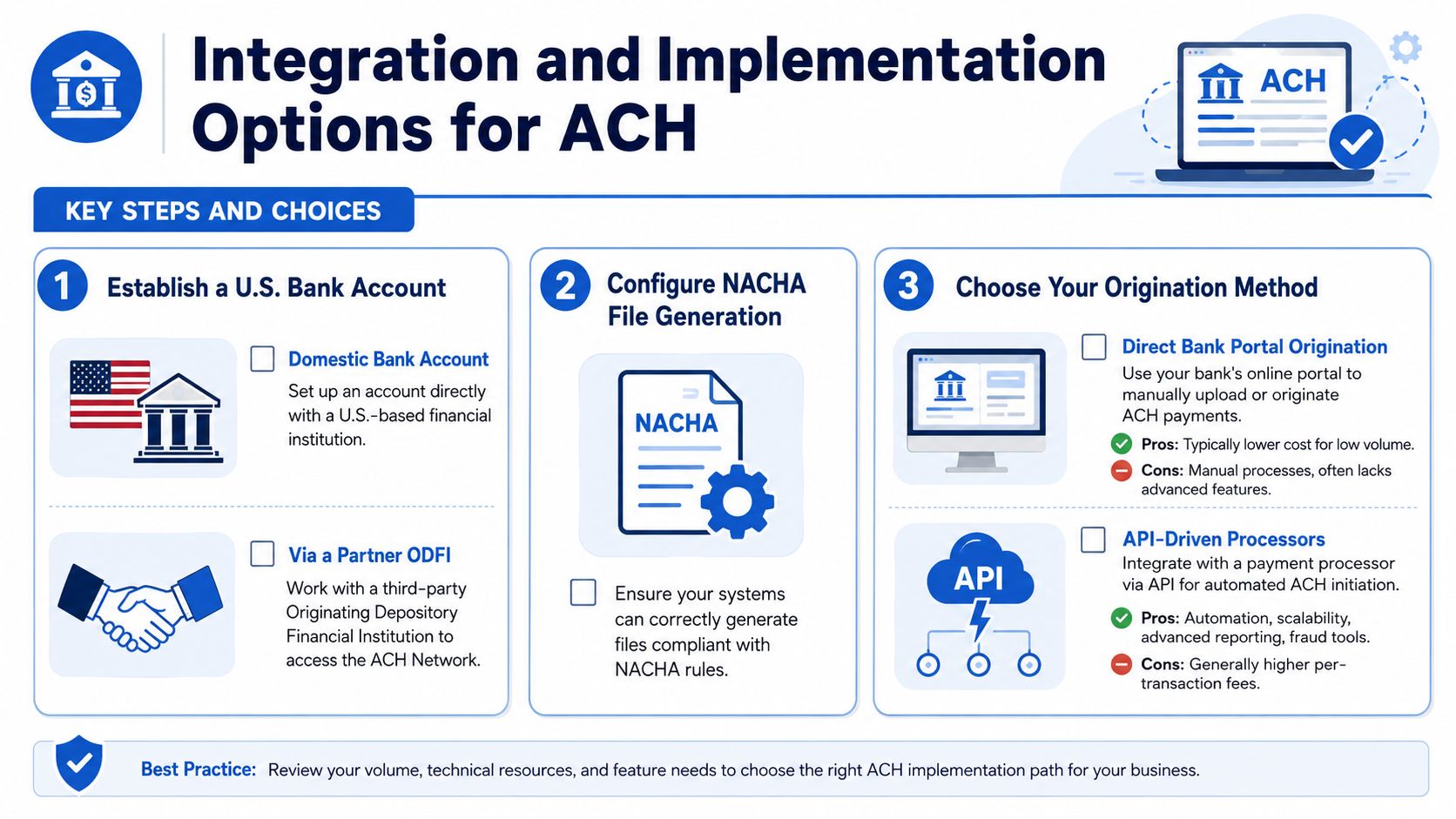
The first route is a direct bank portal. This works for low-frequency payment runs. Someone logs in, uploads a NACHA file, reviews totals, and approves the batch. It's simple, but it creates manual dependencies.
The second route is an API-driven processor. This is better when you need automated payables, recurring collections, or event-driven treasury operations. Chargebee notes that ACH files require standardized receiver bank information and that originator debits happen immediately on file submission, which creates a float period that automated systems must manage. That's the operational issue behind many treasury bugs, and it matters most when your workflow spans multiple funding sources.
The third route is a platform that combines banking rails and treasury tooling. For global or crypto-native teams, this can reduce handoffs between conversion, account funding, payment creation, and reconciliation. One option in that category is OneSafe's guide to business bank account setup for fiat and crypto integration, which is relevant for teams deciding how to connect bank accounts with digital asset workflows.
If your engineers are building payment logic from scratch, it also helps to review broader strategies for secure payment gateway setup, especially around authentication, callback design, and failure handling.
A practical go-live checklist
A clean ACH launch usually follows this order:
Confirm account structure
Decide whether you're using a domestic U.S. business account or working through a partner ODFI.Define your payment types
Separate payroll, contractor payouts, vendor disbursements, and customer debits. They often need different approval and risk rules.Choose file generation or API orchestration
Manual uploads can work early. Automation becomes important once payment runs are frequent or tied to product events.Build internal controls before volume arrives
Add maker-checker approval, change logs, and return monitoring from the start.Test the exceptions
Don't only test successful payments. Test duplicate submission handling, invalid accounts, and delayed funding scenarios.
A working ACH integration isn't just the one that sends money. It's the one that still behaves predictably when a file is late, a return lands, or treasury has to change funding sources mid-cycle.
Common Problems and Best Practices
The failures that hurt teams most are rarely exotic. They're ordinary issues that hit at the wrong time.
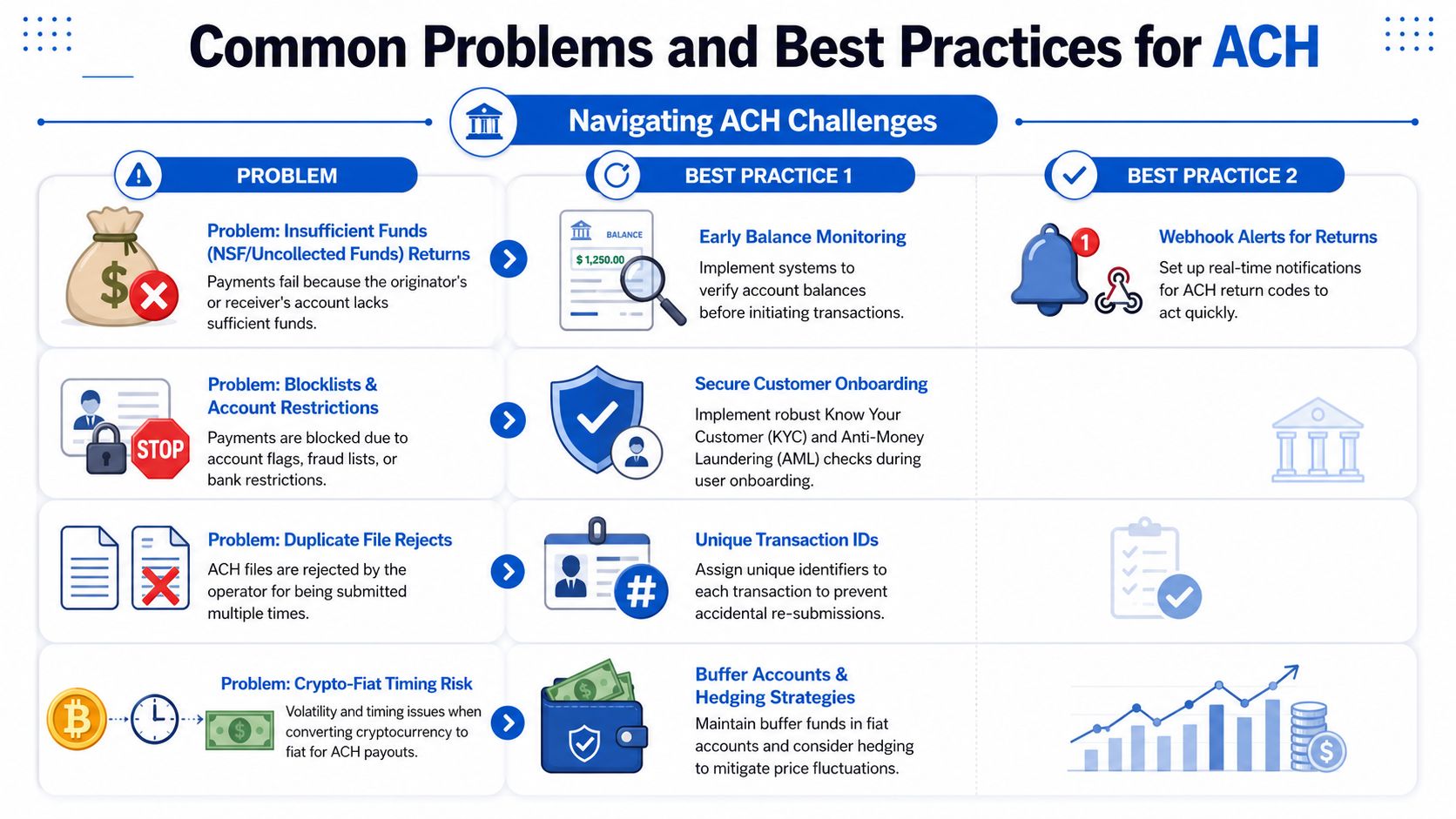
The failures teams see again and again
Insufficient funds returns are common when treasury assumes funds are available earlier than they really are. If your business funds ACH payouts from a conversion event, the timing between conversion, bank availability, and file release has to be explicit.
Duplicate file rejects happen when a team resubmits after not seeing a status update. This often starts as a communication problem, not a technical one.
Account restrictions and blocklists show up during onboarding or after unusual payment behavior. If customer or vendor information isn't validated carefully, downstream rework grows fast.
The most overlooked issue for crypto-native companies is timing risk. GrailPay notes that ACH settlement can take 2 to 5 business days, and in some cases longer depending on bank handling, which exposes firms holding digital assets to conversion and liquidity risk. That gap is the core issue described in this ACH processor overview focused on settlement timing.
Best practices that hold up in production
A few patterns reduce most day-to-day ACH pain:
- Hold a fiat buffer: Don't rely on last-minute conversion for critical payout runs.
- Use webhook or alerting workflows: Returns, rejects, and settlement events should reach both finance and operations.
- Assign unique transaction IDs: This is your best defense against accidental replay.
- Separate onboarding from payout approval: The person adding bank details shouldn't be the only person able to release money.
- Match payout calendars to settlement reality: Don't promise availability based on initiation date.
One more best practice matters for international teams. If your entity sits outside the U.S. but you pay U.S. counterparties often, pick infrastructure that supports both banking access and governance controls. This guide to international banks for crypto integration is useful for evaluating that mix at the account-structure level.
Teams usually don't lose control of ACH in the happy path. They lose control when treasury, compliance, and payment ops each assume someone else is watching the timing.
Conclusion and OneSafe Support
ACH payment processing works well when teams treat it as a system, not a button. The important parts are clear authorization, correct file structure, predictable approval flow, and realistic timing assumptions around settlement and returns.
That timing issue is where many global and crypto-native companies struggle. A payment can be approved internally while funds are still moving through bank windows, and that gap can create liquidity pressure or crypto conversion exposure. Standard ACH may be inexpensive, but it still needs planning. Same Day ACH can shorten urgency-driven flows, but it doesn't remove the need for controls.
For teams operating across fiat and crypto workflows, OneSafe provides multi-currency business accounts, ACH and wire access, corporate cards, and crypto-to-fiat interoperability in one operating environment. That's useful when finance teams need fewer handoffs between treasury, payouts, and approvals, especially for global entities and web3 organizations.
If your team needs ACH workflows that fit global operations and crypto treasury realities, OneSafe is worth a look. It brings multi-currency accounts, payment rails, and crypto-compatible treasury operations into one place, which can simplify how you fund, approve, send, and reconcile ACH payments.