Your customer paid in EUR. Your contractors want USD. A treasury wallet holds USDC. Meanwhile, the finance team is checking three dashboards, copying balances into a spreadsheet, and trying to decide whether to convert now or wait until the next invoice cycle. Then a payout lands in the wrong currency, an intermediary bank removes a fee, and a margin that looked healthy becomes difficult to explain.
That's the true test for multi-currency bank accounts. They shouldn't merely let you display several balances. They should help you control settlement timing, avoid unnecessary conversion, fund payments in the currency you owe, and reconcile every movement without detective work. This guide evaluates them as an operating layer for international finance, not as a list of attractive app features.
Table of Contents
- The Cross-Border Reality Most Businesses Underestimate
- The balance layer
- The FX layer
- The settlement layer
The Cross-Border Reality Most Businesses Underestimate
A global software company can collect subscription revenue in USD, pay European vendors in EUR, settle contractors in local currencies, and hold part of its treasury in USDC. Each flow may work on its own. The operational problem appears when those balances are spread across banks, payment processors, wallets, and card programs.
The finance lead may know the business has enough cash overall, yet still convert funds because the EUR account is short while USD remains idle elsewhere. A refund can create another mismatch when the original processor settles in a different currency. Contractor payments may wait while staff transfer funds between platforms. Cash has not disappeared, but control over where cash sits, when it settles, and what each conversion costs has.
Three risks follow:
- Timing risk: A payment becomes urgent before the required currency settles.
- Reconciliation overhead: Finance matches invoices, wallet movements, card charges, conversions, and bank entries across separate systems.
- Margin leakage: A forced conversion, intermediary deduction, or card markup cuts the economics of a transaction.
Cross-border activity now sits inside ordinary revenue and spending cycles for smaller companies, not just occasional international transfers. Businesses need a cash-optimization layer that keeps receipts in useful currencies, funds obligations from the right balances, and records each movement in a form finance can reconcile.
The headline FX rate is only one part of the result. A provider can advertise an attractive conversion while intermediary bank charges, forced conversion, settlement delays, or manual reconciliation consume the saving. Review the full cross-border payments overview before comparing platforms or payment structures.
Operator's test: If a provider only makes it easier to open balances, but does not improve settlement matching and reconciliation, it has not solved the expensive part of the problem.
Ask one practical question: Can this account reduce forced conversion, shorten the path from receipt to usable funds, and give finance one reliable record of every movement? If the answer is no, additional currency balances add complexity rather than control.
What Multi-Currency Bank Accounts Are, And Why the Distinction Matters
A business multi-currency account combines three functions. Separating them helps finance teams distinguish an operating account from a wallet that merely displays exchange rates.
The balance layer
The balance layer holds funds in parallel currency balances. A company can retain USD, EUR, CAD, or another supported currency without converting every receipt into its base currency. That matters when upcoming obligations are already denominated in the currency received.
A EUR balance can fund a EUR supplier invoice directly. The business avoids selling USD on the payment date, accepting the prevailing rate, and explaining that conversion in its books. The account becomes a staging point for expected receipts and obligations.
The FX layer
The FX layer converts one balance into another. It should show the rate, spread or fee, and resulting amount before confirmation. Finance should be able to hold incoming currency, convert immediately, or schedule conversion around a known payment.
That control makes the account a cash-optimization layer, not just a place to store money. It positions cash for collection, conversion, payment, and reconciliation. The operational benefit comes from choosing the conversion point, rather than accepting forced conversion whenever funds arrive or a payment becomes due.
The settlement layer
The settlement layer connects balances with payment rails and counterparties. It determines whether a customer can pay using local account details, whether a contractor receives the intended currency, and whether a processor can settle funds without converting them first.
A business account also needs controls suited to finance operations. Look for named balances, KYB onboarding, transaction records, user permissions, approval workflows, and exportable audit trails. A consumer wallet or prepaid card may support multiple currencies without providing the entity-level records and controls required for reconciliation.
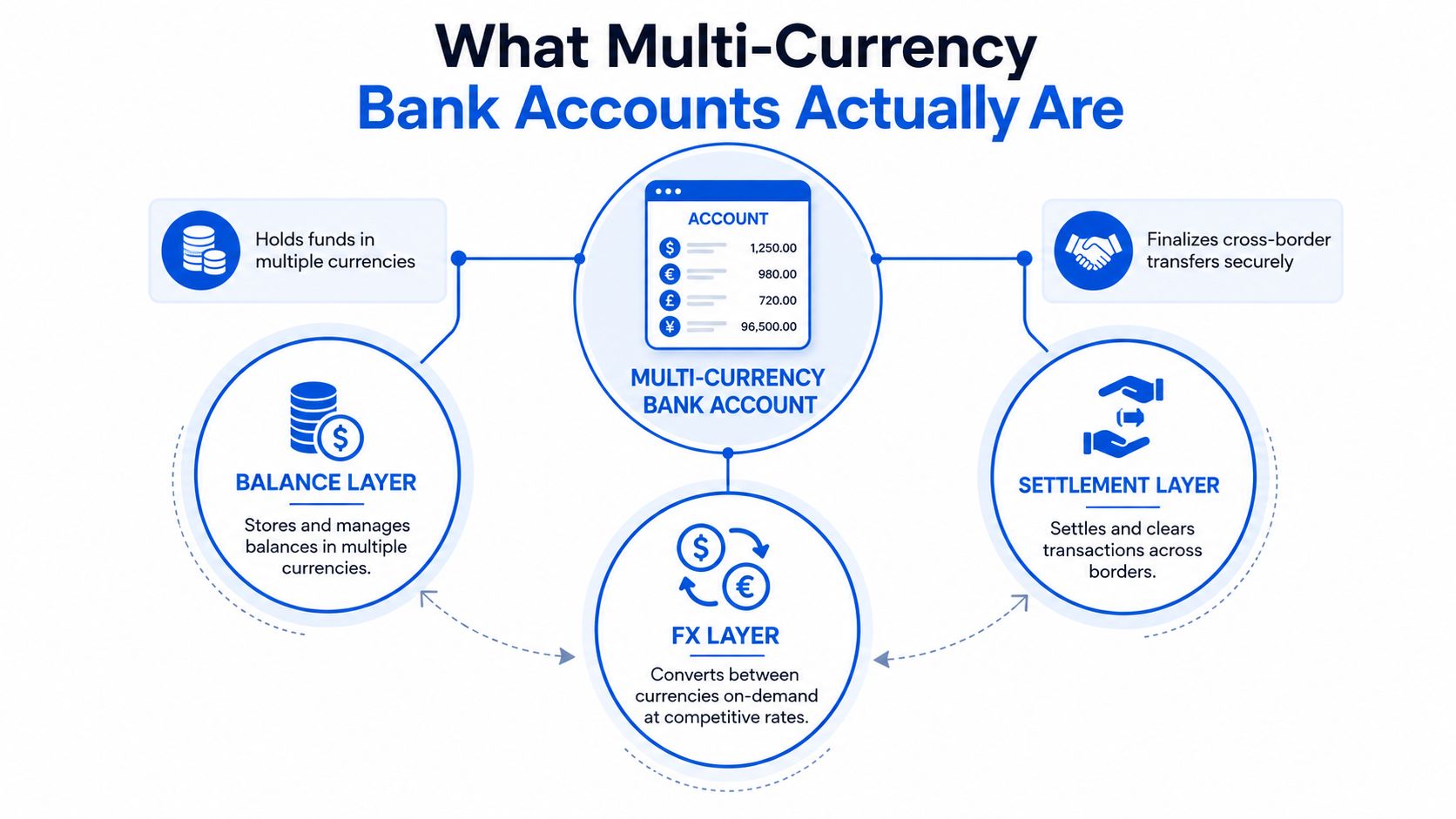
Use this operating model: hold the currency you receive, convert only when required, and settle payments from a matching balance whenever possible. Cards, invoices, contractor payouts, and crypto conversions should fit that model and leave records finance can reconcile.
How FX, Settlement, and Payment Rails Connect
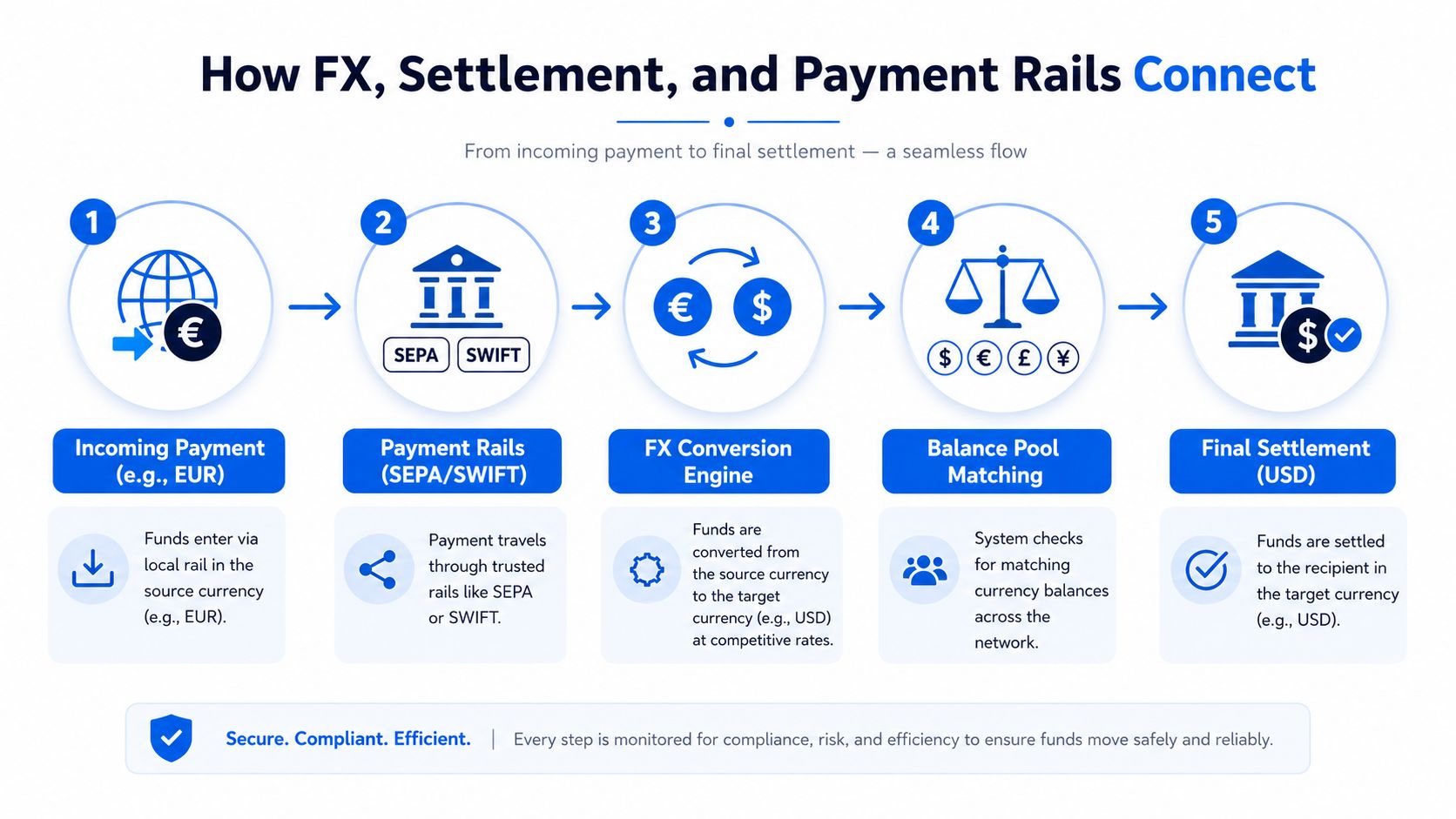
A EUR payment doesn't become usable because it appears in a dashboard. The funds enter through a payment rail, pass through the provider's settlement process, and then land in a currency balance or get converted according to the account configuration.
For a local EUR payment, the provider may route funds through a regional domestic rail. A USD payment may use ACH or a domestic wire. A larger or less-localized transfer may travel through SWIFT, where correspondent banks can participate before the recipient's bank credits the final account. The rail affects speed, eligibility, traceability, and where charges can arise. For a practical explanation of ACH mechanics, see this guide to ACH payment processing.
What happens when currencies match
Suppose a customer sends EUR and the business has a EUR receiving balance. The provider can credit the EUR balance without converting it. Finance can then use those funds for a EUR supplier invoice or contractor payout. The company has avoided an unnecessary conversion cycle and reduced the number of entries requiring reconciliation.
The same principle applies to payment processors. Stripe documents that a business can configure settlement in up to 18 currencies, but each configured settlement currency must be paired with a separate supported bank account in that same currency. If the matching account isn't available, the payout is routed only to a matching-currency bank account, which can result in conversion rather than direct settlement. The Stripe multi-currency settlement documentation makes the operational lesson clear: currency configuration is part of treasury control.
What happens when currencies don't match
If the incoming currency and destination balance don't align, the provider may convert the funds automatically. That conversion can include an FX spread, a platform fee, or both. A payment may also take a slower route if the provider can't use a local rail for the destination.
Notional pooling offers a different treasury approach. JPMorgan describes multi-currency notional pooling as a structure that can offset surplus and deficit balances across currencies without physically converting every balance. In practice, that can improve liquidity visibility and reduce idle cash, because the treasury team can assess net positions rather than treating every currency account as an isolated pot. The JPMorgan treasury paper on multi-currency notional pools provides the underlying framework.
Where charges appear
ACH and domestic rails usually offer a more localized route, while wires can carry sender, recipient, and intermediary charges. SWIFT payments are especially difficult to price from the headline fee because another bank may deduct money before the beneficiary receives the funds. Instant rails can improve availability, but they don't automatically eliminate FX costs or receiving-bank deductions.
Map each flow from source to final beneficiary. Don't compare providers only by the visible transfer fee. Compare the currency entering the account, the rail used, the conversion decision, the receiving currency, and the final amount credited.
The Full Cost Stack Beyond the Headline FX Rate
A business can receive a favourable quoted exchange rate and still lose money on the transaction. The provider may build a spread into the rate, charge for the payment rail, or pass intermediary deductions to the recipient. Review the account as a cash-optimization layer, not as an FX price tag.
Use four cost layers when reviewing a multi-currency account:
- FX spread or markup: The difference between the reference rate and the rate applied to a conversion or card transaction.
- Transfer fee: A fixed charge for ACH, domestic wire, international wire, or SWIFT.
- Intermediary deduction: A charge taken by another bank in the payment chain, often difficult to predict before settlement.
- Card conversion cost: A markup or separate fee applied when a card purchase uses a currency that does not match the available balance or card program terms.
Card spending needs its own model. Currency exchange is already embedded in a meaningful share of card activity. Industry reporting estimates that 6% to 8% of global card payments involve currency exchange, with the figure reaching 12% to 15% in major tourism markets, as documented in the industry report on multi-currency banking. Companies with internationally distributed card spend should calculate card FX separately from supplier payments and treasury conversions.
Representative multi-currency account fee components
| Fee Type | Illustrative Cost | When It Applies |
|---|---|---|
| FX spread or markup | Provider-specific | When one currency balance is converted into another |
| Wire fee | Provider-specific | When funds move through a domestic or international wire |
| SWIFT fee | Provider-specific, sometimes combined with correspondent charges | When a payment uses the SWIFT network |
| Intermediary bank deduction | Variable | When a correspondent bank removes a charge before final credit |
| Card FX markup | Provider-specific | When card spend requires currency conversion |
| Reconciliation cost | Internal operating cost | When statements, wallets, cards, and invoices don't align cleanly |
Reconciliation belongs in the calculation even though it is not a bank fee. Finance staff may spend hours matching partial settlements, unexplained deductions, wallet transfers, and invoices. That operating cost can outweigh an attractive conversion line, particularly when the account separates balances, cards, and payment records across different views.
Practical rule: Price the complete payment path, not the provider's preferred screenshot.
Build a sample basket from actual activity: one customer receipt, one supplier payment, one contractor payout, one card transaction, and one crypto-to-fiat conversion if relevant. Ask each provider to show the beneficiary's final amount, the currency used, expected settlement timing, and every deduction. Then compare the reconciliation work required after each flow. A lower visible fee is not a saving if forced conversion, correspondent charges, or manual matching erase the difference.
Where Multi-Currency Accounts Earn Their Keep
A multi-currency account earns its keep when it removes repeated treasury decisions from daily operations. The value is not a long currency list. It is the ability to receive, hold, and spend funds in the currencies your business uses, while reducing forced conversion, intermediary deductions, and reconciliation work.
A 2025 survey from JPMorgan found that 87% of organizations engage in cross-border payments, while market research projects SME cross-border payment growth at 8.03% annually through 2031. Those figures, cited in the 2025 digital payments survey, show the scale of the operating environment. They do not prove that every company needs another account. Judge the account by the workflow it improves and the costs it removes.
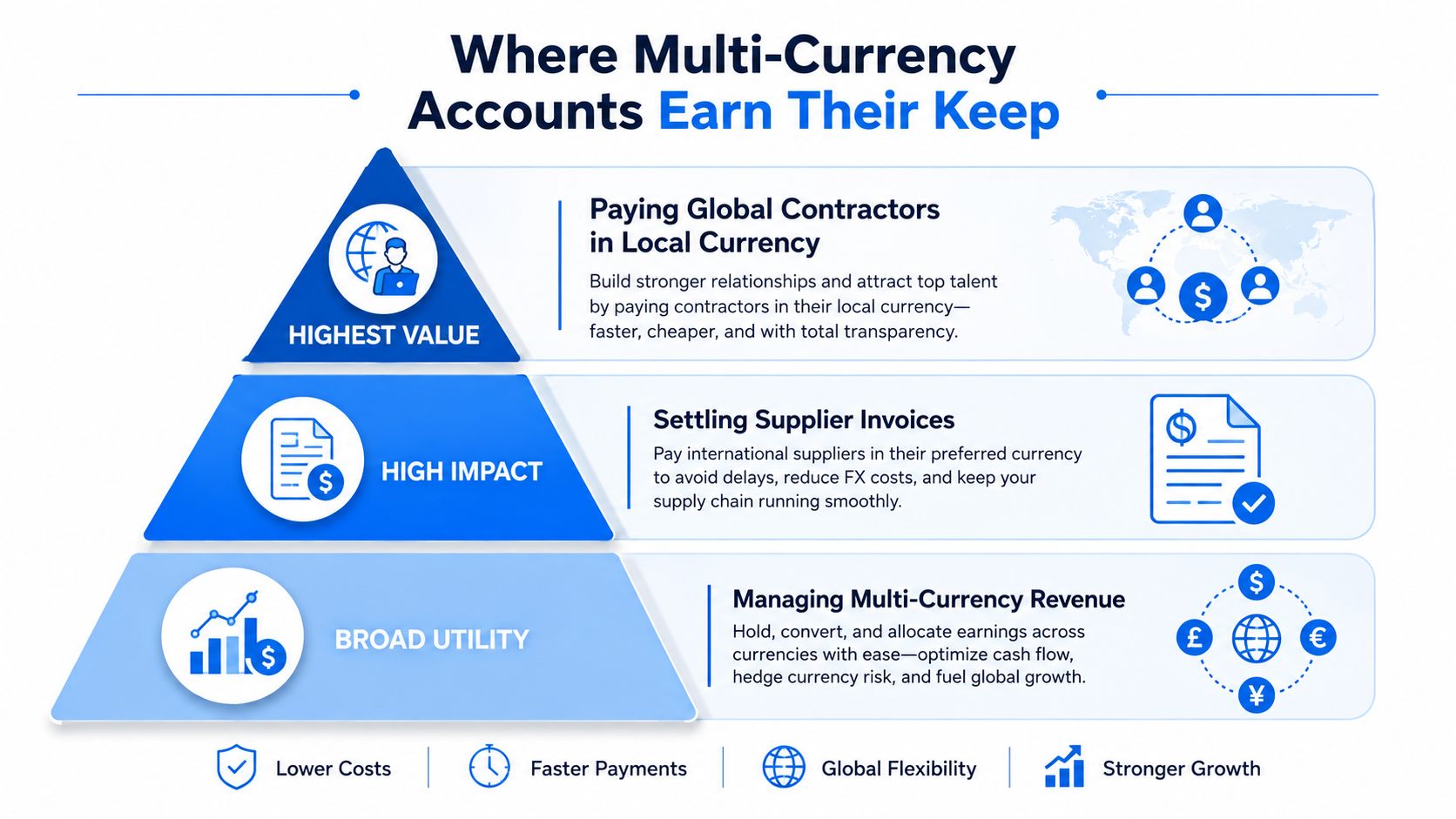
Highest-value workflows
Paying international contractors in local currency is often the clearest use case. When revenue and contractor obligations share a currency, the business can avoid an unnecessary conversion and verify the payment amount more easily. It also reduces the risk that a payment leaves one balance, converts under pressure, and arrives lower than expected after fees.
Settling supplier invoices creates the same advantage. Hold funds in the currency of recurring vendor obligations instead of converting immediately after every customer receipt. That separates collection timing from payment timing and gives treasury control over when currency exposure is created.
Managing multi-currency revenue prevents every foreign receipt from being converted into the reporting currency on arrival. Finance can retain operational balances until there is a clear reason to convert, such as payroll, tax, a supplier run, or a treasury policy threshold. The account becomes a cash-optimization layer rather than a passive holding place.
Supporting crypto-fiat operations helps web3 teams that receive or send stablecoins while paying vendors in fiat. The practical benefit is fewer system switches and a visible conversion event tied to the related business payment. Adding another asset balance to a dashboard is not the objective.
Score the provider against your workflow
| Decision criterion | International SME priority | Web3 organization priority |
|---|---|---|
| Currency and corridor coverage | Local collection and supplier payout support | Fiat corridors plus supported digital assets |
| Fee transparency | Total delivered cost and predictable statements | Conversion, withdrawal, and network-related visibility |
| Settlement speed | Payroll, refunds, and invoice timing | Treasury movement and near-real-time operating needs |
| Controls | Roles, approvals, and accounting exports | Governance, wallet permissions, and spend policies |
| Reconciliation | Invoice, payout, and bank matching | Fiat, card, wallet, and token transaction matching |
The account earns its keep when it removes manual work from a recurring flow. If the business sends only occasional foreign payments and holds little currency exposure, the added provider relationship may not justify its cost.
How to Evaluate a Multi-Currency Account Provider
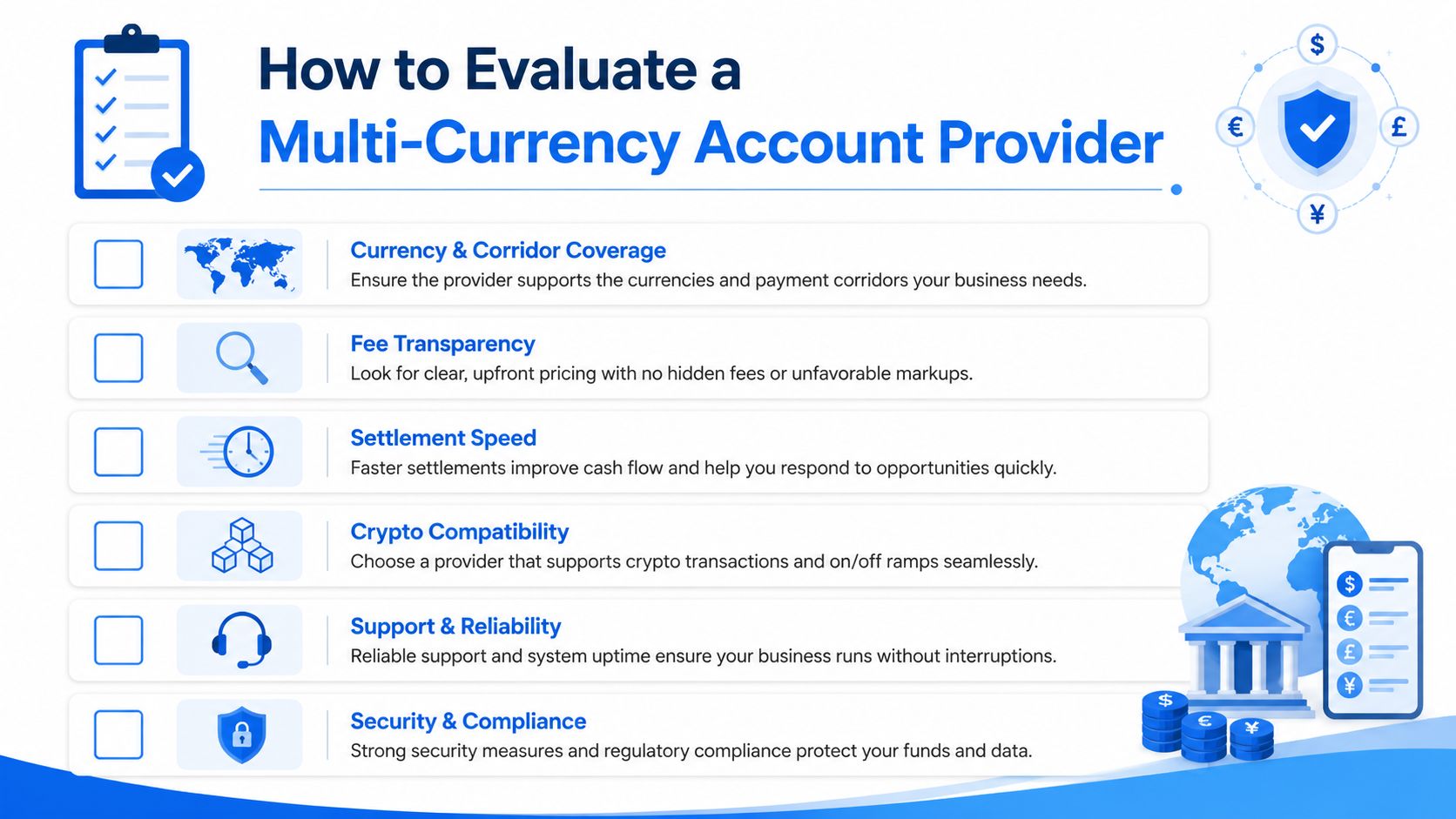
Start with corridors, not currency count. A provider may list a currency as supported while offering no local receiving details, limited payout destinations, or only conversion without settlement. For each currency your business uses, verify whether you can receive, hold, convert, pay, refund, and export records.
The operating checklist
- Currency and corridor coverage: Confirm the exact countries, local account details, payout destinations, and settlement currencies available to your entity.
- Fee transparency: Request a delivered-cost example that includes FX, transfer fees, card conversion, and potential intermediary deductions.
- Settlement speed: Ask when funds become available, not merely when a transfer is marked as sent.
- Crypto compatibility: If your treasury uses digital assets, verify supported deposit and withdrawal assets, conversion timing, custody arrangements, and compliance requirements.
- Team controls: Require role-based access, approval policies, card limits, and clear separation between initiator and approver.
- Security and KYB: Review MFA requirements, custody structure, account safeguarding, transaction monitoring, and the documents needed for onboarding.
- Integration quality: Check whether the platform connects cleanly to accounting, payroll, invoicing, and expense workflows.
A newly incorporated company also needs to verify entity eligibility before it invests time in onboarding. Companies formed in jurisdictions such as the Cayman Islands, BVI, or Panama may face provider restrictions, enhanced KYB, or corridor limitations. Ask for a written eligibility decision based on the actual entity, ownership structure, business activity, and operating countries.
Don't let a polished dashboard outweigh weak controls. A platform that supports many currencies but can't produce clear statements, approval logs, or beneficiary-level payment records will push work back into spreadsheets.
For companies comparing account structures for limited liability entities, this guide to business accounts for LLCs offers a useful starting point. Treat it as a screening resource, then validate the specific provider terms for your jurisdiction.
How OneSafe Fits These Requirements
OneSafe provides a worked example of the criteria above. Its multi-currency business accounts support USD, EUR, and CAD, while its platform connects ACH, domestic and international wires, and SWIFT transfers in one interface. The account structure also supports crypto-compatible workflows, including USDC deposits and withdrawals, crypto payments, near-instant crypto-to-fiat and fiat-to-crypto conversions, and web3 invoicing.
The practical question is whether those features fit the actual operating model. A web3 company paying global contributors may value the connection between USDC treasury activity, fiat conversion, contractor payments, and card spend. A conventional international SME may care more about local receiving details, supplier settlement, accounting exports, and approval controls.
Published pricing gives finance teams concrete inputs for a model. OneSafe lists free or $29+ per month plan options, with illustrative fees including a $10 wire deposit, $25 wire withdrawal, 0.35% plus $50 for SWIFT, 0.15% for fiat deposits and withdrawals, and a 3% FX fee on cards. The relevant comparison isn't whether each line looks low in isolation. It's whether the platform's fee structure matches the rails your business uses.
What the setup includes
Corporate cards can be configured with spend limits, merchant controls, and policy-based approvals. Security controls include Fireblocks-based digital asset custody and mandatory MFA. KYB is designed for startups and web3 entities, with typical onboarding completed within about a week.
That combination may reduce the number of systems a finance team needs to monitor, but it doesn't remove the need for treasury discipline. Configure settlement currencies correctly, document conversion policies, and reconcile card, fiat, and digital asset activity against the accounting record.
The useful question isn't whether OneSafe supports more currencies. It's whether its USD, EUR, CAD, payment, card, and crypto workflows cover your recurring cash movements without creating another reconciliation silo.
Common Pitfalls and When a Multi-Currency Account Is Not Worth It
A multi-currency account isn't automatically a saving. If your company has low cross-border volume, operates mainly in one currency, and rarely holds foreign balances, a standard business account plus occasional transfers may be simpler.
The category also fails when teams configure it carelessly. A payment processor may settle in a currency for which no matching bank account exists, triggering conversion. A SWIFT payment may arrive short because an intermediary bank deducted a charge. A card may apply an FX markup even though the finance team assumed the account's conversion rate covered all spending.
The hidden-cost problem is partly a visibility problem. In a Hong Kong SME survey, 41% of respondents knew that exchange-rate markups are often added to global transactions, while 85% reported negative business effects from poor payment experiences, including using multiple providers and dealing with delays. Those findings are reported in the Hong Kong SME cross-border payments coverage. Access to an account isn't the same as control over the payment experience.
Use this decision filter
Choose a multi-currency account when:
- Currency exposure is recurring: You regularly receive and pay in more than one currency.
- Timing affects margin: You need to hold funds and choose when conversion occurs.
- Settlement matching matters: Local-currency receipts or payouts can reduce forced conversion.
- Controls are a bottleneck: Finance needs approvals, card limits, and unified records.
- Crypto and fiat interact: Your treasury would benefit from fewer platform switches.
Skip it when the account would only add another dashboard. Before signing, request a full fee schedule, test a representative payment path, confirm entity eligibility, verify settlement-currency matching, and ask how intermediary deductions appear in statements. Negotiate the fees that affect your highest-volume rails, not the fee that looks most attractive in a sales conversation.
OneSafe offers multi-currency business accounts, ACH, wire and SWIFT payments, corporate spend controls, and crypto-fiat workflows for international and web3 teams. Review the operating model and published pricing, then visit OneSafe to determine whether its account structure fits your recurring currencies, settlement paths, and treasury controls.