Businesses and DAOs that hold stablecoins now have a hard compliance date: January 18, 2027. On October 22, 2026, the Office of the Comptroller of the Currency finalized its GENIUS Act stablecoin regulation rules, according to KuCoin. The final framework drops proposed stablecoin rewards curbs, keeps the stablecoin yield ban, and requires at least 1:1 backing while giving issuers more reserve flexibility.
Table of Contents
- What just happened: OCC finalizes GENIUS Act stablecoin regulation
- Why this now matters for businesses and DAOs that hold stablecoins
- The background a newcomer needs to follow
- Practical steps before January 18, 2027
- What to watch next and open questions
- Key Takeaways
What just happened: OCC finalizes GENIUS Act stablecoin regulation
The dated decision and where it came from
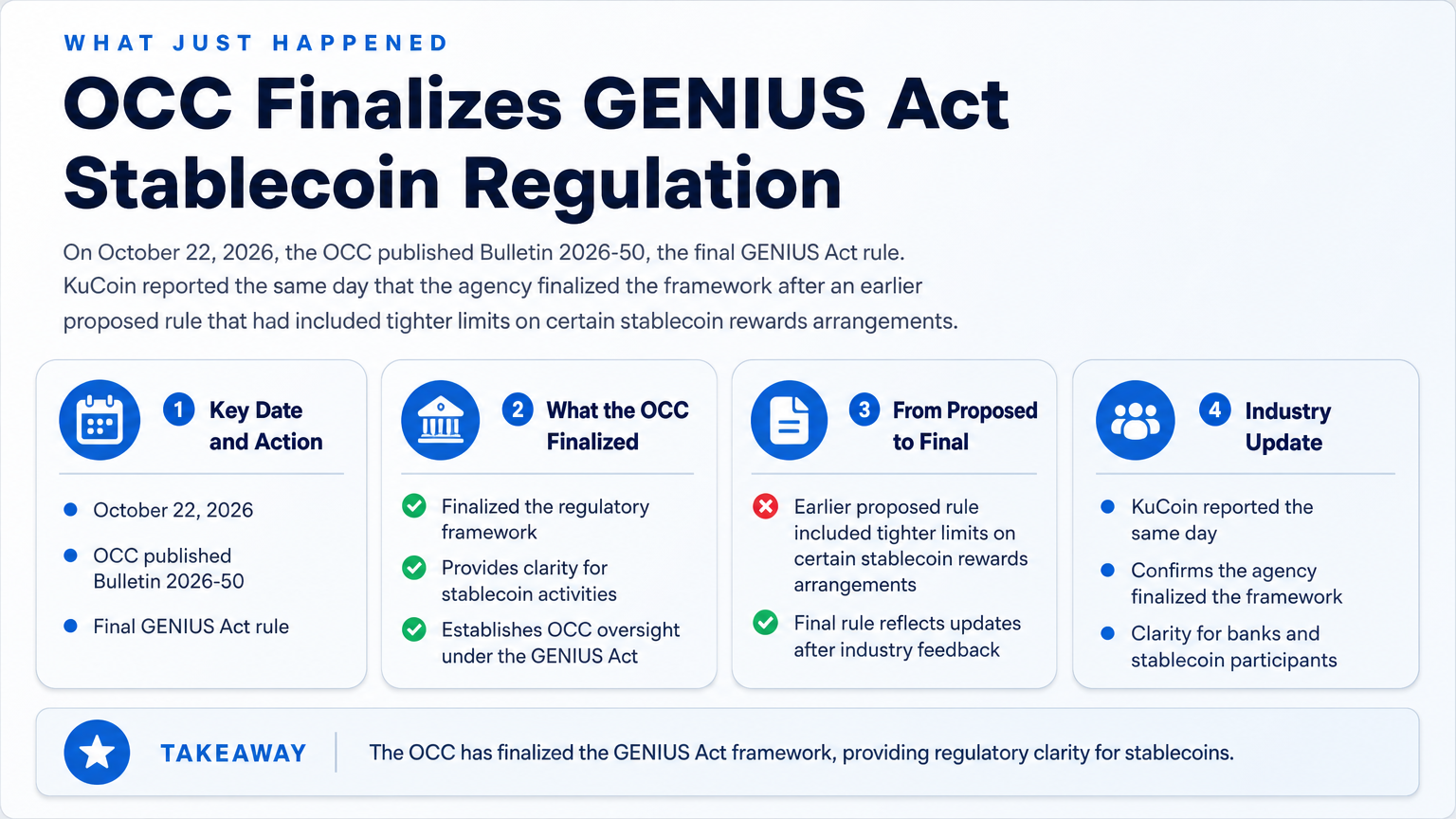
On October 22, 2026, the OCC published Bulletin 2026-50, the final GENIUS Act rule. KuCoin reported the same day that the agency finalized the framework after an earlier proposed rule that had included tighter limits on certain stablecoin rewards arrangements.
The final OCC stablecoin rules implement the Guiding and Establishing National Innovation for US Stablecoins Act, the federal prudential framework for payment stablecoins that President Trump signed into law in July 2025, per the White House fact sheet.
What did the OCC change in the final GENIUS Act stablecoin regulation rules?
According to KuCoin’s October 22 report, the OCC made five changes that matter for non-issuer businesses:
- Dropped the proposed restrictions on stablecoin rewards.
- Retained the stablecoin yield ban.
- Allowed more reserve flexibility for issuers.
- Required stablecoins to remain backed at least 1:1.
- Relaxed reserve management rules while maintaining liquidity and risk appetite standards.
The final rule also leaves anti-money laundering and sanctions requirements pending, which means the OCC’s work is not finished.
Rewards curbs dropped, issuer yield ban stays
The most contentious change is what the OCC did — and did not — do on rewards. KuCoin reports that the final rule drops the proposed restriction on certain stablecoin rewards arrangements but retains the ban on issuers paying yield. That split leaves banks’ dispute with crypto firms unresolved but gives businesses more room to use stablecoin products that offer non-yield rewards.
This changes the product landscape: a stablecoin wallet that pays cashback or usage-based rewards may remain available, while a product that passes reserve yield back to holders as interest would sit on the wrong side of the issuer yield ban. For more on how the OCC yield rule reshapes product design, see Crypto Banking After the OCC Yield Rule: What Changes.
Effective January 18, 2027: reserve flexibility and 1:1 backing
The framework takes effect in 2027. Issuers gain reserve flexibility, but the floor is hard: every outstanding stablecoin must be backed at least one-for-one by eligible reserves. The OCC also eased reserve management restrictions while keeping liquidity and risk standards intact, according to KuCoin. For context on redemption expectations, see Stablecoin Regulation Update: OCC’s 2-Day Redemption Rule.
Why this now matters for businesses and DAOs that hold stablecoins
Stablecoin rewards vs. yield: what changed for holders
The final rule produces a two-track world for stablecoin users. Rewards are not categorically banned. Yield paid by the issuer is.
That distinction is easy to miss in product marketing. A company earning a small return on its idle USDC balance may be exposed to a banned product if the return is structured as time-based yield, while a usage-based cashback program may be compliant. The compliance burden sits with the issuer, but treasury teams inherit the operational risk if they build cash forecasts around a payment stream that later gets challenged.
How does the issuer yield ban affect businesses that hold stablecoins?
The issuer yield ban removes the assumption that a compliant stablecoin issuer will pay interest-like returns directly to holders. Treat any promised yield on stablecoin balances as a compliance flag until the issuer documents its legal structure. If yield comes from a third-party platform rather than the issuer, verify where the return originates. The ban does not prevent every cashback or rebate structured as a usage reward, but a product labeled “rewards” may later be reclassified as yield. For a deeper read on the federal yield line, see Crypto Banking: New Federal Yield Rules, Explained.
The unresolved bank–crypto dispute and what it means for product availability
Banks sought tighter restrictions on rewards, warning that payments for holding stablecoins resemble deposit interest. Crypto firms argued rewards are marketing incentives. Banks worry about retail deposits leaking into stablecoin products without deposit-insurance or prudential baggage; crypto firms worry treating rewards as interest would make loyalty programs impossible and push issuance offshore.
The OCC’s split prevents yield from being dressed up as a deposit substitute while preserving non-yield rewards, but the line is not clean. A reward that scales with balance size or holding period may still be challenged.
Reserve flexibility and counterparty risk for corporate treasuries
For a holder, reserve flexibility does not mean lower risk. The 1:1 backing requirement remains, but the quality and liquidity of reserves can vary. Ask what assets back each stablecoin and how quickly the issuer can redeem at par during stress. The final rule’s liquidity and risk standards constrain the worst outcomes but are not a substitute for issuer-level due diligence.
The background a newcomer needs to follow
US fragmented oversight and the GENIUS Act's role
Before the GENIUS Act, payment stablecoins sat across a patchwork of state money transmitter rules, federal banking oversight, and securities enforcement. The GENIUS Act text created a federal prudential framework for payment stablecoins, covering reserves, redemption, and disclosure; the Paul Hastings guide summarizes the licensing and compliance architecture.
Overseas regulation and US comparison
The EU’s MiCA framework already requires authorization, reserve backing, and redemption protections for significant stablecoins. The US is now filling a gap that MiCA exposed, but not fully aligning. The final GENIUS Act rule gives US issuers more reserve flexibility but leaves AML and sanctions specifics open, so for a DAO or startup with euro and dollar operations, the practical result is two rulebooks rather than one harmonized standard. See DeFi Compliance: EU's MiCA Overhaul Sparks Pivot for the EU side.
What 1:1 backing and yield bans actually require
1:1 backing means the issuer must hold liquid assets at least equal to the face value of all outstanding stablecoins. It does not mean the issuer holds the exact same fiat currency in a bank account. Eligible reserve assets can include cash, short-dated Treasuries, and other liquid instruments.
The yield ban means the issuer cannot pass reserve earnings back to holders as interest. The point is to keep payment stablecoins from functioning like unregistered deposit products.
Practical steps before January 18, 2027
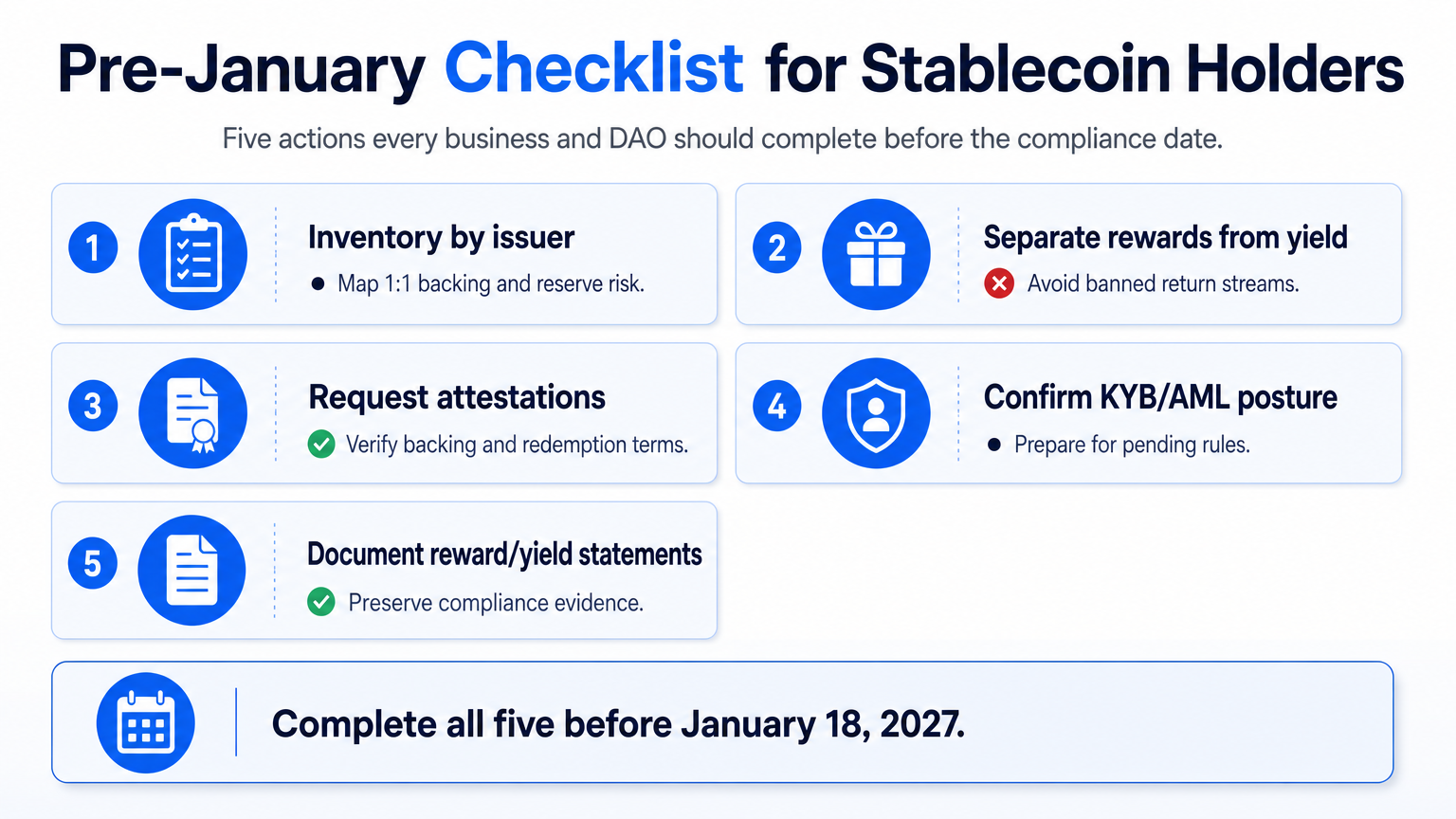
What should companies and DAOs do before January 18, 2027?
The compliance date is a deadline for issuers, but non-issuer businesses and DAOs should use it as a forcing function to make sure their stablecoin holdings and platforms do not leave them holding a product that cannot legally survive.
Reassess your stablecoin treasury mix
Segment every stablecoin position by issuer, chain, reward terms, and redemption rights. If a position currently earns yield from an issuer, assume that yield goes to zero. If it earns usage-based rewards, document the terms and the provider’s legal analysis. Stress-test what happens if redemption takes two days, not instant, and if one issuer’s reserve composition changes.
Verify your banking/crypto platform's compliance posture
Ask your banking or payments provider:
- Is it a bank, a fintech, or both?
- Who provides the underlying bank accounts?
- Are crypto custodians using qualified custody or reserve assets?
- What KYB and transaction-monitoring checks are in place?
These questions matter now because the pending AML and sanctions rules will eventually tighten the operational perimeter.
Where a compliant fiat-crypto platform like OneSafe fits
OneSafe is a financial technology company, not a bank. Banking services are provided through partners. It offers fiat and crypto rails — including USDC deposits and withdrawals at no fee, ACH, wires, bill payments, and on/off-ramps — with digital asset custody secured on Fireblocks and mandatory multi-factor authentication. Onboarding is typically completed within a week. For a DAO stablecoin treasury, OneSafe can reduce operational complexity by keeping fiat and crypto in one interface with customizable roles and permissions. That does not replace issuer-level due diligence, but it gives treasury teams a crypto-friendly business banking layer that can document its own KYB and custody posture, useful when AML rules tighten.
Document rewards, yield expectations, and redemption rights
Keep a dated record of what you were told about rewards, yield, and redemption. If a provider later changes terms or a product is reclassified, this documentation protects the business. The record should name the issuer, the platform, the date of any representation, and the specific reward or yield terms.
Here is a practical pre-January checklist for non-issuer stablecoin holders:
| Action | Why it matters | When |
|---|---|---|
| Inventory stablecoin holdings by issuer | Identify 1:1 backing and reserve exposure | Before Jan 18, 2027 |
| Separate usage rewards from issuer yield | Avoid relying on a banned return stream | Before Jan 18, 2027 |
| Request reserve attestation and redemption terms | Verify backing and liquidity | Ongoing |
| Confirm KYB/AML posture of banking and custody partners | Prepare for pending AML rules | Before Jan 18, 2027 |
| Document any reward or yield statements | Preserve compliance evidence | Before Jan 18, 2027 |
What to watch next and open questions
Pending AML and sanctions rules
KuCoin reports that AML and sanctions requirements are still pending. That is the largest unfinished piece. Businesses should expect additional rulemaking that may impose transaction monitoring, suspicious activity reporting, or sanctions screening obligations further down the stack. The comparison with the UK’s DeFi AML trajectory is instructive; see UK DeFi Compliance Rules: FCA Drafts New AML Guidance.
Will banks and crypto firms resolve the rewards dispute?
The OCC’s decision did not settle the conceptual fight. Banks will keep pressing that balance-linked rewards are deposit-like; crypto firms will keep testing the outer edge of “usage-based” rewards. Enforcement actions or follow-up guidance will define the line, but that could take years.
How international coordination could change your operations
MiCA is in force, the UK is drafting AML guidance, and the US is layering a federal framework on state rules. Companies operating across the US, EU, and UK should avoid building treasury workflows around any one jurisdiction’s assumptions.
Key Takeaways
- The OCC finalized the GENIUS Act stablecoin regulation on October 22, 2026; the rules take effect January 18, 2027.
- The final rule drops proposed stablecoin rewards curbs but keeps the issuer yield ban, leaving a compliance gray zone between usage rewards and balance-based return.
- Stablecoins must be backed at least 1:1 while issuers gain more reserve flexibility, so treasury due diligence should focus on reserve composition and redemption terms.
- Businesses and DAOs should reassess their stablecoin positions, verify their banking and custody partners’ compliance posture, and document rewards, yield expectations, and redemption rights before the effective date.
- AML and sanctions requirements are still pending, and the bank–crypto fight over rewards remains unresolved.
For a single platform that bridges fiat and crypto operations without losing the compliance trail, sign up for OneSafe and bring your treasury workflows up to date before January 18, 2027.