Mastercard’s stablecoin security API launched October 22, 2026, for real-time scoring of stablecoin payments. For finance leads, it’s a compliance shift.
Table of Contents
- What Just Happened
- Which Stablecoins and Blockchains Are Covered by This Security Layer?
- Why This Matters Now for Businesses Using Stablecoin Payments
- The Bleeding‑Edge Infrastructure
- Concrete Implications for Global Operations
- What to Watch Next
- Key Takeaways
- Sources
What Just Happened
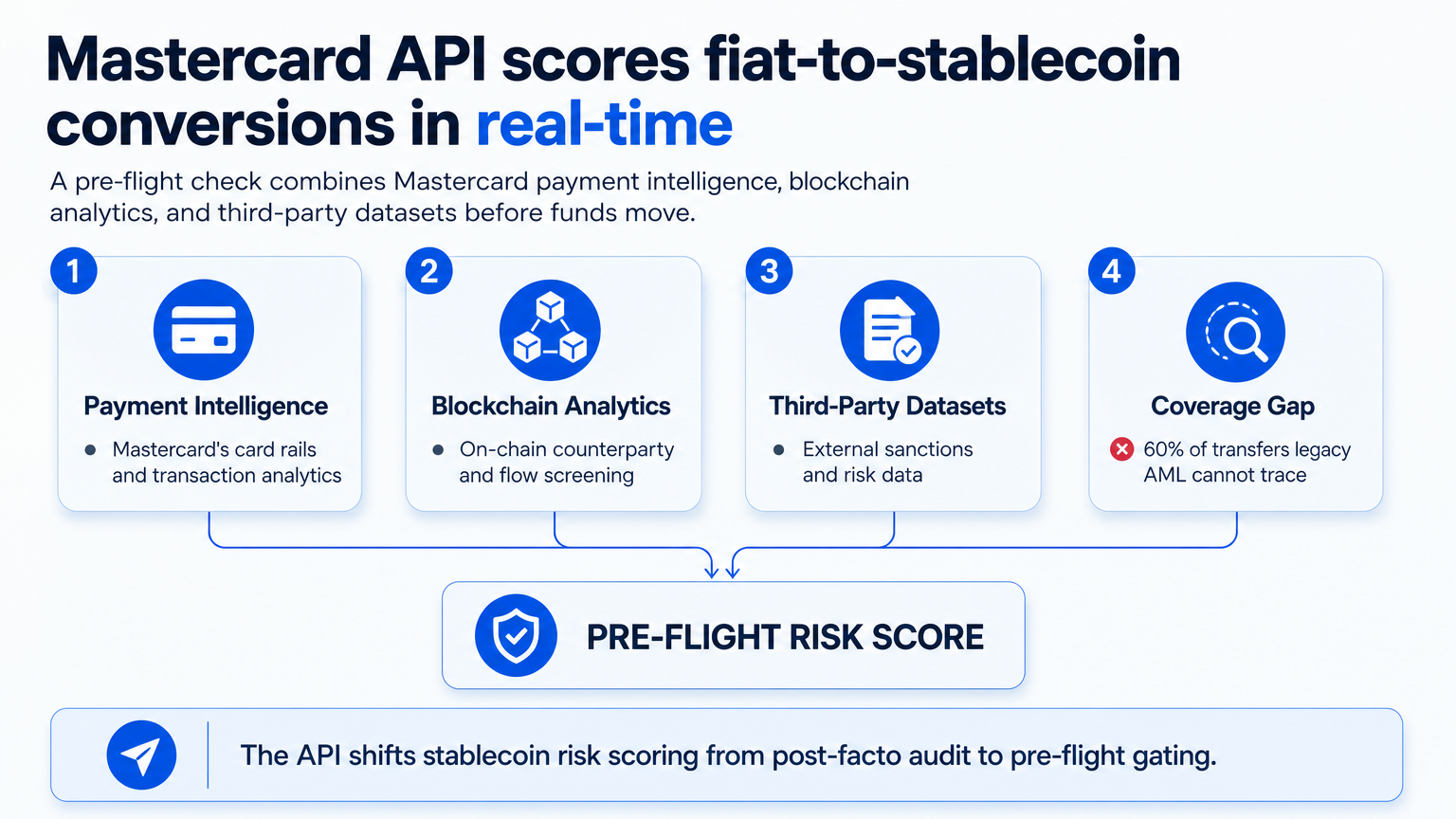
Mastercard’s Stablecoin Security API, unveiled on October 22, 2026 (Simply Wall St.), provides real‑time risk scoring for fiat‑to‑stablecoin transactions—the moment a fiat leg is about to convert into a stablecoin. It combines Mastercard’s payment intelligence, blockchain analytics, and third‑party datasets to assess counterparty and transaction flow before funds move.
The tool is platform‑agnostic: a bank, processor, or treasury platform can plug it into its stack and run “pre‑flight checks” without dictating which blockchain or stablecoin is used. TechTimes reported that the API targets an estimated 60% of stablecoin transfers that legacy AML systems cannot trace, highlighting the gap it intends to close.
Which Stablecoins and Blockchains Are Covered by This Security Layer?
Mastercard has not disclosed an exact list. The API is designed as platform‑agnostic and works across multiple blockchains. Given the product’s positioning, it likely supports major stablecoins like USDC and USDT on Ethereum, Solana, and other widely used chains. The emphasis is on being a risk‑intelligence layer that sits above any specific ledger or asset, rather than a closed‑garden solution.
Why This Matters Now for Businesses Using Stablecoin Payments
How Real‑Time Risk Scoring Affects Fiat‑to‑Stablecoin Payments
Today, compliance for a fiat‑to‑stablecoin conversion typically relies on onboarding checks and batch screening of wallets. Mastercard’s API inserts a split‑second risk assessment at the moment of conversion—the precise point where fiat touches the stablecoin leg. This shifts stablecoin security risk scoring from post‑facto audit to inline gating, giving CFOs fewer frozen accounts and a cleaner audit trail.
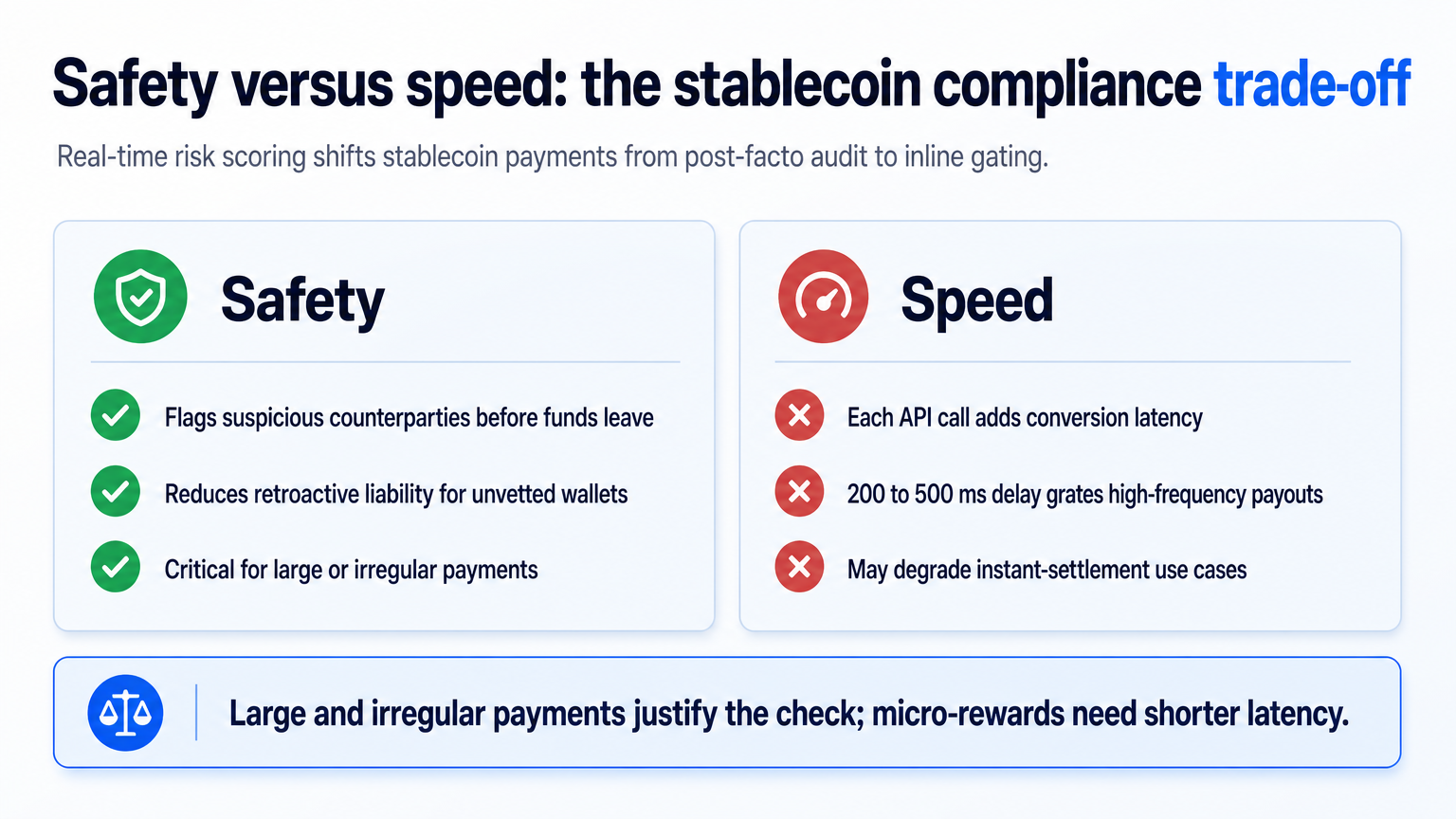
Safety vs. Speed
Safety: Real‑time screening flags suspicious counterparties before funds leave the fiat account—crucial for business stablecoin settlement with unvetted wallet addresses. It reduces retroactive liability.
Speed: Each API call adds latency. For high‑frequency, low‑value payments (e.g., streaming payroll), even a 200‑500 ms delay may grate. Mastercard hasn’t disclosed adjustable thresholds, but most such APIs allow dialing rigor up or down. The trade‑off: safety justifies the milliseconds for large or irregular payments, but could degrade instant‑settlement use cases.
The Startup and DAO Angle
A crypto‑native startup using a platform like OneSafe for stablecoin treasury management might view the API as a welcome compliance shield—particularly if banking partners require enhanced monitoring. For a DAO paying contributors in USDC, a pre‑flight check that blocks a sanctioned wallet is lightweight insurance.
But if the API becomes a non‑negotiable requirement from a partner bank, stablecoin onboarding risk rises: a business might be denied a payment because of a black‑box risk score it can’t appeal, locking lean teams out of critical flows.
The Bleeding‑Edge Infrastructure
Stablecoin payments already offer faster, cheaper settlement than correspondent banking. Stripe supports USDC payouts, Visa settles in USDC on Ethereum and Solana, and Paxos provides white‑label stablecoin infrastructure. BVNK integrates stablecoin rails into banking apps, and Mastercard’s own Global Money Platform anchors the shift.
However, most offerings treat compliance as a separate module, not an embedded real‑time layer. Mastercard’s API bridges the divide: it commoditizes blockchain analytics for payments, making it available at the point of conversion for both on‑chain‑native and wrapper‑based operators.
Concrete Implications for Global Operations
Plugging Into Existing Workflows
For a treasury platform, adding the API is a middleware decision: call it before a fiat‑to‑stablecoin conversion, receive a score, then proceed, hold, or request verification. Integration is non‑trivial; it must not break the “instant” experience.
For a platform like OneSafe—which already handles KYB, Fireblocks‑based custody, and post‑facto transaction monitoring—the API could be an optional add‑on for high‑value wires.
How Existing Platforms Handle Compliance Today
Most business‑grade platforms handle compliance through:
- Rigorous onboarding (business documents, ID, EIN)
- Custodial controls (Fireblocks, MFA)
- Post‑facto transaction screening
The missing piece is a real‑time, pre‑flight risk score. Mastercard’s API would complement static onboarding guardrails with a dynamic check before settlement.
Recommended Actions for Finance Leads
- Map exactly where fiat converts to stablecoins in your flows. That’s where the risk score would sit.
- Decide on risk tolerance: large, infrequent payments may not need it; high‑volume, multi‑counterparty flows benefit most.
- Simulate latency. Even 300 ms matters for high‑frequency use; test how the API responds and whether you can degrade gracefully.
- Watch the regulatory push. The OCC’s Genius Act framework emphasizes real‑time compliance; early adoption may smooth future bank partnerships.
What This Means for DAOs and Crypto‑Native Startups
For DAOs, a fiat on‑ramp integrated with the API can screen contributor wallets before conversion, reducing the risk of an OFAC‑related freeze. Startups using a unified platform like OneSafe gain an institutional‑grade compliance layer without a full‑time officer.
Trade‑Offs: Risk Checks vs. Speed
Yes, trade‑offs are prominent. For millions in a single wire, the seconds are negligible. For micro‑rewards every few seconds, the accumulated latency breaks experience. Black‑box risk scores also raise transparency concerns—an incorrect flag can halt payment with no clear reason. Smart implementation would toggle scoring depth by payment type, amount, and counterparty risk.
What to Watch Next
Will Visa, Paxos, or Stripe Counter?
Visa and Stripe have deep blockchain analytics partnerships. A response with their own pre‑flight tools, or bundled into existing settlement APIs, seems likely in 3‑6 months.
Does This Accelerate Mainstream Stablecoin Settlement?
For traditional institutions, the API directly addresses risk concerns that have held them back—likely accelerating adoption. For crypto‑native users who already found settlement fast enough, the added check feels like friction only if forced as a mandatory gate. Voluntary, configurable adoption keeps speed for most users.
The Regulatory Shadow
With the OCC’s framework demanding robust compliance, private risk scores could become de facto standards. If Mastercard’s API denies a transaction without appeal, regulators may push for transparency. Finance leads should treat the API as one input, not the sole arbiter, and keep meticulous override records.
Key Takeaways
- Mastercard’s Stablecoin Security API delivers real‑time risk scoring at the fiat‑to‑stablecoin conversion point, shifting compliance from post‑facto to pre‑flight.
- For large or irregular stablecoin payments, it reduces counterparty risk and eases banking relationships but adds latency and third‑party dependency.
- Startups and DAOs benefit most when the API is optional and integrated into their existing neo‑banking stack—not forced as a non‑negotiable gate.
- Platforms like OneSafe already provide strong onboarding and custody; the API complements with dynamic scoring for high‑value flows.
- Voluntary, configurable adoption preserves speed while the regulatory environment likely pushes toward mandatory use—evaluate now, with an eye on transparency and appeals.
For businesses integrating stablecoin payments with a secure, compliance‑ready layer, see how OneSafe simplifies fiat and crypto operations in a single platform.
Sources