
The surprising part of onboarding checklist examples is that the longest checklist may be the least useful one. A widely used HR example contains at least 32 distinct items, from identity verification and payroll enrollment to equipment, access provisioning, training, and 30/60/90-day check-ins. That breadth proves onboarding is an operating control, not a welcome note, as shown in this employee onboarding process and checklist.
The right template depends on your entity structure, payment mix, governance model, and geographic footprint. The ten examples below are organized by operating model, with practical stages for documents, approvals, access, currencies, payment rails, and reconciliation. Use them as adaptable workflows, not forms to copy blindly. A long generic list can create friction, while a role-specific sequence can move a person, entity, or payment process toward independent execution.
Practical rule: Establish ownership and transaction controls before payment volume makes informal workarounds look permanent.
For employment-specific comparisons, you can also compare top PEO providers before deciding whether payroll, benefits, and compliance should sit inside your organization or with an external partner.
Table of Contents
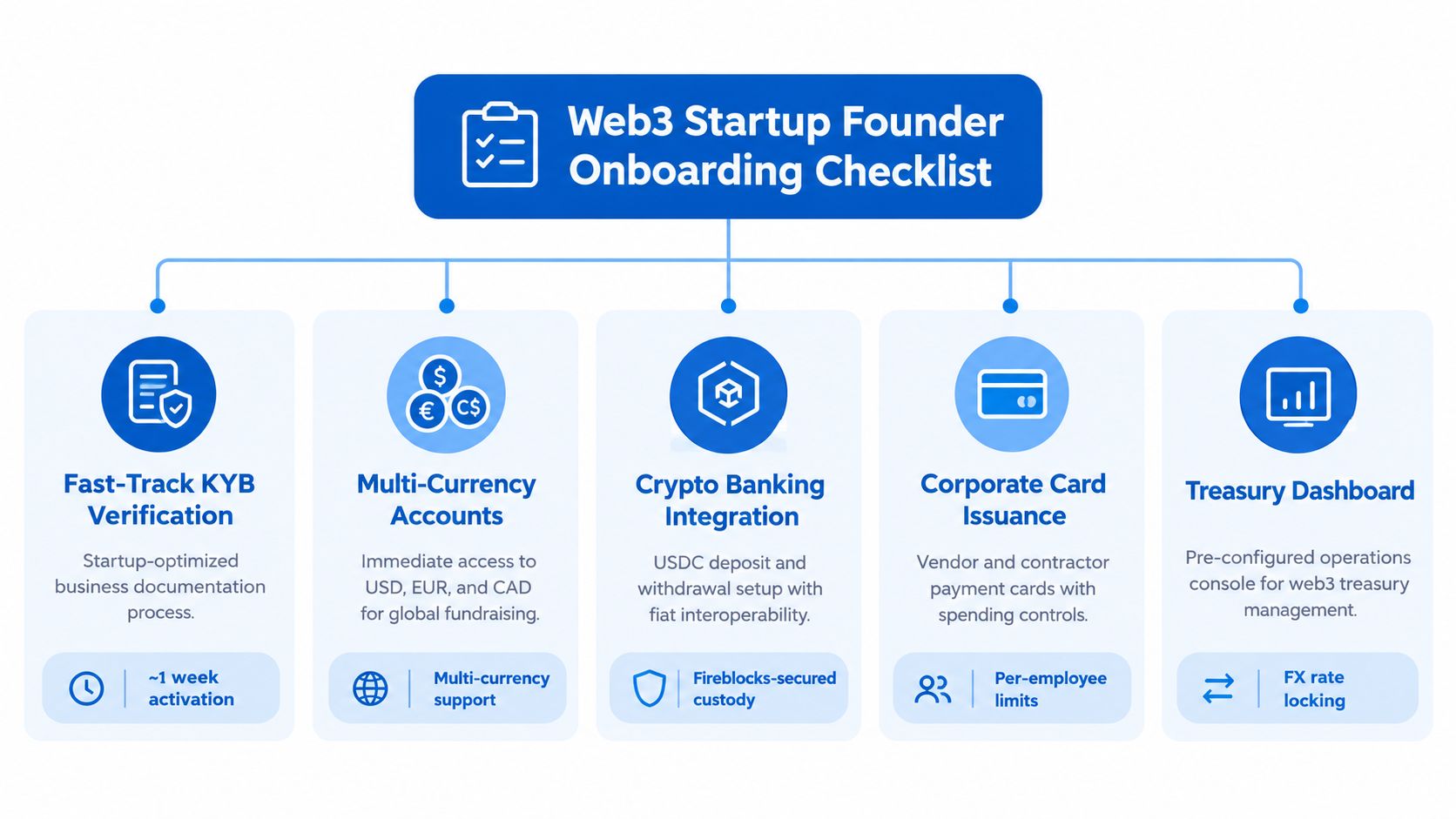
1. Web3 Startup Founder Onboarding Checklist
A web3 founder often needs to solve two problems at once: satisfy traditional KYB requirements and create a treasury that can handle fiat, crypto assets, and multiple currencies. A DeFi protocol preparing for launch, an NFT studio paying creators, or a Layer-2 company hiring international engineers shouldn't begin with wallets and cards alone. The founder needs a documented operating model for who can move funds, which rails are permitted, and how transactions will be monitored.
Pre-launch documents and account design
Prepare certified articles of incorporation, ownership records, identity documents, and a clear description of the business model before starting KYB. Explain the relationship between the legal entity, protocol, foundation, operating company, treasury wallet, and any parent organization. Ambiguous ownership or unexplained wallet activity can delay review.
A practical sequence looks like this:
- Define the entity: Record jurisdiction, legal name, business activity, and beneficial ownership.
- Separate responsibilities: Name the founder, finance operator, approver, cardholder, and technical treasury monitor.
- Map currencies: Decide which balances will support payroll, vendors, customer receipts, and crypto operations.
- Prepare access evidence: Store wallet ownership records, signer policies, and MFA enrollment confirmations.
- Plan monitoring: Configure webhook notifications after activation so treasury movements reach the responsible finance or security channel.
OneSafe's web3 financial services are relevant where the company needs a unified workflow connecting business accounts, payments, cards, and crypto-compatible activity. The founder should still document the control environment independently. A platform doesn't replace board authority, wallet governance, tax review, or internal approval policy.
First-week controls
Configure role-based card spending, conversion permissions, and transaction alerts before the first contractor invoice or launch expense. Where regular foreign-exchange activity is expected, OneSafe states pricing of 0.25% or the applicable FX rate, so the finance owner should record the expected conversion path and compare it with the company's treasury policy.
The checklist is complete when the founder can show who approved each payment, which account funded it, and where supporting evidence is stored.
2. DAO Treasury Operations Onboarding Checklist
A DAO treasury needs governance before convenience. Community funds, grants, contributor payments, and infrastructure expenses can move through different approval paths, so a single “treasury manager” permission is usually too broad. A Uniswap-style protocol, a Gitcoin-style grants organization, or a DAO paying node operators globally should convert its constitution into an operational hierarchy.
Governance before transactions
Start by translating governance language into payment rules. Define treasury managers, approvers, spenders, signers, and observers. Then record the wallet address associated with every role in the DAO handbook. This reduces knowledge concentration and gives contributors a shared reference when personnel or delegates change.
Use separate approval lanes for routine operations, budgeted initiatives, and exceptional spending. The DAO may permit direct execution for low-risk recurring expenses, require designated approvers for planned operating costs, and reserve governance votes for major or unusual transfers. The exact thresholds should come from the DAO's constitution and treasury policy, not from a generic template.
Payment workflow and evidence
Use financial services for DAOs where a DAO needs operational payment workflows alongside crypto activity. Corporate cards can handle recurring hosting, software, and infrastructure costs without forcing a new governance action for every subscription, provided the policy authorizes those payments and the cards carry appropriate limits.
Assign one person to produce monthly treasury reconciliation, another to review it, and a governance forum to receive the report. Export APIs can support the evidence trail, but the DAO should retain proposals, approvals, invoices, wallet confirmations, and exception notes together. The useful checklist isn't merely “funds sent.” It records why the payment was allowed, who executed it, and how the community can verify the result.
3. International Remote Team Payroll Onboarding Checklist
Global payroll fails when finance treats every worker as the same type of payee. A distributed Ethereum studio, an AI startup with employees and contractors, and a gaming company with teams across regions may need different documents, currencies, withholding rules, and approval paths for each worker.
Build the worker record first
Create an onboarding form that captures worker classification, country, legal name, tax information, invoice requirements, preferred currency, payment rail, and manager. Store country-specific withholding instructions in the payment template rather than relying on memory. Local employees, independent contractors, and crypto-paid contributors should have visibly different workflows.
Group payroll batches by currency where that matches the company's banking and reconciliation process. For example, keep EUR payments together for EU workers and CAD payments together for Canadian staff. This makes currency review easier and gives finance a clear record of which conversion or settlement supported each payroll run.
A remote payroll checklist should also include:
- Approval ownership: Assign manager review for team expenses and finance approval for higher-value payments.
- Card alternatives: Consider cards for approved operational spending where a wire would create unnecessary friction.
- Crypto invoicing: Offer a documented web3 invoicing path for eligible crypto-native contractors.
- Exception handling: Require written approval for changes to bank details, wallet addresses, classification, or payment currency.
Remote execution controls
Publish one place for payroll questions, define cutoff dates internally, and make the first payment a verification event. Confirm recipient details through an approved channel, keep evidence of the review, and separate payment preparation from release authority.
The checklist should extend beyond setup. Schedule recurring reconciliation for payroll liabilities, withholding, card transactions, and failed payments. Remote teams need fewer assumptions, not more software. A clear owner, a repeatable batch process, and a documented correction path are more valuable than a long list nobody reviews.
4. Cross-Border SME Expansion Onboarding Checklist
International expansion starts with a legal and cash-flow map, not a new account. A US SaaS company opening EU operations, a Canadian e-commerce company entering the US, and a UK fintech serving several EMEA markets may each need local registration, regional hiring, vendor settlement, refunds, and separate management reporting.
Establish the local operating picture
Before onboarding the financial platform, confirm the target subsidiary or branch, its ownership, business activity, directors, beneficial owners, expected transaction types, and countries of counterparties. Prepare incorporation records and ownership evidence so KYB reflects the actual group structure.
Create separate cost centers for each currency and geography. That lets finance attribute local payroll, vendor expenses, refunds, card spending, and conversions to the correct operating unit without rebuilding the P&L from bank statements. The cost-center design should match the reporting package used by management and the parent company.
A practical market-entry sequence is:
- Register the operation: Complete the target-country entity or branch requirements.
- Define local payments: List payroll, vendors, tax, refunds, and customer-receipt flows.
- Assign authority: Name a regional approver and a parent-company reviewer.
- Open currency paths: Create the balances needed for local settlement and central treasury.
- Document intercompany transfers: Record purpose, approval, supporting documents, and reconciliation treatment.
Consolidate without hiding local responsibility
Multi-currency accounts can reduce the need to maintain separate banking relationships, but they don't remove local compliance obligations. Finance should reconcile each currency separately, then document inter-subsidiary settlement into the group view.
Corporate cards may help with local vendor relationships and routine operating spend. Restrict them by subsidiary, currency, merchant category, and approver. The best checklist preserves local accountability while giving the parent company consolidated visibility.
5. Cryptocurrency Payment Processor Onboarding Checklist
A crypto payment processor has a different first question from a normal merchant. It must decide not only how to receive money, but also how to manage asset exposure, conversion timing, custody, reconciliation, and customer communication. A SaaS plugin accepting USDC, an asset platform converting receipts into EUR for payroll, and an NFT marketplace receiving ETH and USDC all need an explicit settlement policy.

Separate receiving, conversion, and settlement
Create receiving wallets or addresses by customer segment where that improves reconciliation. For example, B2B receipts and consumer receipts may need separate identifiers, ledgers, or review queues. Connect every receipt to an order, invoice, customer record, or exception case.
Then define when the business converts crypto to fiat. Some companies may convert routinely to protect payroll and vendor obligations. Others may retain an approved operating balance and convert only when a treasury condition is met. An automated conversion rule can be useful, but it should include directional controls, review permissions, and an exception path for unusual market conditions.
Make the customer-facing procedure explicit
Document the settlement sequence in language customers and vendors can understand. State which assets are accepted, how confirmations are handled, when conversion occurs, what currency the recipient receives, and how failed or misdirected payments are investigated.
The finance owner should monitor exchange rates and record the rate, time, spread, and resulting balance for each conversion. OneSafe lists free USDC deposits and withdrawals among its platform capabilities, but the company should still review the total cost of its chosen payment route, including conversion, card, wire, and operational reconciliation costs. A crypto processor checklist is complete only when the ledger can explain every asset movement.
6. Newly Incorporated Offshore Entity Onboarding Checklist
An offshore entity may be legally incorporated before it is operationally usable. A Cayman Islands fund, a BVI holding company, or a Panama-incorporated fintech still needs a complete ownership chain, a credible business explanation, authorized users, intercompany procedures, and a payment policy that matches its parent organization.
Prepare the ownership chain
Gather certified incorporation records, amended or restated bylaws where applicable, director information, identity documents, and beneficial ownership evidence. If a US company owns the offshore entity, document the relevant US parent ownership details rather than presenting the offshore company as an isolated applicant.
Describe expected activity in operational terms. Explain whether the entity will receive investor capital, pay vendors, distribute funds to limited partners, hold intellectual property, consolidate subsidiaries, or fund a global operating company. KYB reviewers need a coherent connection between the legal structure and the projected transaction activity.
Connect the new entity to group finance
Write intercompany payment procedures before account activation. Specify who can request a transfer, who approves it, what evidence is required, how the recipient entity records it, and how both sides reconcile the balance. Separate accounts by subsidiary when a holding company, operating company, and investment vehicle have distinct purposes.
Use a short control register:
- Authority matrix: Match board, director, CFO, and finance-manager permissions to governing documents.
- Beneficial ownership file: Keep the ownership chart and supporting records current.
- Payment purpose codes: Require a purpose for capital contributions, loans, reimbursements, distributions, and vendor payments.
- Exception log: Record unusual counterparties, urgent transfers, and policy overrides.
- Review cadence: Assign a recurring owner for account access, documents, and intercompany reconciliation.
The offshore checklist shouldn't promise frictionless access. It should make the structure understandable, support transparent review, and prevent the new entity from becoming a disconnected cash account.
7. Corporate Card Program Launch Onboarding Checklist
A corporate card program can improve payment speed while creating a new control surface. The risk isn't the card itself. It's issuing cards without role-based limits, merchant restrictions, receipt ownership, or a reconciliation process that finance can enforce.
A scaling SaaS team may need different permissions for engineers, managers, sales, operations, and finance. A web3 startup may use cards for contractors or influencers rather than repeated wires. A staffing agency may need regional cards in EUR and USD. Each use case should begin with a written spend policy.
Configure cards around responsibility
Start with the role, not the employee's request. Define which merchants a cardholder can use, whether recurring subscriptions are allowed, which currencies are supported, and who approves exceptions. Pre-approved vendors can reduce repetitive reviews, while unknown merchants should route to an authorized approver.

Make reconciliation someone's job
Assign department heads or budget owners responsibility for categorizing transactions and attaching receipts. Finance should review completeness, investigate exceptions, and reconcile the card ledger with accounting records on a recurring schedule.
Useful launch controls include:
- Merchant controls: Disable categories that don't fit the role and enable only those needed.
- Budget ownership: Tie each card to a department, subsidiary, project, or grant.
- Policy exceptions: Require written approval before a limit or merchant restriction changes.
- Access lifecycle: Suspend cards when a worker changes role or leaves.
- Spend analysis: Review merchant categories to identify duplicate tools, unused subscriptions, or policy gaps.
Don't treat transaction data as a report generated after the fact. It should inform budget decisions and expose where the policy doesn't match how teams work. A card program is operationally sound when cardholders understand their limits and finance can trace each charge to a business purpose.
8. Venture-Backed Startup Financial Operations Onboarding Checklist
Institutional capital changes the standard for financial operations. A venture-backed SaaS company hiring across countries, a crypto startup managing fiat and digital-asset funding, or a fintech preparing for investor scrutiny needs more than a bank account and an expense spreadsheet.
Set governance before scale
Write the finance handbook before the finance team becomes larger. It should define approval authority, budget limits, wire release rules, card usage, FX conversions, policy exceptions, and evidence retention. Keep operating cash distinct from investor capital when that separation improves reporting and makes the source and use of funds easier to explain.
Create a monthly reporting package that covers cash position, budget variance, payroll reconciliation, vendor obligations, and unresolved exceptions. A board dashboard can draw from account and payment data, but the finance owner must validate the numbers and explain material changes in plain language.
The checklist should identify:
- Cash owners: Who prepares forecasts, approves transfers, and releases payments.
- Account purpose: Which account supports payroll, vendors, tax, capital, or restricted activity.
- Reporting evidence: Where invoices, approvals, contracts, and reconciliation files live.
- Cross-border treatment: How conversion rates, fees, and settlement timing enter the books.
- Board visibility: Which metrics and exceptions require escalation.
Build for the next review
Startups often postpone controls because the finance function is small. That trade-off creates avoidable cleanup when investors, auditors, lenders, or strategic partners request historical evidence. A lightweight policy with clear ownership is better than an elaborate system nobody follows.
If a unified platform connects accounts, cards, payments, and crypto workflows, document the exact controls being used rather than describing the platform as the control itself. Finance remains accountable for approvals, reconciliations, and reporting integrity.
9. Global Contractor and Freelancer Payout Onboarding Checklist
Contractor payments should be easy for the recipient and controlled for the payer. A design agency paying freelancers across the US, EU, and Latin America, a protocol paying open-source contributors in USDC, and a content platform mixing fiat and crypto payouts all need a reliable invoice-to-payment path.
Begin with one contractor form that captures legal identity, classification, tax information, invoice frequency, preferred currency, bank details, and wallet details where relevant. Give the contractor clear instructions for changing payment information. A new wallet address or bank account should never be updated solely from an unverified email request.
Create payment lanes
Use separate lanes for recurring contractors, one-time vendors, and crypto-native contributors. Recurring invoices can follow a standing approval rule when the amount and scope remain consistent. One-time invoices should require contract or work-order evidence, while crypto payments need wallet verification and transaction references.
A practical operating list includes:
- Payment options: Offer USD wire, EUR wire, CAD wire, and an approved USDC wallet path where suitable.
- Invoice rules: State required fields, currency, service period, and supporting documentation.
- Batching policy: Choose a recurring processing cadence that balances recipient expectations with transaction costs.
- Tax review: Document country-specific obligations and the company's reporting responsibility.
- Failed-payment process: Define who contacts the contractor, corrects details, and records the resolution.
Paying international contractors can be relevant for companies that need fiat and web3 invoicing options in one operating workflow. The platform choice doesn't remove classification or tax obligations. Finance should have counsel review the contractor model, especially where workers operate across borders or resemble employees.
The best checklist gives contractors visibility into status without giving every requester permission to alter payment records.
10. Financial Services Compliance and Audit Readiness Onboarding Checklist
Compliance onboarding starts with an evidence map. A crypto exchange, fintech lender, or stablecoin issuer must show who initiated a transaction, who approved it, which policy applied, and how exceptions were handled. The sequence should connect each control to evidence before the account or payment workflow goes live.
Map controls to evidence
List requirements from the applicable compliance program, audit scope, banking partner, or institutional agreement. Assign each requirement to a system record, document, approval log, reconciliation file, or external integration. If the selected platform cannot produce a required record, set up a compensating control and assign its owner before launch.
Use transaction categories that match the organization's risk framework. Categories can cover suspicious activity, high-risk counterparties, customer refunds, treasury conversions, payroll, and intercompany transfers. They should help reviewers identify unusual activity and generate consistent reports, rather than only organizing the ledger.
Make segregation of duties explicit. The transaction initiator should not be its sole approver. Configure MFA, role-based access, documented approvals, and an escalation route for policy exceptions.
Schedule recurring reviews
Prepare recurring exports for transaction summaries, approver logs, exception reports, and reconciliation status. Retention periods vary by jurisdiction and regulator. Confirm the applicable requirement, commonly 5 to 7 years, with counsel and record it in the records policy.
An audit-ready onboarding file should contain:
- Control map: Requirement, owner, system evidence, and review frequency.
- Approval matrix: Initiator, reviewer, approver, and escalation authority.
- Counterparty taxonomy: Risk classification and required due diligence.
- Exception register: Description, decision, approver, remediation, and closure evidence.
- Reporting calendar: Owner and deadline for each recurring compliance output.
Compliance work continues after account activation. The company must reproduce the decision trail without reconstructing it from private messages. Schedule control reviews, test evidence retrieval, and record remediation when a workflow or approval path changes.
10-Point Onboarding Checklist Comparison
| Checklist | 🔄 Implementation Complexity | Resource Requirements | ⭐📊 Expected Outcomes | Ideal Use Cases | ⭐ Key Advantages / 💡 Tips |
|---|---|---|---|---|---|
| Web3 Startup Founder Onboarding Checklist | Moderate, fast-track KYB but needs full corporate docs; ~1 week | Certified articles, cap table, founder IDs; regional restrictions apply | Crypto-compatible multi-currency accounts, corporate cards, treasury live in ~1 week ⭐📊 | Early-stage crypto-native startups, DeFi/NFT studios, Layer‑2 teams | Unifies fiat+crypto; reduces onboarding friction. Tip: prepare certified docs; use ⚡ fiat↔crypto conversions |
| DAO Treasury Operations Onboarding Checklist | High, requires governance votes and multi-sig setup | DAO governance approvals, signer address mapping, multi-approver coordination | Transparent multi-sig treasury, audit trails, policy-based approvals ⭐📊 | DAOs managing grants/treasuries (Uniswap, Gitcoin, protocol DAOs) | Aligns with DAO governance; prevents unauthorized drains. Tip: define tiers and document signer mappings |
| International Remote Team Payroll Onboarding Checklist | Medium‑High, country-specific compliance and payroll configs | Country tax forms, contractor/employee banking details, payroll integrations | Automated multi-currency payroll; bulk processing; reduces time from days to hours ⚡📊 | Distributed tech teams, web3 orgs paying global contractors/employees | Speeds payroll and stabilizes FX. Tip: batch by currency and configure FX locking |
| Cross‑Border SME Expansion Onboarding Checklist | Medium, KYB per subsidiary and accounting integration | Subsidiary registration docs, KYB for each entity, accounting system integration | Instant multi-currency accounts and consolidated reporting; faster market entry ⭐📊 | SMEs expanding to EU/CA/US; SaaS/e-commerce entering new markets | Eliminates multi-bank onboarding delays. Tip: pre-register subsidiaries; set cost centers |
| Cryptocurrency Payment Processor Onboarding Checklist | Medium, custody and exchange integrations required | Fireblocks custody, exchange partners, crypto-fiat workflow expertise | Near‑instant crypto→fiat settlement; low processing costs; automated settlements ⚡⭐ | Exchanges, crypto payment gateways, NFT marketplaces | Zero-fee USDC and rapid settlement. Tip: auto-convert large balances; monitor spreads |
| Newly Incorporated Offshore Entity Onboarding Checklist | High, detailed offshore KYB and beneficial ownership mapping | Certified incorporation docs, ownership chains, tax advisor support | Operational offshore banking with regulatory-grade documentation; faster than typical offshore banks ⭐📊 | Cayman/BVI/Panama/Singapore funds, holding companies, offshore fintechs | Consolidates fragmented offshore banking. Tip: document full ownership chain; consult tax advisors |
| Corporate Card Program Launch Onboarding Checklist | Medium, policy design and bulk issuance (2–3 weeks) | Spending policies, merchant controls, accounting integration | Reduces expense reporting 60–80%; real‑time spend visibility; fraud controls ⭐📊 | Companies launching corporate card programs; distributed teams | Cuts reconciliation work and enforces policy. Tip: tiered limits and pre‑approved vendors; note 3% FX card fee |
| Venture‑Backed Startup Financial Operations Onboarding Checklist | Medium‑High, governance, investor reporting, controls | Investor reporting templates, payroll/cap table processes, transaction controls | Investor‑grade reporting, scalable payroll/treasury, audit trails for due diligence ⭐📊 | Series A/B startups scaling operations; fintechs/web3 with investors | Simplifies investor due diligence. Tip: separate operating vs investor capital; set monthly reports |
| Global Contractor and Freelancer Payout Onboarding Checklist | Low‑Medium, simple workflows; APIs for high volume | Contractor bank or crypto wallet details, tax forms; possible API integration | Faster contractor payouts (1 day), web3 invoicing option, lower fees for USDC ⭐⚡ | Agencies, platforms, web3 protocols paying many freelancers | Improves recruitment with fast pay. Tip: auto-approve recurring contractors; batch weekly to save costs |
| Financial Services Compliance and Audit Readiness Onboarding Checklist | High, tailored controls, long-term retention and monitoring | Compliance/legal team input, MFA/logging, record retention policies | Audit-ready controls; reduces audit timelines 30–40%; regulatory reporting capability ⭐📊 | Regulated fintechs, exchanges, firms preparing audits or institutional partnerships | Demonstrates strong risk management to regulators. Tip: map audit requirements to controls; retain records 7 years |
Turn the Template Into an Operating System
Choose one checklist based on the legal entity and operating model that will transact. A founder-led web3 company, a DAO, a remote payroll operation, an offshore holding company, and a contractor network may share tools, but they don't share the same approval logic or evidence requirements. Start with the nearest template, then remove tasks that don't apply and add the controls your legal, tax, security, and finance teams require.
Assign one accountable owner. That person should maintain the checklist, coordinate KYB, confirm beneficial ownership documents, collect contracts and tax records, configure user access, and schedule the first reconciliation. Don't distribute responsibility so widely that every team participates but nobody can say whether onboarding is complete.
The sequence across these examples is consistent:
- Start with identity and KYB: Establish the legal entity, ownership chain, business activity, and authorized representatives.
- Define access controls: Use MFA, least-privilege permissions, role-based cards, signer mappings, and scheduled access reviews.
- Connect payment rails: Map ACH, domestic wires, SWIFT, cards, fiat balances, crypto wallets, and invoicing paths to specific use cases.
- Document approval thresholds: Separate preparation, review, approval, and release, especially for treasury and regulated activity.
- Preserve evidence: Store invoices, contracts, identity records, approvals, wallet confirmations, conversion details, and exception notes together.
- Reconcile on a cadence: Review each currency, account, card, wallet, payroll batch, and intercompany balance on a recurring schedule.
- Review after launch: Examine failed payments, delayed approvals, unused permissions, unexpected fees, and recurring exceptions, then update the workflow.
Onboarding checklists often become too long because teams add tasks without removing obsolete ones. A widely used HR checklist can span compliance, IT, workplace setup, orientation, training, and early performance management, which is useful only when each task has an owner and a completion signal. For customer or product onboarding, the same discipline matters. A 2026 benchmark covering 188 B2B SaaS companies reported average checklist completion of 19.2% and median completion of 10.1%, according to the 2026 onboarding benchmark. Treat those figures as a warning against generic task overload, not as a target for finance operations.
Measure the funnel, not just the checklist. Track completion alongside activation and time-to-value, because an unchecked item can reveal the exact point where a user or operator stops progressing. Industry guidance places median B2B SaaS time-to-value at about 1 day 12 hours, and recommends pairing checklist completion with activation metrics in onboarding experience guidance. For a finance team, equivalent measures might be time from entity approval to first controlled payment, time from contractor submission to verified payout, or time from account activation to completed reconciliation.
Don't optimize for a full checklist if the completed tasks don't support safe independent execution. One onboarding case study found that users who completed a checklist converted at a rate 3x higher than users who didn't, illustrating why step-level completion should be connected to downstream adoption rather than treated as a vanity metric. The onboarding case study research recommends comparing step completion with activation and cohort retention to identify the tasks that matter.
Completion standard: A checklist is complete only when ownership, evidence, and review cadence are explicit.
Use OneSafe where its multi-currency accounts, global payments, corporate cards, crypto-compatible workflows, web3 invoicing, and team controls fit the operating model. Verify availability, partner-bank terms, fees, jurisdictional restrictions, and compliance requirements before committing critical treasury activity. A unified interface can reduce system switching, but governance still belongs to the organization.
Finish by turning the chosen template into a controlled operating document. Add the entity name, responsible owner, approvers, documents, payment rails, access rules, exception path, reconciliation schedule, and evidence location. Then run the workflow with a real low-risk transaction, review what failed, and update the checklist before the organization grows into the gaps.
OneSafe offers multi-currency business accounts, global payments, corporate cards, crypto-compatible workflows, and web3 invoicing for companies operating across borders and in web3. Use the checklist that matches your entity and payment model, then visit OneSafe to evaluate whether its account, card, approval, and fiat-to-crypto workflows fit your controls.