You've just received your first serious overseas order. The buyer wants the goods shipped before paying, while your team needs cash to purchase materials and cover freight. Neither side is being unreasonable. The buyer fears paying for goods that may arrive late or fail inspection, and you fear shipping valuable inventory to a company you barely know.
That tension sits at the center of payment methods in international trade. The payment method determines who carries the risk, when cash moves, what documents control the transaction, and how easily your finance team can reconcile the payment later. It also affects whether a deal feels commercially attractive to the buyer.
A small exporter might request cash in advance. A long-standing supplier may accept an open account. A bank can stand between unfamiliar parties through a letter of credit, while an escrow provider can hold funds until agreed conditions are met. Web3 businesses add further choices, including stablecoin settlement, smart-contract escrow, and fiat conversion workflows.
The right answer isn't automatically the fastest or cheapest rail. It's the method that gives both parties enough confidence, preserves working capital, limits fraud exposure, and leaves a clean record for accounting and compliance. This guide to international business payments helps frame that decision around the actual trade flow, rather than treating every cross-border payment as the same problem.
Table of Contents
- Introduction to Payments Methods in International Trade
- The three positions on the risk spectrum
- Why escrow feels different
Introduction to Payments Methods in International Trade
A useful way to think about the decision is simple: payment is a transfer of risk before it's a transfer of money. If the buyer pays before shipment, the seller has stronger protection, but the buyer carries more uncertainty. If the seller ships first and waits for payment, the buyer gains flexibility, while the seller finances the transaction.
This guide moves from that basic risk trade-off to practical rail selection. It covers cash in advance, open account terms, documentary collections, letters of credit, consignment, escrow, bank guarantees, factoring, and digital or crypto-based settlement. The aim isn't to declare one universal winner. Trade flows differ by relationship, product, corridor, value, urgency, regulation, and the quality of the payment data that reaches your ledger.
For an SME, the payment question might be, “Can I afford to wait for this invoice?” For an importer, it may be, “How do I avoid paying before I can verify the goods?” For a DAO or web3 company, the question may include wallet controls, stablecoin conversion, contractor verification, and an audit trail that works for both on-chain and fiat transactions.
Practical rule: Choose the rail that controls the most important risk in the transaction, not merely the rail that appears fastest.
International trade has no single dominant settlement pattern. An Oxford Economics review of trade payment practices summarizes a widely cited IMF-BAFT survey in which about 43% of global international transactions used post-shipment terms, 22% used pre-shipment terms, and 35% used letters of credit on average. The same review cites a SWIFT-based estimate placing letters of credit at around 13% of global trade, showing why businesses continue to use a mixture of open-account, documentary, and bank-supported structures.
How International Trade Payments Balance Risk and Trust
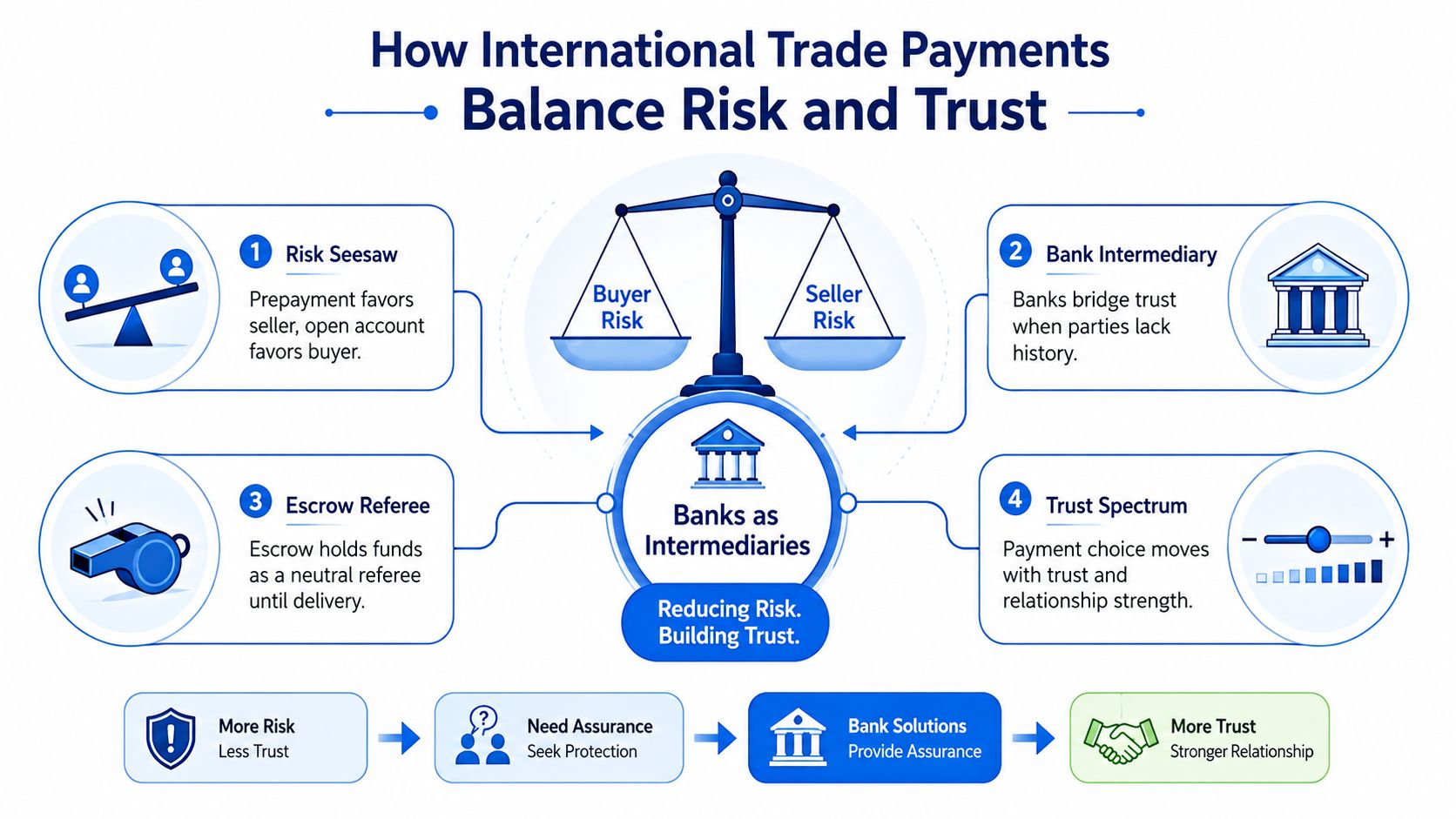
Start with a seesaw. One side holds buyer risk, and the other holds seller risk. Moving the payment date changes the balance.
If the buyer pays before shipment, the seller can fund production with less collection risk. The buyer, however, must trust the seller to produce and ship as promised. If the seller ships before payment, the buyer can inspect or receive the goods first, but the seller must wait and hope the invoice is paid.
The three positions on the risk spectrum
Most classic payment structures fit into three broad positions:
- Pre-shipment payment: The buyer pays before the seller ships. Cash in advance protects the seller's receivable, but it asks the buyer to trust performance before delivery.
- Post-shipment payment: The seller ships and invoices the buyer for later payment. Open account terms support the buyer's working capital but expose the seller to delay, default, and currency risk.
- Bank-supported settlement: A bank adds document handling, a payment undertaking, or a conditional guarantee. Letters of credit belong here, although the seller must still comply precisely with the stated conditions.
A bank doesn't remove every risk. It can verify documents, route funds, issue a commitment, or provide a guarantee, but the parties still need accurate commercial terms and reliable counterparties. A letter of credit, for example, generally depends on compliant documents. A bank may examine the paperwork rather than physically inspect the goods.
Why escrow feels different
Escrow works like a neutral referee. The buyer places funds with a third party, and the seller receives them when the agreed conditions are satisfied. Those conditions might involve delivery confirmation, an inspection result, approval of a milestone, or matching digital evidence.
That structure can reduce the trust gap without requiring the buyer to hand over money directly to an unfamiliar seller. It also creates a new operational requirement: both parties must define the release conditions clearly. Ambiguous instructions can leave funds frozen even when the commercial relationship is sound.
The global picture reinforces the same lesson. No single payment method dominates every trade relationship, because different corridors and counterparties need different balances of trust, control, liquidity, and cost. In merchandise trade, BIS payment-system material notes that SWIFT MT700 messages associated with letters of credit represented about 12% of world merchandise trade in 2020, while documentary collections represented just over 1%. Letters of credit provide stronger bank verification and payment commitment, while documentary collections can be cheaper and faster because banks exchange documents without guaranteeing payment.
Comparing Core Payment Methods and Their Trade Offs
The five classic methods form a practical ladder. Cash in advance gives the seller the strongest payment position. Consignment gives the buyer or distributor the most flexibility. The middle options exchange protection for competitiveness, simplicity, or working-capital access.
| Payment Method | Risk to Seller | Risk to Buyer | Cost and Speed | Best Use Case |
|---|---|---|---|---|
| Cash in advance | Lowest collection risk, because payment arrives before shipment | Highest performance and delivery risk | Often straightforward, but commercial friction can be high | New buyers, custom goods, or transactions where the seller can't resell the product easily |
| Letter of credit | Lower payment risk if the seller meets the stated documentary conditions | Lower delivery risk than prepayment, but the buyer funds a bank-supported process | More documentation and bank charges, with timing tied to compliant presentation | High-value shipments, unfamiliar partners, or higher-risk corridors |
| Documentary collection | Moderate, since the bank handles documents without guaranteeing payment | Moderate, because documents and payment steps are connected | Usually simpler and less expensive than an L/C, though the buyer may still refuse payment | Established relationships where both parties want document control without a full bank undertaking |
| Open account | Highest exposure to delayed payment, default, and liquidity strain | Lowest payment timing risk, since the buyer receives goods before paying | Operationally simple, but the seller waits for cash and may need financing | Trusted buyers, mature supply chains, or competitive markets |
| Consignment | Highest overall exposure, since payment depends on the distributor's resale | Very low inventory-payment exposure | Can support market entry, but cash timing is uncertain and stock remains exposed | Deeply trusted distributors, subsidiaries, or carefully controlled channels |
Cash in advance and open account
Cash in advance is a strong defensive choice when the buyer is unknown, the goods are highly customized, or the seller can't comfortably finance production. The commercial drawback is obvious: many buyers won't want to carry the full performance risk.
Open account terms reverse that position. The seller ships first and collects later, which can make the offer more competitive, but the invoice becomes an unsecured exposure. Export credit insurance, factoring, or a standby letter of credit can reduce that exposure without forcing the buyer into full prepayment.
Documentary collections
A documentary collection sits between a direct invoice and a letter of credit. Banks transmit the shipping documents and follow the agreed instructions, but they don't promise payment in the way an L/C does. Under documents against payment, the buyer pays before receiving the documents. Under documents against acceptance, the buyer accepts an obligation to pay later.
This method can fit an established partner that wants more structure than open account terms but doesn't need the cost and documentary precision of an L/C. It isn't a substitute for checking the buyer's willingness and ability to pay.
Letters of credit and consignment
A letter of credit can make an unfamiliar transaction more bankable, but the seller must treat the wording as an operating checklist. Product descriptions, dates, transport documents, insurance details, and presentation requirements need careful review before shipment.
Consignment takes the opposite path. The seller retains ownership while the distributor sells the goods, so the seller faces inventory, storage, damage, and resale uncertainty. It should be reserved for relationships where the distributor's controls and reporting are already well understood.
Modern Rails for Global Businesses Including Escrow and Digital Payments
Modern trade finance doesn't replace classic methods in every transaction. It adds tools that address specific weaknesses, such as a trust gap, a cash-flow delay, or fragmented fiat and crypto operations.
Match the tool to the friction
Escrow is useful when the buyer and seller need conditional release rather than unconditional prepayment. It can support physical delivery milestones or digital service acceptance. The agreement must specify who confirms completion, which evidence counts, and what happens when the parties disagree.
A bank guarantee supports the seller without necessarily requiring the buyer to move the full amount immediately. The bank promises payment if the buyer defaults under the guarantee's terms. That can preserve buyer liquidity while giving the seller a stronger fallback than a bare invoice.
Factoring addresses the seller's cash-flow problem. The business assigns or sells eligible receivables to a factor and receives cash earlier, subject to the factor's pricing and assessment. The seller should examine whether the arrangement is recourse or non-recourse, who manages collections, and how the buyer will perceive the assignment.
Forfeiting is designed for longer-dated receivables, often in capital-goods or structured trade. The seller converts future payment claims into current liquidity, while the financing provider evaluates the underlying obligation and relevant country or bank risk.
Digital and crypto settlement
Digital payment platforms can improve transfer visibility and automate reconciliation, but “digital” doesn't automatically mean low risk. Teams still need verified wallets, sanctions screening, approval policies, transaction monitoring, and a clear record of why funds moved.
Stablecoins can be relevant to web3 firms and DAOs because they support borderless settlement without requiring every contractor or vendor to use the same local banking rail. Yet the business must manage wallet security, issuer and platform exposure, conversion into fiat, tax treatment, and the possibility that a recipient still needs a bank transfer for expenses.
A unified platform such as OneSafe can provide multi-currency business accounts, international payment workflows, corporate cards, and crypto-compatible functions including USDC deposits and withdrawals and crypto-to-fiat conversion. For a business comparing cross-border payment workflows, the important test is whether the system preserves approvals, beneficiary records, conversion details, and ledger-ready remittance information across both fiat and digital transactions.
Speed matters, but it isn't the whole decision. The better question is whether the faster rail leaves your finance team with enough evidence to reconcile the payment and enough control to stop an unauthorized or misdirected transfer.
How to Choose the Right Payment Method for Your Trade Scenario
Begin with four questions:
- How well do you know the counterparty?
- Who can absorb a delayed or failed payment?
- What evidence should trigger release of funds?
- Which currency and settlement record does the finance team need?
The answers usually point to a method more clearly than a generic pros-and-cons list.
Four practical matches
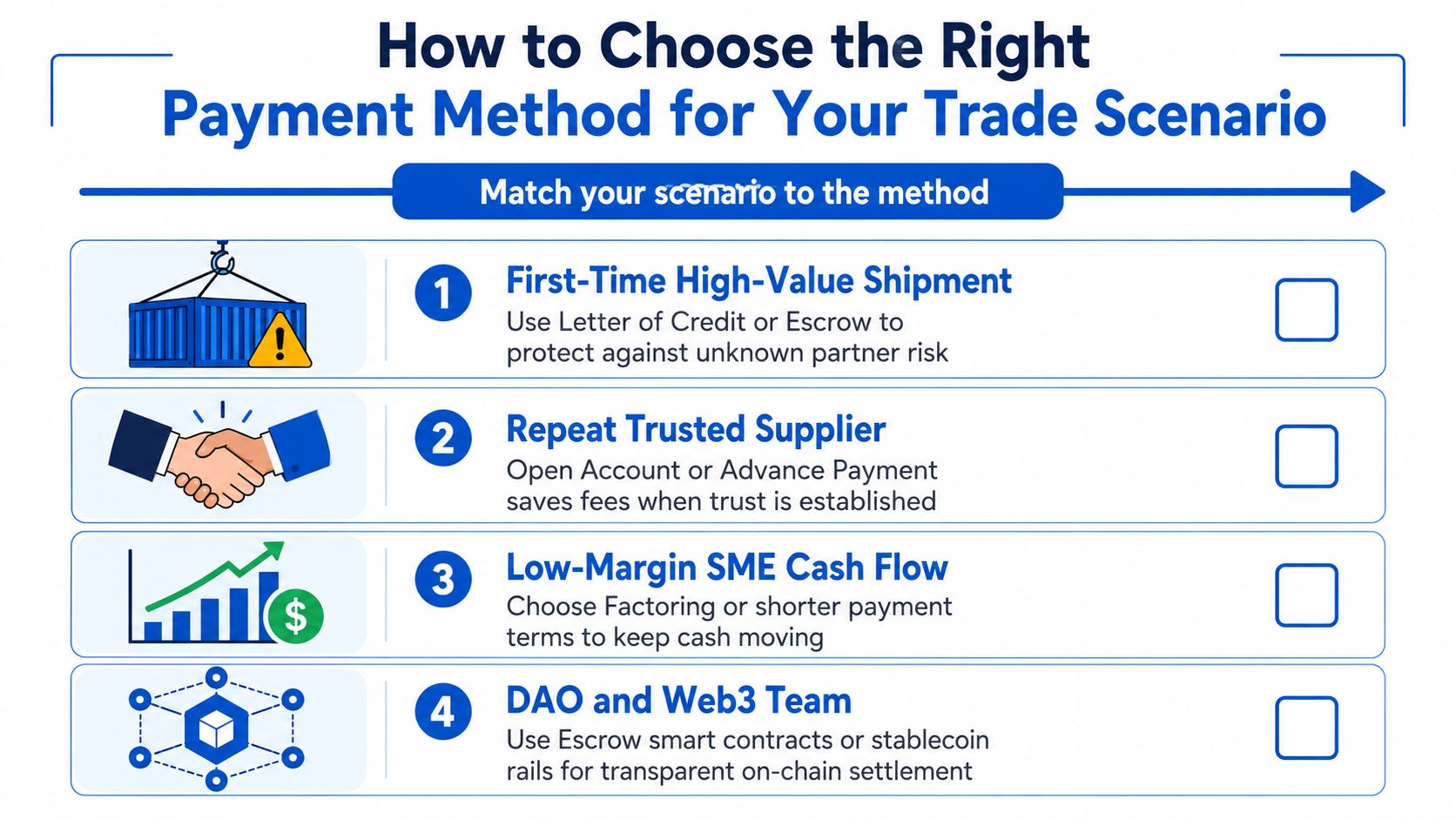
First-time, high-value shipment: Use a letter of credit or escrow when the relationship is new and a failed shipment would materially affect working capital. An L/C suits transactions where bank document control is valuable. Escrow may fit better when both parties can define objective delivery or inspection conditions without accepting the full burden of documentary credit.
Repeat supplier with proven performance: Open account terms can remove unnecessary processing when payment history is strong. A seller may also accept advance payment for selected orders when the administrative simplicity and cash certainty matter more than buyer financing.
Low-margin SME with tight cash flow: Consider shorter payment terms, factoring, or a structure that releases cash at defined milestones. The cheapest nominal rail can become expensive if the seller must borrow to fund production while waiting for an invoice.
DAO paying global contractors: Use an approval-controlled workflow that records the contractor, scope, wallet or bank details, currency, and payment evidence. Stablecoin settlement or smart-contract escrow may suit milestone-based work, but the DAO still needs an off-chain policy for disputes, conversion, and accounting.
For web3 organizations, the business account for international payments should be judged by how well it connects treasury policy to actual execution. A wallet transfer without beneficiary verification or a fiat payment without matching invoice data can create the same reconciliation problem in different technical clothing.
Decision test: If a payment fails, ask which loss would hurt more, losing the cash, losing the goods, losing time, or losing the audit trail. Select the method that limits that specific loss.
Best Practices to Reduce Cost Fraud and FX Risk in Execution
A seller receives an urgent email saying the buyer's bank account has changed. At the same time, the invoice is denominated in a foreign currency, and the payment provider shows one amount while the beneficiary expects another. The payment method was reasonable, but the execution controls were weak. Treat each transfer as a chain of identity, document, currency, approval, and reconciliation checks.
A 2025 cross-border payments survey by Visa found that fraud, data security, completion time, and limited visibility into FX rates and fees were leading concerns for sending and receiving businesses. The survey also reports that 58% of UK SMEs viewed paying international suppliers in local currencies as a headache, 53% identified international FX fees as a pain point, and 70% viewed hidden fees as a necessary evil. FX therefore belongs in the workflow, not only in the rate comparison.
Build controls around the payment event
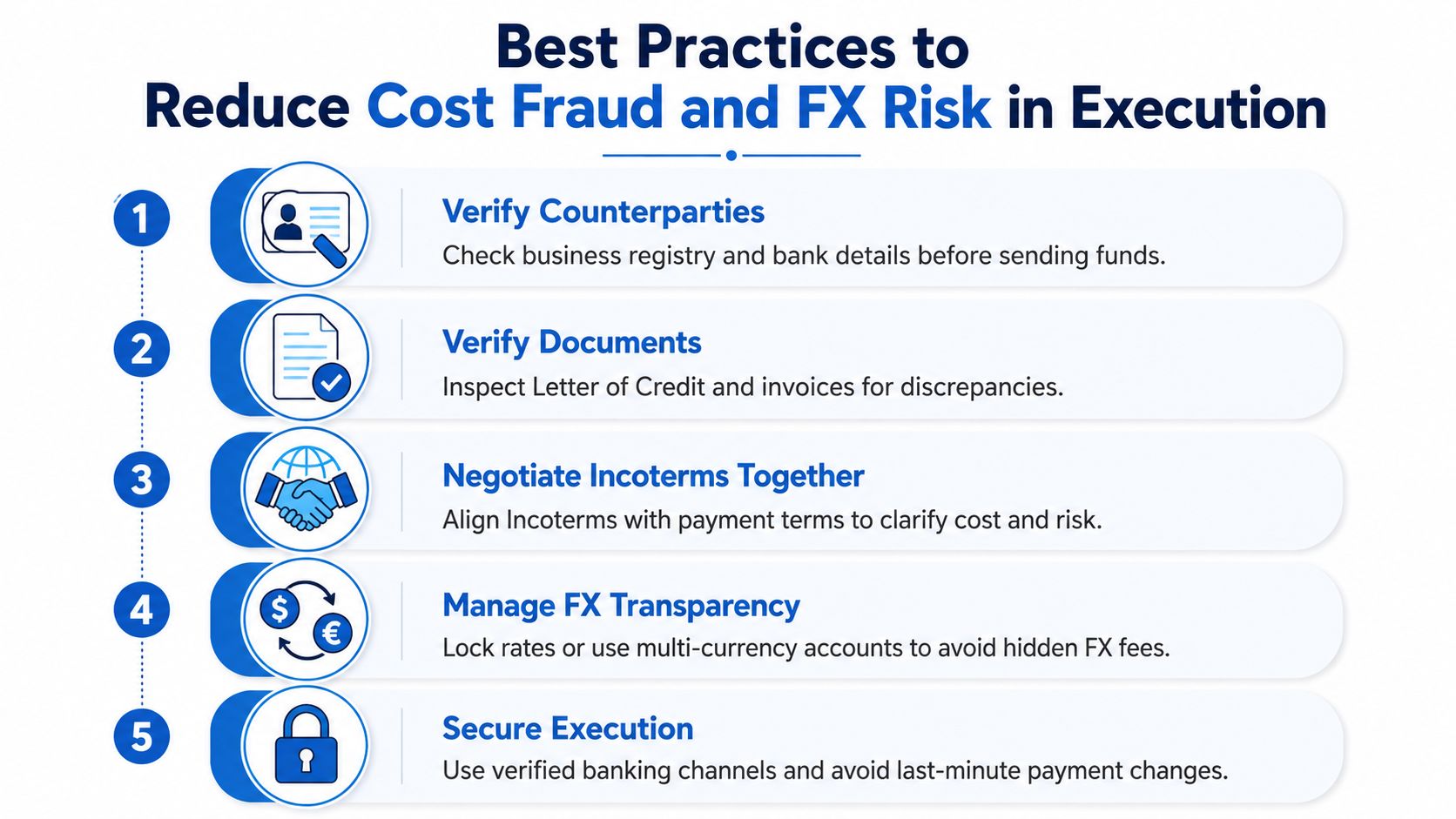
- Verify counterparties: Check the legal entity, trading history, beneficiary name, and bank details through an independent channel. A last-minute email change requires separate confirmation.
- Match documents: Compare the purchase order, commercial invoice, shipping documents, and payment instruction. For an L/C, treat each documentary condition as a required control point.
- Align Incoterms and payment terms: Incoterms set delivery responsibilities and risk transfer, while payment terms set cash timing. Negotiate both so freight, insurance, title, and funding obligations remain connected.
- Make FX visible: Record the agreed currency, conversion rate, spread, fees, settlement date, and amount the recipient should receive. Businesses handling tax and regulatory requirements can review VAT-compliant forex for SMEs before selecting a provider.
- Use layered approvals: Separate vendor setup from payment approval, apply spend limits, require extra confirmation for changed bank details, and keep wallet permissions narrow for crypto transactions.
A local-currency payment can reduce work for the recipient, but it does not remove the sender's checks. Confirm how the provider converts funds, whether intermediary charges apply, and whether remittance data will match the invoice in the accounting system.
Reconciliation should be designed before authorization. Put a stable invoice reference, legal entity name, purchase order, currency, and payment purpose in the record. A fast transfer without usable information can create manual investigation, duplicate-payment risk, and uncertainty about which obligation has been settled. For crypto or escrow workflows, preserve the wallet address, approval record, release condition, conversion details, and transaction hash alongside the commercial documents.
Conclusion and Next Steps for Secure International Trade Payments
The central lesson is straightforward: payment method selection is risk allocation plus reconciliation design. Cash in advance protects the seller but asks the buyer to trust performance. Open account supports the buyer but makes the seller finance and monitor the receivable. Documentary collections, letters of credit, guarantees, escrow, factoring, and digital rails each solve a different part of that problem.
Before accepting the next international order, write down the counterparty risk, shipment value, delivery evidence, cash-flow requirement, settlement currency, and information your ledger needs. Then choose the least complicated method that controls the most serious exposure. For a new corridor, that may mean an L/C or escrow. For a proven partner, open account may be commercially sensible. For a web3 team, stablecoin settlement may work when wallet governance, conversion, and documentation are designed together.
The payments ecosystem is becoming more interoperable, but more rails won't automatically create simpler operations. Research tracked by the BIS Committee on Payments and Market Infrastructures covers 82 jurisdictions, 197 operational payment systems, and 57 fast payment systems, which signals broader connectivity without proving that every cross-border workflow is frictionless.
Audit one live trade flow this week. Identify where trust, approval, FX, and reconciliation can fail, then pilot a payment structure that addresses that failure before expanding it across suppliers or contractors.
OneSafe brings multi-currency business accounts, international payment workflows, corporate card controls, and crypto-compatible settlement into one interface for global and web3 companies. Visit OneSafe to review how its fiat and crypto tools could fit your cross-border payment and reconciliation process.