On September 4, 2026, Revolut received conditional approval from the U.S. Office of the Comptroller of the Currency (OCC) for a national bank charter, a move that could reshape the crypto banking landscape for businesses and institutions. For global companies and DAOs that have struggled to access reliable banking services, a major fintech breaching the traditional bank perimeter with a crypto mandate is significant. But the charter's real impact depends on how it intersects with the purpose-built neobanking platforms that already serve borderless, crypto-native organizations.
Table of Contents
- What just happened: Revolut's OCC green light
- Why this matters now for global businesses and DAOs
- The background: how crypto banking got here
- Concrete implications for your global business
- What to watch next and open questions
- Key Takeaways
What just happened: Revolut's OCC green light
The conditional approval and its immediate meaning
Revolut, the London-based fintech with over 40 million users globally, secured the OCC's conditional approval to operate a national bank in the United States, according to a report by Pluang on September 4, 2026. While the full charter is not yet issued, the approval allows Revolut to begin building out a banking entity that can offer traditional services—checking, savings, lending—alongside crypto trading and custody. This is the first time a large, consumer-facing fintech has come this close to a full U.S. bank charter with an explicit crypto banking mandate.
The OCC has been cautiously expanding its stance on digital assets. In 2025, the FDIC clarified processes for banks to engage in crypto-related activities, signaling a more coordinated federal approach. The Revolut OCC approval marks a tangible result of that shift.
What we know about the timeline and planned services
Details remain sparse. Revolut has not publicly released a launch date or a full service menu. The conditional approval means the company must still meet final requirements before the charter is granted. Its U.S. banking arm is expected to include crypto business banking accounts, fiat on-ramps, and possibly custody services for institutional clients. The Pluang report notes that the charter is a "key step toward launching full crypto banking services in the U.S."
Why this matters now for global businesses and DAOs
What the charter means for crypto banking
For years, crypto-native firms have navigated a patchwork of banking relationships. Traditional banks often deny services or impose high compliance costs, while crypto-focused institutions like Silvergate collapsed. The Revolut bank charter signals that a mainstream brand can now offer federally regulated crypto banking, potentially lowering the barrier for other fintechs to follow and pressuring incumbents to accelerate digital asset offerings.
But for businesses already using crypto-first platforms, the charter validates the category without erasing the friction a traditional bank charter introduces—slow onboarding, rigid compliance, and limited support for decentralized structures.
The gap between traditional banking and crypto-native operations
The core problem for crypto business banking is that traditional banks view crypto as a speculative, high-risk asset. Regions Bank, for example, has publicly categorized crypto as such, limiting services to crypto firms. Crypto-native platforms like Anchorage and neo-banking solutions like OneSafe treat stablecoins and digital assets as viable operational currencies, not just volatile investments.
A traditional bank with a crypto department is still built on batch processing, correspondent banking networks, and manual compliance reviews. A crypto-native organization—whether a DeFi protocol, a DAO, or a Web3 startup—needs to move funds 24/7, settle invoices in stablecoins, and manage multi-signature wallets. A bank charter doesn't automatically provide that.
How a charter could reshape access and perception
The charter could improve access to the U.S. banking system for crypto firms that have been denied accounts and lend regulatory legitimacy that encourages institutional partners to engage. However, it also introduces legacy overhead: capital requirements, liquidity ratios, and multi-regulator examination. This is precisely the burden crypto-native companies have avoided by using neobanking platforms that partner with banks rather than hold a charter.
The background: how crypto banking got here

How crypto banking works for global businesses
Crypto banking has evolved from simple custodial wallets to integrated fiat crypto platforms that allow businesses to hold, send, and convert both fiat and digital assets. A single platform offers multi-currency accounts, cross-border payments, and on-chain custody. The NerdWallet guide to crypto banking explains that these services typically include interest-bearing accounts, debit cards, and trading—but for businesses, the emphasis is on treasury management, payroll, and supplier payments.
In practice, a global business might receive revenue in USDC, pay a developer in EUR, and hold reserves in a mix of fiat and stablecoins. A crypto banking platform automates the conversion through local banking rails or blockchain networks, often with lower fees and faster settlement than traditional wires.
Are crypto banks regulated?
The regulatory landscape is fragmented. In the U.S., the OCC and state banking regulators have granted limited-purpose trust charters to companies like Anchorage and Paxos, allowing them to custody digital assets. The FDIC clarified in 2025 that banks may engage in crypto-related activities, provided they manage risks and notify the agency. But a full national bank charter that includes crypto banking—like the one Revolut seeks—is still rare.
In other jurisdictions, the UAE has introduced a dedicated stablecoin framework, and the European Central Bank is exploring an on-chain euro, as covered in analyses of ECB's on-chain euro turning point and UAE stablecoin regulation. These developments push crypto banking toward a more regulated—but also more fragmented—future.
The role of neo-banks in serving businesses banks left behind
Neo-banks are technology companies that provide banking services through partnerships with licensed banks, without holding a charter. As Plaid's definition explains, they offer a digital-first experience with faster onboarding and lower fees. In crypto, they bridge fiat and digital assets for businesses.
Platforms like OneSafe exemplify this approach. OneSafe is a financial technology company, not a bank, and its banking services are provided by partners. It supports fiat and crypto accounts, corporate cards, ACH and wire transfers, and instant crypto-to-fiat conversions. By using Fireblocks custody for digital assets, it provides institutional-grade security without charter overhead.
Concrete implications for your global business
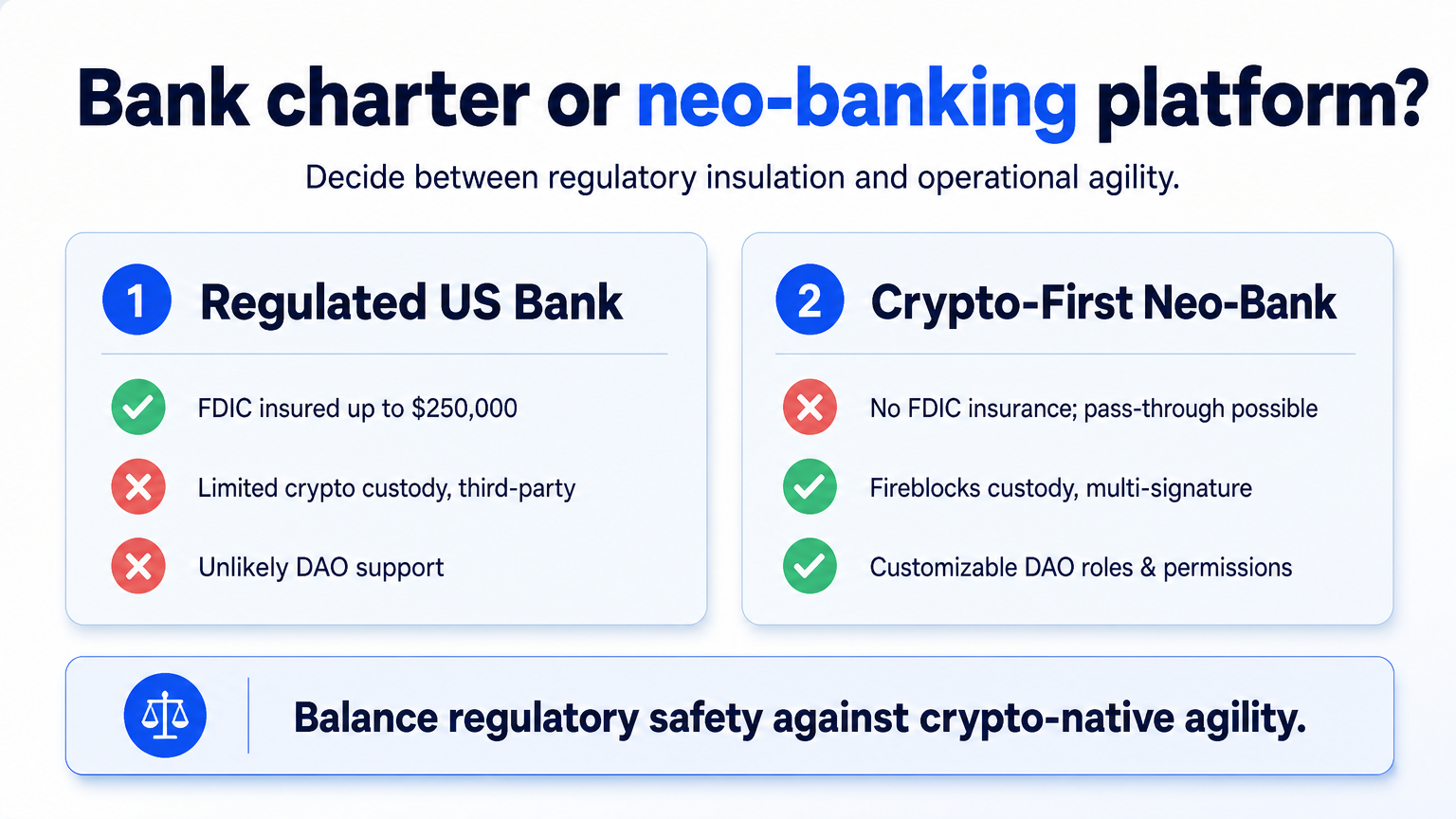
Crypto bank vs. crypto-friendly neo-banking platform
A crypto bank holds a charter, accepts deposits, offers FDIC insurance (for fiat), and accesses the Federal Reserve's payment system. A crypto-friendly neo-banking platform partners with chartered banks to provide accounts and payment rails, adding crypto-native functionality on top.
| Feature | Regulated US Bank (e.g., Revolut's future charter) | Crypto-First Neo-Banking Platform (e.g., OneSafe) |
|---|---|---|
| Fiat deposit insurance | FDIC insured (up to $250,000) | Not insured (funds held at partner banks may have pass-through insurance) |
| Crypto custody | Usually limited; may involve third-party custodian | Fireblocks custody, multi-signature, on-chain access |
| Supported currencies | Fiat (USD, EUR, etc.) plus a few crypto assets | Fiat (USD, EUR, CAD) and multiple stablecoins, with direct crypto-to-fiat conversion |
| Onboarding speed | Typically weeks, with heavy KYC/AML | Under one week, fully digital |
| Cross-border payments | SWIFT/wire, often slow and expensive | Domestic wires, ACH, and stablecoin rails for near-instant settlement |
| DAO support | Unlikely; no native role-based permissions | Customizable roles, permissions, and automated payment workflows for DAOs |
| Compliance burden | Full bank regulatory compliance | KYB/KYC, OFAC screening, supported by partner bank compliance |
| Corporate cards | Available, but often limited to fiat | Virtual and physical cards with spend controls, linked to fiat or crypto balances |
| Crypto-native workflows | Developing; batch settlement, limited on-chain integration | Real-time on-chain transaction tracking, multi-sig, stablecoin billing |
The choice depends on whether your priority is regulatory insulation or operational agility. A bank charter brings FDIC insurance and a direct Fed connection, but locks you into legacy banking hours and processes. A neo-banking platform offers speed, crypto-native features, and global reach without the full suite of banking protections.
Managing fiat and crypto in one place
A fiat crypto platform consolidates financial operations into a single interface. Instead of toggling between a bank account, an exchange, and a wallet, a business can receive stablecoin payments, convert to fiat, pay bills via ACH, and issue corporate cards—all from one dashboard. OneSafe's model supports stablecoin accounts with free USDC deposits and withdrawals, automatic FX conversion, and integrated invoicing in multiple fiat and stablecoins.
What a bank charter does not solve
Even a chartered crypto bank inherits traditional banking limitations. Settlement times for fiat transfers depend on correspondent banks and clearing hours. A DAO paying contributors in USDC every Friday will find batch processing and market hours incompatible with 24/7 operations. A neo-banking platform enables instant crypto-to-fiat conversions and on-chain settlements in minutes, regardless of time zone.
The charter also doesn't address decentralized governance needs. What should DAOs look for in a banking partner? A DAO requires multi-signer approvals, segregated treasury funds, and automated payments based on smart contract triggers. OneSafe's customizable roles and permissions, combined with Fireblocks custody, are designed for these use cases—something a traditional bank is unlikely to offer.
What to watch next and open questions
Will other fintechs follow Revolut's path?
Revolut's charter success depends on navigating OCC conditions and delivering a competitive product. If it succeeds, a wave of fintechs may seek charters to offer crypto services. However, capital requirements alone can deter many, who may prefer partnering with banks rather than becoming one. The trend of 21 banks issuing stablecoins suggests a two-tier market emerging: bank-issued stablecoins and decentralized stablecoins managed through neo-banking platforms.
Regulatory and market uncertainties
The crypto banking sector remains vulnerable to regulatory shifts. The OCC's stance could change with a new administration, and the FDIC's 2025 guidelines are still being tested. Meanwhile, crypto banking scams have surged, underscoring the need for robust security. For businesses, the safest approach is a platform combining strong crypto custody (like Fireblocks) with transparent compliance, rather than relying on a single regulatory badge.
Key Takeaways
- The Revolut OCC conditional approval legitimizes crypto banking but doesn't solve operational needs of crypto-native businesses.
- Regulated crypto banks and neo-banking platforms serve different needs: the former offers FDIC insurance and legacy rails; the latter provides speed, crypto-native workflows, and global reach.
- For DAOs and Web3 startups, a purpose-built fiat crypto platform like OneSafe, with Fireblocks custody and customizable permissions, addresses pain points a bank charter cannot.
- Businesses should evaluate their need for speed, cross-border payments, and stablecoin integration when choosing between a traditional bank and a neo-banking partner.
- The regulatory landscape is evolving rapidly; the next 12 months will reveal whether the OCC charter model becomes a blueprint for other fintechs or a cautionary tale.
Manage your fiat and crypto operations in one place—explore how OneSafe streamlines global business banking.