
On October 27, 2026, Ripple and Robinhood broadened their RLUSD partnership into payments, treasury management, lending, and perpetual futures. The NewsCord report, published at 23:19 UTC, gives crypto treasury management an institutional case study: settlement, custody, and on/off-ramps are assigned by name—BNY Mellon, Bitstamp by Robinhood, and C2FO—not left as wallet abstractions. For founders and finance leads, the question is how to rebuild a treasury stack around institutional crypto rails without concentrating counterparty risk.
Table of Contents
- What just happened
- Why this matters for crypto treasury operators
- Crypto treasury management in one paragraph
- Implications for DAOs and global businesses
- Recommended actions now
- What to watch next
- Key Takeaways
What just happened

The October 27, 2026 expansion, dated and attributed
According to NewsCord's October 27, 2026 report, Ripple and Robinhood expanded their cooperation around Ripple USD to include payments, treasury management, lending, and trading services. Ripple said the expansion would strengthen institutional financial services through Ripple Treasury, Ripple Prime, and a launch of perpetual futures trading. Robinhood planned to use RLUSD to settle institutional trades and automate treasury operations.
BNY Mellon now custodies XRP and RLUSD, and clients can mint or redeem RLUSD via BNY. Bitstamp by Robinhood will serve as an exchange venue for RLUSD-based settlement. Ripple also said it would work with BNY and C2FO on XRP and RLUSD custody and B2B payments, with the first C2FO transaction planned for later this year.
| Layer | Named player | Reported role |
|---|---|---|
| Custody and stablecoin issuance | BNY Mellon | Custodies XRP and RLUSD; clients can mint/redeem RLUSD |
| Settlement venue | Bitstamp by Robinhood | Exchange venue for RLUSD-based settlement |
| Treasury automation | Robinhood | Settle institutional trades and automate treasury operations |
| B2B payments | Ripple, BNY, C2FO | XRP and RLUSD custody and B2B payments; first C2FO transaction planned later this year |
Source: NewsCord, published 27 Oct 2026, 23:19 UTC.
Who controls settlement, custody, and treasury automation now
BNY Mellon sits at custody and mint/redeem. Bitstamp by Robinhood is the settlement venue. Ripple Treasury and Ripple Prime operate at the application layer; C2FO adds B2B payables/receivables. This is a named custody and settlement stack, not a token announcement. Each layer has its own approval flow, minimums, and failure mode, so crypto treasury custody should be mapped layer by layer.
This extends Crypto Treasury Management Shifts With RLUSD.
Why this matters for crypto treasury operators
From stablecoin on exchanges to institutional settlement rails
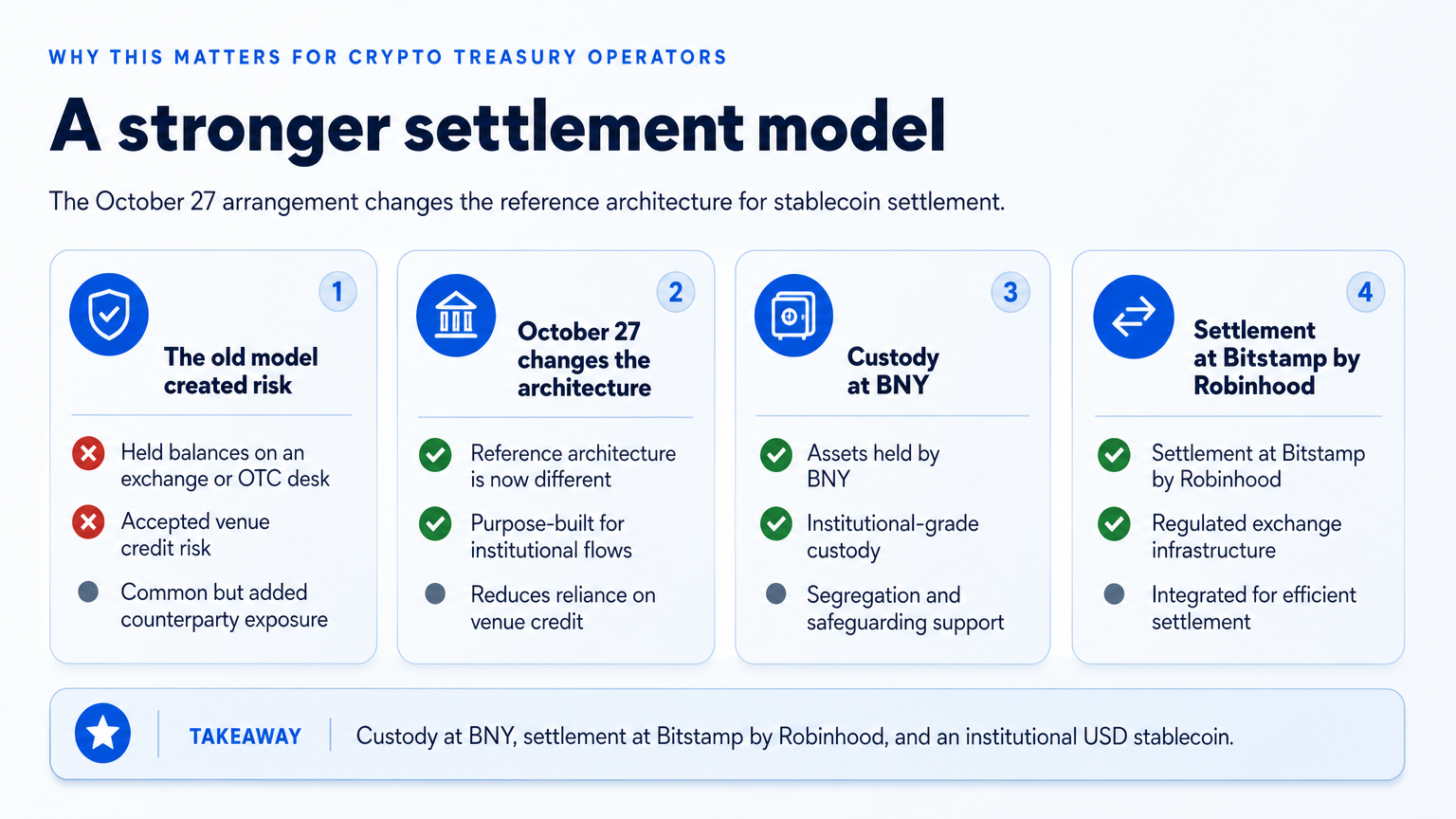
Until recently, stablecoin settlement often meant holding balances on an exchange or OTC desk and accepting venue credit risk. The October 27 arrangement changes the reference architecture: custody at BNY, settlement at Bitstamp by Robinhood, and an institutional USD stablecoin at the center. That reduces unaudited touchpoints but means treasury teams must know which counterparty holds what at each step.
The end of ‘self-custody or nothing’ as the only serious answer
The old custody debate collapsed into self-custody versus exchange. The Ripple Robinhood RLUSD expansion adds a third route: named institutional custody and redemption. Self-custody remains legitimate, especially for DAOs with strong multisig and governance discipline. But for businesses that already need fiat accounts, quarterly reporting, and board-level controls, "self-custody or nothing" is outdated. The responsible position is counterparty-aware.
How is treasury management for crypto different from traditional treasury management?
Crypto treasury management faces more frequent volatility-driven rebalancing, irreversible custody errors, faster but less reversible settlement finality, and 24/7 price movement that still hits fiat rails closed on weekends. Traditional treasury leans on the bank as the trusted middle; crypto treasury splits trust across issuer, custodian, venue, and fiat off-ramp.
Does the future of treasury management require support for crypto assets?
For global businesses and DAOs that pay vendors, contributors, or liquidity providers in stablecoins, yes in practice. The treasury stack must execute stablecoin settlement, crypto-to-fiat conversion, and on/off-ramp flows without a parallel manual process. The Ripple–Robinhood deal accelerates this because treasury automation is built natively around a stablecoin.
This continues Crypto Treasury Management: Analyzing the 24/7 Shift.
Crypto treasury management in one paragraph
Compressed consensus: what the SERP already covers
Ranking pages agree: crypto treasury management is managing, safeguarding, and deploying an organization's digital asset holdings. Liquidity and cash-flow forecasting are core. Custody and security are critical. Treasury operations increasingly span crypto and fiat. This article assumes those points and focuses on what the dated news changes.
What is crypto treasury management?
Crypto treasury management is the process of managing, safeguarding, and deploying an organization's digital asset holdings: deciding what to hold, where to custody it, how to meet fiat obligations, and how to maintain liquidity without taking unrewarded issuer, venue, or bridge risk. It includes policy, permissions, accounting, and execution—not just portfolio allocation.
Where the RLUSD expansion changes the old checklist
The old checklist asked: multisig wallet? staking yield? cold storage share? accounting tool? The new checklist adds four questions: which issuer, which custodian, which settlement venue, and at what all-in cost? Most ranking pages treat custody as solved, but the expansion introduces concentration questions cold storage does not solve. Routing material RLUSD treasury management through one issuer, one BNY custodian relationship, and one Bitstamp settlement venue is efficient but concentrated. Diversification of issuers and venues still matters.
Implications for DAOs and global businesses
What BNY custody and Bitstamp settlement mean for mid-market teams
Read the report as an availability signal, not universal access. NewsCord does not say every startup or DAO can open a BNY relationship directly. Mid-market teams should expect to access it through partners or a qualified custodian with a BNY relationship. Access and minimums vary.
For DAO treasury operations, the counterparty register now has three layers: issuer, custodian, and venue. Each needs approval rules and a failure contingency.
Regulatory clarity determines access; What Ripple’s OCC Approval Means for Crypto Banking traces the bank-access side.
On/off-ramp pricing and fiat-to-stablecoin flow under the new rails
The announcement does not publish spreads, deposit minimums, or conversion fees. Do not assume BNY custody or Bitstamp settlement is automatically the cheapest path. The real question is all-in cost from fiat to stablecoin settlement back to fiat. Platforms like OneSafe—a financial technology company, not a bank, that combines fiat accounts, ACH and wire rails, bill payments, and crypto-to-fiat conversion—show the operational layer when a treasury needs both worlds. New rails may change where settlement happens; they do not remove the need to compare on/off-ramp pricing per flow.
How do DAOs handle treasury operations when custody and settlement become institutional?
DAOs hold assets via a custodian and enforce internal authority through governance or multisig. The work shifts to: who can initiate a mint/redeem request, which multisig or contract approves movement, who can send funds to a Bitstamp settlement account, and how approval is recorded. Institutional custody centralizes some risk and mitigates others; DAO treasury operations still need role separation, approval limits, and real-time reconciliation.
Recommended actions now
Reassess custody and venue concentration
Do not copy the partnership's consolidation into your own treasury. For each stablecoin, list the issuer, qualified custodian, exchange or settlement venue, and fiat bank rail. Then set a maximum percentage of total stablecoin value exposed to any single issuer, custodian, or venue. Treat BNY custody and Bitstamp settlement as counterparties, not neutral plumbing.
Map your RLUSD-derived treasury workflow in three steps
- Inventory every stablecoin balance by custodian, venue, and fiat off-ramp.
- Model the new path: mint/redeem through BNY, settle via Bitstamp by Robinhood if available, convert to fiat through an on/off-ramp that matches your banking location.
- Pilot with a small, non-material amount before moving material balances; document finality, fees, spread, and failover.
For finance leads who want the updated policy published, Joyrise—your blog, written and published every day—plans, writes and publishes illustrated SEO articles to your Webflow blog every day; read your first article before you pay. That makes the policy public without pulling the treasury team away from execution.
This aligns with OCC Stablecoin Move Reshapes Crypto Banking for Startups.
What should I change in my treasury setup after the RLUSD announcement?
First, update your counterparty register—not just your wallet list. Add BNY as custodian, Bitstamp by Robinhood as venue, and Ripple as issuer if you hold or plan to hold RLUSD. Second, set exposure limits before balances move; lower friction can tempt unmonitored consolidation. Third, document fiat-to-stablecoin and stablecoin-to-fiat off-ramps, including failover if the named venue pauses settlement.
What to watch next
The C2FO first transaction scheduled for later this year
The C2FO payment is the operational proof. NewsCord reported that the first C2FO transaction is planned for later this year—not completed, not dated, not sized. Watch whether the execution announcement names volume, settlement time, and counterparties. That will show whether the stack moves from names to live payment flow.
For a comparable institutionalization, Stablecoin Regulation: Canada's CADC Exemptive Relief tracks how regulatory carve-outs shape custody and settlement access.
Open questions on issuer risk, venue risk, and stablecoin diversification
- Will BNY mint/redeem access expand beyond large institutional clients?
- Does Bitstamp by Robinhood become the dominant RLUSD settlement venue?
- How do RLUSD, USDC, and other stablecoins compare on redemption terms, custody fees, and venue liquidity?
- What contingency does a treasury have if an issuer, custodian, or venue is unavailable?
What does secure treasury management look like for crypto?
Secure crypto treasury management means segregating custody from payment initiation, enforcing multisig or MFA at every approval layer, setting conversion limits, reconciling on-chain balances to internal accounting in real time, and maintaining at least one independent off-ramp. BNY and Bitstamp by Robinhood can improve operational security, but security comes from access controls, failover, and documented approvals—not brand.
Key Takeaways
- The October 27, 2026 Ripple–Robinhood RLUSD expansion is a custody and settlement infrastructure shift: BNY custodies, Bitstamp by Robinhood settles, and the first C2FO transaction is pending later this year.
- Treasury teams should treat BNY, Bitstamp by Robinhood, and Ripple as distinct counterparties and set issuer, custodian, and venue exposure limits rather than defaulting to consolidation.
- On/off-ramp pricing and fiat-to-stablecoin conversion remain local, unannounced variables; model all-in costs before moving balances.
- Self-custody is not obsolete, but "self-custody or nothing" is no longer the only serious answer.
- The next real signal is execution: the first C2FO transaction later this year, not another product announcement.
To build a fiat-plus-crypto treasury workflow around these new rails without fragmenting your banking stack, sign up at OneSafe's unified financial platform.



