After $3.5B Hack, What Secure Crypto Banking Looks Like
On October 29, 2026, Binance confirmed it was investigating a series of massive, unauthorized outflows from its hot wallets — an incident that, according to on-chain analytics firm Unchained, reached roughly $3.52 billion in Ethereum-based losses (Disruption Banking, October 30, 2026). The scale immediately eclipsed the previous record (the Bybit hack) and forced every business that relies on crypto banking to reexamine how digital assets are held, moved, and protected. For a foundational understanding of the space, NerdWallet’s Crypto Bank and Crypto Banking 101 outlines the basics. What follows is a breakdown of what actually occurred, why the architecture of custodial wallets matters, and what genuinely secure crypto banking looks like for businesses and DAOs that can’t afford to be the next headline.
Table of Contents
- What happened in the $3.5bn Binance hot wallet hack?
- How does this hack affect businesses that rely on crypto banking?
- What security measures should a business demand from a crypto banking provider?
- What is the difference between hot wallets and institutional custody like MPC?
- Are funds held with a platform like OneSafe at risk from similar hacks?
- What to Do Now: Immediate Steps for Crypto-Native Businesses
- What’s Next for Crypto Banking Regulation and Security
- Key Takeaways
What happened in the $3.5bn Binance hot wallet hack?
The Scale of the Breach
By the afternoon of October 29, Binance’s security team was scrambling to trace outflows that appeared to drain hot wallets on Ethereum and possibly other chains. The Guardian reported on October 29 that the exchange was investigating a suspected hack while blockchain watchers circulated numbers well above $3 billion. Unchained’s estimate — $3.52 billion — represents the largest single crypto theft ever, more than double the $1.5 billion Bybit suffered in 2025. Binance has not publicly confirmed a final dollar amount, but the early data points to a breach of unprecedented magnitude.
How Hot Wallets Are Exploited
An exchange hot wallet is an online key store designed for active liquidity — millions of transactions a day require private keys to be accessible to signing infrastructure. That accessibility is precisely what makes hot wallets a high-value target. Attackers who compromise a server, exploit a smart-contract bug, or phish an operator can drain the wallet in seconds. In Binance’s case, initial indicators suggest the movement of funds was rapid and coordinated, consistent with an attacker who had gained deep access to signing logic. The incident starkly illustrates why holding large, operational treasury balances in a single hot wallet is akin to keeping the company safe in the lobby.
How does this hack affect businesses that rely on crypto banking?
Custodial vs. Non-Custodial Platforms
Many startups and DAOs use “crypto banking” platforms that themselves rely on integrated exchange wallets or shared hot wallets to process client transactions. In a custodial model where the platform pools user funds into its own hot wallet, a breach at the platform level can wipe out client assets — even if the client never directly interacted with Binance. Non-custodial or segregated-custody models, by contrast, keep each client’s assets in distinct wallets (or segregated sub-accounts) that are not commingled in a single hot pool. The Binance hack is a reminder that custodial hot wallet architectures create a single point of failure for potentially thousands of businesses.
The Business Risks of Centralized Exchange Hot Wallets
For a company holding working capital in USDC or ETH on an exchange’s native hot wallet, the damage is obvious: funds can vanish with no guarantee of recovery. But even for a business that merely uses an exchange as a liquidity bridge, the hack disrupts market confidence, delays withdrawals, and can freeze connected services. As major institutions like Itaú have recently formalized their crypto banking offerings (as noted in our analysis of Crypto Banking Gets a Formal Boost from Itaú), the push toward mainstream adoption makes robust custody infrastructure a prerequisite. Visa’s Crypto in Banking: What You Need to Know provides additional perspective on how traditional payment networks are incorporating digital assets. A neobank crypto platform that still relies on a traditional exchange’s hot wallet is borrowing the same vulnerability that just wiped out $3.5 billion.
What security measures should a business demand from a crypto banking provider?
MPC and Fireblocks: Institutional-Grade Custody
Businesses should begin their due diligence with one question: Is our provider using multi-party computation (MPC) custody, and if so, who provides it? MPC-based institutional custody is the standard for enterprises that cannot afford hot wallet exposure. Instead of a single private key, MPC splits cryptographic control into multiple, independently held secrets. A transaction is signed only when a quorum of parties cooperates — no complete key ever exists in one place, and no single compromised server can authorize a transfer. Fireblocks is the leading infrastructure provider in this category, used by banks, liquidity networks, and fintech platforms to power secure digital asset operations. A crypto banking partner that leverages Fireblocks (or an equivalent MPC layer) effectively removes the hot wallet attack surface for stored funds.
Multi-Factor Controls and Segregation of Assets
Beyond the custody engine, businesses should demand:
- Mandatory multi-factor authentication (MFA) at signup and for all high-risk actions.
- Configurable role-based permissions, so that no single employee can unilaterally move treasury funds.
- Segregated client accounts — each business’s fiat and crypto positions should reside in logically separated sub-ledgers and, where possible, distinct on-chain wallets.
- Real-time monitoring and withdrawal velocity checks that flag anomalous behavior.
A platform that treats client assets as a single balance on a hot wallet, no matter how “insured” it claims to be, is not delivering enterprise-grade crypto custody. Our breakdown of Crypto Treasury Management and Citi's Bitcoin Custody shows that even legacy banks are moving toward segregated, MPC-based architectures — the same standard a business should expect from its crypto banking provider.
What is the difference between hot wallets and institutional custody like MPC?
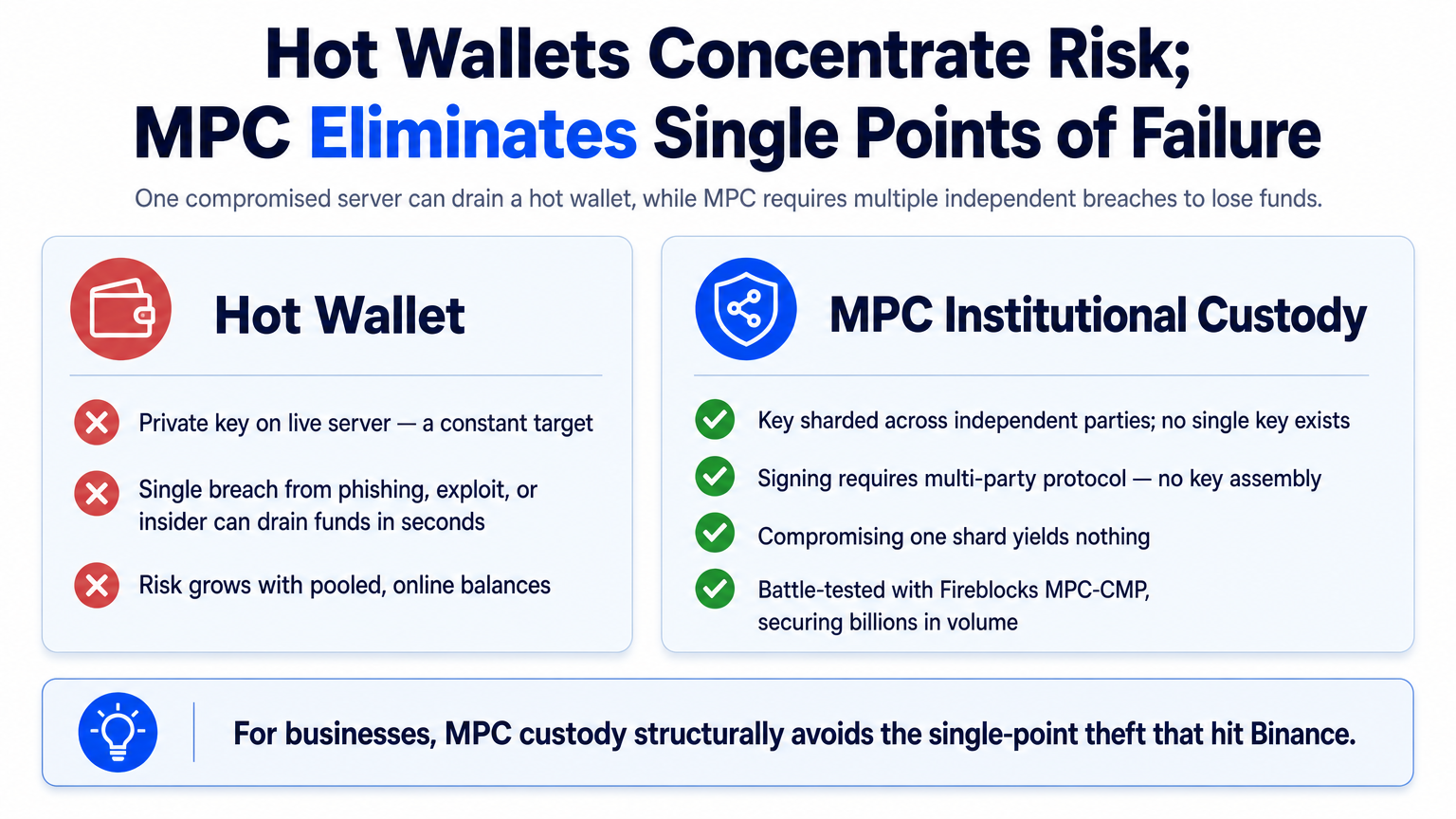
In a hot wallet, the private key that controls funds lives on an internet-connected server. That server is a perpetual target. Successful phishing, a zero-day exploit, or an insider with access can drain the wallet in the time it takes to confirm a block. MPC institutional custody changes the threat model fundamentally. The key is never assembled; it exists only as separate shards held by different, mutually independent parties. To sign a transaction, those parties execute a multi-round cryptographic protocol that produces a valid signature without ever reconstructing the private key. An attacker who compromises one shard gets nothing useful.
This is why Fireblocks has become synonymous with secure crypto custody — its MPC-CMP protocol has been audited and battle-tested across billions in transaction volume. When a crypto banking platform integrates Fireblocks, it is saying that client funds are not sitting in a hot wallet ripe for the kind of single-point theft that hit Binance. For DAOs managing community treasuries or global businesses running cross-border payments, the difference is between continuous exposure and a security model where multiple, independent compromises would be required to lose a single satoshi.
Are funds held with a platform like OneSafe at risk from similar hacks?
OneSafe is a financial technology company, not a bank, and its digital asset custody is built on Fireblocks. That means the private key material is never concentrated in a hot wallet. Every client’s crypto assets are secured through an MPC infrastructure that eliminates the exact vulnerability exploited in the Binance breach. Additionally, the platform mandates MFA at signup, enforces KYB checks during onboarding, and maintains segregated accounts for each business — funds are not pooled in a shared wallet that could be drained en masse.
No security system is foolproof; operational errors, social engineering, or a breach at the MPC provider itself could theoretically create risk. But the architectural choice matters: by relying on institutional custody rather than a hot wallet, a platform like OneSafe structurally avoids the attack vector behind the $3.5 billion loss. For a DAO or Web3 startup that processes payroll, vendor payments, or treasury operations through a business crypto account, that distinction is the difference between a headline and business continuity. (For questions about your specific setup, you can reach OneSafe’s support at support@onesafe.io.)
What to Do Now: Immediate Steps for Crypto-Native Businesses
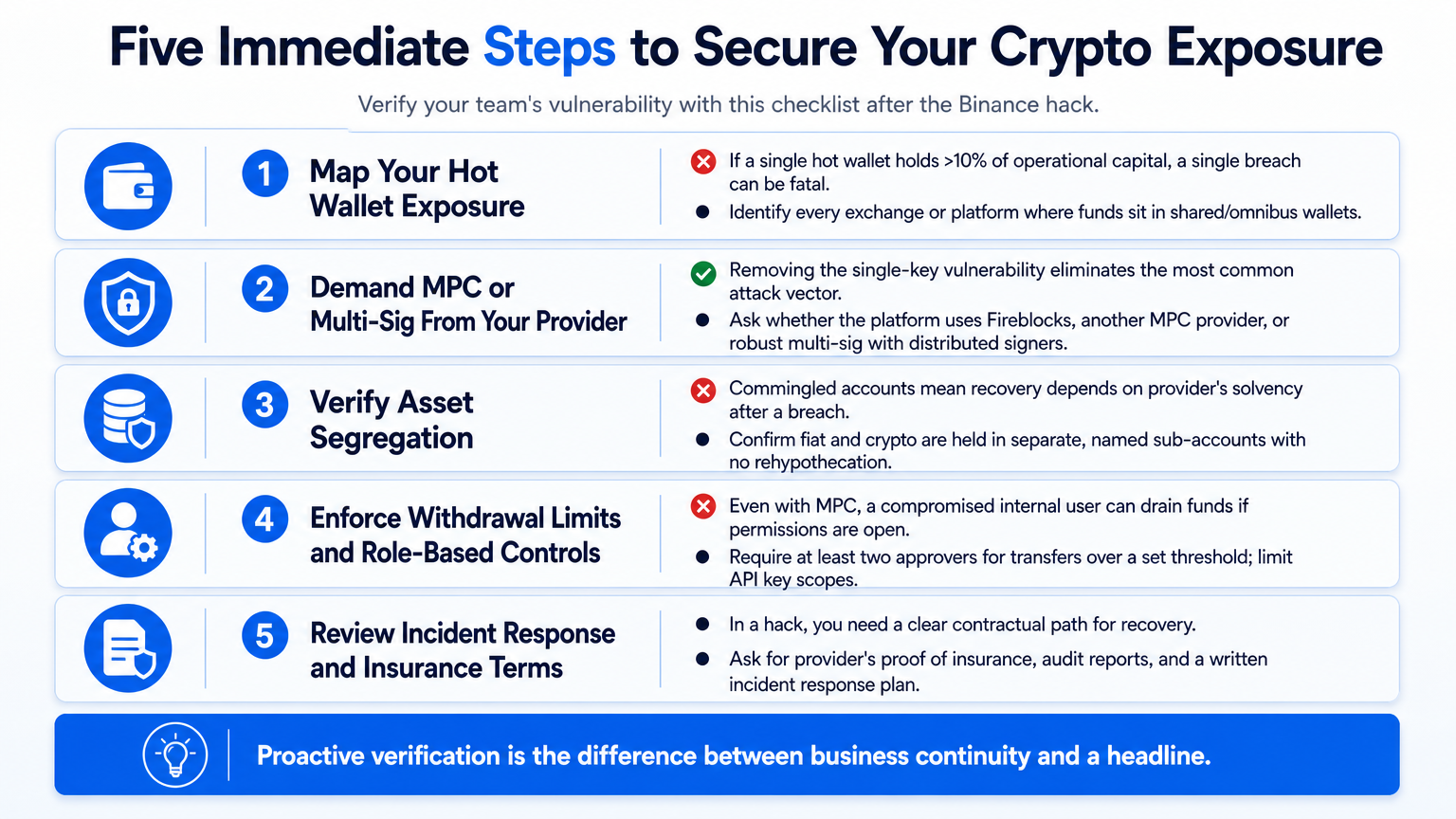
The Binance hack is not an isolated incident; it is a pattern. Here is a short, actionable checklist for any team that wants to verify its exposure right now.
| Action | Why It Matters | What to Look For |
|---|---|---|
| Map your hot wallet exposure | If a single hot wallet holds >10% of your operational capital, a single breach can be fatal. | Identify every exchange, bridge, or platform where your team holds funds in a shared or omnibus wallet. |
| Demand MPC or multi-sig from your provider | Removing the single-key vulnerability eliminates the most common attack vector. | Ask whether the platform uses Fireblocks, another MPC provider, or a robust multi-signature scheme with geographically distributed signers. |
| Verify asset segregation | Commingled accounts mean your recovery depends on the provider’s solvency after a breach. | Confirm that your fiat and crypto are held in separate, named sub-accounts with no rehypothecation. |
| Enforce withdrawal limits and role-based controls | Even with MPC, a compromised internal user can drain funds if permissions are wide open. | Require at least two approvers for transfers over a set threshold; limit API key scopes. |
| Review incident response and insurance terms | In the event of a hack, you need a clear contractual path for recovery. | Ask for the provider’s proof of insurance, audit reports, and a written incident response plan. |
For DAO banking specifically, customizable roles and permissions become critical — a multi-signature governance structure with on-chain verifiability adds a layer of transparency that hot wallet architectures cannot match. As we noted in our Crypto Treasury Management News Analysis, teams that treat treasury management as a governance discipline rather than an afterthought are the ones that survive black swan events.
What’s Next for Crypto Banking Regulation and Security
The $3.52 billion number will almost certainly accelerate regulatory action. The OCC’s stablecoin rule, set to take effect on January 18, 2027, already mandates that national banks engaging in crypto activities meet specific custody and risk-management standards (see Stablecoin Regulation: OCC Rule's Business Impact). Expect post-Binance discussions to broaden — lawmakers and agencies like the FDIC may propose explicit hot wallet exposure limits, mandatory MPC-or-cold-storage requirements for custodians, and stricter third-party audit obligations. For businesses, the direction is clear: the era when a fintech could get away with “we use a secure exchange wallet” is ending. Providers like First Citizens Bank are already offering Banking built for crypto-native companies. Crypto banking software solutions, such as the one reviewed on SDK.finance, are evolving to meet these demands.
This is also a moment when transparent communication about security becomes a competitive advantage. Organizations that maintain a steady stream of educational content — from technical breakdowns to policy updates — build trust faster. Services like Joyrise help teams automate that effort; Joyrise plans, writes, and publishes illustrated SEO articles to your blog every day, a useful tool for any crypto banking provider that wants to keep its community informed without diverting internal resources.
Staying ahead will mean watching how Binance’s investigation reshapes insurance markets, whether Tether or Circle face pressure to freeze or reissue tokens linked to the stolen funds (a scenario we covered in Stablecoin Regulation: The Freeze Angle), and how quickly regulators transform today’s best practices into binding rules.
Key Takeaways
- The October 2026 Binance hot wallet breach, estimated at $3.52 billion, is the largest crypto hack in history and underscores the existential risk of hot wallet architectures for any business relying on crypto banking.
- Businesses should demand that their provider use institutional-grade MPC custody (such as Fireblocks) rather than a shared hot wallet, which creates a single point of failure.
- Segregation of client assets, multi-factor authentication, and role-based withdrawal controls are non-negotiable components of a secure business crypto account.
- Platforms that integrate MPC custody eliminate the hot wallet vulnerability structurally; though no system is risk-free, this architecture insulates funds from precisely the kind of exploit that hit Binance.
- Regulatory momentum — including the OCC stablecoin rule and likely post-hack proposals — will soon make hot wallet-dependent crypto banking untenable for serious enterprises.
Ready to move your business treasury to a platform that anchors crypto custody on Fireblocks rather than a hot wallet? Explore OneSafe’s unified fiat and crypto accounts.