On October 30, 2026, stablecoin regulation took a concrete, operational turn: $2.4 billion in USDT and USDC were frozen in wallets tied to the Binance hack stablecoin theft, pushing freeze powers from policy debate into a real-world event every business using stablecoins must now plan for. This article unpacks exactly how those freezes work, why a legitimate business can get caught with no wrongdoing, and what finance and ops teams can do about stablecoin compliance for businesses.
Table of Contents
- What are stablecoins?
- How are stablecoins regulated in the US?
- What just happened with the Binance hack and stablecoin freezes?
- What are stablecoin freeze powers and who can invoke them?
- What is the difference between a freeze and a blacklist?
- How can a legitimate business get its stablecoins frozen?
- Why this matters now for finance and ops teams
- What should I do if my stablecoin wallet gets frozen?
- How can I protect my business from stablecoin freezes?
- How does OneSafe handle stablecoin custody and freeze risk?
- What should finance teams watch for next in stablecoin regulation?
- Key Takeaways
- Sources
What are stablecoins?
Stablecoins are digital tokens pegged 1:1 to a fiat currency, mostly the US dollar. USDT and USDC together exceed $200 billion in market cap and are widely used for stablecoin business payments, trading, and as a stablecoin on/off ramp between crypto and fiat—dollar-equivalent liquidity without traditional banking friction.
How are stablecoins regulated in the US?
No single federal law governs stablecoins. Oversight is split: the SEC may view some as securities; the CFTC treats them as commodities in derivatives; state money transmitter rules impose direct stablecoin issuer obligations; and the OCC allows national banks to custody them. The EU’s MiCA stablecoin framework provides the most complete cross-border regime, while US legislation remains pending.
The result is a two-track system. Issuers face mounting compliance pressure—KYC, suspicious activity reporting, and freeze functions. Businesses, however, often operate with little visibility—until a freeze lands on their wallet. The OCC rule effective January 18, 2027, integrates freeze requirements into banking channels without shielding businesses. (Stablecoin Regulation: OCC Rule Starts Jan. 18, 2027)
What just happened with the Binance hack and stablecoin freezes?
Following the hack, Tether and Circle froze $2.4 billion in USDT and USDC across multiple addresses. (Stablecoin Regulation: The Freeze Angle) This was the largest coordinated freeze ever, triggered by law enforcement and internal screening. It shows that large-scale freezes are now a routine OFAC stablecoin compliance tool, often hitting downstream wallets with no direct connection to the theft.
What are stablecoin freeze powers and who can invoke them?
Freeze powers exist because issuers control the smart contracts. Tether’s freeze() function and Circle’s equivalent immobilize an address instantly. They’re invoked by:
- Law enforcement requests (subpoenas, court orders)
- OFAC stablecoin sanctions—any SDN-listed address must be blocked
- Internal monitoring flagging theft, hacks, or suspicious flows
Legally, holding USDT or USDC means agreeing to terms that permit freezes. Issuers must also act under AML obligations once they have reasonable suspicion.
What is the difference between a freeze and a blacklist?
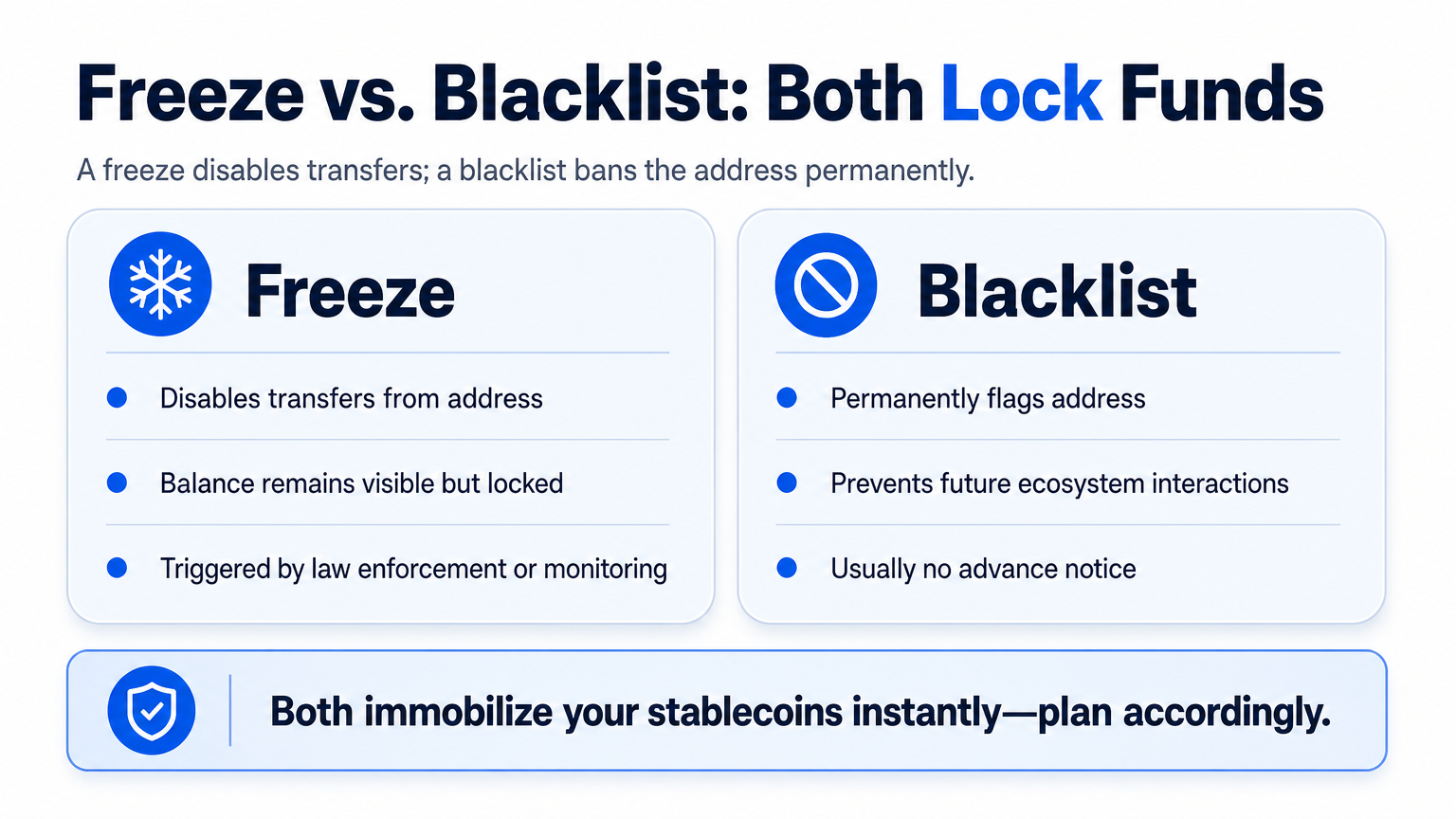
A freeze disables transfers from an address; the balance stays visible but locked. A blacklist flags the address permanently, preventing future interactions with the issuer’s ecosystem. For a business, both make the stablecoin balance inaccessible, typically with no advance notice.
How can a legitimate business get its stablecoins frozen?
You can be frozen without wrongdoing because compliance follows chain-of-custody, not intent. Stolen USDT moved through mixers, then a fraction arrives as a legitimate payment to your startup. Law enforcement traces the taint, the wallet is frozen, and payroll, stablecoin business payments, and the stablecoin on/off ramp halt. This isn’t hypothetical—the $2.4B freeze likely caught downstream wallets, and interacting with an OFAC-listed address does the same.
Why this matters now for finance and ops teams
The gap between regulators and end users
Regulators focus on issuers, leaving businesses in a gray area. When a freeze hits, unfreezing goes through law enforcement or courts, not the issuer.
What a freeze does to payroll, vendor payments, and on/off-ramps
An immobilized wallet means:
- Payroll in stablecoins stops.
- Vendor payments can’t settle, damaging relationships.
- The stablecoin on/off ramp is severed; working capital trapped.
Centralized freeze authority recovers stolen funds but creates instant liquidity risk for legitimate operators. (Stablecoin Payments After the $1.8B Freeze)
What should I do if my stablecoin wallet gets frozen?
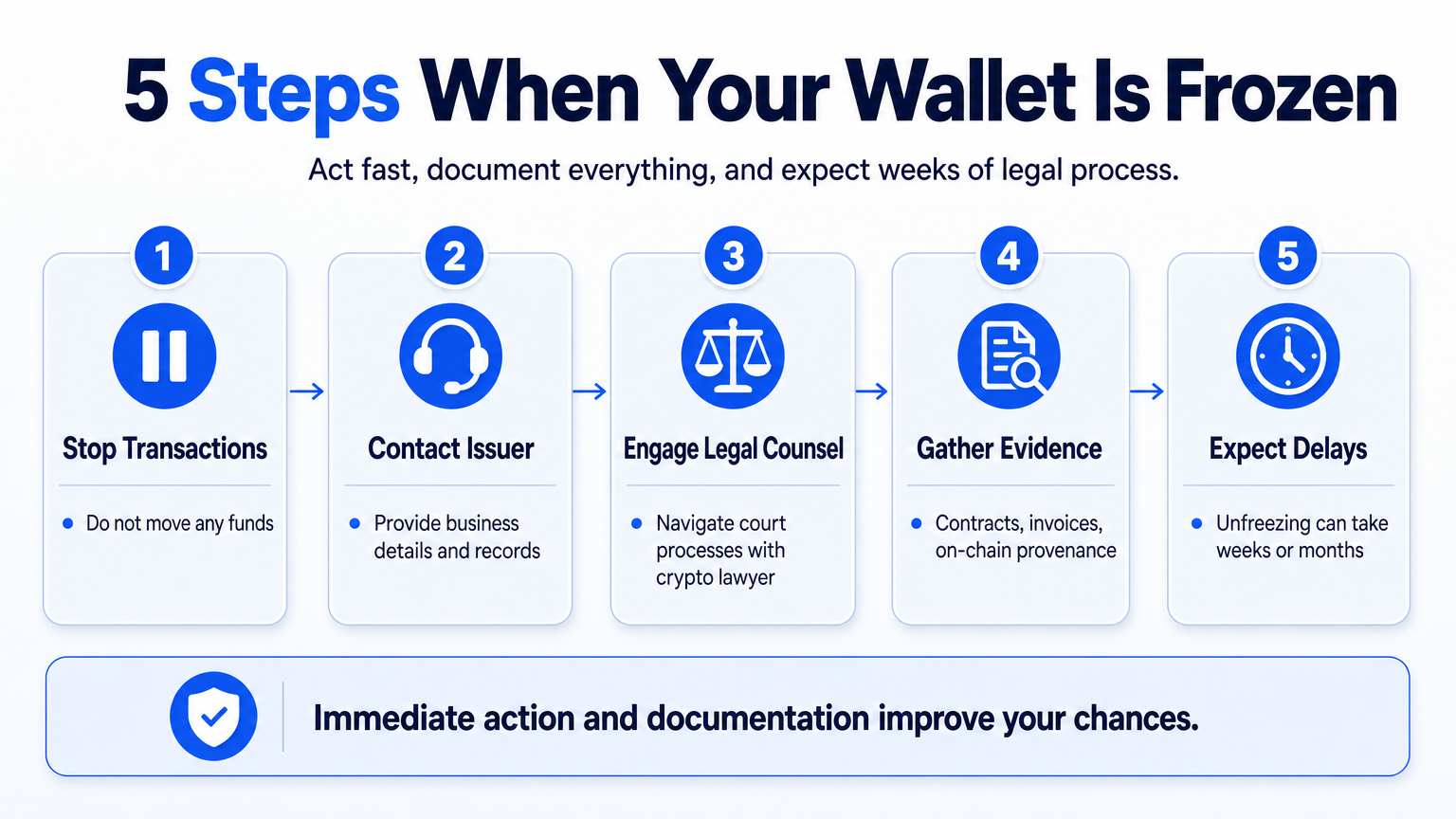
- Stop all transactions immediately.
- Identify the issuer and contact their compliance team with business details and transaction records.
- Engage crypto-asset legal counsel to navigate court processes.
- Gather evidence of legitimate activity (contracts, invoices, on-chain provenance).
- Expect delays; unfreezing takes weeks or months.
How can I protect my business from stablecoin freezes?
No precaution eliminates all risk, but three habits sharply reduce it.
Monitor wallet health and transaction provenance
Screen incoming addresses with a freeze checker (like BlockSec’s tool) and on-chain analytics. Set a threshold above which every new counterparty must be screened to avoid tainted stablecoin business payments.
Diversify stablecoin exposure and have a fiat fallback
Split working capital across USDT, USDC, and a fiat backstop. A single-issuer freeze won’t wipe all liquidity. The rule: never rely on one stablecoin rail for time-critical payments.
Document compliance and KYB/KYT internally
Maintain counterparty business registrations and transaction logs. If frozen, you’ll need to prove the source of funds was lawful. This documentation can speed legal resolution.
| Action | Why It Matters | How to Implement |
|---|---|---|
| Screen incoming addresses | Prevents receiving tainted stablecoins | Use a freeze checker and on-chain analytics before accepting large payments |
| Diversify issuer holdings | Avoids single-issuer freeze wiping all liquidity | Split capital across USDT, USDC, and fiat accounts |
| Maintain KYB/KYT records | Proves legitimate fund sources quickly | Collect counterparty IDs and log transaction hashes with purpose |
| Keep fiat fallback | Ensures payroll and vendors stay paid | Fund a separate operating bank account independently |
| Engage legal/compliance expertise | Handles freeze events with speed | Retain a crypto-savvy law firm and appoint an internal lead |
How does OneSafe handle stablecoin custody and freeze risk?
OneSafe couples fiat accounts with stablecoin on/off-ramps and uses Fireblocks for custody, adding whitelisting and screening that can block tainted funds before they enter. Segregated fiat and stablecoin rails mean a freeze on one doesn’t paralyze the other. However, no platform can prevent a retroactive freeze on already-received funds; the goal is to minimize the odds with thorough inbound screening. (After $3.5B Hack, What Secure Crypto Banking Looks Like)
What should finance teams watch for next in stablecoin regulation?
- US federal legislation may standardize freeze obligations and due-process rights.
- OCC rule embeds freezes deeper into banking starting January 18, 2027. (Stablecoin Regulation: OCC Rule's Business Impact)
- Circle’s SEC cash treatment push could tighten freeze protocols. (Stablecoin Regulation: Circle's SEC Cash Push)
- MiCA stablecoin enforcement will affect non-EU businesses dealing with EU counterparties.
- On-chain analytics will speed both counterparty screening and issuer freezes.
The trend is clear: issuers will freeze faster and in larger amounts. For teams needing to stay current without internal content overhead, services like Joyrise plan, write, and publish illustrated SEO articles to your blog every day, turning regulatory updates into actionable content.
Key Takeaways
- The Binance hack triggered $2.4B in USDT and USDC freezes, proving issuer freeze powers now operate at scale.
- A legitimate business can be frozen by receiving stablecoins that passed through a flagged wallet, with only slow legal recourse.
- Protecting operations means screening incoming addresses, diversifying across issuers, and keeping fiat fallback liquidity.
- Platforms with segregated fiat/stablecoin rails and transaction screening reduce but don’t eliminate freeze risk.
For a financial platform that helps global businesses manage fiat and stablecoin operations with segregated custody and built-in compliance screening, explore OneSafe’s neo-banking solution.
Sources