

Table of Contents
- Summary: Canada’s Proposed Stablecoin Regulations
- 5 Takeaways from the Draft Stablecoin Act
- What You Should Do About It
- What to Watch Next
- What do Canada’s proposed stablecoin rules actually require?
- How will the Stablecoin Act affect my business if I use stablecoin payments today?
- Do I need to change my payment provider because of these regulations?
- What does compliant stablecoin payment infrastructure look like?
- Can I still use stablecoins for cross-border settlements if I’m not a Canadian company?
- What’s the difference between a regulated and unregulated stablecoin under these rules?
- Key Takeaways
Summary: Canada’s Proposed Stablecoin Regulations
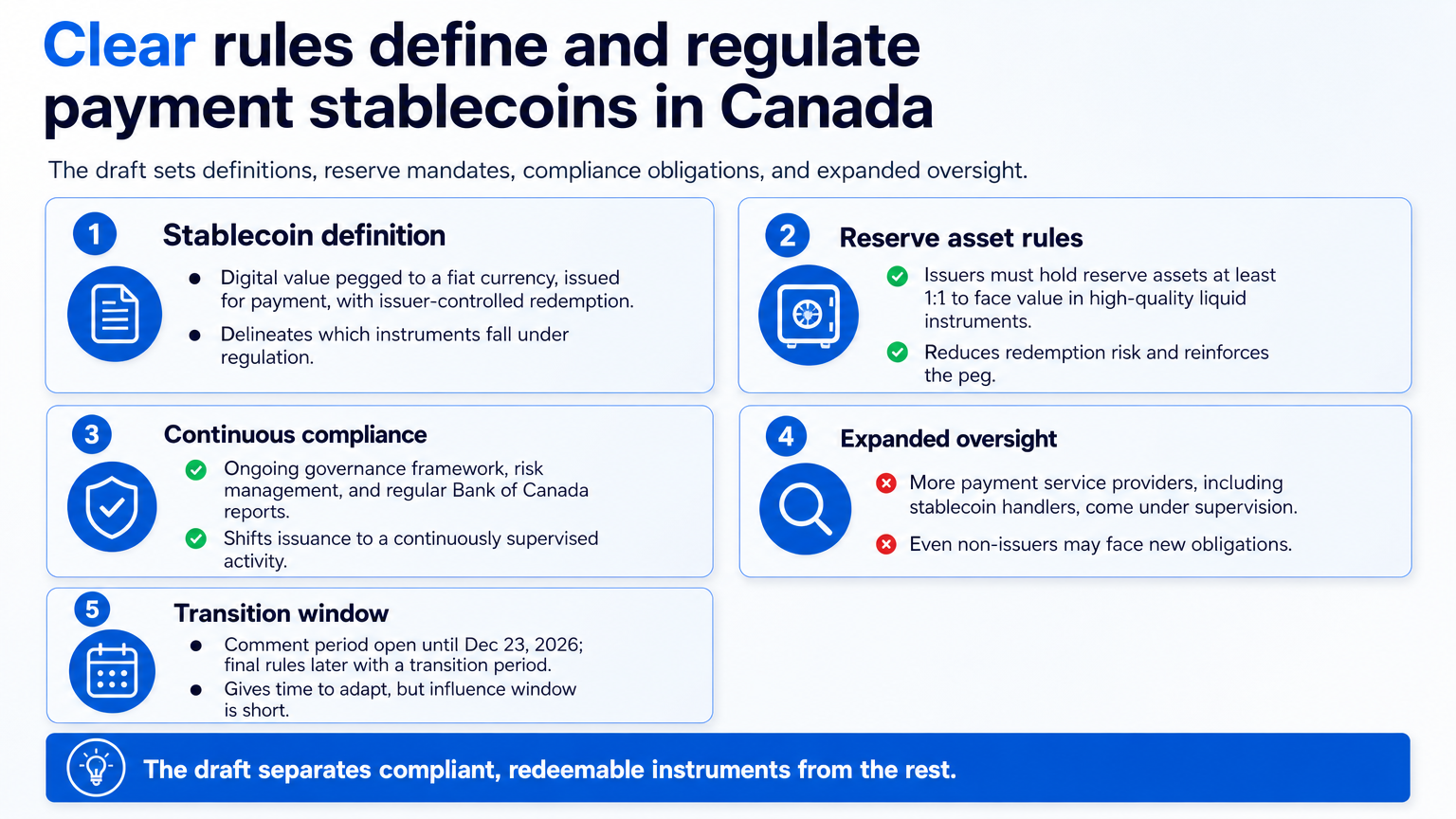
On October 24, 2026, Canada’s Department of Finance published draft regulations under the Canada Stablecoin Act, alongside amendments to the Retail Payment Activities Regulations (RPAR), according to a November 17, 2026 analysis by Osler, Hoskin & Harcourt LLP. The draft defines what constitutes a payment stablecoin, mandates reserve asset standards, and introduces ongoing issuer compliance obligations — including governance, risk management, and reporting to the Bank of Canada. The comment period ends December 23, 2026. For businesses that already use or are weighing stablecoin payments, this is the clearest North American blueprint yet for how governments will supervise payment stablecoins. It separates compliant, redeemable instruments from the rest, and it pulls non-issuing businesses into the regulatory orbit through expanded retail payments oversight. Below, we unpack the draft’s five most impactful provisions and what founders and finance leads should do right now.
| Provision | What It Requires | Why It Matters |
|---|---|---|
| Stablecoin definition | A digital representation of value pegged to a fiat currency, issued for use as payment, where the issuer controls redemption. | Clearly delineates which instruments fall under regulation. |
| Reserve asset rules | Issuers must hold reserve assets at least 1:1 to face value, composed of high-quality liquid assets (cash, short-term treasuries, etc.). | Reduces redemption risk and reinforces the stablecoin’s peg. |
| Continuous compliance | Issuers must have a governance framework, risk management program, and submit regular reports to the Bank of Canada; violations risk penalties. | Shifts stablecoin issuance from a launch‑and‑forget model to an ongoing, supervised activity. |
| Expanded retail oversight | Amendments to the RPAA bring more payment service providers under supervision, including those that handle stablecoin‑denominated transactions. | Even non‑issuing businesses may face new obligations if they use a covered payment service. |
| Transition window | The draft regulations are open for comment until December 23, 2026; final rules are expected later with a likely transition period before enforcement. | Gives firms time to adapt, but the window for influence is short. |
Source: Osler analysis of the draft regulations published October 24, 2026
5 Takeaways from the Draft Stablecoin Act
1. A stablecoin is now a defined legal instrument
The draft carves out a precise definition: a payment stablecoin is a digital representation of value, pegged to a fiat currency, issued for use as payment, where the issuer controls the redemption. This definition is the threshold — if an instrument falls within it, the issuer must comply with the entire regime. For businesses using stablecoin payments, the definition determines which tokens your payment provider can safely support and which ones will be pushed out of the regulated Canadian payments system. If you’re reliant on a stablecoin that doesn’t meet the definition, your settlement rails could get disconnected. This clarity arrives as global stablecoin payments standards are taking shape; the U.S. Treasury recently proposed rules defining stablecoin issuance and sales domestically, mirroring the push toward enforceable definitions Treasury proposes rules defining stablecoin issuance, sales in U.S..
2. Reserve assets get a hard look—and a 1:1 mandate
A central requirement: issuers must back every stablecoin in circulation with reserve assets at least equal to the aggregate face value, and those assets must be high‑quality liquid instruments. This kills the model of fractional backing or opaque reserves that plagued earlier stablecoins. For a business accepting stablecoin payments, the rule means the redemption promise becomes enforceable — you won’t wake up to a depegged token because an issuer’s reserves were invested in risky assets. In practice, expect your payment provider to only support stablecoins that can demonstrate compliant reserve composition, and to require periodic attestations. Stablecoin issuer requirements like these are hardening across jurisdictions; the OCC’s final rule on U.S. digital asset leadership reinforces that issuers must operate within a federal regulatory perimeter OCC Advances U.S. Digital Asset Leadership with Final Rule to ....
3. Issuer compliance moves from launch-and-forget to continuous oversight
The draft imposes ongoing obligations that go far beyond a one‑time registration. Issuers must maintain a governance framework, a risk management program, and submit regular reports to the Bank of Canada. Penalties for non‑compliance can follow. This changes the relationship between a business and its stablecoin partner: you’ll want to see evidence of a robust stablecoin payment compliance posture, not just a white paper. The Federal Reserve Board’s request for public comment on proposals related to stablecoin activities underscores that supervision is becoming a permanent feature of the landscape Federal Reserve Board requests public comment on two proposals ....
4. Retail payments oversight expands alongside stablecoin rules
The proposed amendments to the Retail Payment Activities Regulations bring more payment service providers under the Bank of Canada’s supervision. Even if you never issue a stablecoin, using a payment processor that handles stablecoin-denominated transactions could trigger new reporting or operational requirements. For finance leads, the takeaway is straightforward: your payment provider’s regulatory standing now matters directly to your business. A partner that hasn’t built compliance into its stack may expose you to undisclosed risks. The U.S. GENIUS Act proposed rulemaking, which the Treasury is now soliciting comment on, shows how even non-issuing intermediaries will face heightened expectations for cross-border stablecoin settlement flows Treasury Seeks Public Comment on GENIUS Act Proposed Rulemaking.
5. The timeline is tight for comment, but implementation gives you breathing room
Comments are due December 23, 2026 — a narrow window for industry to shape the final text. However, the draft indicates that final regulations won’t take effect overnight; a transition period is expected. That means you can act methodically. Use this time to evaluate your current payment providers, understand the stablecoins they support, and map what a compliant alternative would look like. Ignoring the draft today risks a scramble when enforcement begins. The broader arc of stablecoin regulations 2026 points toward convergence; a proposed rule implementing the guiding and establishing national innovation for U.S. stablecoins framework sets parallel timelines that Canadian firms should track Proposed Rule.
What You Should Do About It
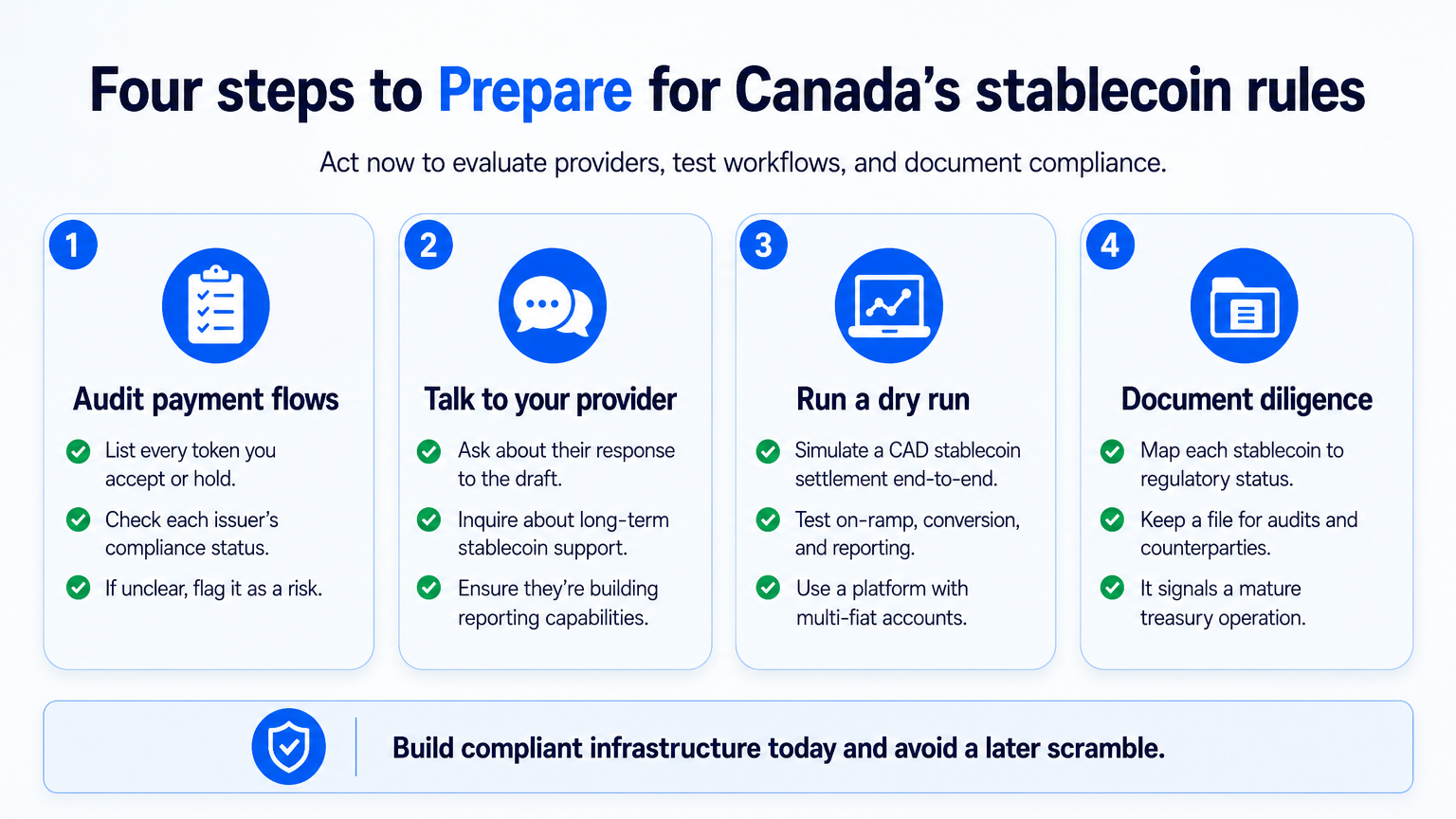
- Audit your stablecoin payment flows. List every token you accept or hold for settlement. For each, identify the issuer and whether it meets the draft’s definition and reserve requirements. If you can’t get clear answers, the stablecoin is a risk.
- Talk to your payment provider. Ask how they’re responding to Canada’s draft, which stablecoins they plan to support long‑term, and whether they’re building out Bank of Canada‑style reporting capabilities. A provider that can’t articulate its regulatory readiness isn’t ready.
- Run a “compliant‑rail” dry run. Pick a single CAD‑denominated payment corridor and simulate what a fully compliant stablecoin settlement would look like — including fiat on‑ramp, conversion, and reporting. A fiat and crypto payments platform that already supports multi‑fiat accounts and crypto‑to‑fiat conversion lets you test whether operational workflows hold up under the coming rules.
- Document your due diligence. If you’re working with global counterparties, you’ll need to show that your payment arrangements use compliant instruments, especially when Canadian dollars or Canadian entities are involved. Having a file that maps each stablecoin to its regulatory status is no longer nice‑to‑have — it’s a sign of a mature treasury operation.
What to Watch Next
The comment period runs until December 23, 2026. Watch for revised draft regulations in early 2027, and for any final rules that set compliance dates. Pay attention to whether the Bank of Canada publishes guidance on permissible reserve assets and reporting templates. Cross‑reference developments in the U.S., where the OCC’s final rule on digital asset leadership and the Federal Reserve’s proposed GENIUS Act rulemaking are moving in parallel — DAOs and stablecoins will increasingly intersect with these frameworks as decentralized organizations seek compliant payment rails. Ultimately, Canada’s draft is likely to become a template for other G7 regulators, so building compliant stablecoin payment infrastructure now is an investment that will pay out across borders.
What do Canada’s proposed stablecoin rules actually require?
The draft requires that a “payment stablecoin” (fiat‑pegged, payment‑use digital value) be issued by a regulated entity that holds 1:1 reserves in high‑quality liquid assets, implements governance and risk management frameworks, and submits regular reports to the Bank of Canada. The rules also expand retail payment oversight, pulling more payment service providers under supervision. These requirements are not self‑executing; they create an ongoing compliance obligation, with penalties for violations. The full text is open for comment until December 23, 2026.
How will the Stablecoin Act affect my business if I use stablecoin payments today?
If you are not an issuer, the most immediate effect is indirect: your payment provider will need to ensure it only supports stablecoins that meet the definition and reserve standards, and it may be subject to new reporting obligations. If you hold or accept a non‑compliant stablecoin, its liquidity could dry up as regulated platforms delist it. Additionally, if your business handles Canadian dollar‑pegged stablecoins or transacts with Canadian counterparties, the expanded retail payments oversight may require your payment provider to register — and that could change service terms, fees, or supported corridors. In short, your stablecoin payment flows will only be as reliable as the compliance posture of your partners.
Do I need to change my payment provider because of these regulations?
Not necessarily today, but you should evaluate whether your current provider is actively engaging with the draft and has a credible path to compliance. A provider that has already built multi‑fiat accounts, crypto‑to‑fiat conversion, and secure custody is better positioned to adapt than one that treats stablecoins as a side experiment. The key is to avoid a provider that will be forced to discontinue the very tokens you rely on. If your provider’s response to the draft is silence or generic reassurances, begin testing alternatives now — including platforms that combine CAD accounts with crypto on/off‑ramps — so you aren’t caught in a migration crunch later. Tools like Joyrise can help your team stay ahead of regulatory shifts by automating content that educates your treasury and compliance stakeholders as rules evolve.
What does compliant stablecoin payment infrastructure look like?
Compliant infrastructure combines traditional multi‑currency fiat accounts (including CAD) with stablecoin on‑ramps and off‑ramps, underpinned by robust KYC/AML, real‑time transaction monitoring, and secure digital asset custody. It should be able to generate the types of reports the Bank of Canada will expect, and it should only support stablecoins from issuers that meet the reserve and governance requirements. A platform that seamlessly handles ACH, wire, bill payments, and crypto payments within a unified interface is a practical reference point.
Can I still use stablecoins for cross-border settlements if I’m not a Canadian company?
Yes. The draft applies to Canadian‑regulated entities and to stablecoins offered in Canada. If your settlement involves a non‑Canadian stablecoin and no Canadian counterparty, the rules don’t directly bind you. However, if you use a Canadian dollar‑pegged stablecoin, or if your payment provider or a Canadian bank touches the transaction, compliance becomes relevant. Moreover, the Canadian framework is being watched closely by other G7 regulators; non‑Canadian businesses that adopt compliant infrastructure now will have a smoother time when their own jurisdiction introduces similar rules.
What’s the difference between a regulated and unregulated stablecoin under these rules?
A regulated stablecoin is issued by an entity that meets the Canada Stablecoin Act’s definitional, reserve, and ongoing compliance obligations. Unregulated stablecoins lack this oversight — they have no legally enforceable reserve requirements, no mandatory reporting, and no Bank of Canada supervision. Under the draft, Canadian payment service providers would not be able to support unregulated stablecoins. For a business, using an unregulated stablecoin means accepting counterparty risk that the token’s issuer can’t be held accountable for misrepresentation, reserve shortfalls, or operational failures. In a post‑regulation world, regulated stablecoins become the only viable settlement tools for any serious enterprise.
Key Takeaways
- Canada’s draft regulations turn payment stablecoins into a legally defined, 1:1‑backed, and continuously supervised instrument — separating regulated from unregulated tokens with enforceable consequences.
- Businesses using stablecoin payments face indirect but real exposure: their payment providers must adapt, and non‑compliant stablecoins will lose liquidity.
- Evaluate your payment provider’s regulatory readiness now, while the comment period is open and transition window looms; silence or inaction from a provider is a red flag.
- Compliant infrastructure blends multi‑currency fiat accounts (including CAD) with stablecoin rails, secure custody, and real‑time reporting — a stack already available through crypto‑native platforms.
- The draft is a blueprint likely to influence other G7 nations; building compliant payment flows today saves a costly retrofit later.
Ready to put this into practice? Get started with onesafe.io.



