

On November 14, 2026, UK-licensed bank Griffin closed a $20 million Series B round to expand its embedded banking platform into card issuing and stablecoin banking infrastructure—a move that reshapes the landscape for stablecoin payments. The raise doesn’t just fund a product roadmap; it signals that stablecoin settlement rails are moving inside licensed banks, forcing every fintech and business leader to re-evaluate how they handle cross-border money.
Table of Contents
- What is Griffin and why does its funding matter for stablecoin payments?
- How do stablecoin payments work for a business that isn’t crypto-native?
- Does my business need a bank license to offer or use stablecoin payments?
- What should a finance lead look for in a stablecoin-ready platform?
- How does the Griffin news change the roadmap for stablecoin adoption?
- Key Takeaways
- Sources
What is Griffin and why does its funding matter for stablecoin payments?
What Happened: The Details of the Series B
Griffin, a fully licensed UK bank, raised $20 million in Series B funding led by Octagon Partners, with participation from Notion Capital, A+ Ventures, Nordic Ninja, Breega, and others. The round values the company at more than $100 million, according to a report from Pulse 2.0 on November 14, 2026. Griffin provides embedded banking infrastructure that lets fintechs and tech platforms integrate accounts, payments, and compliance into their products. It already serves over 80 businesses—including Uber, Countingup, Anna Money, Yonder, and Prosper—with infrastructure supporting more than 300,000 underlying customers and processing nearly 10 million payments annually. The new capital will fuel expansion into debit and credit card issuing and stablecoin-related services, putting a banking license behind digital-currency features.
Why It Matters: Bringing Stablecoin Rails Inside a Licensed Bank
When a bank with a full regulatory license builds stablecoin rails, the whole conversation shifts. Previously, stablecoin payments were the domain of crypto-native firms or fintechs that partnered with third-party liquidity providers. Now, a bank is directly embedding stablecoin compatibility into its core platform as a licensed stablecoin bank, which means the settlement, compliance, and fiat on/off ramps can sit inside a regulated framework. That lowers the perceived risk for business clients that have been cautious about stablecoins. It also pressures other banks to follow suit—just as PNC’s USDC pilot and large institutions’ experiments with tokenized deposits signal a broader shift. Griffin’s move isn’t about a niche crypto bank; it’s about the infrastructure layer where mainstream fintechs already operate.
How do stablecoin payments work for a business that isn’t crypto-native?

Settlement Speed and Cost vs. Traditional Wires
A business that isn’t crypto-native can use stablecoin payments without ever holding a crypto wallet. The typical flow: a company sends a payment in its home fiat currency through a platform; the platform converts the fiat to a regulated stablecoin like USDC; the stablecoin transfers over a blockchain to the recipient’s account; and the platform then converts the stablecoin into the recipient’s local fiat. This all happens in minutes—sometimes seconds—versus the 3–5 days a SWIFT wire takes. The fiat to stablecoin on-ramp is seamless and compliant, handled entirely by the platform. Costs are minimal: while a traditional cross-border wire can cost $25–50 in fees plus a 3–5% FX spread, a stablecoin payment is often a $0 transfer fee with a small conversion charge. For example, OneSafe charges 0.15% for fiat deposits and withdrawals, and USDC transfers are free.
This efficiency is driving adoption. USDC business payments, in particular, offer a stable value and wide acceptance. B2B stablecoin payments are the fastest-growing slice of the stablecoin market, as businesses use them for supplier invoices, payroll, and intercompany settlement. Even large enterprises are moving in—Visa describes B2B stablecoin payments as enabling “always-on” settlement, a stark contrast to batch-based legacy systems.
From Remittances to B2B: Use Cases That Are Working Today
Stablecoin payments are already solving real problems. Cross-border stablecoin payments for supplier invoices and payroll are a proven use case. A startup paying remote contractors in multiple countries can cut payroll costs by avoiding per-wire fees and bad FX rates. A digital marketplace settling payouts to global sellers can do so instantly, improving liquidity. And cross-border remittances—historically a 7%+ cost burden—are being re-engineered with stablecoins. The key is a platform that handles the fiat-to-stablecoin conversion and the final mile, so the business never touches a private key. That’s exactly how platforms like OneSafe bridge fiat and crypto without any blockchain expertise required.
Does my business need a bank license to offer or use stablecoin payments?
No. A business does not need a bank license to use—or even to offer—stablecoin payments, provided it works through a properly structured partnership. This is where embedded banking models come in.
The Embedded-Banking Model Explained
Griffin itself is a prime example: it holds the UK banking license and provides the regulated infrastructure; its fintech clients build their products on top of it without needing their own charters. The embedded finance stablecoins model extends to a platform connecting to Griffin’s banking APIs for fiat accounts, card issuing, and now stablecoin settlement, all while Griffin handles the heavy regulatory lift. For non-bank fintechs, this means they can offer crypto-friendly business accounts that support stablecoin payments without becoming a bank.
How Platforms Like OneSafe Bridge Fiat and Crypto Without a Bank Charter
OneSafe, for instance, is a financial technology company—not a bank—that partners with licensed banks to deliver multi-currency accounts, ACH, wires, and crypto-fiat conversions. It enables businesses to send and receive USDC, convert funds seamlessly, and manage both fiat and crypto operations in one interface. Because it sits atop regulated banking partners and uses Fireblocks for custody, its customers get a crypto-friendly business account that complies with KYB/AML standards without needing to obtain a license themselves. This is the path most growing companies will take: adopting a unified platform that has already done the integration and regulatory work. The Griffin news simply adds another licensed backbone that other platforms may choose to integrate in the future, widening the field.
What should a finance lead look for in a stablecoin-ready platform?
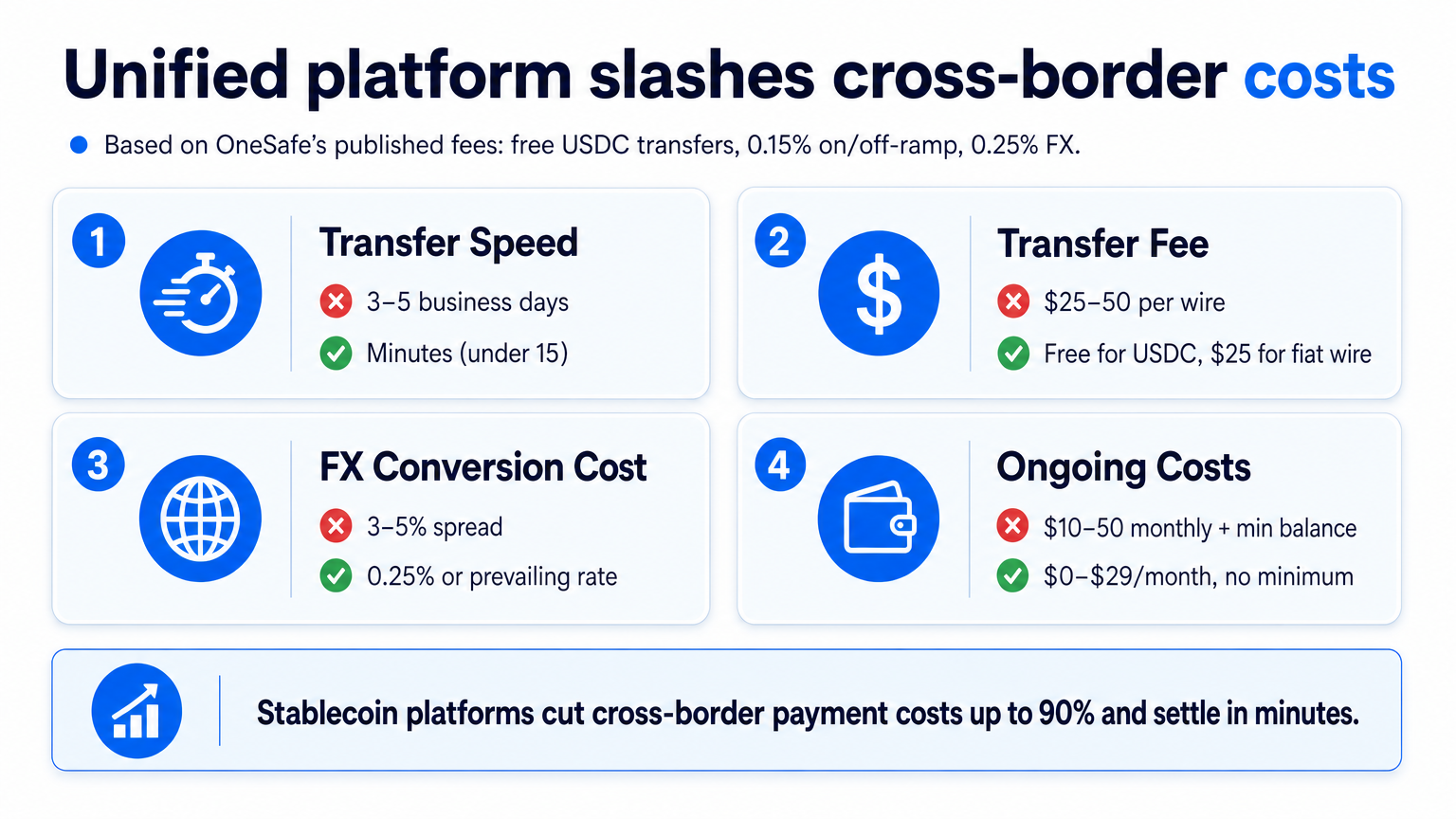
When evaluating a platform, focus on four areas that determine whether stablecoin payments will reduce cost and risk instead of creating new headaches.
Audit Your Cross-Border Payouts for Stablecoin Fit
Start with an audit: map every cross-border payout stream—supplier payments, contractor payroll, intercompany transfers—and identify those with high historical wire fees, long settlement times, or FX markup. If a payee already accepts digital payments, a stablecoin route can be tested with a small batch. The decision framework below can help.
Checklist: Is a Payout Ready for Stablecoins?
- Does the counterparty accept fiat bank transfer today?
- Is the amount under $50,000 (a typical ceiling for piloting stablecoins without liquidity concerns)?
- Does the corridor have reliable fiat on/off-ramp (USD, EUR, CAD, etc.)?
- Is the payment recurring (saving per event compounds quickly)?
If three of four are “yes,” a stablecoin test is low-risk and high-reward.
Choose a Unified Fiat-Crypto Platform Over Point Solutions
Point solutions—a crypto wallet here, a separate FX provider there—multiply reconciliation work and compliance exposure. A unified platform that handles fiat accounts, stablecoin conversions, and wire payouts under one roff simplifies both operations and audit trails. Look for a provider that supports USDC natively, offers multi-currency accounts in USD, EUR, CAD (and more coming), and provides instant conversion between fiat and crypto.
For businesses that already operate across fiat and digital assets, a platform like OneSafe consolidates these functions. Its pricing model is transparent: fiat deposit/withdrawal at 0.15%, wire withdrawals at $25, SWIFT transactions at 0.35%+$50, and USDC deposits and withdrawals are free. FX conversions cost just 0.25% (or the prevailing rate)—a fraction of the typical bank spread—and the platform integrates accounting software to keep everything in one place.
Prioritize Compliant, Audited Partners to Future-Proff Your Stack
Regulatory scrutiny is intensifying. stablecoin regulation 2026 has pushed firms to demand that partners hold proper registrations, meet KYB/AML standards, and segregate customer funds. When assessing a stablecoin-ready platform, verify that:
- The platform’s banking partner is licensed in a reputable jurisdiction.
- Digital assets are custodied with a qualified custodian (e.g., Fireblocks, which OneSafe uses).
- The platform enforces multi-factor authentication and encryption by default.
- The onboarding process collects business formation papers and government-issued ID, not just an email.
- The provider is transparent about its regulatory status—whether a bank or a technology company—and doesn’t claim FDIC insurance if it can’t deliver it.
A good practice is to request the platform’s latest compliance report or ask specifically about how it handles the fiat exit problem—a pain point where poor liquidity or unclear off-ramp procedures can trap funds.
The table below summarizes the cost and speed advantages that a well-integrated platform can provide, using OneSafe’s published fees as a concrete reference point.
| Service | Typical Traditional Bank Wire | Stablecoin Payment via Platform (e.g., OneSafe) |
|---|---|---|
| Transfer speed | 3–5 business days | Minutes (often under 15) |
| Transfer fee (outgoing) | $25–50 per wire | $0 for USDC transfer; $25 for wire when using fiat |
| FX conversion cost | 3–5% spread | 0.25% (or prevailing rate) |
| On-ramp fee | N/A (no conversion) | 0.15% for fiat deposit |
| Off-ramp fee | N/A | 0.15% for fiat withdrawal |
| SWIFT fee | $30–50 + beneficiary bank charges | 0.35% + $50 |
| Recurring costs (monthly) | $10–30 account fees | $0 (free plan) or $29+/month (premium) |
| Minimum balance | Varies ($1,000–$10,000) | $0 – $10,000 depending on plan |
Note: Traditional wire fees and spreads vary widely by bank and corridor. Platform fees reflect OneSafe’s published pricing as of the date of this article and are illustrative; always verify current terms.
How does the Griffin news change the roadmap for stablecoin adoption?
Will More Licensed Banks Follow Griffin’s Lead?
The Griffin round is not an isolated event. It comes at a time when central bank stablecoin tests and private-sector pilots are multiplying. PNC has completed a USDC pilot for treasury management; JP Morgan is moving deeper into tokenized deposits. Griffin’s entry as a builder of infrastructure—not just a user—suggest that within the next 12–18 months, we’ll see other small to midsize banks in the UK, Europe, and potentially the US offering stablecoin settlement as a service to fintechs. The licensing moat these banks hold will become a distribution advantage: they can package stablecoin rails alongside traditional accounts, making adoption frictionless for the non-crypto businesses that already trust bank-grade tools.
For fintechs, this means the pressure to differentiate will shift from access (which anyone can now buy by partnering with a licensed banking-as-a-service provider) to execution: who can offer the smoothest UX, lowest fees, and broadest currency coverage atop those rails.
Open Questions on Multi-Chain Settlement and Stablecoin Standards
However, three open questions remain. First, multi-chain fragmentation: while USDC on Ethereum is dominant, newer networks like Soana and Sui are gaining traction, and a platform that locks onto a single chain may face liquidity or compatibility issues. Second, stablecoin standards: as regulatory frameworks like the GENIUS Act in the US and Thailand’s daily cap regulation emerge, businesses must watch for compliance hurdles that could affect which stablecoins are permissible and in what amounts. Third, interoperability between bank-led stablecoin systems and public blockchains isn’t a given—it will require common APIs and settlement protocols that don’t yet exist at scale. These are exactly the integration challenges a licensed stablecoin bank like Griffin is positioned to solve, but the timelines are uncertain.
Key Takeaways
- Griffin’s $20M raise marks a turning point: a licensed bank is now actively building stablecoin infrastructure, signaling that stablecoin payments are moving from fintech fringe to regulated core.
- Businesses do not need a bank license to benefit; platforms like OneSafe partner with banks to offer compliant, crypto-friendly accounts that execute stablecoin payments without any blockchain expertise from the user.
- The fastest way to start is to audit existing cross-border payouts against a simple checklist—recurring payments under $50,000 in corridors with good fiat on/off ramps are ideal pilot candidates.
- When selecting a platform, prioritize those that unify fiat and stablecoin operations, publish transparent fees (e.g., free USDC transfers, low FX), and demonstrate strong custody and compliance practices.
- The next 18 months will likely bring more banks following Griffin’s lead, but businesses can act now by integrating a single platform that both isolates regulatory complexity and cuts cross-border costs today.
And while you focus on payments, your content marketing can grow organic traffic while you sleep—a service that automates SEO article publishing to your site.
Open a free account at OneSafe to manage fiat and stablecoin payments in one place.
Sources



