Stablecoin payments’ real friction isn’t on‑chain — it’s the fiat exit. Visa and Mastercard’s 2026 moves treat off‑ramps as the product. Here’s how to close the gap.
Table of Contents
- What just happened: payments giants signal the exit is the product
- Why the exit has become the bottleneck no one talks about
- From wallet to invoice paid: mapping the real off‑ramp journey
- What a reliable stablecoin pay‑out infra actually looks like
- Practical steps for a treasury team to derisk the exit today
- What to watch next in stablecoin payments
- What is the ‘exit problem’ in stablecoin payments?
- How do Visa and Mastercard’s latest stablecoin offerings actually work for business payouts?
- What does the BIS research say about the true cost of stablecoin cross‑border payments?
- What should a finance lead check before paying a supplier in USDC?
- How can a business keep stablecoin‑to‑fiat conversion costs predictable?
- What infrastructure closes the gap between on‑chain settlement and supplier bank delivery?
- Key Takeaways
What just happened: payments giants signal the exit is the product
Visa Direct now supports USDC prefunding for cross‑border payouts, starting with Inyo Global
Visa Direct stablecoin prefunding, using USDC, moved into production on October 15, allowing businesses to fund cross‑border payouts via stablecoin and settle through existing card rails. The signal is clear: Visa isn’t just exploring crypto‑native settlement; it’s letting businesses plug USDC directly into the payout infrastructure that already reaches billions of cards and accounts. (Visa’s USDPT Move Signals Stablecoin Payments Shift)
Mastercard bundles fiat, stablecoins, and local bank payouts into a single API
Mastercard’s stablecoin API, launched with BVNK as the Global Money Platform, bundles fiat and stablecoin balances, conversion, and local bank payouts. According to Mastercard’s stablecoin primer, such APIs bridge digital assets with everyday treasury operations. This unification collapses a multi‑hop process into one orchestrated flow, directly linking a business’s USDC to a supplier’s bank account.
A BIS stablecoin paper quantifies the cost drag after the blockchain transfer
An October 2026 BIS working paper compared bank, fintech money transfer operator, and stablecoin payment routes. Its core finding: a cheap on‑chain transfer does not guarantee a cheap end‑to‑end international payment. For cross‑border B2B payments, the off‑ramp—exchange spreads, withdrawal fees, correspondent charges—can shrink the final amount by 2–5%. An illustrative example shows a sender converting dollars into 100 USDC and moving them, only to find that less than equivalent local currency arrives in the destination bank account.
Why the exit has become the bottleneck no one talks about
Suppliers bill in local currency, not in USDC — businesses must convert somewhere
Most suppliers still invoice in their domestic currency. Even when a business holds USDC and can initiate a payment in seconds, someone must sell the stablecoin for local fiat and push a final bank wire. That conversion and delivery leg, when handled by separate providers, layers on costs and delays that go unnoticed.
The BIS finding: moving $100 USDC on‑chain doesn’t guarantee a $100 end‑payment
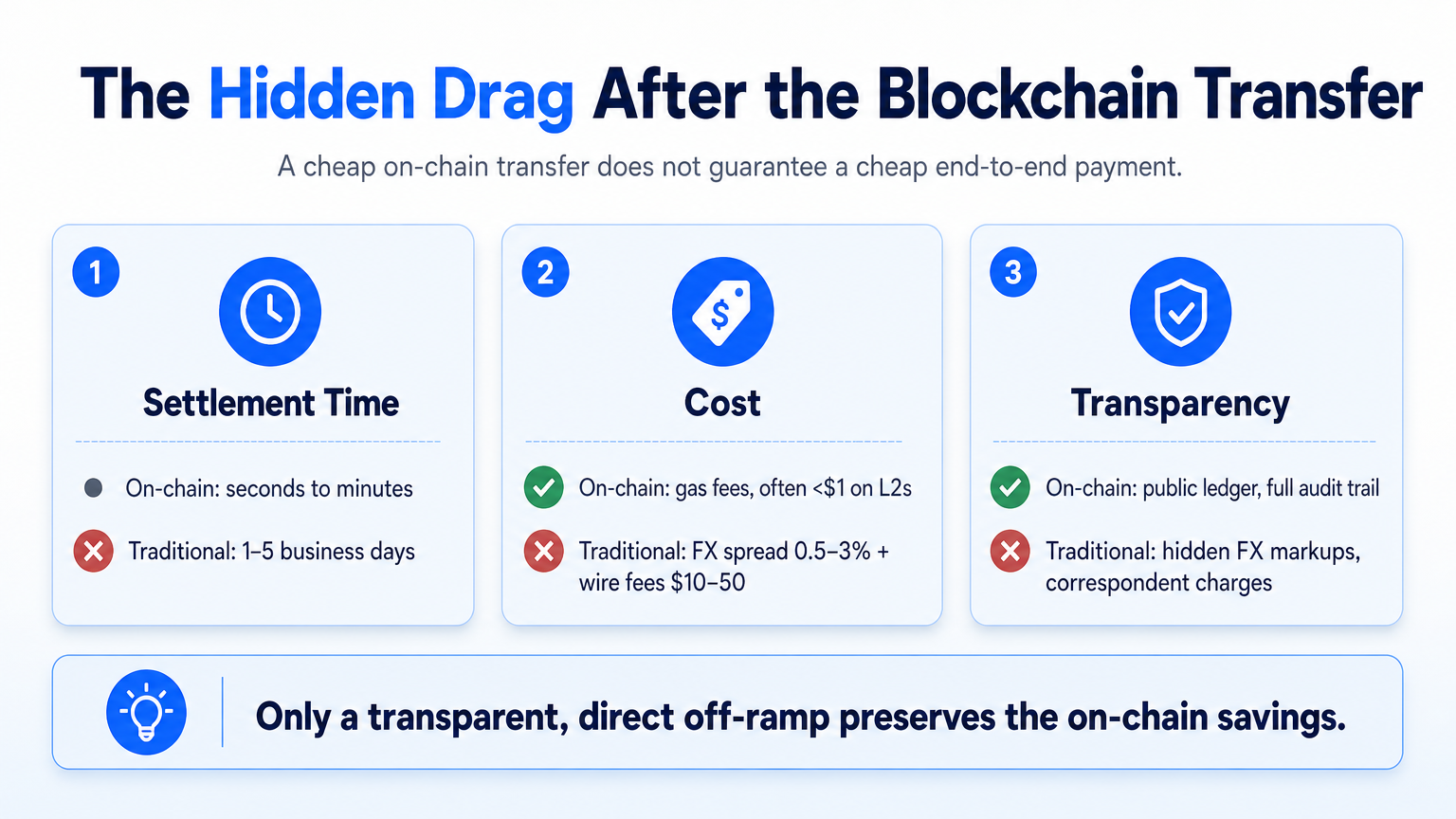
The BIS stablecoin paper makes the hidden costs explicit. After the sender converts to USDC on one exchange and off‑ramps through another, the cumulative effect of an exchange spread, a withdrawal fee, and a correspondent lift can cut 2–5% from the amount the supplier receives. What looked like a 0.1% blockchain cost turns into a meaningful dent.
When banking rails clash with blockchain speed: cutoff times and intermediary bank fees
A USDC transfer settles in seconds, but a local bank might only execute outbound wires during business hours. If conversion completes after a Friday cutoff, the supplier’s funds won’t arrive until Tuesday. Add a correspondent bank deducting $15, and a payment that should have been fast and economical suddenly looks like the legacy system it was meant to replace.
| Aspect | On‑Chain USDC Transfer | Traditional Off‑Ramp Delivery |
|---|---|---|
| Settlement time | Seconds to minutes | 1–5 business days (dependent on bank cutoffs) |
| Cost | Gas fees, often <$1 on L2s | FX spread (0.5–3%) + wire fees ($10–$50) |
| Certainty | Deterministic blockchain finality | Subject to intermediary hops and local delays |
| Transparency | Public ledger | Hidden FX markups, correspondent charges |
From wallet to invoice paid: mapping the real off‑ramp journey
Step 1: USDC in a wallet — making sure it can be moved without degrading the balance
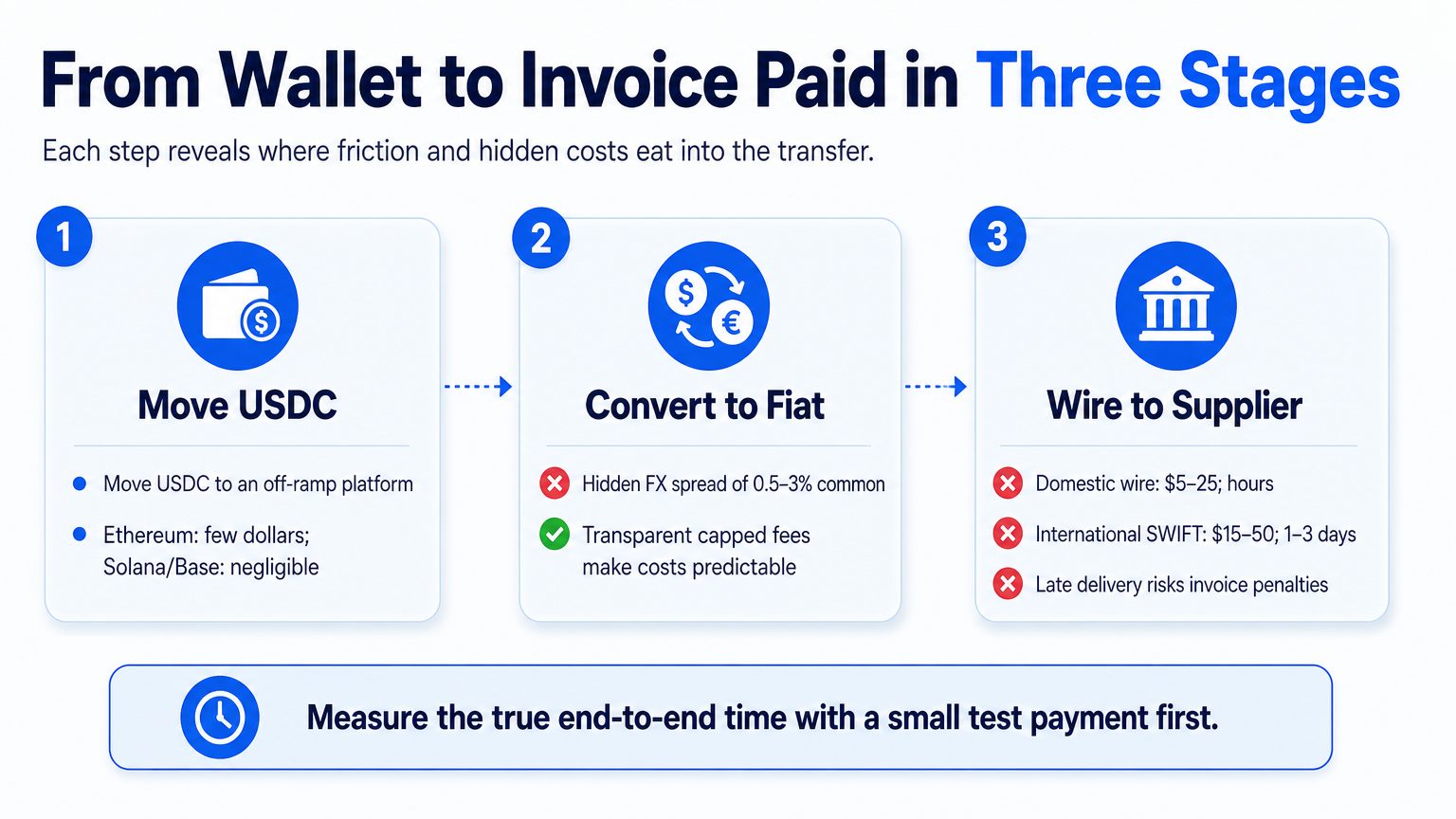
Before any conversion, the business needs to move USDC to a platform that can actually off‑ramp. Network fees range from a few dollars on Ethereum to negligible on Solana or Base. The first friction is simply getting the tokens to a place that can turn them into cash.
Step 2: Conversion to local fiat at a rate that doesn’t erase the on‑chain savings
The biggest hidden cost is often the FX spread. Exchanges and fintech money transfer operators commonly embed a 0.5% to 3% markup in the exchange rate without disclosing it as a fee. Only transparent, capped conversion fees—not floating spreads—make the cost predictable.
Step 3: Pushing funds to the supplier’s bank account within their payable window
Once converted, the payment must travel the last banking mile. A domestic wire might cost $5–$25 and land within hours; an international SWIFT transfer could add $15–$50 and take one to three business days. If the timeline misses the supplier’s invoice due date, late‑payment penalties wipe out any savings.
What a reliable stablecoin pay‑out infra actually looks like
A reliable stablecoin pay‑out infrastructure demands three elements: direct local bank partnerships to avoid correspondent chains, transparent FX with capped fees (ideally a fixed percentage like 0.25%), and segregated fiat accounts that hold both stablecoins and local currencies. McKinsey’s analysis of stablecoins payments infrastructure for modern finance confirms that integrated off‑ramps with direct banking and clear pricing eliminate the hidden costs that plague cross‑border flows.
For blockchain supplier payments, such a stack turns a fragmented three‑party flow into a single‑platform operation. Instead of sending tokens to an external exchange, converting, and routing funds through a separate bank, the business can hold USDC alongside fiat, convert at a known rate, and wire directly to supplier accounts—cutting out external bridges. OneSafe, for example, provides that by letting businesses hold USDC with USD, EUR, and CAD, convert at 0.25%, and pay suppliers domestically.
Practical steps for a treasury team to derisk the exit today
- Ask your stablecoin provider what local bank rails are under the hood. Demand to know: in which countries do you have direct bank partnerships? Which payment schemes—ACH, SEPA, Faster Payments—are available? If the answer reveals a chain of correspondent banks, the final leg will be slower and more expensive than the marketing suggests.
- Run a test payment before committing a supplier run. Pick a small invoice, fund it with USDC, and record the exact moment the supplier’s bank receives the funds. The difference between the on‑chain settlement timestamp and the bank‑credit timestamp is the off‑ramp delay. Use that measurement, not the provider’s stated processing time.
- Consider platforms that keep fiat and crypto under one roof. When stablecoins and fiat sit in the same account environment, conversion and transfer become a single, auditable step. That consolidation turns a fragmented process into a repeatable operation.
What to watch next in stablecoin payments
Will card networks push interoperability standards for stablecoin settlement?
Visa and Mastercard’s simultaneous moves suggest they view stablecoin pay‑outs as a new network effect. The next logical step is a standard that lets one network’s token flow through another’s rails—essential if businesses are to pay any supplier regardless of the pay‑out network they sit on.
How the GENIUS Act’s payment stablecoin regulation shapes off‑ramp licensing
U.S. regulation is zeroing in on a specific category: payment stablecoins. The emerging payment stablecoin regulation will determine which entities can legally operate the fiat‑conversion leg of a stablecoin payment. This licensing framework will either accelerate the growth of compliant off‑ramps or force businesses into a grey‑zone, depending on how quickly it materializes. (See also Circle’s framing of USDC as a consumer utility.)
The next BIS paper will likely quantify speed vs. cost trade‑offs across rail combinations
The October 2026 BIS working paper exposed the cost drag; a follow‑up study is expected to map speed‑vs‑cost trade‑offs across different rail combinations (e.g., USDC‑to‑SEPA versus USDC‑to‑SWIFT). For treasury teams, that data will replace guesswork with decision‑quality numbers.
What is the ‘exit problem’ in stablecoin payments?
The exit problem, or crypto off‑ramp, is the difficulty of converting stablecoin value into a form a supplier can actually use—typically a deposit in their local bank account in their local currency. While blockchain transfers settle in seconds, the subsequent conversion and fiat delivery add costs, delays, and uncertainty because most business suppliers still invoice in fiat.
How do Visa and Mastercard’s latest stablecoin offerings actually work for business payouts?
Visa launched Visa Direct stablecoin prefunding, letting businesses pay cross‑border with USDC and settle in local bank accounts. Mastercard’s stablecoin API, part of the Global Money Platform with BVNK, bundles fiat and stablecoin balances, conversion, and local bank payouts into a single API. In both cases, the card networks integrate the off‑ramp directly into their existing payment rails, so the business can hold USDC and still deliver fiat to suppliers without managing the conversion leg manually.
What does the BIS research say about the true cost of stablecoin cross‑border payments?
The BIS stablecoin paper found that a cheap on‑chain transfer does not guarantee a cheap end‑to‑end international payment. Even when the blockchain leg is nearly free, the off‑ramp—exchange spreads, withdrawal fees, correspondent bank charges—can erode savings, sometimes leaving the supplier with 2–5% less than the nominal amount sent. Its example shows moving 100 USDC on‑chain can result in less than equivalent local currency arriving, due to cumulative charges after the blockchain step.
What should a finance lead check before paying a supplier in USDC?
A finance lead should verify the entire exit chain, not just the blockchain leg. Specific checks: Does the platform have direct bank partnerships in the supplier’s country, or does it rely on a chain of correspondent banks? What is the exact spread or conversion fee—is it a fixed percentage or a hidden market spread? What are the wire‑out fees and typical settlement times for local payouts? Finally, run a test payment with a small amount to measure true end‑to‑end time before committing regular supplier payments.
How can a business keep stablecoin‑to‑fiat conversion costs predictable?
Predictable conversion costs come from a transparent, fixed fee structure rather than a floating exchange spread. Ideally, the provider charges a stated percentage on the converted amount, with no additional hidden margin. Using a platform that holds both stablecoins and fiat in the same account environment lets you lock in the rate at the moment of conversion and see exactly what the supplier will receive. (The same consolidation helps with fiat‑to‑crypto conversion, avoiding fragmented fees when loading stablecoins.)
What infrastructure closes the gap between on‑chain settlement and supplier bank delivery?
The gap is closed by an integrated stack: direct local bank partnerships that bypass correspondent banking, transparent FX conversion with capped fees, and segregated fiat accounts that hold both stablecoins and local currencies. When a platform offers these under one roof, the business can convert USDC and immediately route a domestic wire—without transferring value to an external exchange and then to a separate bank. This unified approach turns a three‑party flow into a single‑platform operation, eliminating the main sources of delay and cost.
Key Takeaways
- Stablecoin payments are only as efficient as their weakest off‑ramp leg; the real cost appears after the blockchain transfer.
- Visa and Mastercard’s October 2026 moves integrate USDC directly into payout rails, acknowledging that the exit is the product.
- The BIS stablecoin paper confirms that on‑chain cheapness does not translate into cheap end‑to‑end international payments unless the off‑ramp is transparent and direct.
- Treasury teams should validate a provider’s local bank partnerships, conversion fees, and actual delivery times with a small test payment before scaling.
- Keeping fiat and crypto in a single platform eliminates external bridges, making both conversion and payout predictable.
To keep your finance content fresh while you focus on operations, Joyrise automatically writes and publishes SEO articles to your Webflow, WordPress, or Shopify site every day—starting with your first article before you pay.
For businesses ready to unify their fiat and crypto supplier payouts with transparent off‑ramps, explore OneSafe’s platform.