
On November 19, 2026, PYMNTS reported that banks are actively courting blockchain customers through tokenized deposits and stablecoin partnerships — without giving up the deposit funding that supports lending. That puts crypto banking at the center of a structural shift, not just a product cycle.
Table of Contents
- Summary: What Happened?
- What does the bank-blockchain convergence mean for crypto banking?
- Why do banks want blockchain’s customers now?
- How will tokenized deposits affect businesses that use crypto?
- Should Web3 startups keep using neo-banks or switch to traditional banks?
- What are the risks of relying on a bank for crypto services?
- How does this shift impact DAOs specifically?
- What regulatory changes could come next for crypto banking?
- What's Still Unknown About Banks and Crypto Banking?
- What to Watch Next in Crypto Banking
- Key Takeaways
Summary: What Happened?

On November 19, 2026, PYMNTS published "Why Banks Want Blockchain's Customers", reporting that banks want blockchain's speed without losing deposits. The report describes tokenized deposits and stablecoin partnerships as tools that let banks modernize payments while protecting the customer balances that fund lending and broader financial relationships.
The sharper point is that the real competition is shifting from moving money to managing it. As payment rails become interchangeable, PYMNTS argues, competitive advantage may migrate toward liquidity, credit, risk management, and control of the customer relationship. Blockchain adoption, the report says, depends on business value — lower costs, better liquidity, reduced risk — not technology.
For founders and finance leads, that means crypto banking decisions now carry strategic weight: which provider sees your transaction data, holds your deposits, and controls the rail between fiat and crypto.
What does the bank-blockchain convergence mean for crypto banking?
The bank-blockchain convergence means crypto banking is moving from a fintech specialty into a contested core service where banks, neo-banks, and protocols compete for the same corporate treasury flows.
Until recently, crypto-friendly business accounts and fiat-crypto rails were mostly served by specialized platforms because traditional banks treated the activity as compliance risk. The November 19 report signals a reversal: banks want those customers back, but on bank terms. In practice, that can widen access and build institutional legitimacy, while also making the choice of platform more consequential. If the underlying payment rail becomes less of a differentiator, the value shifts to control — who can offer credit, liquidity, risk management, and a real relationship.
Why do banks want blockchain’s customers now?
Banks want blockchain's customers now because tokenized deposits and stablecoin partnerships let them modernize payments while protecting the deposits that fund lending, PYMNTS reported on November 19, 2026.
The strategic logic is straightforward. Banks have long controlled both where money sits and how it moves. Deposits provide funding; payment networks generate fees; the infrastructure connecting them keeps customers inside the banking system. Blockchain rails threatened that two-sided advantage. By offering tokenized deposits and stablecoin partnerships, banks can adopt blockchain's speed without handing the deposit base to a nonbank.
PYMNTS frames the takeaway directly: the real competition is shifting from moving money to managing it. Once payments move quickly and cheaply regardless of rail, the winner is whoever holds the relationship, the liquidity, and the credit.
How will tokenized deposits affect businesses that use crypto?
Tokenized deposits could give businesses a bank-issued digital cash instrument that settles faster than legacy rails while remaining a bank liability — but the benefits depend on programmability, transferability, and counterparty acceptance.
Lower costs vs. relationship control
The practical trade-off is lower payment costs against deeper bank visibility into treasury. Tokenized deposits may reduce settlement delays and wire fees, but they pull cash back toward bank-controlled ledgers and real-time reporting. For a global business comparing fiat and crypto banking options, the question is whether the savings justify giving one institution a more complete view of how money enters and leaves the business. Payment mechanics like ACH versus wire transfers already create cost and speed differences; tokenized deposits could compress those differences further, but only if the bank's ledgers interoperate.
The role of stablecoins and tokenized deposits
Stablecoin partnerships are the more mature path for cross-border settlement, while tokenized deposits are an emerging bank-issued alternative. The legal distinction matters: a payment stablecoin and a tokenized bank deposit are not the same instrument, as Brookings has laid out. For treasury teams, the practical effect is liquidity and counterparty risk: a tokenized deposit may sit on the bank's balance sheet, while a stablecoin's backing and redemption terms depend on the issuer. As Visa Direct adds stablecoin payments, the rail layer is becoming interchangeable faster than the regulatory layer.
Should Web3 startups keep using neo-banks or switch to traditional banks?
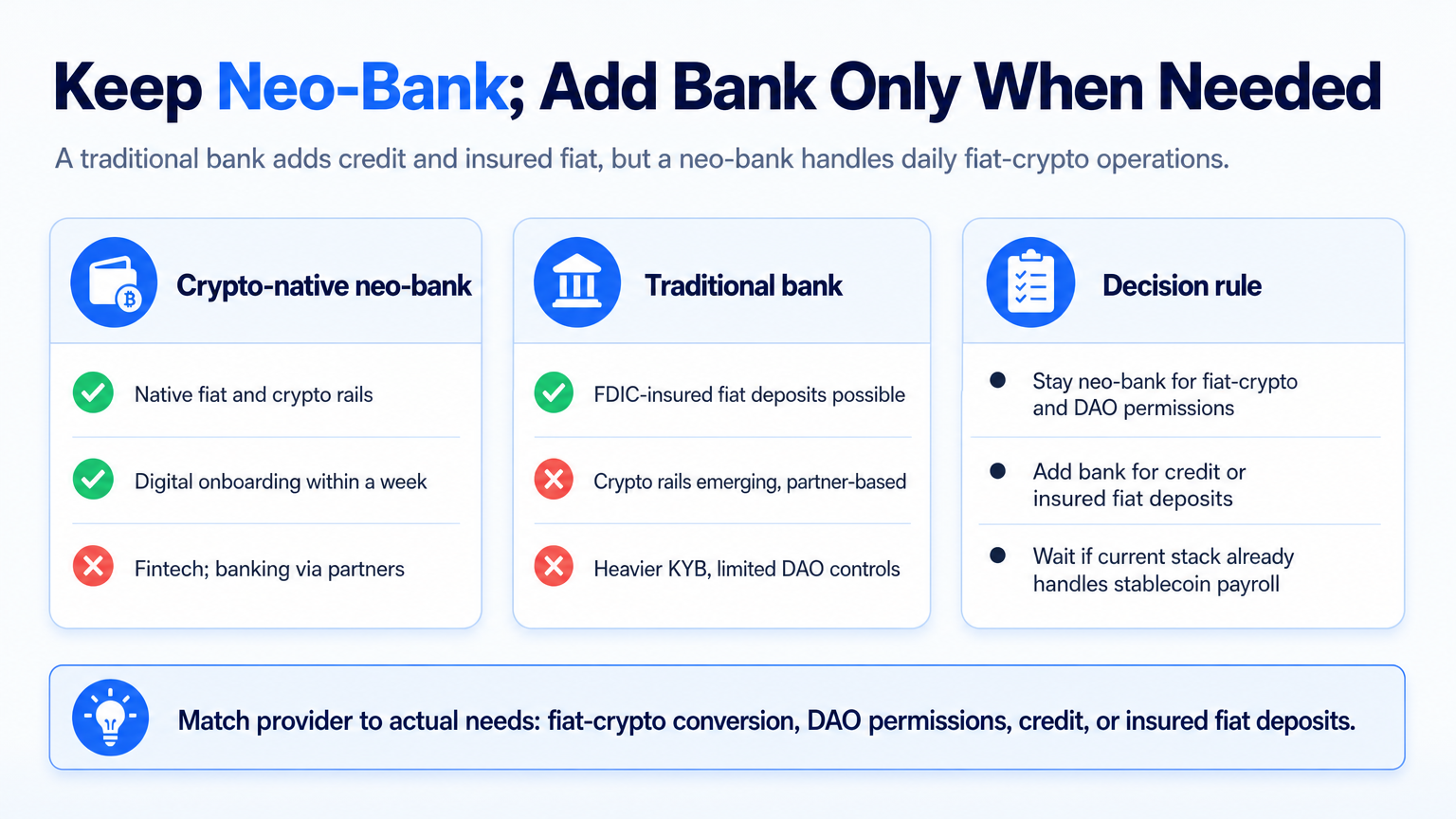
Most Web3 startups should not treat this as an either/or; the right default is to keep a crypto-native neo-bank as the operating stack and add a traditional bank relationship only when credit, insured fiat deposits, or a specific jurisdiction requires it. Specialized neo-banking for crypto still solves the daily fiat-crypto interface more directly.
Trade-offs: banks vs. neo-banks
| Dimension | Traditional bank crypto offering | Crypto-native neo-bank |
|---|---|---|
| Regulatory status | Bank or trust charter; fiat deposits may be insured | Fintech, not a bank; banking services via partners |
| Fiat + crypto rails | Emerging, often partnership-based | Native ACH, wires, crypto on/off-ramp |
| Onboarding | Varies; often heavier KYB | Fully digital, typically within a week |
| DAO/Web3 controls | Limited | Customizable roles, permissions, workflows |
| Crypto custody | Depends on partner or trust | Fireblocks custody, mandatory MFA |
| Fee examples | Varies | USDC deposits/withdrawals free; wire withdrawal $25; FX up to 0.25% or FX rate |
OneSafe is a financial technology company, not a bank, and provides fiat and cryptocurrency transaction capabilities through bank partners. It processed over $800 million in transaction volume from more than 1,000 businesses across 30+ countries, according to company data. For a Web3 business that moves between USDC and USD several times a month, free USDC deposits and withdrawals and a single interface for fiat and crypto can matter more than a bank's brand.
A short decision checklist:
- Stay with a crypto-native neo-bank if you need fiat-crypto conversion, DAO-style permissions, or multi-currency accounts without waiting on a bank's crypto roadmap.
- Add a bank relationship if you need credit, lending, or FDIC-insured fiat deposits.
- Wait if your current stack already handles stablecoin payroll and invoicing; do not migrate on a bank's pilot promises until terms are public.
What are the risks of relying on a bank for crypto services?
The main risks of relying on a bank for crypto services are relationship concentration, slower product iteration, and potential account restrictions when transaction activity falls outside the bank's risk appetite.
A bank may offer tokenized deposits or stablecoin partnerships as a retention feature rather than a committed product line. If policy changes or compliance thresholds tighten, a business with all its fiat and crypto flows in one bank may have limited alternatives. Custody arrangements also vary: fiat deposits may benefit from insurance, but crypto assets may be held under different legal protections with third-party custodians. The safer assumption is to evaluate the bank's crypto offering on written terms, not marketing. Don't treat a bank's crypto pilot as a long-term treasury strategy until it survives a full regulatory cycle.
How does this shift impact DAOs specifically?
DAOs face the sharpest version of this shift because they typically need multi-signer controls, programmable permissions, and simultaneous fiat and crypto payment rails that traditional banks still do not offer.
Banks are built around named individuals and legal entities; DAO financial management usually requires customizable roles, automated payment workflows, and on-chain custody that map poorly to legacy account structures. The convergence may eventually improve fiat access for DAOs with legal wrappers, but it will not immediately solve governance or treasury execution. DAOs should watch whether bank tokenized deposit programs support programmable permissions or assume a single corporate signer. Until then, a platform with crypto treasury management built for web3 financial services is likely to remain the more usable operating layer.
What regulatory changes could come next for crypto banking?
The most likely next regulatory change is clearer state or federal guidance on tokenized deposits and bank-fintech partnerships, because policymakers must decide whether these instruments are deposits, securities, or something else.
State banking supervisors have already weighed in on tokenized deposits; the CSBS has published guidance on their treatment. The wider crypto banking charter wave shows that supervision is moving from no-rules to rule-making. For businesses, the regulatory path will determine whether a bank's tokenized deposit is as safe as a demand deposit, whether stablecoin partnerships are permanent, and how DAOs can hold fiat on-chain.
What's Still Unknown About Banks and Crypto Banking?
What's still unknown is whether banks will treat blockchain customers as a core segment or as a defensive detour, and whether tokenized deposits can match the 24/7 programmability businesses already get from stablecoins.
The November 19 PYMNTS report is a strategic signal, not a product catalogue. It does not specify launch dates, jurisdictions, pricing, custody models, or how banks will treat DAOs. Also unresolved: whether banks will offer real-time fiat-crypto conversion or simply a tokenized wrap around existing treasury services. Businesses should ask for written terms on deposit eligibility, transaction limits, and crypto custody before changing infrastructure.
What to Watch Next in Crypto Banking
Regulatory developments
Watch for federal and state regulators to clarify whether tokenized deposits receive deposit insurance treatment and how stablecoin issuers fit into bank charters. The MoonPay bank charter bid and related charter moves are a useful leading indicator for how crypto banking supervision is consolidating.
Platform consolidation
Expect banks, card networks, and neo-banks to consolidate around custody, stablecoin issuance, and fiat-crypto interface. The banks vs fintech boundary will blur further as each side absorbs the other's capabilities. For teams that also run a content or analyst program, Joyrise analyzes your site, then writes and publishes SEO articles to Webflow, WordPress or Shopify every day; your first article is written before you pay.
Key Takeaways
- Banks are entering crypto banking to protect deposit funding and customer relationships, not to replace stablecoins — treat their crypto offers as strategic, not neutral.
- Businesses should match a provider to actual needs: real-time fiat-crypto conversion, DAO permissions, credit, or insured fiat deposits.
- Tokenized deposits may reduce settlement friction, but they differ legally from stablecoins — confirm which instrument you hold before committing treasury.
- Web3 startups and DAOs should not assume they must switch to a bank; convergence makes the choice of crypto banking platform more important, not less.
- Watch regulatory definitions and bank-fintech partnership terms before locking into long-term infrastructure.
If you're evaluating a crypto banking setup that handles fiat and crypto in one place, sign up for OneSafe today.



