Table of Contents
- What Just Happened: South Korea's Stablecoin Cross-Border Payments Hit ₩860 Billion Despite Regulatory Stasis
- Why This Matters Now for Global Businesses and Web3 Startups
- The Background: A Quick Primer on Stablecoins and the Global Regulatory Patchwork
- The Disagreement: Are Stablecoins Securities, Commodities, or Something Else?
- What This Means for Your Business: Navigating Stablecoin Payments Amid Uncertainty
- Looking Ahead: What to Watch as Regulation Evolves
- Key Takeaways
What Just Happened: South Korea's Stablecoin Cross-Border Payments Hit ₩860 Billion Despite Regulatory Stasis
On September 17, 2026, BigGo Finance reported that South Korean companies had processed approximately $620 million (₩860 billion) in overseas stablecoin payments between January 2021 and September 2026.[^1] The volume surged even though South Korea stablecoin regulation remains in a legislative deadlock — a years-long impasse that has left businesses without a clear legal classification for stablecoins or a dedicated licensing regime.
The data underlines a stark reality: cross-border stablecoin payments are growing at enterprise scale in one of Asia’s most technologically advanced economies, while the National Assembly has yet to pass a bill defining how stablecoins should be treated. The ₩860 billion figure reflects real invoices paid, supply-chain settlements made, and treasury transfers executed by Korean firms — not speculative trading volume. This mirrors a pattern visible globally: businesses are moving faster than lawmakers, adopting dollar-pegged digital assets to cut remittance costs and settlement times, often with no explicit legal safe harbor.
The question for global businesses is no longer whether stablecoins work for international payments — it is how to manage the compliance risk until the rules catch up.
Why This Matters Now for Global Businesses and Web3 Startups
The ₩860 billion milestone is a signal that business stablecoin adoption has passed a tipping point in a major exporting country. For global businesses and Web3 startups, it means three things immediately:
- Market infrastructure is maturing. Korean firms have built internal processes to source, hold, and pay with stablecoins, indicating that enterprise-grade tooling (custody, on/off-ramps, FX conversion) is available and operating at meaningful scale.
- Regulatory pressure will intensify. When transaction volumes reach hundreds of millions of dollars without a legal framework, financial authorities face pressure from international standard-setters like the Financial Stability Board. South Korea stablecoin rules are likely to accelerate, and other jurisdictions will watch closely.
- Compliance is your own problem today. In the absence of clear rules, each business must design its own compliance framework — choosing jurisdictions, stablecoin issuers, and banking partners that meet acceptable standards.
The surge highlights the disconnect between regulatory stalling and real-world utility. When companies save millions by moving on-chain, they are not waiting for a legislative committee. That gap is where competitive advantage and compliance risk coexist.
The Background: A Quick Primer on Stablecoins and the Global Regulatory Patchwork
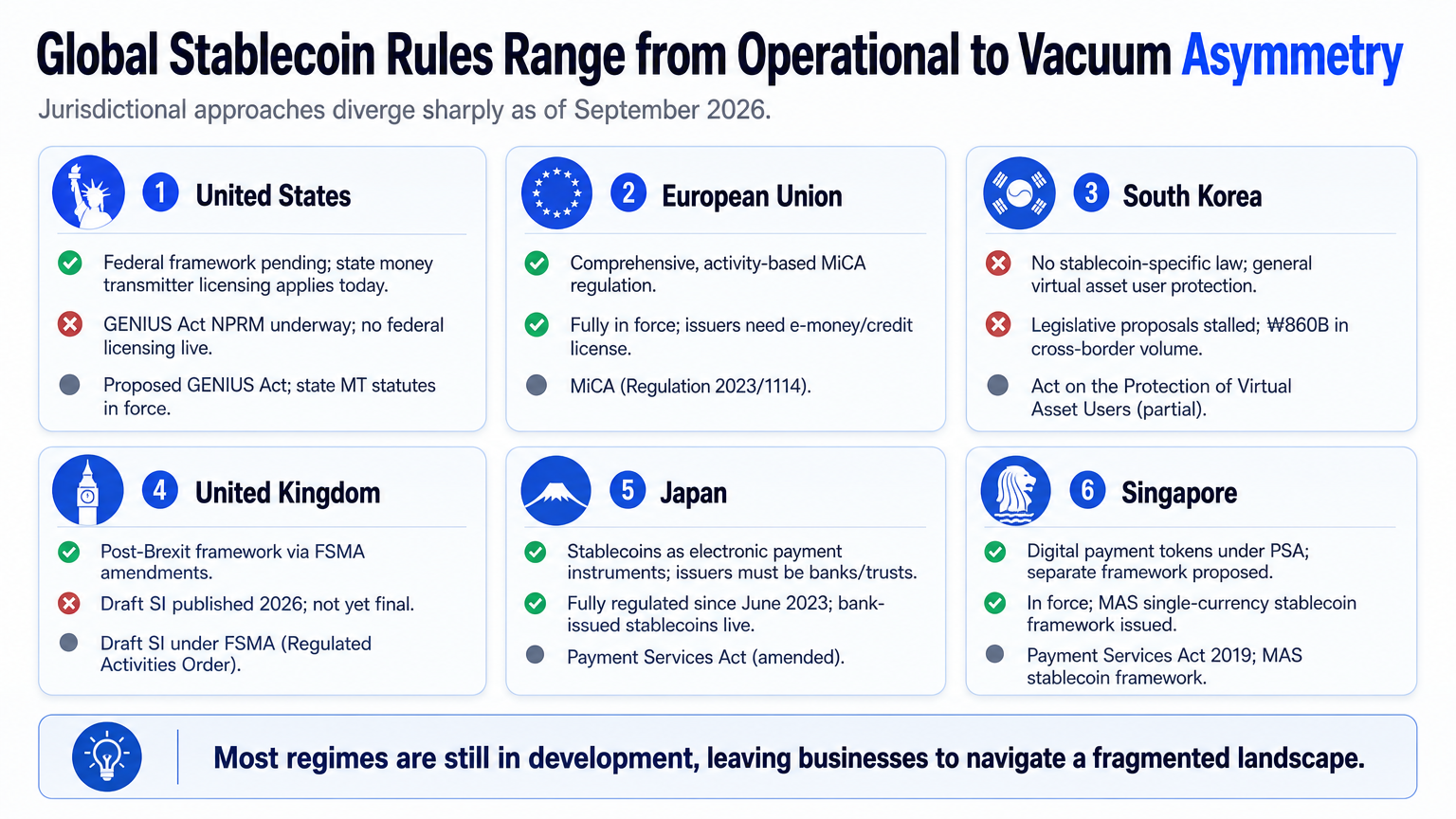
A stablecoin is a digital asset engineered to maintain a stable value relative to a reference asset, usually the US dollar. For businesses, the chief use case is moving money across borders quickly and cheaply — but the legal treatment of that activity varies dramatically by country. Below is a concise snapshot as of September 2026.
| Jurisdiction | Primary Regulatory Approach | Status (Sept 2026) | Key Instrument |
|---|---|---|---|
| United States | Federal framework pending; state-level money transmitter licensing applies today | The GENIUS Act is advancing with a Notice of Proposed Rulemaking from the OCC;[^2] no federal licensing regime is yet live | GENIUS Act (proposed); state MT statutes |
| European Union | Comprehensive, activity-based regulation under MiCA | Fully in force; MiCA stablecoin issuers must hold an e-money or credit institution license; custodians and exchanges are regulated | MiCA (Regulation 2023/1114) |
| South Korea | No stablecoin-specific law; general crypto-asset user protection rules apply | Legislative proposals stalled; cross-border payment volumes reported at ₩860B despite the vacuum | Act on the Protection of Virtual Asset Users (partial coverage) |
| United Kingdom | Post-Brexit framework via amendments to the Financial Services and Markets Act | Draft statutory instrument published in 2026 to bring fiat-backed stablecoins into the regulated payments perimeter;[^3] not yet final | Draft SI under FSMA (Regulated Activities Order) |
| Japan | Stablecoins recognized as “Electronic Payment Instruments”; issuers must be banks, trust companies, or registered funds transfer businesses | Fully regulated since June 2023; several bank-issued stablecoins already operational | Payment Services Act (amended) |
| Singapore | Stablecoins regulated under the Payment Services Act as digital payment tokens; a separate stablecoin framework proposed | In force; Monetary Authority of Singapore has issued a stablecoin regulatory framework for single-currency pegged stablecoins | Payment Services Act 2019; MAS stablecoin framework |
Table: Sources: BVNK global stablecoin regulations 2026, Eco.com US federal and state rules 2026, and UK policy note 2026.[^3]
The picture is one of profound asymmetry. The EU and Japan have detailed, operable regimes. The US and UK are moving toward frameworks but have not implemented them. South Korea and many emerging markets remain in limbo.
What is the GENIUS Act and how might it change U.S. stablecoin regulation?
The GENIUS Act (Generating Effective Networked and Inclusive Uniform Structures Act) is a proposed federal bill that would create a clear stablecoin legal framework for the United States. As of September 2026, the Office of the Comptroller of the Currency has issued a Notice of Proposed Rulemaking to implement key provisions of the Act, signaling that federal rulemaking is now underway.[^2]
The GENIUS Act aims to define stablecoins as a distinct instrument class, set prudential requirements for issuers (including reserve composition and redemption policies), and establish which federal and state agencies supervise them. If enacted, it would allow both state-chartered banks and specially licensed non-bank entities to issue stablecoins under a dual federal-state oversight model. That would resolve the current fragmentation, where operators navigate 50 state money-transmitter regimes with no federal consistency.
The Act would have direct consequences for businesses using stablecoins for cross-border payments. A federally licensed issuer with mandated 1:1 reserves and regular attestation would offer a compliance anchor that currently doesn’t exist. Payment processors and corporate treasurers could point to the issuer’s federal license when addressing counterparty due diligence. For now, that clarity remains on paper.
Europe's MiCA: A Comprehensive Approach
The EU’s Markets in Crypto-Assets (MiCA) regulation is the most complete stablecoin framework in force today. It classifies stablecoins as either e-money tokens (pegged to a single fiat currency) or asset-referenced tokens, and subjects issuers to licensing, capital, and reserve requirements resembling those for electronic money institutions. Custodians and trading platforms must also be authorized. The Payments Association notes that MiCA stablecoin rules are already reshaping payments by giving regulated stablecoins a legal path that unlicensed crypto transactions lack.[^6] For global businesses, a MiCA-compliant stablecoin simplifies regulatory risk assessment when serving European counterparties, because the entire lifecycle — issuance, transfer, redemption — falls under a single supervisory architecture.
Asia's Regulatory Mosaic: Progress and Paralysis
Japan’s stablecoin regime, operational since mid-2023, treats stablecoins as a regulated payment instrument issued only by licensed financial institutions. Singapore has a detailed framework for single-currency stablecoins, while Hong Kong is building a regulatory sandbox. South Korea, despite being a digital-payments leader, has no dedicated stablecoin law; the ₩860 billion in cross-border volume has flowed through a void. That vacuum demonstrates that real business adoption precedes legal architecture, but it leaves firms exposed — if Korean regulators eventually act, they could impose retroactive fines or disrupt existing payment rails.
The Disagreement: Are Stablecoins Securities, Commodities, or Something Else?
The classification of stablecoins remains one of the most consequential unsettled issues in financial regulation. The debate has three main positions:
- Securities: Some argue that stablecoins fall under securities laws because they can involve investment contracts, especially if the issuer retains discretion over reserve investments. The SEC historically hinted at this view, though no enforcement action has firmly established it for plain fiat-backed stablecoins.
- Commodities: Others see stablecoins as crypto-commodities because their value derives from an underlying asset (fiat currency) and they trade on spot markets like commodities. The CFTC has indicated that certain stablecoins could be treated as foreign exchange contracts.
- Novel asset class: Many industry participants argue that stablecoins designed solely for payments and redeemable at par are functionally digital cash, requiring bespoke legislation rather than shoehorning into 1930s-era securities or commodity laws.
Where a jurisdiction lands shapes everything from issuer licensing to user tax treatment. The EU sidestepped the debate by creating the e-money token category. The GENIUS Act aims to do something similar in the US by treating payment stablecoins as a distinct instrument that is not a security. Without such legislative clarity, stretching old statutes to fit new instruments creates compliance uncertainty. The South Korean situation is a case in point: without a statutory definition, companies cannot be sure when a cross-border stablecoin transfer triggers securities trading rules, foreign exchange controls, or something else entirely.
What This Means for Your Business: Navigating Stablecoin Payments Amid Uncertainty
How does regulatory stalling affect business use of stablecoins?
Regulatory inaction does not forbid stablecoin use — but it loads additional due-diligence and legal risk onto the user. The ₩860 billion Korean volume shows that stalling does not stop adoption; it simply means companies operate without a safety net. The practical effects include:
- No clear safe harbor. Businesses cannot rely on a statutory provision shielding them from unexpected classification. A payment token deemed a security overnight could trigger securities-law violations.
- Banking friction. Many traditional banks remain reluctant to serve companies that transact in stablecoins where classification is ambiguous, forcing firms into fragmented banking relationships.
- Counterparty uncertainty. When a stablecoin issuer is unlicensed in a key jurisdiction, counterparties must assess credit risk, reserve adequacy, and redemption rights via contract rather than regulation.
Yet businesses are adopting stablecoins anyway because the operational savings are large. For a Korean exporter receiving dollar payments from an emerging-market buyer via stablecoins, the cost can be less than 0.5% versus 3–5% on a traditional correspondent-banking route — and settlement takes minutes, not days.
Why Businesses Are Adopting Stablecoins Anyway
The core driver is real-time, low-cost cross-border settlement. Stablecoins bypass the correspondent-banking chain using blockchain networks as the rail. Benefits include near-instant finality, 24/7 availability, and the ability to hold and move dollars digitally without a US bank account. In markets like South Korea, where overseas remittances are subject to decades-old foreign-exchange processes, stablecoins offer a practical arbitrage. B2B payments particularly benefit because invoice amounts are large and time-sensitive, and stablecoins remove the currency-conversion spread when both parties agree to denominate in USDC or an equivalent.
How can businesses stay compliant when using stablecoins?
Until the regulatory picture solidifies, businesses can follow a structured approach that reduces legal exposure while capturing efficiency gains. Below is a practical compliance framework.
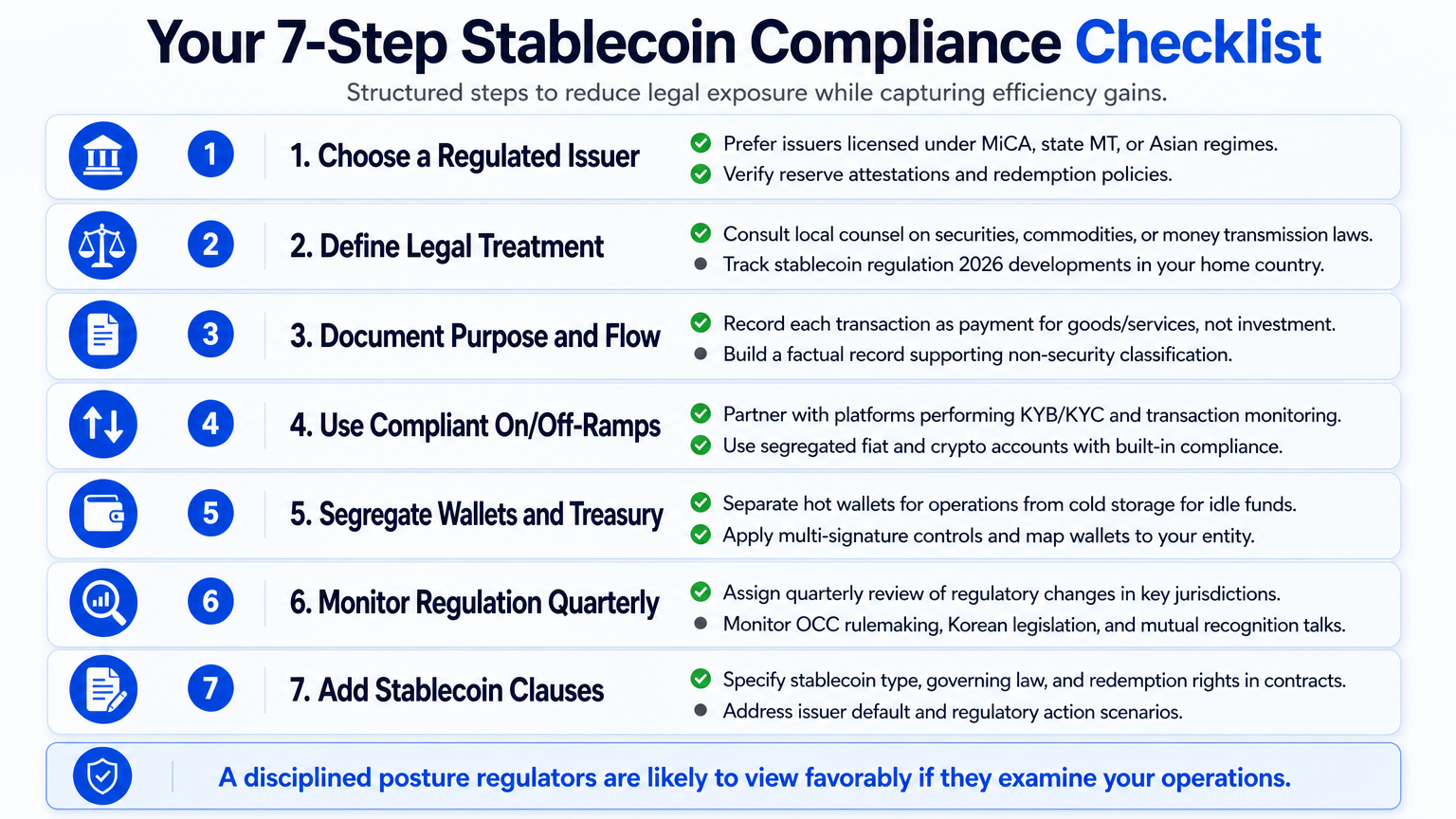
Stablecoin Compliance Checklist for Businesses
- Choose a regulated stablecoin issuer. Prefer issuers licensed under a recognized regime (e.g., MiCA in the EU, a state money-transmitter license in the US with robust reserve policies, or a Japanese/Singaporean license). Verify reserve attestations and redemption policies.
- Define the legal treatment in your own jurisdiction. Consult local counsel to determine whether stablecoin payments might trigger securities, commodities, or money transmission laws in your home country. In South Korea, work with legal advisors monitoring stablecoin regulation 2026 developments.
- Document the purpose and flow of each transaction. Maintain clear records showing stablecoin use is for payment of goods/services, not investment or speculation. This builds a factual record supporting a non-security classification.
- Use compliant on/off-ramp partners. Partner with a banking provider or platform that performs KYB/KYC, monitors transactions, and offers segregated accounts for fiat and crypto. Platforms handling both fiat and stablecoin flows with built-in compliance protocols simplify audit trails and reduce the number of banking relationships needed.
- Segregate operational wallets and treasury holdings. Distinguish between hot wallets for operational payments and cold storage for idle balances. Apply internal limits and multi-signature controls, mapping all wallet addresses to your corporate entity.
- Monitor regulatory developments quarterly. Assign a team member or retain an external advisor to track changes in jurisdictions where you send or receive stablecoins. The OCC’s proposed rulemaking in 2026,[^2] for example, will affect US-facing activity as it moves toward finalization.
- Include stablecoin-specific clauses in commercial contracts. Specify the stablecoin type, the applicable legal jurisdiction, and redemption rights in the event of an issuer default or regulatory action.
This checklist imposes a disciplined compliance posture that regulators are more likely to view favorably if they later examine your operations. It also aligns with guidance from bodies like the Financial Action Task Force, which expects virtual-asset service providers and their customers to apply risk-based controls.
Looking Ahead: What to Watch as Regulation Evolves
Four developments deserve close attention in the coming months:
- US rulemaking milestones. The OCC’s proposed rule under the GENIUS Act will progress through comment periods. Any sign of finalization or a Congressional vote would mark a watershed. Watch for federal preemption of certain state-level rules, which would greatly simplify interstate stablecoin use.
- South Korea’s legislative breakthrough. The ₩860 billion data point puts pressure on Korean lawmakers. Any draft bill that emerges will likely include licensing requirements and could have extraterritorial effects if it regulates won-pegged stablecoins. Korean exporters and their global partners should monitor the National Assembly’s agenda.
- Cross-border coordination. MiCA provides a template, and jurisdictions are discussing mutual recognition of stablecoin licenses. The Payments Association reports that such talks are accelerating in 2026.[^6] Mutual recognition could create “passportable” stablecoins that ease compliance for global payment operations.
- Stablecoin classification court rulings. In the US, a decisive court decision could force the SEC or CFTC’s hand before legislation is enacted. Any ruling treating a major stablecoin as a security would send shockwaves through the market, potentially making existing stablecoin holdings toxic for corporate treasuries overnight.
Key Takeaways
- $620 million in South Korean cross-border stablecoin payments between 2021 and September 2026 prove that business adoption is racing ahead of regulation, even in countries with stalled legislative processes.
- Regulatory stalling does not stop usage but shifts compliance burden onto businesses, requiring them to vet stablecoin issuers, document payment rationale, and structure contracts to mitigate classification risk.
- The US GENIUS Act and EU MiCA represent two ends of the spectrum — proposed versus fully operational — and businesses should anchor their stablecoin choices to the most mature frameworks available today.
- A practical compliance checklist — choosing regulated issuers, using compliant on/off-ramps, segregating wallets, and monitoring stablecoin regulation 2026 developments quarterly — is the best substitute for absent legislation.
- South Korea stablecoin policy response and US rulemaking milestones are the most immediate signals to watch; both could reshape the compliance landscape for dollar-pegged stablecoin payments within months.
[^1]: BigGo Finance, “South Korean Firms' Stablecoin Cross-Border Payments Hit ₩860 Billion as Regulation Stalls,” September 17, 2026. [^2]: Office of the Comptroller of the Currency, “GENIUS Act Regulations: Notice of Proposed Rulemaking,” Bulletin 2026-3, 2026. [^3]: HM Treasury, “Draft statutory instrument amending the Financial Services and Markets Act 2000 (Cryptoassets Regulations) 2026: Policy Note,” 2026. [^4]: BVNK, “Global stablecoin regulations 2026: What enterprises need to know,” 2026. [^5]: Eco, “Stablecoin Regulation: US Federal and State Rules (2026),” 2026. [^6]: The Payments Association, “How stablecoin regulation is reshaping payments in 2026,” 2026.
Ready to put this into practice? Get started with onesafe.io.