
Meta Description: Senator Blumenthal’s Tether probe puts stablecoin regulation in the spotlight. Learn what the $6.3M deal and GENIUS Act lobbying inquiry mean for your business treasury.
What the Tether Probe Means for Stablecoin Regulation & Your Business
On October 23, 2026, Senator Richard Blumenthal escalated a Senate investigation into Tether over a $6.3 million marketing deal, thrusting stablecoin regulation back into the crosshairs. The probe digs into alleged lobbying coordination around the draft GENIUS Act, and for any business that holds, receives, or settles in stablecoins, it’s a stark reminder: the regulatory noose is tightening well before the final law is on the books. The move comes days after the Treasury’s Office of Foreign Assets Control sanctioned a cryptocurrency mixing service and multiple stablecoin wallets, showing that enforcement is actively policing unregulated on-chain payments (OFAC, October 19, 2026). The question is’t whether enforcement will land — it’s who it lands on next.
Table of Contents
- The Tether Probe: A New Front in Stablecoin Regulation Enforcement
- Why This Matters for Every Business Touching Stablecoins
- Stablecoin Regulation 101: Where We Are Today
- The Hidden Risk: Using Unregulated Stablecoins Without Realizing It
- How Smart Businesses Are Bulletproofing Their Stablecoin Operations
- What to Watch Next: Ripple Effects on Legislation and Enforcement
- Key Takeaways
- Sources
The Tether Probe: A New Front in Stablecoin Regulation Enforcement
What Senator Blumenthal is demanding — and why
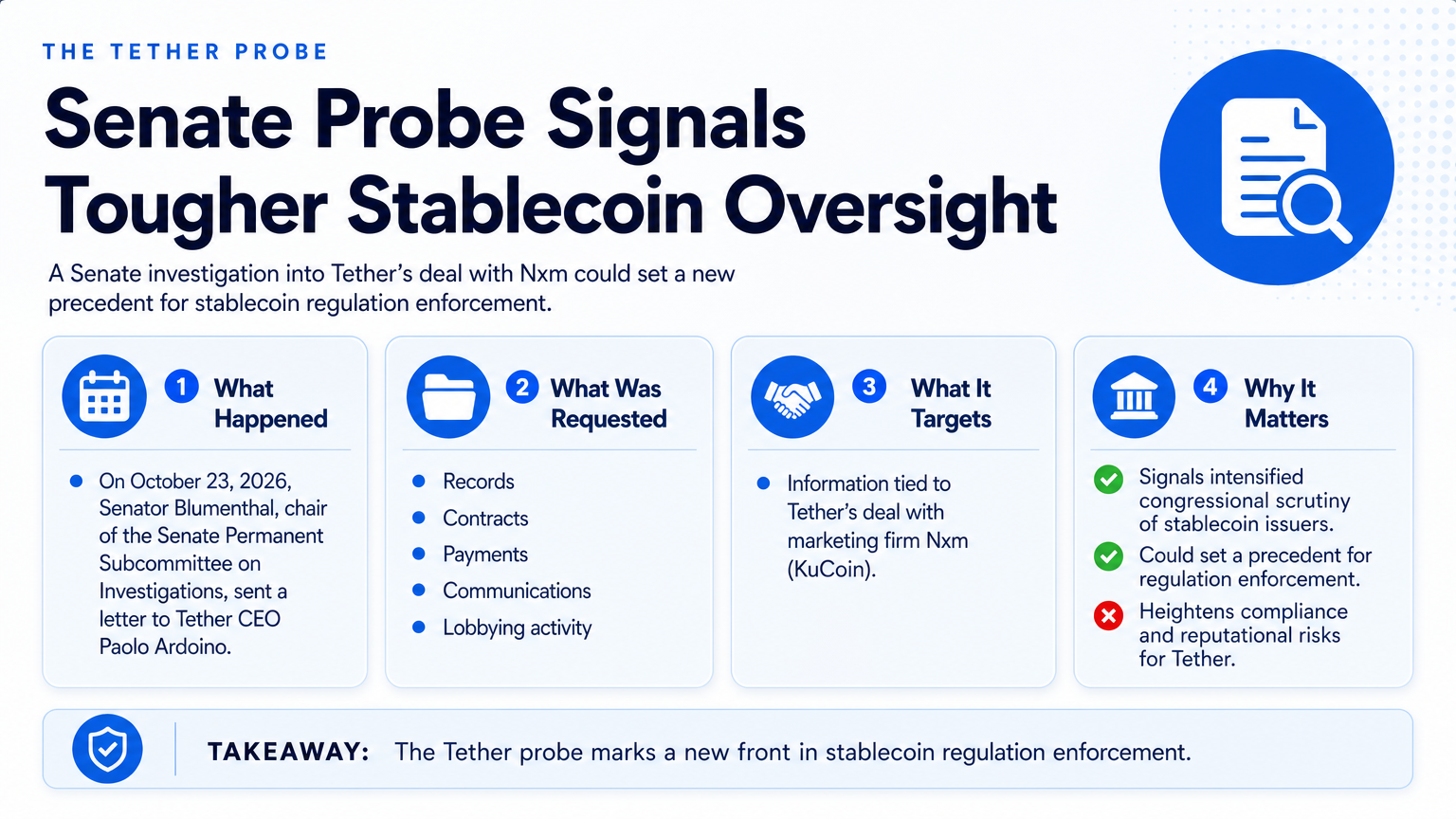
On October 23, 2026, Senator Blumenthal, chair of the Senate Permanent Subcommittee on Investigations, sent a letter to Tether CEO Paolo Ardoino requesting records, contracts, payments, communications, and lobbying activity tied to Tether’s deal with marketing firm Nxm ((KuCoin, Oct23, 2026). The Senator is’t just fishing; he’s directly linking the transaction to potential influence peddling around stablecoin legislation 2026 — specifically the GENIUS Act. Blumenthal pointed to messages that allegedly show direct coordination on lobbying efforts.
The $6.3 million link to ex-White House crypto adviser Bo Hines
The investigation centers on Nxm, a firm tied to Bo Hines, a former White House crypto adviser. The alleged arrangement — a $6.3 million marketing contract — raises conflict-of-interest questions that could taint the legislative process. For a bill that has already drawn scrutiny over how it balances state vs. federal authority, this adds a new dimension: were the rules written with hidden hands?
Tether’s response and what’s at stake
Tether has denied wrongdoing, citing an earlier external review that found no impropriety. The firm asserts it complies with law enforcement and treasury transparency requirements. Yet the probe isn’t happening in a vacum. In late 2025, federal prosecutors were already examining Tether over potential bank fraud, though the company denied any active investigation ((WSJ, Oct. 2024; Reuters, Oct.25, 2024). What’s different now is the political spotlight: a Senate subcommittee demanding documents is a step toward legislative action, not just law-enforcement inquiry.
Why This Matters for Every Business Touching Stablecoins
From user to target: how enforcement risk trickles down
If Tether — the largest stablecoin by market cap — faces heightened scrutiny, that places a new lens on any treasury that touches USDT. The real risk isn’t just the issuer getting sanctioned; it’s that downstream holders could find their assets frozen, their banking partners spooked, and their own compliance under review. Counterparty risk is now regulatory risk, and it’s not limited to direct contracts with Tether. Any third-party liquidity provider, payment rail, or DeFi protocol that routes through unregulated stablecoins pulls that exposure onto your balance sheet.
The unregulated is no longer invisible in cross-border and Web3 operations
Web3 startups and DAOs often use stablecoins precisely because they promise frictionless, borderless settlement. But the probe surfaces a hard truth: unregulated stablecoins — even those that maintain 1:1 reserves on paper — operate outside a supervisory framework that can mandate redemption, segregate reserves, or enforce AML controls. For businesses that run payroll, supplier payments, or customer refunds in USDT, the legal exposure just became concrete. It’s no longer a theoretical debate over state vs. federal oversight; it’s a live investigation that can redefine what counts as a legitimate payment instrument.
Stablecoin Regulation 101: Where We Are Today
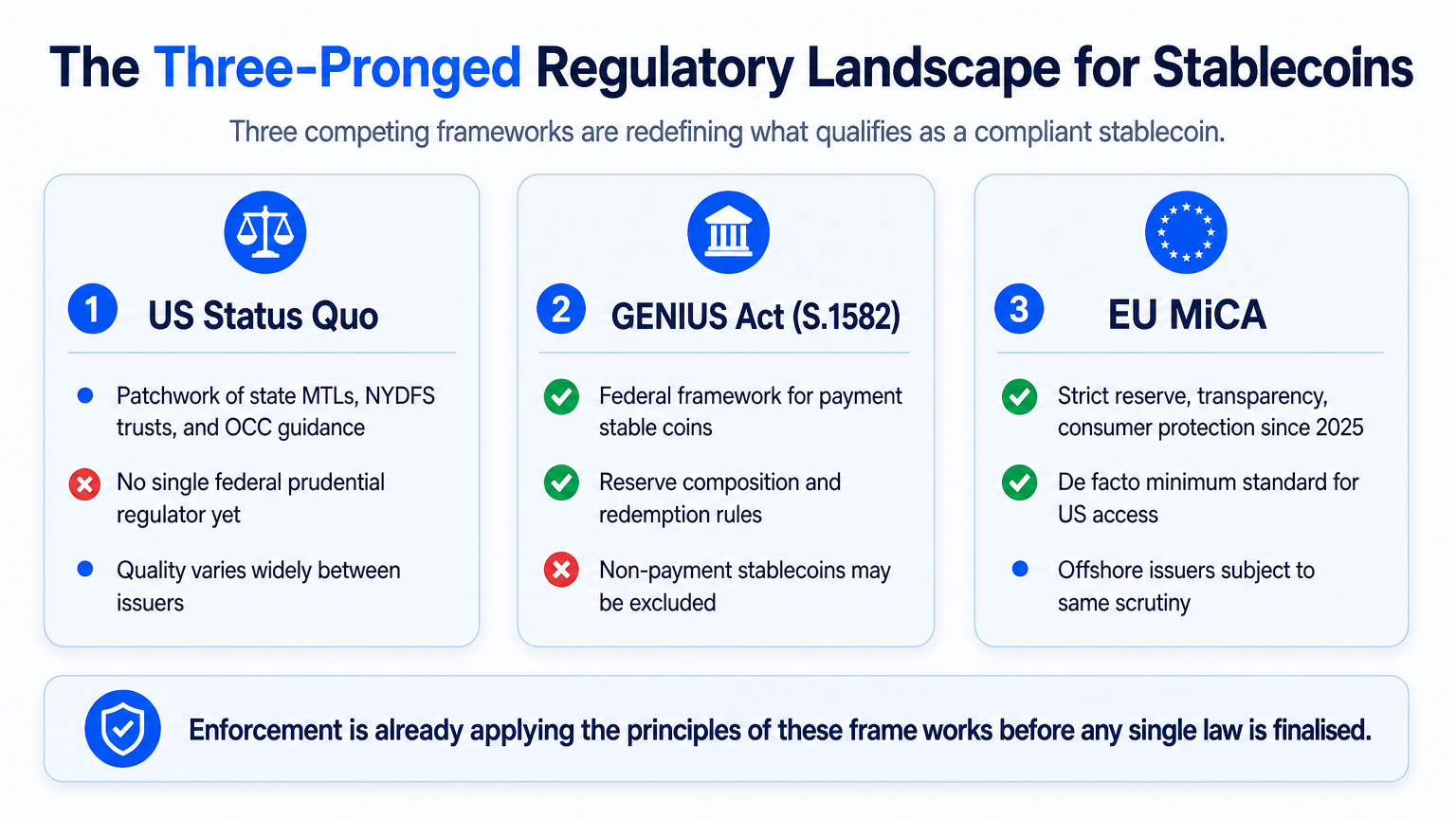
In the United States, stablecoin oversight is a fragmented quilt of state money-transmitter licenses (MTLs), New York Department of Financial Services (NYDFS) trust charters, and occasional Office of the Comptroller of the Currency (OCC) guidance. There is no single federal prudential regulator for stablecoins — yet. That has let a regime where some issuers operate under robust supervision (e.g., Circle’s USDC through New York trust entities) and others rely on offshore structures and state-level registrations of varying quality.
The Generating Needed Information for Unspecified Stablecoins Act of 2025 (S.1582) aims to create a federal framework for payment stablecoin issuers: reserve composition rules, redemption rights, and prudential standards. Yet critics note that it leaves gaps — non-payment stablecoins may not be covered, and offshore issuers serving US users could still exploit jurisdictional ambiguity. The Tether investigation shows that enforcement agencies are’t waiting for final passage — they’re already acting on the bill’s principles.
The EU’s Markets in Crypto-Assets (MiCA) framework, fully applicable since 2025, sets strict reserve, transparency, and consumer-protection requirements. This creates a jurisdiction-shopping dynamic: an issuer might avoid MiCA by basing in the Caribbean, but US market access now draws the same scrutiny as a domestic actor. The result is a de facto requirement for any stablecoin that wants US business to meet either GENIUS Act-lke standards or MiCA equivalence — or risk being treated as unlicenced.
The Hidden Risk: Using Unregulated Stablecoins Without Realizing It
Regulated vs. unregulated: the marks that actually matter
A truly regulated stablecoin should carry at least one of these marks: a NYDFS trust charter, a federal or state banking charter with issuance authority, or a state MTLL with independently audited reserves and demonstrable AML/C FT compliance. Absent those, you’re likely dealing with an unregulated issuer, no matter how large the market cap. The Tether probe demonstrates that even the biggest can fall into the unregulated bucket when congressional oversight kicks in.
Why ‘1:1 reserve’ isn’t enough without supervisory teeth
A 1:1 reserve claim without on-site examinations, independent attestations from a recognized audit firm, and legal ring-fencing of assets is little more than a promise. Tether’s investigations have long revolved around reserve opacity; a 2021 settlement with the New York Attorney General already mandated transparency reports. Without a supervisor that can enforce segregation and liquidity requirements, the reserve figure becomes a marketing statement, not a solvency guarantee.
The Tether pattern: when jurisdictional arbitrage becomes a business liability
Tether operates through entities in the British Virgin Islands and elsewhere, outside direct US prudential oversight. That structure once looked like a competitive advantage — no onerous compliance, fast growth. Now it’s the exact reason the probe has teeth: the company’s interactions with US policy and lawmakers through intermediaries create an enforcement hook. For businesses, the lesson is clear: if your stablecoin of choice cannot show a regulated entity in a recognized jurisdiction standing behind it, you inherit that regulatory gap.
How Smart Businesses Are Bulletproofing Their Stablecoin Operations
Vet every issuer, every token, every reserve report
Stop treating stablecoins as fungible commodity. For each token held or accepted:
- Identify the issuing legal entity and its regulatory status (chater, license, supervisor)
- Obtain the latest independent attestation or audit report on reserves
- Check for any outstanding enforcement actions or settled consent orders
Use banking platforms that bake in compliance (not bolt it on)
Many businesses operate across fiat and crypto using fragmented services — a conservative bank for wires and a separate unregulated exchange for stablecoin settlement. That split creates blind spots. A crypto banking platform that natively integrates multi-currency accounts, Fireblocks custody, and KYB onboarding helps teams enforce a consistent compliance posture. For instance, a platform like OneSafe provides segregated accounts, crypto-fiat on/off-ramp, and mandatory Multi-Factor Authorization, ensuring that treasury operations don’t inadvertantly drift into unregulated rails.
What to look for: segregated accounts, Fireblocks custody, native crypto-fiat rails
- Segregated accounts: ensure stablecoin holdings are legally separated from the bank or platform’s proprietary assets.
- Fireblocks custody: hardware secured, MPC-based wallet infrastructure that meets institutional-grade security standards.
- Native crypto-fiat rails: the ability to convert USDC (or other regulated stablecoins) into fiat and execute payments without third-party bridge risk.
Action checklist: three moves you can make this quarter
| Step | Specific Action | Why It Matters |
|---|---|---|
| 1. Audit your stablecoin exposure | List every token your business holds and the issuing entity behind it. | Uncovers hidden unregulated exposure. |
| 2. Require a regulatory mark | For at least 80% of your stablecoin holdings, only use tokens from NYDFS-tusted or similarly supervised issuers (e.g., USDC). | Shifts treasury into legally defensible assets. |
| 3. Consoldate onto a compliant platform | Migrate treasury operations to a platform that supports AML for stablecoins, automated KYB, and direct fiat-crypto settlement (like a crypto-friendly business banking solution with Fireblocks custody). | Creates an audit trail and reduces counter-party complexity. |
What to Watch Next: Ripple Effects on Legislation and Enforcement
Will other stablecoin giants face the same scrutiny?
USDC’s issuer Circle operates within the NYDFS framework and other regulatory structures, reducing the surface for similar probes. However, any large issuer that relies on state-chatered trust entities may still face congressional questions about the consistency of oversight. Expect the Senate to broaden its lens to all non-bank stablecoin issuers, especially those that engaged with the GENIUS Act lobbying process.
GENIUS Act revisions: what the lobbying inquiry changes
Even before this probe, the bill faced criticism for leaving room for regulatory arbitrage. Now, the allegations of undisclosed lobbying coordination could accelerate amendments that require stricter disclosure of political activities and that close the gap on non-payment stablecoins. Legislators will be under pressure to show that the law’s plumbing was’t built on preferential access.
The international domino: how a US crackdown reshapes stablecoin flows
If US enforcement actions push USDT out of compliant US-dollar fed rails, we’ll see a bifurcation: regulated “light” stablecoins like USDC gaining market share in treasury operations, while unregulated alternatives retreat to gray markets. For global businesses, that means the cost of staying with unregulated stablecoins could soon include de-banking risks, not just reputational ones. Keep an eye on guidance from the OCC and the Federal Reserve on the permissibility of stablecoin holdings for banks; the OCC’s recent stablecoin rule already points toward clearer expectations.
Key Takeaways
- The Tether probe signals that unregulated stablecoin exposure is no longer a gray area — it’s an identifiable legal and operational risk for any business, even if you only touch USDT indirectly.
- Regulated stablecoins are defined by a supervisor, not by marketing; look for a NYDFS trust charter, bank charter, or verifiable MTL with independent attestations.
- The GENIUS Act may not close every gap, but enforcement patterns are already reshaping what counts as an acceptable treasury asset — and the bar is rising fast.
- Consoldating treasury operations onto a platform with Fireblocks custody, segregated accounts, and integrated compliance helps avoid accidental unregulated exposure.
Ready to bring your treasury up to the new standard of stablecoin compliance? Open a OneSafe account today and manage fiat and regulated stablecoins in a single, security-built platform.
Sources



