meta description: The U.S. Bitcoin Reserve Bill (ARMA, 2026) reshapes crypto treasury management. Learn the operational pivots, custody upgrades, and compliance steps CFOs and DAOs must take now.
What the U.S. Bitcoin Reserve Bill Means for Crypto Treasury Management
On May 21, 2026, a bipartisan bill—the American Reserve Modernization Act (ARMA)—directs the federal government to acquire up to 1 million Bitcoin and lock it in a Strategic Bitcoin Reserve for at least 20 years. For finance leaders, that single legislative stroke rewrites crypto treasury management, shifting digital assets from a corporate experiment to an asset class with explicit sovereign backing. This anchors the operational changes treasury teams must make before ARMA’s provisions harden into law.
Table of Contents
- What Just Happened
- Why ARMA Rewrites the Crypto Treasury Playbook
- Crypto Treasury Management101: Compressed Basics
- The Real Gaps: What Existing Guides Miss After ARMA
- Building a Resilient Crypto Treasury for the Post‑ARMA World
- What to Watch Next: Timeline and Open Questions
- Conclusion: The Preparedness Window Is Narrow
- Key Takeaways
What Just Happened

On May 21, 2026, Representative Nick Begich and15 co‑sponsors filed ARMA in the U.S. House, as first reported by CoinMarketCap. The bill orders the Treasury to acquire 1 million BTC over five years and manage them inside a codified Strategic Bitcoin Reserve. ARMA builds on the March2025 executive‑order reserve and Senator Lummis’s BITCOIN Act. Patrick Witt of the President’s Digital Assets Council called it “Version2” of the BITCOIN Act.
Key provisions:1M BTC acquisition,20-year lock‑up, Treasury management
| Provision | Detail | Immediate Implication for Corporate Treasuries |
|---|---|---|
| Acquisition target | Purchase up to1 million BTC over five years, using existing forfeited BTC (~328,372 BTC worth >$25.5B) and new buys. | Sovereign demand at this scale will absorb available supply, reinforcing strategic value and reducing long‑term downside pressure. Bitcoin can't be dismissed as a fringe holding. |
| 20‑year minimum custody | All reserve BTC held in government custody for at least20 years, unless sold to reduce national debt. | Signals a long‑term reserve asset, not a trading instrument. Corporates that dabble can now build durable, policy‑driven positions. |
| Oversight | Treasury manages reserve alongside a separate Digital Asset Stockpile. | Establishes sovereign‑grade custody, accounting, and reporting frameworks that regulators will apply to private‑sector treasuries. |
| Bipartisan backing | Republican sponsor with cross‑aisle co‑sponsors. | Reduces political hostility risk, making it safer for CFOs to commit to bitcoin holdings and supporting infrastructure. |
Why ARMA Rewrites the Crypto Treasury Playbook
Before ARMA, corporate bitcoin on the balance sheet was an experiment confined to a few early movers. A1‑million‑coin sovereign buyer transforms Bitcoin into a national‑economic‑security asset. The possibility that the U.S. Treasury becomes the largest Bitcoin holder forces every CFO to re‑evaluate their own crypto treasury management framework.
ARMA, combined with the March2025 executive‑order reserve (White House), confirms crypto is a permanent fixture of U.S. financial policy. For treasury leads, systems that treat crypto as a fiat‑only add‑on are now a compliance and strategic liability. The signal isn’t “hold Bitcoin now”—it’s that custody, accounting, and risk infrastructure must assume a long‑term digital‑asset line item.
Crypto Treasury Management101: Compressed Basics
What is a crypto treasury?
A portfolio of digital assets—Bitcoin, stablecoins—held alongside fiat reserves, with the wallets and systems to safeguard and deploy them.
What is crypto treasury management?
Stewardship encompassing custody, liquidity, risk controls, accounting, and coordination of on‑chain and fiat operations. It fuses24/7 markets, immutable settlement, and novel compliance into one framework.
How does it differ from traditional treasury?
- Crypto markets never close and settle in minutes, demanding dynamic intraday liquidity. - Cold‑storage and multi‑sig custody replace bank accounts. - On‑chain trails are immutable but require new reconciliation tools. - Regulatory fragmentation means no single global standard.
Key risks?
Volatility, operational security (loss of keys), compliance/tax uncertainty, concentration risk, and reconciliation blind spots from fragmented accounts.
The Real Gaps: What Existing Guides Miss After ARMA
How will a U.S. Bitcoin reserve impact corporate treasury strategy?
ARMA’s multi‑year, non‑selling buyer mandate acts as a de facto anchor. Downside tail‑risk events become less likely, and Bitcoin’s correlation with safe havens may rise. For corporates, the “too speculative” objection weakens. A small allocation (1%–3%) becomes a prudent diversification, akin to gold. But this requires real‑time, transparent reporting and auditable custody to satisfy boards and auditors now watching sovereign moves.
The compliance and reporting upgrades that will become non‑negotiable
Once a federal agency runs a Bitcoin reserve under formal oversight, private‑sector treasury controls will be measured against that benchmark. Expect regulators to eventually require proof of reserves, segreated customer assets, and on‑chain attestations for any material digital‑asset holdings. The EU’s MiCA framework and stablecoin countdown show how fast jurisdictions move. Upgrading to systems that produce an immutable, verifiable record of all crypto holdings—ideally in real time—shifts from optional to essential.
What should DAOs do differently in light of ARMA?
DAO treasury management sits at ARMA’s most underappreciated implication: a sovereign Bitcoin buyer will rapidly tighten the regulatory perimeter around custodians and transactors. For Web3 companies and DAOs, informal multi‑sig treasuries may soon be inadequate. Steps now:
- Adopt institutional custody with role‑based permissions so treasury actions are governed, not just gated by a few signers.
- Unify fiat and crypto operations on a single platform to maintain a complete audit trail and avoid fragmentation.
- Build reporting templates for monthly proof‑of‑reserves and attestations, anticipating oversight inspired by sovereign treasuries.
A platform that combines multi‑signature treasury controls with a fiat‑crypto unified platform—such as OneSafe’s offering that handles ACH, wires, and on‑chain transactions while securing assets on Fireblocks—colapses the compliance burden into one interface. That usability may separate DAOs that thrive from those that stumble.
Why DAOs and Web3 startups must prepare now for a tighter regulatory regime
Waiting for a final vote is a mistake. Even if ARMA stalls, the precedent of a strategic Bitcoin reserve exists at the executive level. Treasury teams that begin integrating blockchain treasury reporting and crypto accounting compliance now will pivot fastest when rules tighten.
Building a Resilient Crypto Treasury for the Post‑ARMA World
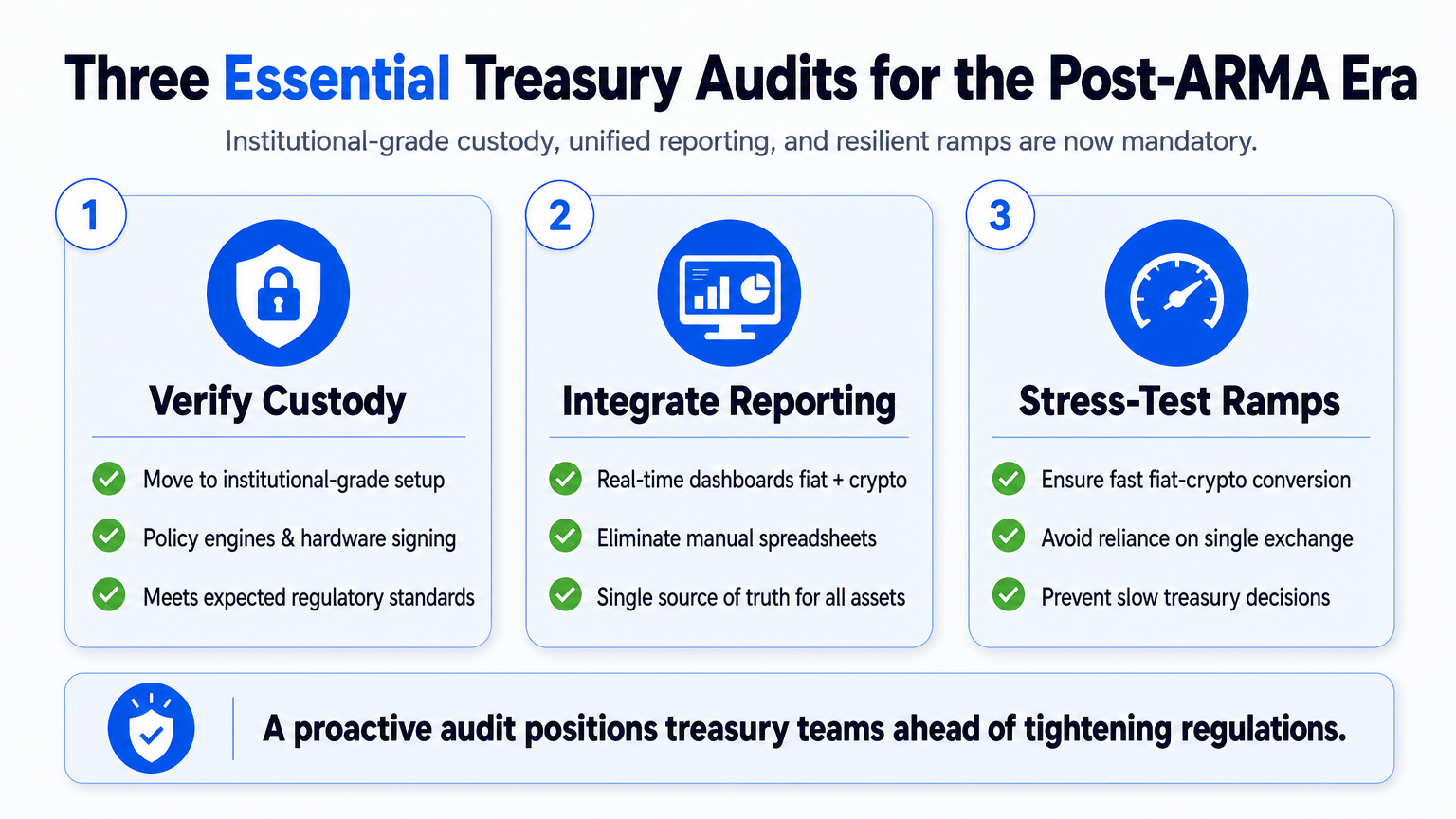
Three‑point treasury audit checklist
- 1. Verify custody architecture. Move from a simple hot wallet or single multi‑sig to an institutional‑grade setup with policy engines, hardware signing, and automated workflows. Crypto custody best practices now mirror what regulators will expect.
- 2. Integrate real‑time reporting across fiat and crypto. Insist on dashboards that merge bank balances, on‑chain positions, and wire transfers into one view. Manual spreadsheets create audit gaps.
- 3. Stress‑test on‑off ramps. Ensure your platform can convert between fiat and crypto in minutes, not days, without relying on a single exchange. Slow ramps throttle treasury decisions.
Custody: from multi‑sig to institutional‑grade
A 3‑of‑5 Gosis Safe served startups last cycle, but post‑ARMA expectations will demand policy‑enforceable custody. Look for solutions that combine multi‑signature approval chains with hardware‑baced key storage and insurance. For example, Fireblocks‑based custody, as used by OneSafe for DAO clients, provides the policy engine and secure enclave regulators will likely require.
Transparent, real‑time reporting
Circle’s US DC integration with SAP proves enterprise‑grade real‑time reconciliation is achievable. Treasury teams should demand a single source of truth for all fiat and crypto balances, with automated feeds into ERP systems. In a post‑ARMA world, inability to produce real‑time proof‑of‑assets invites auditor and board pressure.
Choose a platform that bridges both worlds
Managing fiat through one bank and crypto through a separate exchange introduces latency, errors, and compliance risk. A fiat‑crypto unified platform—with global multi‑currency accounts, cards, wires, and native on‑chain payments—eliminates that fragmentation. OneSafe, for instance, supports ACH, wire, bill payments, and instant crypto‑to‑fiat conversions, all visible in a single dashboard. That integration is quickly becoming a compliance requirement.
What to Watch Next: Timeline and Open Questions
Legislative timeline and White House stance
ARMA was introduced in May2026 but has yet to move through committee. Bipartisan support gives it a plausible path, though a trillion‑dollar asset purchase faces fiscal scrutiny. The White House is open, having already created the reserve. Key questions remain: Will annual purchases be capped? Will the Fed be involved? Expect hearings through late2026 and into2027. Watch for movement to the House Financial Services Committee.
Global ripple effects on stablecoin and crypto regulations
ARMA is already influencing other jurisdictions. If the U.S. formalizes a Bitcoin reserve, the EU will accelerate its digital‑asset framework beyond MiCA, and large Asian economies will reconsider stances. Treasury teams operating cross‑border should plan for stablecoin regulations tightening in tandem. As explored in our analysis of stablecoin payments and Mastercard’s cross‑border vision, fiat‑crypto settlement infrastructure is maturing fast, and regulation will follow.
Conclusion: The Preparedness Window Is Narrow
ARMA may not become law exactly as introduced, but the direction is set. A national Bitcoin reserve—first by executive order, now by legislation—changes the foundational assumptions of crypto treasury management. Corporates that treat digital assets as experimental side‑projects will be caught off‑guard. The window to build integrated, audit‑ready, policy‑governed crypto treasury systems is open but won't stay so indefinitely.
Key Takeaways
- ARMA’s 1M‑BTC acquisition plan and20‑year lock‑up reframe Bitcoin as a long‑term reserve asset, removing a core CFO objection.
- Corporates need institutional‑grade custody, real‑time fiat‑crypto reporting, and airtight audit trails—not just a multi‑sig wallet.
- DAOs and Web3 starups must unify fiat and crypto on a single platform now; future regulatory pressure will make fragmented systems a liability.
- Begin the three‑point treasury audit today: verify custody, integrate reporting, stress‑test on‑off ramps—before the legislative clock runs out.
For teams ready to unify fiat and crypto treasury under a single, audit‑ready platform, start your OneSafe onboarding today.