Stablecoin Regulation: USDT’s 90-Day EU Countdown
On October 9, 2026, EU regulators handed down a clear ultimatum: crypto platforms have until January 8, 2027 to resolve noncompliant stablecoin holdings, with USDT squarely in the spotlight. For any business or DAO managing euro-denominated treasury flows or cross-border payments with Tether’s dollar-pegged token, this is not a distant policy debate—it’s a 90-day operational pivot. What follows is a practical guide to navigating the stablecoin regulation shift, protecting liquidity, and reconfiguring your financial rails before the deadline hits.
Table of Contents
- What is happening with USDT in the EU right now?
- Why it matters now for global businesses and DAOs
- The regulatory background (in 300 words)
- What does the January 8, 2027 deadline mean for businesses using stablecoins?
- What alternatives to USDT exist for cross-border payments and DAO operations?
- How can businesses comply with the new EU stablecoin rules?
- What to watch next
- Key Takeaways
What is happening with USDT in the EU right now?
The January 8, 2027 deadline and its immediate implications
On October 9, 2026, the European Securities and Markets Authority (ESMA) and national regulators confirmed that crypto-asset service providers have three months to align with the Markets in Crypto-Assets (MiCA) framework where stablecoins are concerned. According to a report from CCN.com on that day, the EU’s 90-day countdown places all non-MiCA-compliant stablecoins—including USDT—at risk of forced delisting from European platforms after January 8, 2027.
Why is USDT in the crosshairs—MiCA compliance gaps
USDT’s problem is simple: MiCA classifies stablecoins as either e-money tokens (EMTs) or asset-referenced tokens (ARTs), both requiring a license from an EU national competent authority and strict reserve, redemption, and disclosure obligations. Tether has not publicly confirmed that it has applied for or secured such a license, and EU regulators have repeatedly signaled that USDT does not meet the mark. As of October 2026, many exchanges already delisted USDT for EU users in stages, but the new deadline forces remaining platforms—including those handling crypto-to-fiat conversions—to purge USDT entirely from EU-facing services.
How crypto exchanges and platforms are already reacting
Several major exchanges, including Binance and Kraken, began restricting USDT for EU residents months earlier, though some smaller or decentralized platforms maintained access. Now, with the January 8 deadline, every custodian, broker, and neobank with an EU footprint must complete the exit. The effect: USDT’s liquidity window in the EU is closing fast. Providers like Eco have already detailed how they restrict USDT due to MiCA, and the pressure is mounting.
Why it matters now for global businesses and DAOs
USDT’s role in cross-border payments and DAO treasury management
For international startups and DAOs, USDT has long served as a neutral dollar settlement layer that bypasses correspondence banking delays. Many DAOs hold millions in USDT within multi-sig wallets for contributor payouts, vendor payments, and liquidity provisioning. The EU’s regulatory line now cuts directly through these workflows: any EU-based wallet or counterparty holding USDT after January 8 faces operational uncertainty.
The liquidity disruption that delisting would cause
Even if a business itself is not EU-domiciled, its EU-based suppliers, exchange accounts, or fiat on-ramps may be severed from USDT. This creates a last-minute scramble for liquidity—converting USDT to a compliant stablecoin in a thin market can trigger slippage and extra FX costs. A DAO that routinely pays European developers in USDT, for instance, will suddenly have to route through a regulated alternative or incorporate fiat payment rails, potentially fragmenting its treasury operations.
A regulatory signal that’s reshaping the stablecoin market forever
The EU isn’t just banning USDT; it’s drawing a permanent line between regulated and unregulated stablecoins. This is the first large economic bloc to do so, and the signal will influence bank partnerships, auditor comfort, and institutional adoption globally. For enterprises, the notion of a “safe” unregulated stablecoin is now obsolete.
The regulatory background (in 300 words)
Why are stablecoins being regulated in 2026?
Stablecoins have grown from niche settlement tokens to critical financial infrastructure, moving trillions of dollars in value annually. Regulators fear that opaque reserves, run risk, and the potential for systemic contagion demand the same prudential oversight as e-money institutions. The collapse of unbacked algorithmic stablecoins in prior years and persistent questions about Tether’s reserve composition intensified the push. By 2026, jurisdictions concluded that stablecoin issuers must be licensed, transparent, and redeemable on demand—treating them, in essence, as private money.
What are the major stablecoin regulations by jurisdiction?
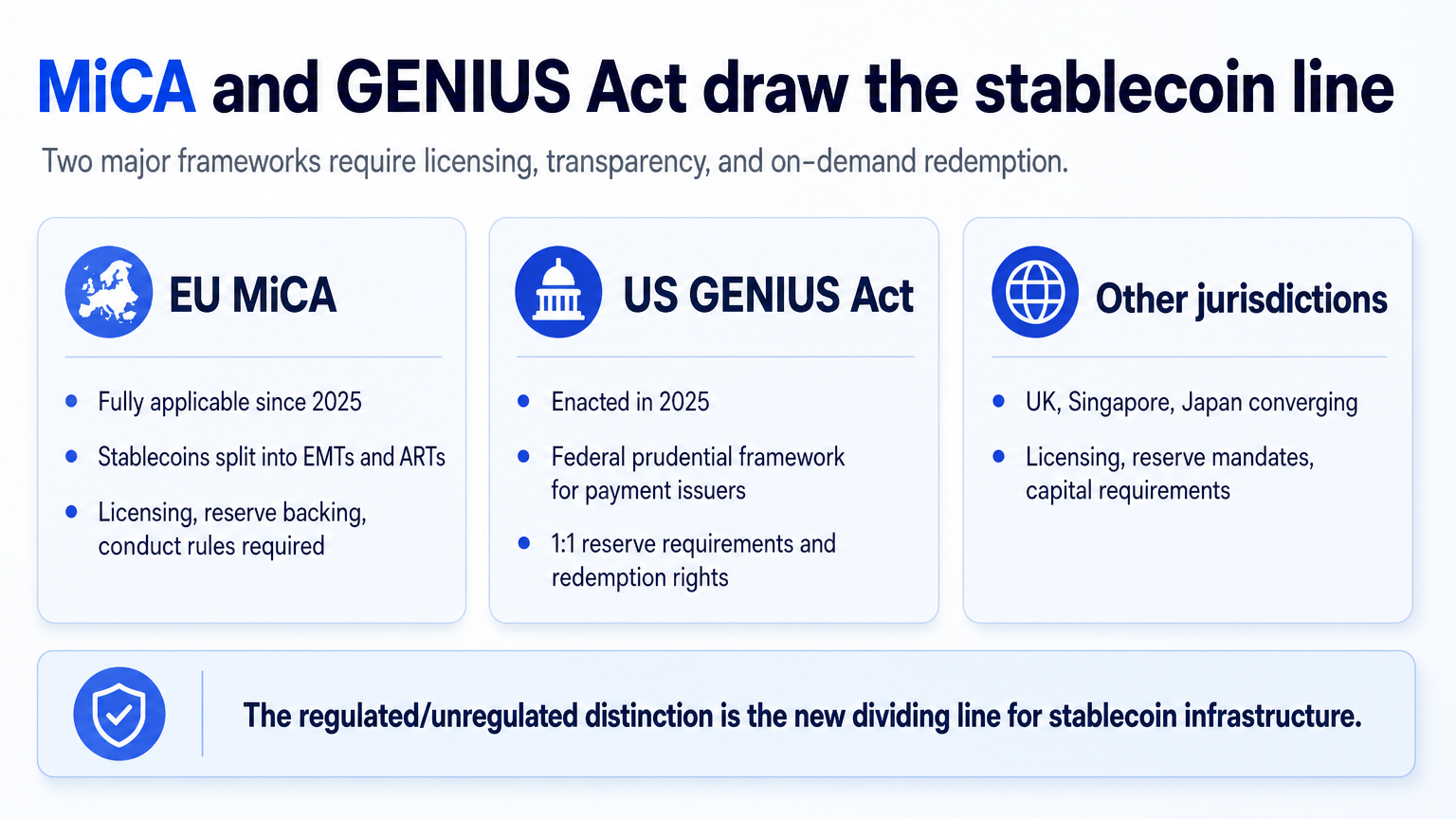
Two frameworks dominate: the EU’s MiCA and the US GENIUS Act. MiCA, fully applicable since 2025, divides stablecoins into EMTs (pegged to a single currency) and ARTs (basket-pegged), both requiring licensing, reserve backing, and compliance with ongoing conduct rules. The US GENIUS Act, enacted in 2025, created a federal prudential framework for payment stablecoin issuers, emphasizing 1:1 reserve requirements and redemption rights. Other jurisdictions—the UK, Singapore, Japan—are converging on similar principles: licensing, reserve mandates, and capital requirements. These frameworks make the regulated/unregulated distinction the new dividing line.
The GENIUS Act vs. MiCA: what you need to know right now
While GENIUS Act stablecoins set a high bar for US issuers, MiCA is currently the regulation with the most immediate deadline for any business touching the EU market. For non-EU businesses, the choice between using a US-regulated stablecoin (like USDC, which is expected to comply with both regimes) and a MiCA-compliant euro stablecoin (like EURC) is becoming a core treasury decision.
What does the January 8, 2027 deadline mean for businesses using stablecoins?
Simply put: any EU-based business or any business with EU-facing payment flows that still uses USDT must act now. After January 8, 2027, regulated platforms will not support USDT for EU residents, and OTC desks may refuse to settle in USDT if the counterparty is EU-linked. This is an operational hard stop, not a soft recommendation.
The immediate risks: EU wallets that hold USDT might find themselves unable to convert to fiat via regulated on/off-ramps, and automated treasury systems that sweep payments in USDT could fail. The cost of inaction includes broken payroll, delayed supplier payments, and emergency conversion fees.
What alternatives to USDT exist for cross-border payments and DAO operations?
The most straightforward replacements are Circle’s USDC and EURC, both of which Circle has publicly confirmed are MiCA-compliant under its EU e-money license. Circle’s MiCA hub states that USDC and EURC are issued by a regulated e-money institution, meeting full reserve and redemption standards. For dollar exposure, USDC is the immediate substitute; for euro-denominated flows, EURC eliminates FX complexity. These stablecoins enjoy deep liquidity and broad exchange support, making them practical for real‑time cross‑border settlements and DAO treasury management.
For DAOs and hybrid teams that use both fiat bank accounts and on-chain wallets, a unified platform that integrates compliant stablecoin rails (USDC, EURC) alongside traditional currency accounts can eliminate fragmentation. OneSafe, for example, provides a single account that holds fiat and supports USDC transactions, enabling instant crypto-to-fiat conversion and multi-currency functionality—directly addressing the last‑mile problem of EU stablecoin compliance. Such neobank‑style integrations let a DAO or startup redirect payment rails without dismantling existing workflows.
How can businesses comply with the new EU stablecoin rules?
Your 90-day action plan
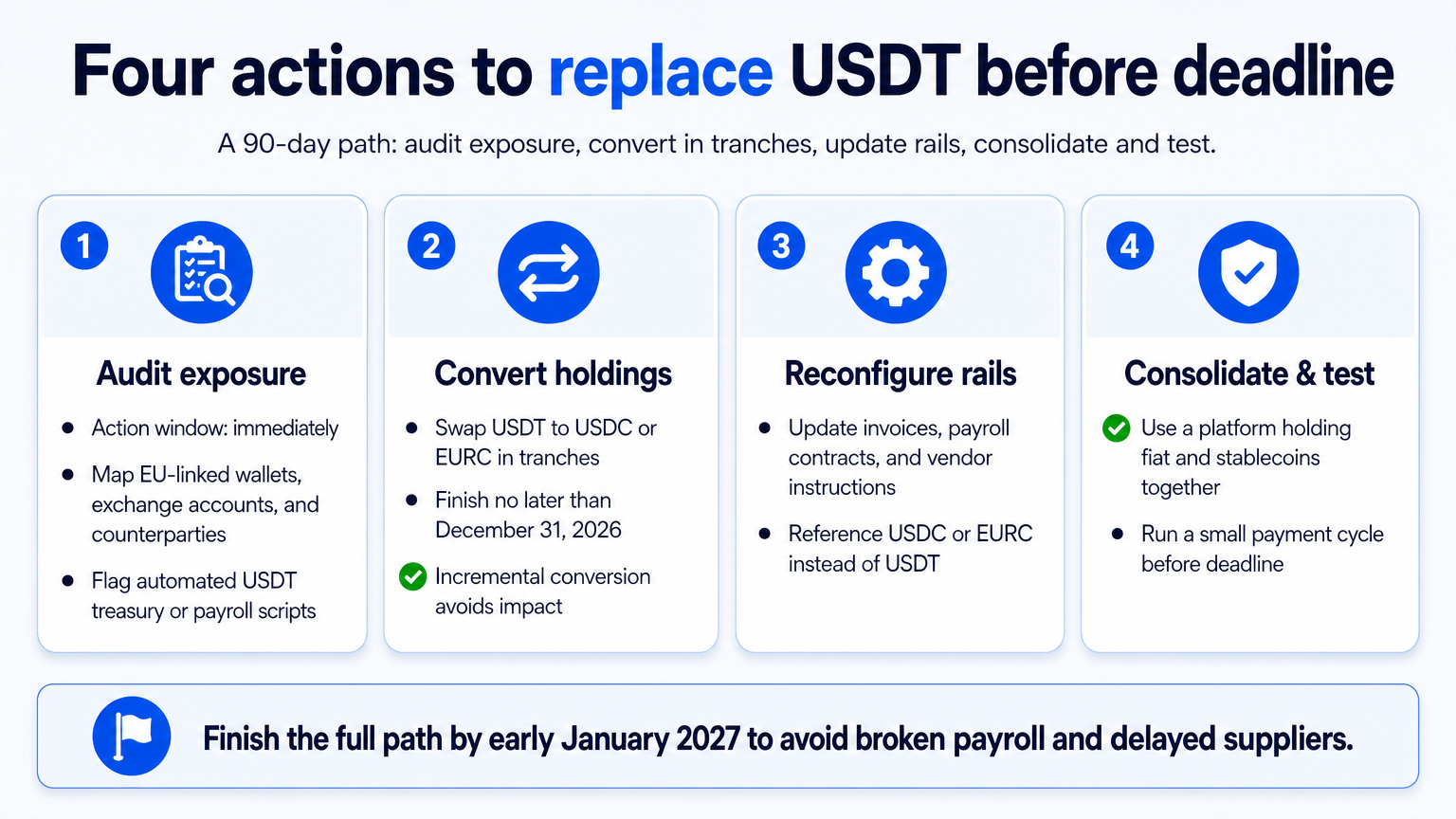
Step 1: Audit your EU stablecoin exposure today
Map every wallet, exchange account, and counterparty that holds or transacts in USDT and has an EU nexus. Flag any automated treasury or payroll scripts that touch USDT.
Step 2: Convert or migrate USDT holdings before the deadline
If you hold USDT in a non-custodial wallet that you control, swap to USDC (or EURC) via a decentralized exchange aggregator or a trusted centralized platform while liquidity remains robust. For larger amounts, execute the conversion incrementally to avoid impact. The key rule: treat the EU regulator’s signal as binding, regardless of Tether’s public stance. Even if Tether were to file a last‑minute application, the window is too narrow for certainty. Convert now.
Step 3: Reconfigure payment rails for regulated stablecoins and fiat
Update invoicing templates, payroll smart contracts, and vendor payment instructions to reference USDC (or EURC) instead of USDT. If you receive fiat from EU clients, set up a multi-currency account that can accept euro and hold both fiat and stablecoins natively. This keeps operations going without requiring recipients to open new wallets.
Step 4: Use a unified platform to avoid fragmentation
OneSafe, a financial technology company (not a bank) offering neo‑banking services through banking partners, provides a single account that holds fiat (USD, Euro, CAD) and supports USDC transactions. DAOs can set up a crypto‑friendly business banking account with customizable roles, and the platform’s instant crypto‑to‑fiat conversion lets teams move from USDT to USDC or EURC without off‑platform hops. With Fireblocks custody, MFA, and segregated accounts, the platform bridges the old and new worlds of money—directly addressing the last‑mile problem of EU stablecoin compliance. According to company data, OneSafe has processed over $800 million in transaction volume from more than 1,000 businesses across 30+ countries, testament to its capacity to handle global payment flows.
| Action | What to do | Deadline / urgency |
|---|---|---|
| 1. Identify USDT exposure | List all EU-facing wallets, exchange accounts, payment links using USDT | Immediately |
| 2. Plan conversion | Choose a swap route (DEX aggregator, compliant exchange, or integrated platform) | Before Jan 8, 2027 |
| 3. Execute conversion | Convert USDT to USDC/EURC in tranches to manage slippage | No later than Dec 31, 2026 (to leave buffer) |
| 4. Update payment instructions | Notify counterparties, revise templates, update contracts | By early January 2027 |
| 5. Consolidate into a unified account | Onboard to a neobank-like platform supporting stablecoins and fiat | Can be done in parallel |
| 6. Test end‑to‑end | Run a small payment cycle to ensure no disruption | Before deadline |
What to watch next
Tether’s response and potential MiCA filings
Tether has historically taken a combative regulatory approach. It could still file for a license or challenge MiCA’s classification, but as of now, no public filing exists. Businesses should not wait for a last‑minute reprieve.
Other jurisdictions following the EU’s lead
The UK’s forthcoming stablecoin rules and the implementation of the GENIUS Act in the US may create parallel deadlines. Expect more jurisdictions to mandate that only regulated stablecoins 2026 onwards be used in mainstream payments. The EU Stablecoin Regulation: 2027 Compliance Deadline & Actions offers a deeper dive into the evolving landscape.
The knock‑on effect for DeFi and permissionless protocols
Decentralized exchanges and lending protocols are not directly covered by the deadline, but their EU-facing interfaces may be geoblocked, and the liquidity migration from USDT to USDC in European markets will shift on-chain dynamics. DAOs that use USDT-heavy pools should evaluate the long‑term viability of those positions.
Key Takeaways
- EU regulators have given crypto firms until January 8, 2027 to delist non‑MiCA‑compliant stablecoins like USDT, making immediate conversion a necessity.
- Businesses and DAOs with any EU nexus should audit and convert USDT holdings to regulated alternatives such as USDC or EURC now, not later.
- Regulated stablecoins are the only path forward for institutional liquidity, and the EU’s action signals a permanent shift in market infrastructure.
- A unified platform that handles fiat and compliant stablecoins natively can mean the difference between a chaotic migration and a seamless operational pivot.
- Monitor Tether’s regulatory moves and watch for similar deadlines in other jurisdictions, but don’t let hope delay action.
Ready to streamline your stablecoin operations and stay compliant? Open a OneSafe account to manage fiat and regulated stablecoins in a single platform.