

Meta description: Visa and Mastercard now let businesses pay with stablecoins. Discover how stablecoin payments cut costs and speed up cross-border transactions.
Visa, Mastercard Bet on Stablecoin Payments: What It Means for Web3
On October 15, 2026, Visa and Mastercard each launched commercial services letting businesses fund payments with stablecoins—predominantly USDC—settling recipients in fiat. BigGo Finance reported the dual move on October 17, marking the moment stablecoin payments become institutional plumbing for the $27 trillion B2B payments market.
Table of Contents
- What Just Happened
- Why This Matters Now
- The Background: Stablecoin Payments in 2026
- Implications for Web3 Startups, DAOs, and Global Businesses
- Actionable Recommendations for Your Business
- What to Watch Next
- How does OneSaf differ from traditional banks when it comes to stablecoin payments?
- What types of transactions can I perform with a OneSaf account?
- How does OneSaf handle currency conversion for fiat and crypto?
- Is OneSaf really available worldwide for stablecoin transactions?
- Key Takeaways
What Just Happened
Visa’s platform integrates stablecoin minting, movement, and management directly with its treasury and acquiring partners. Mastercard’s service similarly enables corporate customers to send stablecoin-funded payments that settle in local fiat across its global network. Both are production-grade and available to existing network members—a huge addressable base.
At the transactional level, a business holds USDC in a compatible wallet. Initating a payment moves the stablecoins on-chain to a network-controlled treasury address; the network atomically converts them to fiat and settles the recipient’s bank account or card—often within seconds. The entire flow is abstracted behind an API, eliminating the need to pre-fund accounts in multiple currencies and cuting correspondent banking intermediaries. On-chain settlement reduces per-transaction costs to fractions of a cent, while conversion to local fiat happens at market rates near-instantaneously, as How stablecoin payments work for remittances explains.
Why This Matters Now

Stablecoin payments were largely confined to on-chain DeFi protocols and crypto exchanges. Vsa’s new platform—announced via Visa Introduces Platform for Stablecoin Minting, Movement and Management—targets mainstream corporate treasurers, not crypto enthusiasts. Mastercard stablecoin integration embeds stablecoin funding alongside ACH and wire transfers, with the same interfaces treasurers already use.
For Web3 startups and DAOs that hold significant stablecoin treasuries but struggle to pay fiat bills without manual off-ramping, these rails mean stablecoin dollars can stay interest-bearing and crypto-native until the moment of payment. The speed and cost advantage is stark: traditional SWiFT wires take 2–5 business days and cost up to 3% in fees, while stablecoin settlements finalize in seconds for well under $1, dramatically reducing both cost and settlement time, as Top Benefits of Stablecoins for Payments and Remitence Companies details.
The Background: Stablecoin Payments in 2026
A payment stablecoin—like USDC or PYUSD—is a blockchain-based token pegged 1:1 to a fiat currency and fully reserved with cash and short-duration Treasury bills. It is built for value transfer, not speculation. The pending GENIUS Act will further separate this class from riskier crypto assets by imposing prudential oversight.
Key players: Circle’s USDC (over $60 billion in circulation) dominates, and is the funding token for both new services. PayPal’s PYUSD gains traction for merchant settlements. Infrastructure from Fiireblocks, Ripple, and Crossmint allows any business to plug into USDC business payments via APIs (see Top Cross-Border & Stablecoin Payment Providers in 2025). On-chain settlement locks funds irrevocably within seconds—a property correspondent banking cannot replicate.
Implications for Web3 Startups, DAOs, and Global Businesses
Visa and Mastercard solve the acceptance side: they convert stablecoins to fiat and push it to any endpoint on their network. But they do not solve crypto-native management needs. A DAO with $5 million in USDC across multiple multi-sig wallets still needs custody, role-based access controls, on-chain signing workflows, payroll in both crypto and fiat, and audit-ready records tying on-chain activity to off-chain accounting. Card-network APIs alone do not provide these capabilities. As Stablecoin Payments Go Live: Visa’s Production Leap and What’s Next notes, enterprises adopting these rails must still answer hard questions about wallet infrastructure and compliance.
A neo-banking for Web3 platform like OneSafe bridges this gap. Instead of cobbling together a separate custodian, bank account, and card-network integration, a DAO can hold its USDC treasury in secure, Fireblocks-backed custody, instantly convert to fiat for bill payments or corporate card spend, and route international wires—all from a single dashboard with customizable roles. The platform connects to card networks and banking rails, so the DAO doesn’t manage disjointed stacks. For businesses that use corporate cards, being able to top up those cards directly with stablecoins closes the loop.
Actionable Recommendations for Your Business
Audit your current cross-border payment stack. Map how long international wires take, total fees (including hidden FX spreads), and hours spent reconciling on-chain and off-chain ledgers. Many Web3 startups bleed 2–4% on cross-border payments and lose days in settlement delays.
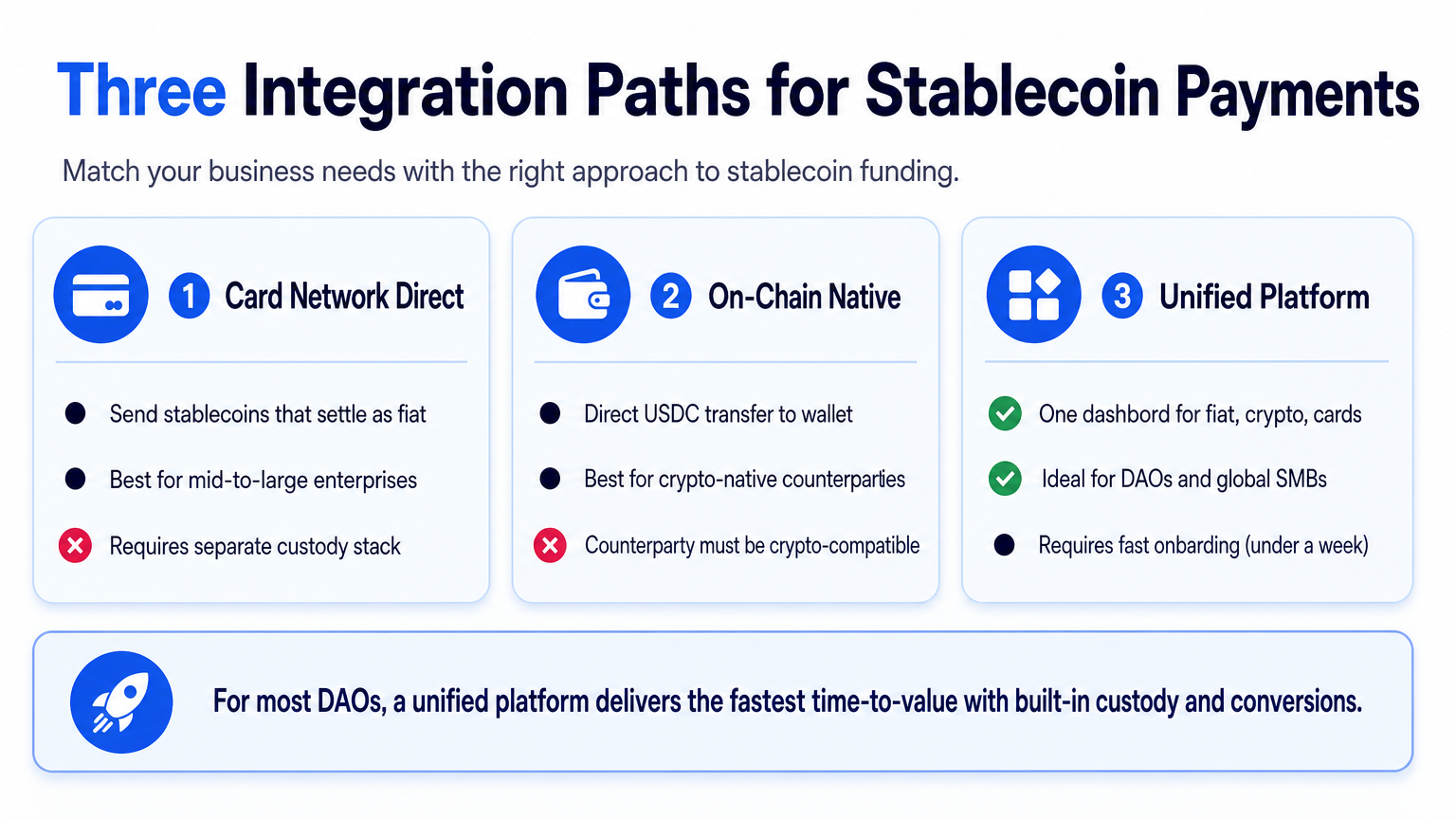
Decide on an integration path using this framework:
| Integration Path | How It Works | Best For | Key Trade-off |
|---|---|---|---|
| Card network direct (Visa/Mastercard) | Stablecoins fund payments that settle in fiat at merchant/bank endpoints. | Mid-to-large enterprises with in-house crypto custody and treasury banks. | Requires separate custody and compliance stack. |
| Stablecoin network / on-chain native | Send USDC directly to a counterparty’s wallet; they handle off-ramping. | Crypto-native counterparties, DeFi protocols, contributor payouts. | Counterparty must be crypto-compatible; no built-in fiat cash-out. |
| Unified neo-banking platform (e.g., OneSafe) | Combines fiat accounts, USDC custody, FX, corporate cards, and on/off-ramps in one dashboard. | Web3 startups, DAOs, global SMBs needing both fiat and crypto without multiple vendors. | Requires platform onboarding (typically under a week). |
For most DAOs and smaller Web3 businesses, the unified platform offers the fastest time-to-value because it eliminates custody complexity and provides stablecoin on-ramp off-ramp functionality in the same interface where payroll and vendor payments happen.
Start small: Pick a recurring $5,000–$10,000 cross-border payment. Instead of a SWIFT wire, fund a virtual corporate card with USDC via a platform like OneSafe, then pay the supplier. Track settlement time, all-in cost, and reduction in manual reconciliation to build the internal case for scaling.
What to Watch Next
Regulatory clarity: The GENIUS Act is progressing through Congress and would officially designate “payment stablecoins” as a distinct, regulated asset class. Final rules on reserves, redemption rights, and interoperability with bank rails will determine how widely these card-network services scale.
Will other networks and PSPs follow? With Visa and Mastercard live, Amex, Discover, and processors like Adyen and Stripe will likely accelerate their own stablecoin-funding modules. Banks relying on SWIFT correspondent fees will face pressure to offer stablecoin settlement or risk losing corporate clients.
Can stablecoin payments maintain their cost advantage? On-chain transfer costs are negligible, but AML and sanctions-screening requirements will add compliance overhead. Early data suggests stablecoin payments remain 84% cheaper than traditional rails, as analyzed in Stablecoin Payments 84% Cheaper: New Data for Businesses, but margin compression may occur as compliance tooling builds out.
How does OneSaf differ from traditional banks when it comes to stablecoin payments?
OneSaf is a financial technology company, not a licensed bank. It natively supports both fiat and cryptocurrency operations within a single interface, bridging conventional banking services (ACH, wires, corporate cards) with crypto-friendly business banking and DAO treasury management. You can hold USDC in secure custody, convert it to fiat instantly for bill payments, and pay a supplier’s bank account—without bouncing between a separate exchange and your bank’s portal.
What types of transactions can I perform with a OneSaf account?
You can send and receive ACH and domestic wire transfers, initiate international wires, pay bills, convert crypto to fiat (and vice versa), make crypto payments, and issue virtual or physical corporate cards with spend limits—all from the same dashboard. Invoicing, automated payments, and payroll management are also built in.
How does OneSaf handle currency conversion for fiat and crypto?
OneSaf partners with multiple exchanges to source competitive rates. Fiat-to-fiat foreign exchange costs either 0.25% or the prevailing FX rate, while crypto-to-fiat (and reverse) conversions are executed near-instantaneously. USDC deposits and withdrawals carry no fee, and the platform provides real-time conversion visibility, reducing hidden spread costs.
Is OneSaf really available worldwide for stablecoin transactions?
Yes, OneSaf is a global platform, open to businesses in over 30 countries. The primary exclusions are OFAC-sanctioned countries and certain U.S. states where regulatory clearance is pending. Onboarding is fully digital, requiring standard business formation documents and government ID; for specific availability, contact support@onesafe.io.
Key Takeaways
- Visa and Mastercard now offer commercial services that let businesses fund cross-border payments with stablecoins, settling recipients in fiat—a tangible step toward mainstream adoption.
- Web3 startups and DAOs can eliminate manual off-ramping and reduce payment costs by integrating stablecoin funding directly into their treasury workflows.
- Card networks provide the acceptance infrastructure, but crypto-native treasury management still requires a unified platform that handles custody, multi-sig, and fiat conversions.
- A pragmatic first step is to pilot a stablecoin-funded corporate card for a recurring international payment, then scale based on measurable savings and reduced reconciliation time.
- Regulatory progress—especially the GENIUS Act—will shape how widely and quickly these services can be adopted, so monitor final rulemaking closely.
Ready to bring your business’s fiat and crypto operations into a single, secure dashboard? Open an account with OneSafe and launch your first stablecoin-funded payment in days, not weeks.



