
Stablecoin payments cost 84% less than traditional remittances, new Borderless.xyz data shows, giving businesses hard numbers to drop expensive bank wires.
A new analysis finds that stablecoin cross-border payments cost roughly 84% less than traditional remittance methods, giving global businesses and DAOs the data to switch. Published by Borderless.xyz on October 16, 2026, it arrives as corporate treasuries seek alternatives to expensive wires and opaque FX markups. What follows unpacks the numbers, explains the savings, and provides a practical roadmap to integrate stablecoin-based global business payments without breaking compliance or operational budgets.
Table of Contents
- What Just Happened: Stablecoin Remittance Costs Down 84%
- Why This Matters for Global Businesses and DAOs Right Now
- How Stablecoin Payments Work — and Why They Cost So Much Less
- Concrete Steps to Start Saving with Stablecoin Payments Today
- What to Watch Next: Adoption Speed, Regulation, and Open Questions
- Key Takeaways
What Just Happened: Stablecoin Remittance Costs Down 84%
The Borderless.xyz study: key numbers
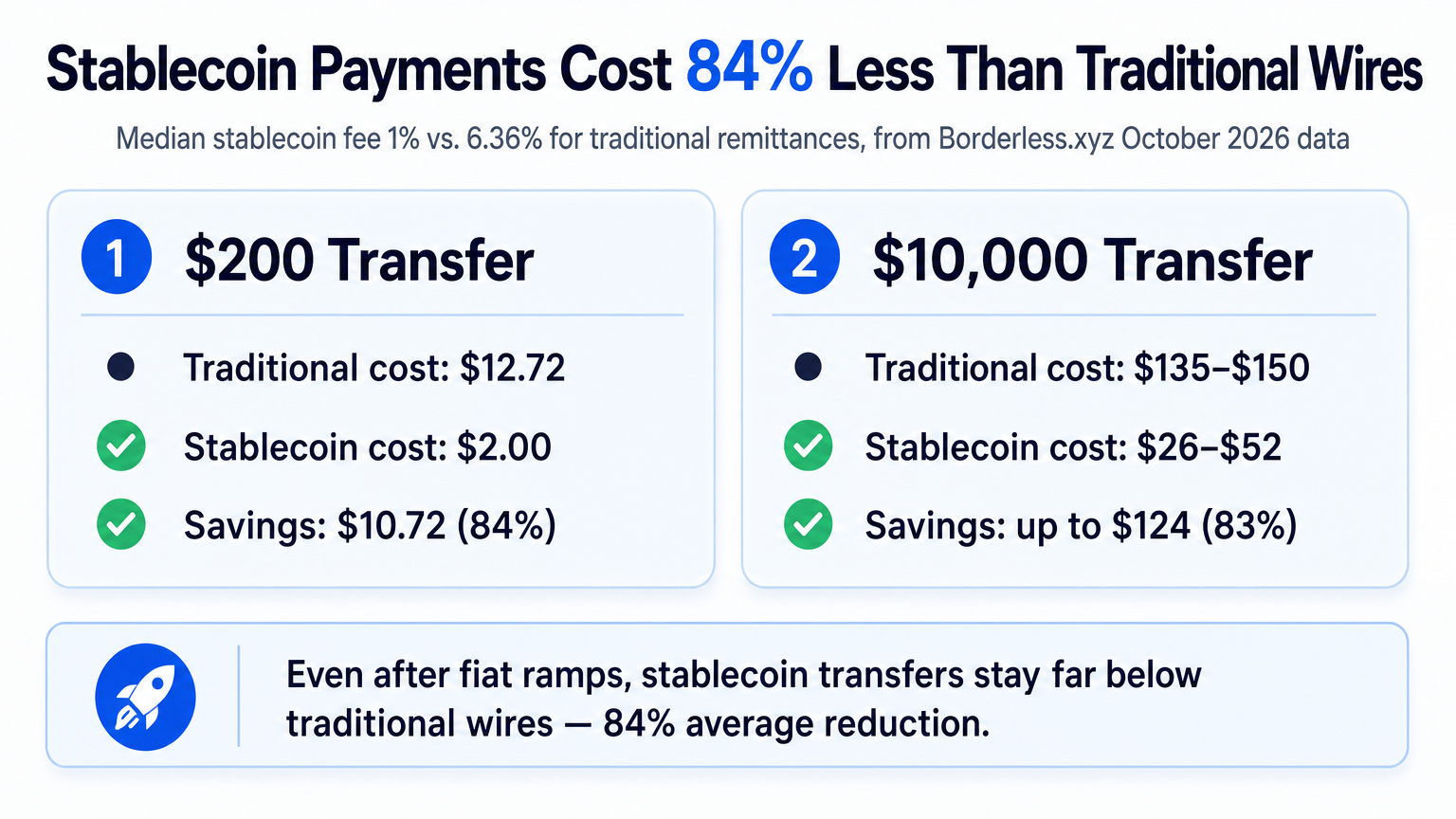
The Borderless.xyz analysis, aggregated by NewsCord on October 16, 2026, compared stablecoin-funded international transfers against World Bank remittance data for the same period in 2025. The headline: a $200 transfer carried a median stablecoin fee of 1% – roughly $2 – while the traditional cost was 6.36%, or $12.72. That’s an 84% reduction. For $10,000, the lowest-cost stablecoin provider charged $26, and the median $52. A traditional bank wire, blending transfer fees and a 1% FX margin, ran $135–$150. Stablecoin remittances compress costs across the entire payment stack, not just low-value transfers.
Methodology and data sources
Borderless.xyz aggregated live provider quotes for on‑/off‑ramp fees, network gas, and conversion spreads across corridors. Traditional costs were benchmarked against World Bank Remittance Prices Worldwide medians. By comparing total fee-to-receiver, the study captures hidden FX margins that stablecoin platforms shrink to fractions of a percent.
Why This Matters for Global Businesses and DAOs Right Now
The end of ‘bank wire as default’
An 84% cost differential changes the unit economics of every cross-border payment. Paying five overseas contractors monthly can save four figures annually. A DAO distributing contributor rewards across ten jurisdictions compounds those savings with every payout. The wire is no longer the safest, most straightforward option; it’s now the most expensive.
The figures should reframe treasury conversations around working capital. Wires require prefunding foreign‑currency accounts, tying up cash. Stablecoin flows eliminate that prefunding drag – a point explored in OneSafe’s analysis of stablecoin prefunding.
How much can stablecoin payments really save?
The savings are clearest on mid‑size transfers where wire fees bite. Based on Borderless.xyz (October 2026), in US dollar equivalents:
| Transfer Amount | Traditional Cost (median) | Stablecoin Cost (median) | Savings ($) | Savings (%) |
|---|---|---|---|---|
| $200 | $12.72 | $2.00 | $10.72 | 84% |
| $10,000 | $135–$150 (incl. 1% FX) | $26–$52 | ~$83–$124 | up to 83% |
These are all-in sender costs. For businesses holding USDC, Ethereum Mainnet gas can be $1–$2; on L2s, under $0.10. The bulk of cost comes from on‑ramp/off‑ramp fees, so selecting a platform with tight fiat‑crypto integration is critical to capturing the stablecoin savings.
Macro context: crypto adoption and regulatory milestones
Stablecoin payments are moving from proof-of-concept to production. Visa settled its first stablecoin transaction on Ethereum in 2025 and its production pipeline launched in 2026. Stripe offers stablecoin payout APIs, and corporate USDC card programs are rolling out. Frameworks like the GENIUS Act and EU MiCA give clearer rules. The 84% figure is a benchmark that will accelerate treasury migration.
How Stablecoin Payments Work — and Why They Cost So Much Less
Payment rails: traditional vs. stablecoin
A cross‑border wire moves through multiple correspondent banks, each adding fees and 1–3 days. The recipient’s bank applies a 1–3% FX markup hidden from the sender. A USDC transfer on a public blockchain costs only network gas, regardless of geography. The Borderless.xyz study confirms that even after adding fiat on‑/off‑ramp costs, total fees stay far below traditional wires. As Stripe’s guide on stablecoin remittances notes, those ramps remain the friction point.
Where the 84% savings come from: fees, FX, and float
Three components account for the difference:
- Correspondent bank fees eliminated. $25–$50 in wire charges vs. a few cents in gas.
- FX margin compressed. Banks levy a 2% spread; a modern platform quotes as low as 0.25% – an FX comparison that reveals the hidden cost.
- Float and prefunding removed. Funds stay in stablecoins until payment, improving liquidity.
Polygon’s primer on stablecoin remittance rails explains how L2 scaling pushes on‑chain costs near zero, leaving converter fees as the main cost driver. A platform bundling fiat conversion and crypto custody can deliver the median $52 cost.
Concrete Steps to Start Saving with Stablecoin Payments Today

Picking a platform that handles fiat and crypto natively
Managing this with a traditional bank plus a separate crypto exchange erodes savings with extra wires and markups. Use a unified neo‑banking platform built for both fiat and crypto, like a crypto business banking provider. Look for:
- Multi‑currency fiat accounts (USD, EUR, etc.)
- Free USDC deposits/withdrawals (no USDC fees)
- Competitive FX rates (0.25% or better)
- Built‑in KYB/KYC and segregated custody (e.g., Fireblocks)
- ACH and international wire support
OneSafe exemplifies these: free USDC transfers, 0.25% fiat-to-crypto conversion, fast onboarding, and Fireblocks security.
What is the best platform for stablecoin business payments?
No universal “best” exists, but judge any platform on whether it executes the full flow: fund fiat → convert to USDC at low cost → send on-chain → off-ramp to fiat. Fewer external hops retain more of the 84% savings. Free USDC transfers and sub‑1% FX are table stakes.
How do I set up stablecoin payments for my startup?
A US‑incorporated startup paying a Portuguese agency €9,200 (~$10,000) monthly can follow this flow using OneSafe:
| Step | Action | Cost (on $10,000) |
|---|---|---|
| 1. Onboard & verify | Submit business documents; account open in ~5 days | Free |
| 2. Fund USD account | Domestic ACH | 0.15% deposit: $15 |
| 3. Convert USD to USDC | Instant at 0.25% FX | $25 |
| 4. Send USDC to agency wallet | Free USDC withdrawal; L2 gas ~$1 | $1 |
| 5. Agency off‑ramps to EUR | Agency uses its own crypto to fiat conversion; if on OneSafe, 0.25% FX applies on their side | — |
Total cost to the startup: $41 for $10,000. The traditional wire would cost $135‑$150, saving at least $94 (62%). The recipient gets euros in minutes. If the agency uses the same platform, internal transfers are free. For DAOs, the same steps apply with customizable roles and multisig permissions.
Minimizing conversion costs and wire fees
- Hold a USDC balance to avoid repeated conversions.
- Batch payments to reduce gas overhead.
- Avoid corporate cards for FX if fees are high (OneSafe’s corporate card FX is 3%, so direct crypto transfers are cheaper).
- Check all‑in quotes when converting fiat to crypto; a 0.25% spread keeps the advantage.
Is stablecoin settlement safe and compliant for DAOs?
Yes – the DAO must pass KYB/KYC on a compliant platform. The Borderless.xyz data shows recurrent payouts on traditional rails bleed 6%, unsustainable for transparent on-chain distribution. A compliant platform verifies the entity and signers, sets spending roles, enforces multisig, and uses institutional custody (e.g., Fireblocks). OneSafe’s customizable roles and permissions automate stablecoin payroll with Multi‑Factor Authentication and tracking.
Regulatory progress is jurisdiction‑dependent. The GENIUS Act and MiCA lay paths; France’s proposed 31.4% stablecoin tax, analyzed by OneSafe, reminds businesses to watch local liabilities. Still, a Banca d’Italia study concluded stablecoin remittances are “feasible and efficient” with compliant ramps.
What to Watch Next: Adoption Speed, Regulation, and Open Questions
Regulatory developments on the horizon
The US Treasury’s neo‑banking stablecoin guidance and the GENIUS Act are pushing traditional banks toward stablecoin rails. Japanese megabanks and Deutsche Bank pilots highlighted in October 2026 round‑up will add liquidity. Watch how quickly B2B payment platforms pass these savings to merchants.
When will stablecoin payments be fully mainstream?
Full mainstream adoption is years away, but the tipping point is close. The 84% advantage is now backed by public data, not just vendor white papers. As a recent academic study notes, remaining barriers are operational (ERP compatibility, de‑pegging risk), not fundamental. A business managing $500,000 in annual cross‑border payables could save $25,000 or more by switching half – pushing finance teams to demand stablecoin‑native interfaces. Early movers connecting directly to a unified fiat‑crypto platform will keep the advantage.
Key Takeaways
- Stablecoin payments cut costs by 84% on a $200 transfer and up to 83% on a $10,000 wire (Borderless.xyz, October 2026).
- Savings come from eliminating correspondent fees and compressing hidden FX margins to as low as 0.25%.
- Capture these with a unified platform that offers free USDC transfers, sub‑1% conversion, and built‑in compliance.
- A five‑step workflow reduces a $10,000 cross‑border payment from $150 to $41 without sacrificing security.
- Regulatory clarity is advancing; local tax rules require attention, but the operational case is unmistakable.
If your business is ready to capture the 84% savings on cross-border transfers, start your stablecoin payment flow today at OneSafe.



