An international wire transfer is an electronic bank-to-bank payment sent across national borders, and it usually settles in 1 to 5 business days. It works through SWIFT messaging and correspondent banks, which means the instruction moves quickly, but the money itself may pass through more than one bank before it lands.
Your vendor just sent an invoice from another country, or treasury needs to move funds between entities. The question isn't only what a wire is, it's whether a wire is the right rail for this payment at all.
Table of Contents
The Plain-English Definition of an International Wire Transfer
A finance team usually meets this payment method at a practical moment, when a supplier wants funds in their local bank account and the bank portal asks for more details than a domestic transfer ever does. At that point, the clean definition matters because it keeps you from mixing up the payment, the message, and the settlement path.
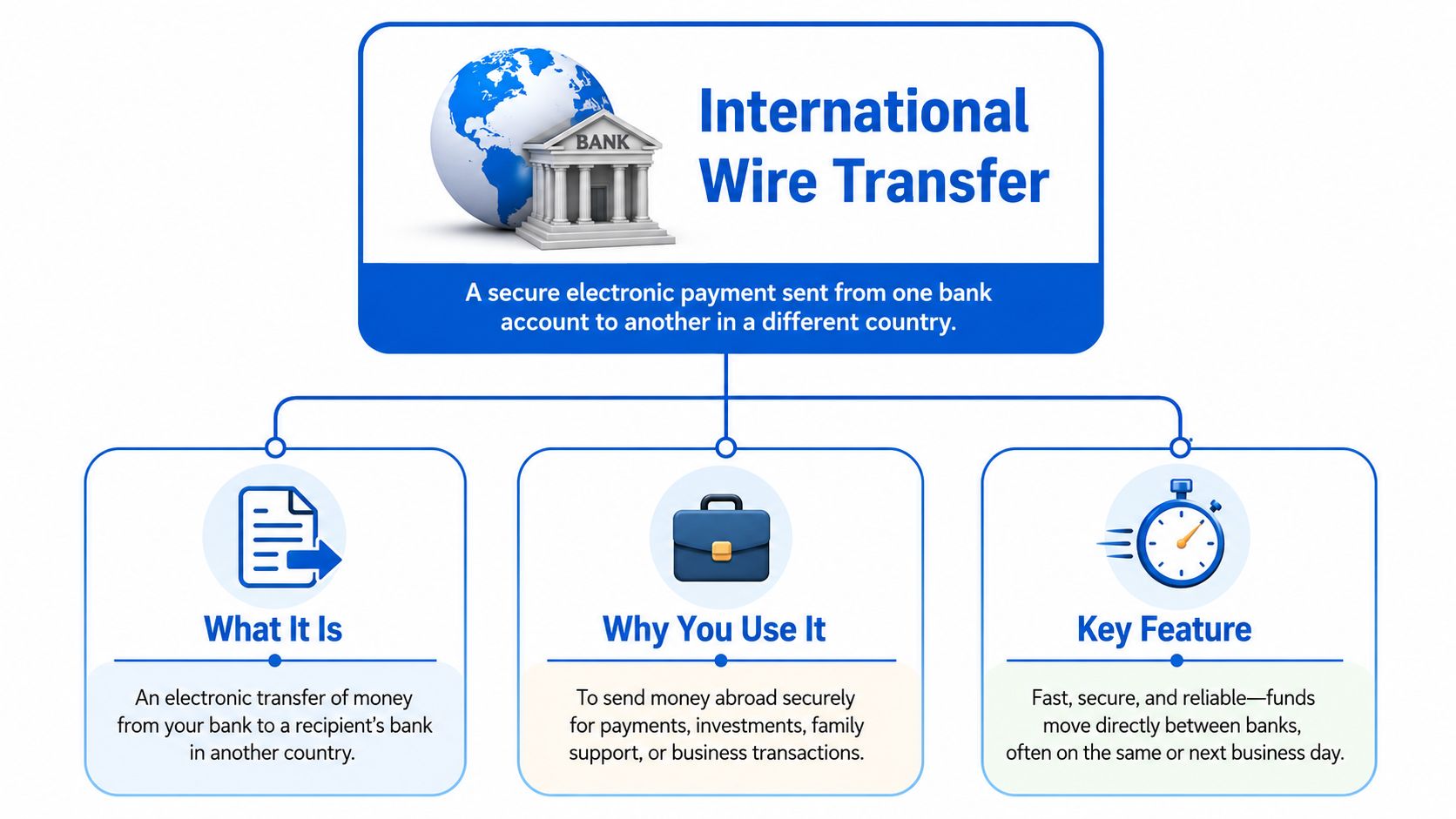
An international wire transfer is an electronic bank-to-bank payment sent across national borders. The instruction is typically transmitted through SWIFT messaging, while the actual funds move through correspondent banking relationships and intermediary banks before reaching the beneficiary bank. Wells Fargo's education page explains the core fields this setup usually needs, including the recipient's legal name, bank address, account number or IBAN, and the bank's SWIFT/BIC code Wells Fargo's transfer guide.
Separate the message from the money
That distinction is where a lot of confusion starts. The SWIFT network does not hold your money in the same way a domestic real-time rail might. It carries the payment instruction, then the banks involved settle the funds through their own banking relationships.
Practical rule: if the bank asks for SWIFT/BIC, IBAN, or intermediary details, you're not just sending a “payment,” you're entering a routing workflow that depends on bank-to-bank coordination.
In business terms, that routing is useful because it reaches banks in many countries and supports higher-value transfers with bank-grade finality. Federal Reserve data shows how central wire infrastructure still is in practice, with 387.7 million commercial wire transfers originated from U.S.-domiciled accounts in 2021 and $1,441.09 trillion in value Federal Reserve wire statistics.
That scale explains why finance teams still rely on wires for B2B settlement, treasury movement, and urgent cross-border payments. The label sounds simple, but the workflow behind it is not.
How a Wire Moves Across Borders
A sender enters one instruction, but the payment can pass through several systems before it reaches the beneficiary. The originating bank accepts the request, the message moves through SWIFT, one or more correspondent or intermediary banks may handle the routing, and the beneficiary bank completes the credit once the transfer clears each required check.
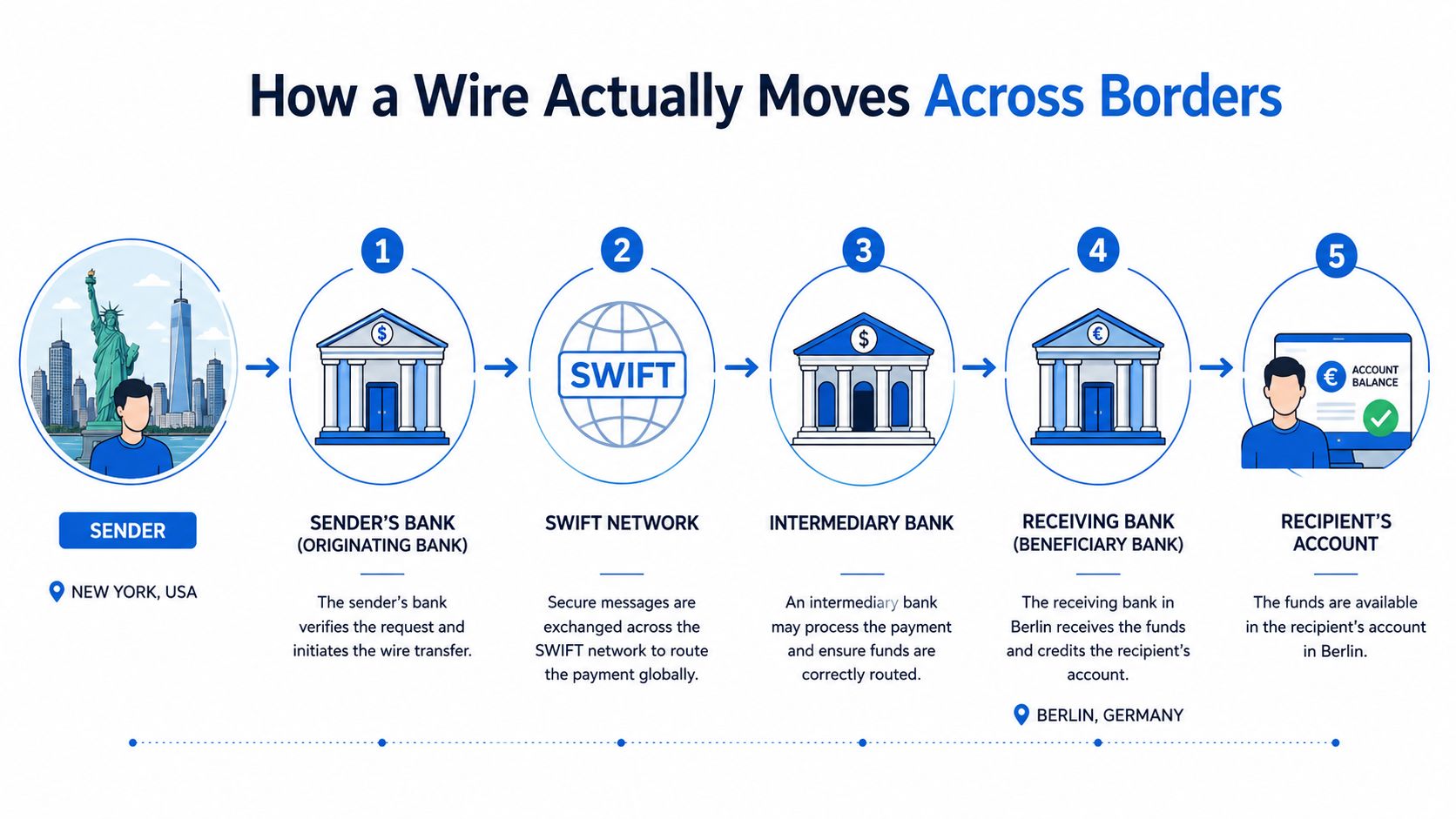
That path is easier to understand if you separate the instruction from the money. The message can move quickly, while settlement depends on how the banks along the route hold accounts with one another and when each institution is able to process the transfer.
The route from sender to recipient
The originating bank first records the payment instruction from the sender. From there, the instruction travels through SWIFT, which carries the message but does not itself move the funds. If the sending bank and the receiving bank do not have a direct relationship, the transfer may pass through a correspondent bank or other intermediary institution that maintains accounts with other banks and helps move value across borders.
The beneficiary bank then credits the recipient account after it matches the instruction and completes any review it requires. Bill.com's international wire overview notes that each correspondent-bank hop can introduce compliance checks, fees, and cut-off delays, which is one reason international wires often move more slowly and less predictably than domestic wires Bill.com's international wire overview.
Why each hop matters
Every handoff gives the payment another place to slow down. A bank can miss a cutoff time, pause the transfer because a name does not match, or wait for currency conversion before releasing the funds.
That is why a wire that looks finished when you click send can still take time to arrive. The route may be short on the screen and long in practice.
A wire is a coordinated chain of instructions and settlements across banks that may not know each other directly.
For finance teams that want fewer moving parts, unified multi-currency platforms can reduce the number of portals and handoffs involved in cross-border payments. OneSafe's cross-border payments brings multiple payment rails into one operating view, which can help teams handle international transfers without switching between separate banking systems.
The practical question is not just how a wire moves. It is whether a wire is the right rail at all, especially when a cross-border payment needs faster routing, clearer visibility, or fewer correspondent-bank steps.
What International Wires Cost and How Long They Take
International wires are electronic, but they're not cheap just because the message is digital. The World Bank's Remittance Prices Worldwide database reports that the global average cost of sending remittances is 6.36% of the amount sent, and industry summaries using the same data place the average near 6.5% for a $200 transfer in 2024–2025 World Bank remittance data. That's one reason teams still treat wires as a serious operating cost, not just a utility function.
Cost shows up in layers
The visible bank fee is only part of the expense. There's also the exchange-rate spread, and there can be deductions by intermediary banks along the route. In practice, the quoted fee can look manageable while the total cost of moving value across borders is much higher than the screen suggests.
| Component | Typical Range | Who Charges It |
|---|---|---|
| Sending fee | Varies by bank | Sending bank |
| FX spread | Embedded in the quoted rate | Sending bank or provider |
| Intermediary deductions | Varies by route | Intermediary banks |
| Receiving fee | Varies by bank | Beneficiary bank |
Timing is usually measured in business days
Major banking guidance says cross-border transfers typically take 1 to 5 business days, and often 1 to 3 business days, depending on correspondent banks, currency conversion, holidays, and compliance checks World Bank remittance data. That lag is structural, not just operational.
If a payment crosses banks, currencies, and time zones, “same day” usually depends on where the route starts, where it ends, and whether the banks' cutoff windows line up.
The scale of wire infrastructure helps explain why these costs persist. Fedwire processed 20,190,387 transfers originated with $107,877,913 million in value in June 2026, which shows how large-value bank payments still depend on wire rails Federal Reserve wire statistics.
That doesn't make wires wrong. It just means they're expensive because they solve a hard routing problem with bank-grade controls, not because someone added a fee by accident.
The Information You Need Before You Send
A wire fails most often for boring reasons, not exotic ones. The sender mistyped the account number, left out the SWIFT/BIC code, or used a shortened business name that doesn't match the beneficiary bank's records.
The core fields banks usually ask for
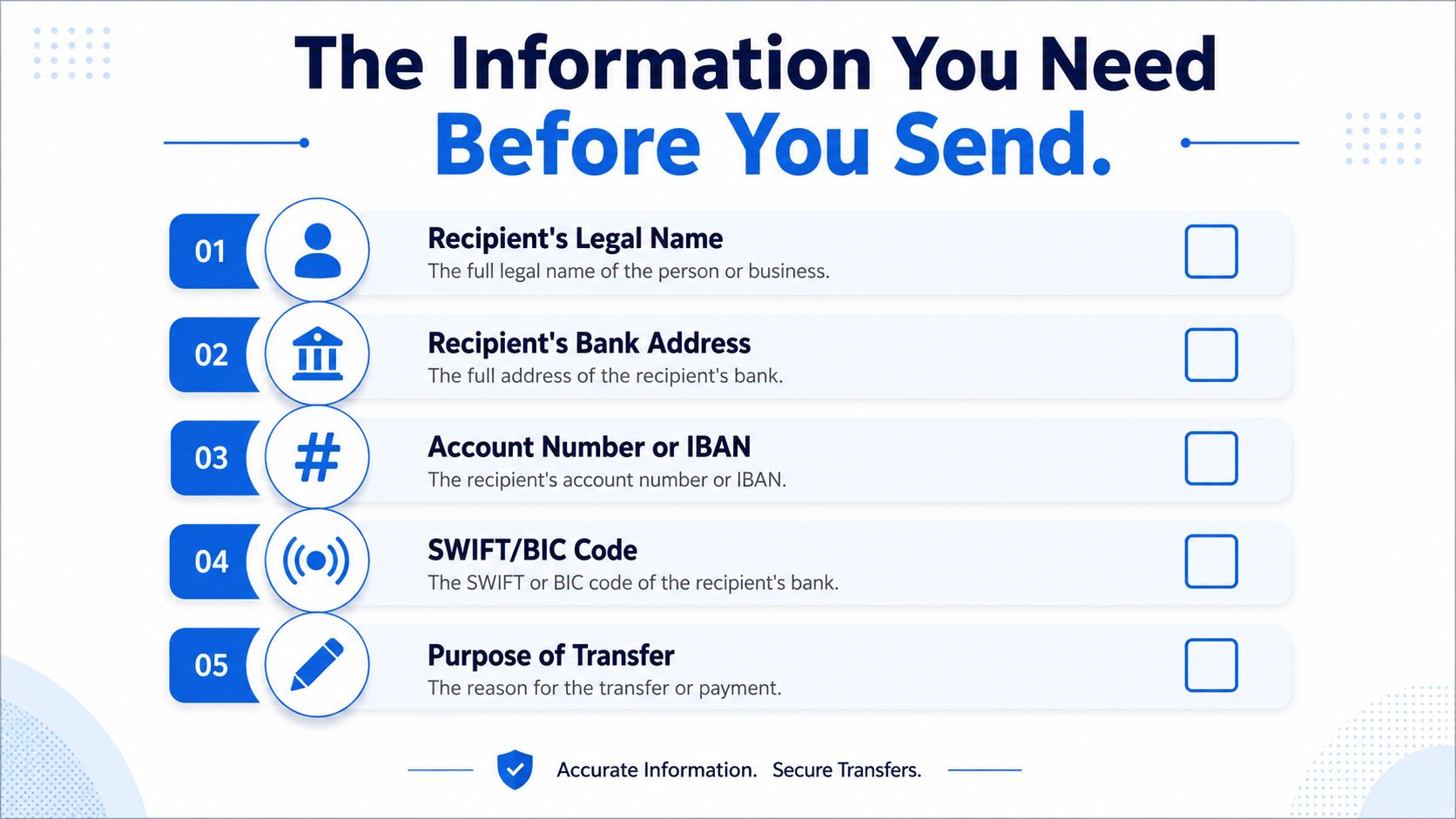
The usual checklist is straightforward:
- Recipient's legal name, exactly as the bank recognizes it.
- Recipient's bank address, because some banks use it for routing and verification.
- Account number or IBAN, depending on the destination country.
- SWIFT/BIC code, which is standardized as 8 to 11 characters.
- Purpose of transfer, which helps with internal controls and compliance review.
IBANs are used in many jurisdictions, while the SWIFT/BIC code identifies the bank in the cross-border network. If even one of these details is wrong, the payment can be delayed, rejected, or returned for correction.
Why validation matters before submission
The best time to catch errors is before the wire leaves your portal. Finance teams often validate beneficiary details against the vendor master, confirm the exact legal entity name, and ask the recipient to send a bank letter or invoice with routing data. That extra step feels slow, but it's cheaper than tracking down a misrouted payment.
A good translation workflow matters here too, especially when invoices, bank letters, or incorporation documents are in another language. For teams that need help converting financial documents accurately, Goodhand legal translation for finance can be a useful reference point.
Operational habit: never treat recipient data as static. Reconfirm it when the bank changes, the legal entity changes, or the payment corridor changes.
The result you want is not just a sent payment. You want a payment that lands on time, in full, and under the right legal name, without creating a reconciliation problem for the recipient.
Wires Compared to ACH, SEPA, and Modern Alternatives
An international wire often becomes the default because it feels safe and familiar, not because it's the best rail for the job. That's a costly habit when a payment is routine, regional, or low urgency.
For domestic vendor runs, ACH payment processing is usually the better fit because it's built for recurring, lower-cost transfers. For eurozone payments, SEPA is the more natural rail. For some cross-border payouts, modern fintech rails can reduce both the fee burden and the operational drag.
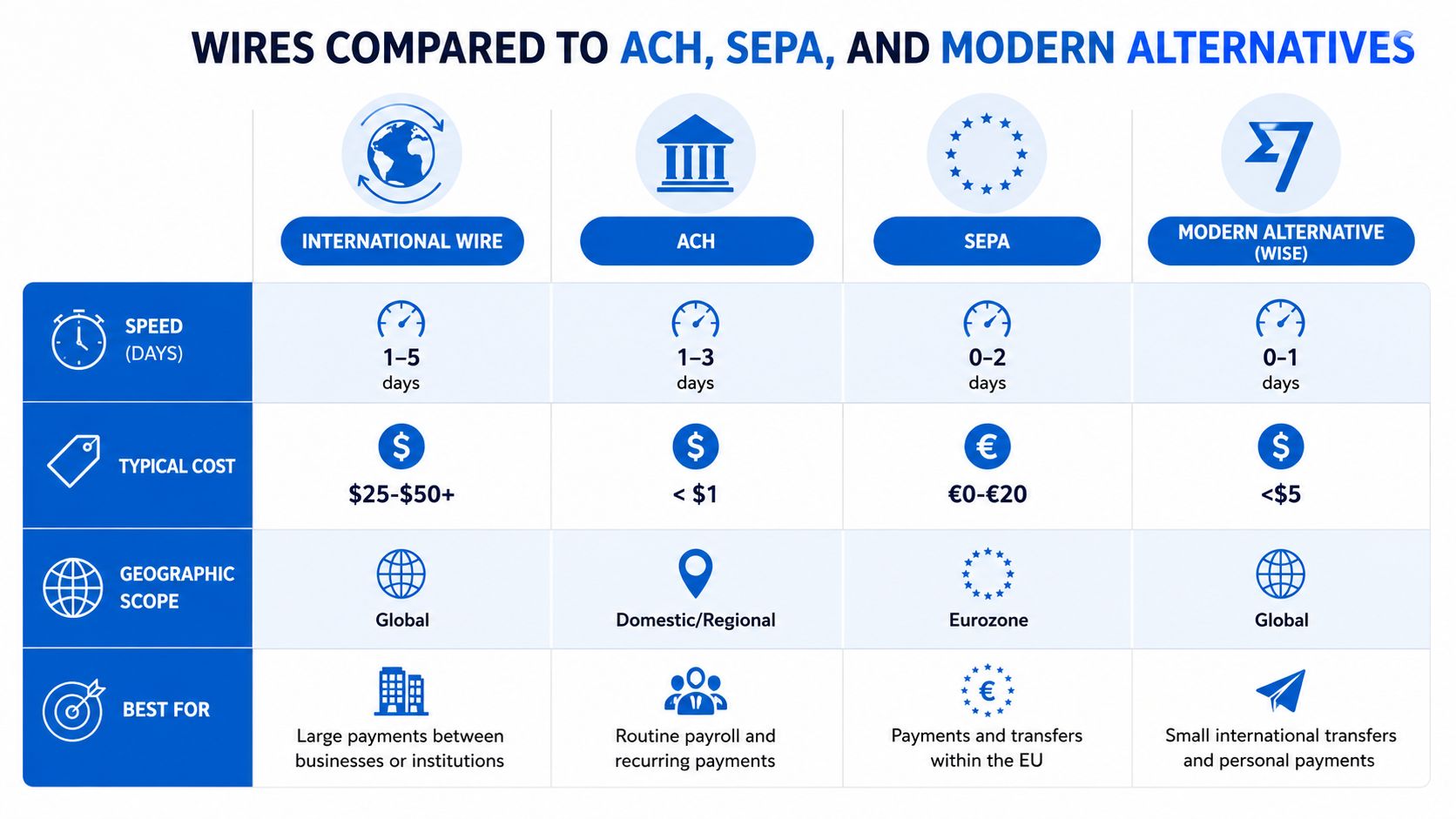
| Payment method | Speed | Typical cost | Geographic scope | Best for |
|---|---|---|---|---|
| International wire | Days | Higher | Global | Large, urgent payments |
| ACH | Business days | Low | Domestic or regional | Routine payroll and vendor payments |
| SEPA | Fast within the euro area | Low to moderate | Eurozone | EU transfers |
| Modern alternative | Often faster than legacy wires | Lower than many bank wires | Global | Smaller transfers and operational simplicity |
The decision rule finance teams actually use
Use a wire when finality, high value, or limited local infrastructure makes it the safest option. Use ACH or SEPA when speed and cost matter more than global reach. Use a modern payment platform when your team wants to reduce manual tracking and avoid managing separate tools for each corridor.
That last point is where modern platforms change the workflow. A unified system can route different payment types without making your team act like a separate operations desk for every country.
The practical trade-off
A wire gives you familiar bank handling, but it also gives you more manual overhead. A regional rail gives you lower cost, but only if the corridor supports it. A modern transfer provider can compress the operational burden, but it still needs clean recipient data and a clear FX strategy.
The wrong rail is often the one that forces your team to pay premium pricing for a payment that didn't need premium speed.
If the payment doesn't need global bank finality, a wire is usually just the most expensive safe option on the menu.
Compliance, Security, and the Irreversibility Reality
International wires sit inside a security framework. Banks screen for AML risks, sanctions exposure, and beneficiary mismatches before they release funds, because the network is built to move money with high confidence, not high flexibility.
Why banks slow the transfer down
That screening is part of the reason wires feel slower than the screen suggests. A bank can hold a payment if the sender name doesn't match the account profile, if the corridor is higher risk, or if the transaction pattern looks unusual for that customer. The point isn't to frustrate you. It's to prevent the bank from sending money into a compliance problem.
Once a wire is completed, it is generally treated as irrevocable. That's the harsh part of the rail. If the money reaches the wrong account, the sender usually has to ask the bank to start a recall process, but success depends on where the funds are, whether the receiving institution cooperates, and whether the recipient still has the balance available.
What to do when something goes wrong
If a wire goes to the wrong account, call the bank immediately. The faster the recall request starts, the better the odds of intervention before the funds move again. After settlement, the process becomes harder because the transfer is no longer a pending instruction, it's a completed movement.
For teams that need a deeper compliance lens, Kons Law on AML compliance failures is a useful context piece on why controls matter. The core lesson for operators is simple, strong controls prevent bigger problems later.
Operational reality: irreversibility is a feature of wires, not a bug. If your team can't afford a mistaken transfer, the approval and validation process has to be strict before send time.
That's why wires stay trusted for high-value B2B payments. They're not forgiving, but they are controlled.
How Multi-Currency Platforms Simplify Cross-Border Wires
The pain point for most finance teams isn't that international wires exist. It's that wires, ACH, FX, SWIFT, cards, and crypto flows often live in separate systems, so every payment corridor turns into a separate reconciliation problem.
A unified multi-currency platform reduces that fragmentation by putting the main payment rails in one place. One example is OneSafe's multi-currency business accounts, which are built to hold balances across currencies and connect fiat movement with crypto workflows in the same interface.
What consolidation changes for operators
When payment rails sit together, teams don't have to switch portals to move between domestic and international payments. They can review balances, choose a rail, and track the payment from the same dashboard. That matters because the hidden cost of cross-border work is often admin time, not just bank fees.
OneSafe's published product details show multi-currency business accounts in USD, EUR, and CAD, free USDC deposits and withdrawals, near-instant crypto-to-fiat conversion, and stated FX pricing of 0.25% or the FX rate. It also lists wire-related fees such as a $10 wire deposit, $25 wire withdrawal, and 0.35% plus $50 on SWIFT. Those figures matter because they make the total payment path more visible up front, which is exactly what legacy correspondent banking often hides.
Why this matters for cross-border operations
A finance team paying contractors, suppliers, or treasury balances across regions needs visibility, not just access. A platform that combines bank rails and crypto rails can reduce the number of places where payment data gets lost, duplicated, or delayed.
If your team is reconciling the same payment across multiple portals, the problem may be the workflow, not the transfer itself.
The best systems don't make wires disappear. They make wires one option inside a broader operating model, so the team can pick the right rail without rebuilding the process every time.
Choosing the Right Rail for Your Next Cross-Border Payment
The better question isn't “what is an international wire transfer?” The better question is when is a wire the wrong rail.
Use a wire when you need settlement certainty, you're moving a large amount, or the corridor doesn't give you a better bank-native option. Use ACH, SEPA, or another local rail when the payment is routine and the main goal is to reduce cost. Use a crypto-to-fiat workflow when treasury wants near-instant conversion and the recipient can settle in that format.
A simple decision filter
Before you send any cross-border payment, check four things:
- Data accuracy, including the beneficiary name, bank details, and routing code.
- Fee disclosure, including the sender fee and any intermediary deductions.
- FX margin, because the exchange rate can hide a major part of the cost.
- Sanctions and compliance exposure, especially on higher-risk corridors.
If any of those are unclear, pause before you click send. A wire that lands late or short is usually more expensive to fix than to delay.
The strongest teams don't treat wires as a default. They use them when the route really needs bank-grade finality, and they route everything else through a cheaper or cleaner rail.
If you're trying to simplify cross-border payments, consolidate treasury, and reduce the number of portals your team has to manage, OneSafe offers multi-currency accounts, global payment rails, and crypto-friendly workflows in one place. It's worth reviewing if your current wire process feels slower, more fragmented, or harder to reconcile than it should be.