

A contractor in Europe sends an invoice in euros. Your product revenue arrived in USDC. A software vendor wants payment in pounds, while payroll is due in local fiat. The money exists, but it's spread across a crypto wallet, a bank account, and several payment portals. Converting funds at the wrong moment, waiting for an international transfer, or missing a receiving capability can turn a routine payment run into a treasury problem.
So, what is multi currency banking? It's a financial setup that lets a business hold, receive, convert, and send funds in multiple currencies through connected infrastructure. Those currencies may include major fiat balances and, where the provider supports it, digital assets such as stablecoins. The important point is that multi-currency isn't merely a travel feature or a collection of extra account numbers. It's an operating layer for managing liquidity, settlement, foreign exchange, and payment approvals across borders.
The scale of the underlying market explains why this matters. The Bank for International Settlements reported that average daily turnover in global foreign exchange markets reached $9.5 trillion in April 2025, up 27% from April 2022. That activity reflects how currency conversion is embedded in international commerce and treasury operations. For a Web3 company, the practical question isn't whether cross-border finance exists. It's whether your workflow controls the conversion, timing, and compliance costs or leaves them to intermediaries.
Table of Contents
Global Business Payments in Practice
A global software company may collect customer funds in euros, pay a contractor in Canadian dollars, and settle cloud infrastructure in US dollars. A Web3 startup may receive USDC, convert part of it for payroll, and use a corporate card for subscriptions. Each payment can work alone. The operational risk appears when the finance team coordinates these flows across a wallet, bank account, card program, and payment portal.
Common failure points include:
- Conversion timing: Funds are exchanged before the team knows which currency the next obligation requires.
- Transfer delays: International wires pass through intermediary banks and may arrive after a supplier's cut-off.
- Fragmented records: Wallet activity, card expenses, bank transfers, and invoices do not reconcile cleanly.
- Unclear pricing: A small visible transfer fee can obscure a wider FX margin.
A multi-currency setup gives treasury more control over that workflow. Rather than converting every incoming payment immediately, the business can retain a balance for a known obligation, receive funds in a supported currency, route them to a vendor, and convert only the shortfall. The account structure therefore affects liquidity planning, settlement timing, and approval controls.
Practical rule: Treat every currency conversion as a pricing decision. Track the value received, the rate applied, the spread, and the amount that finally reaches the beneficiary.
The dollar remains central to international payment activity. The BIS has noted that approximately half of global trade is invoiced in US dollars, although the share varies by region. A company can therefore operate across many markets while concentrating treasury activity in a smaller currency set. Customer invoices may use one currency, supplier contracts another, and local operating expenses a third.
The mix continues to change. SWIFT data cited by the BIS show that the renminbi overtook the Japanese yen as the fourth most active global payment currency in December 2021. The same source records the dollar at 59.10%, the euro at 13.92%, and the renminbi at 2.18% of global payment transaction value in June 2026. These figures do not require every company to hold every currency. They support a corridor-by-corridor review of customer receipts, supplier payments, payroll, conversion points, and settlement capabilities.
For teams comparing fiat and crypto infrastructure, a curated overview of top blockchain payment platforms can help identify providers that support more than wallet transfers. Evaluate the complete workflow, including crypto-to-fiat conversion, fiat settlement, vendor payments, approval controls, and accounting records.
How Multi-Currency Accounts and Settlement Work
Multi-currency platforms generally follow one of two architectures. The first is a segregated multi-currency model. Each currency has its own balance, ledger treatment, and settlement account. If a business receives euros, it holds euros. If it needs dollars, it either uses an existing dollar balance or initiates a conversion.
The second is a cross-currency model. The platform converts funds inside the payment flow, so one participant can be debited in one currency while another is credited in a different currency. The IMF explains that this design reduces the number of settlement accounts participants need to maintain, but it moves FX pricing and liquidity provisioning into the platform layer. The platform's control over conversion, liquidity, and settlement timing therefore becomes central to treasury efficiency. See the IMF analysis of multicurrency and cross-currency settlement designs for the architectural distinction.
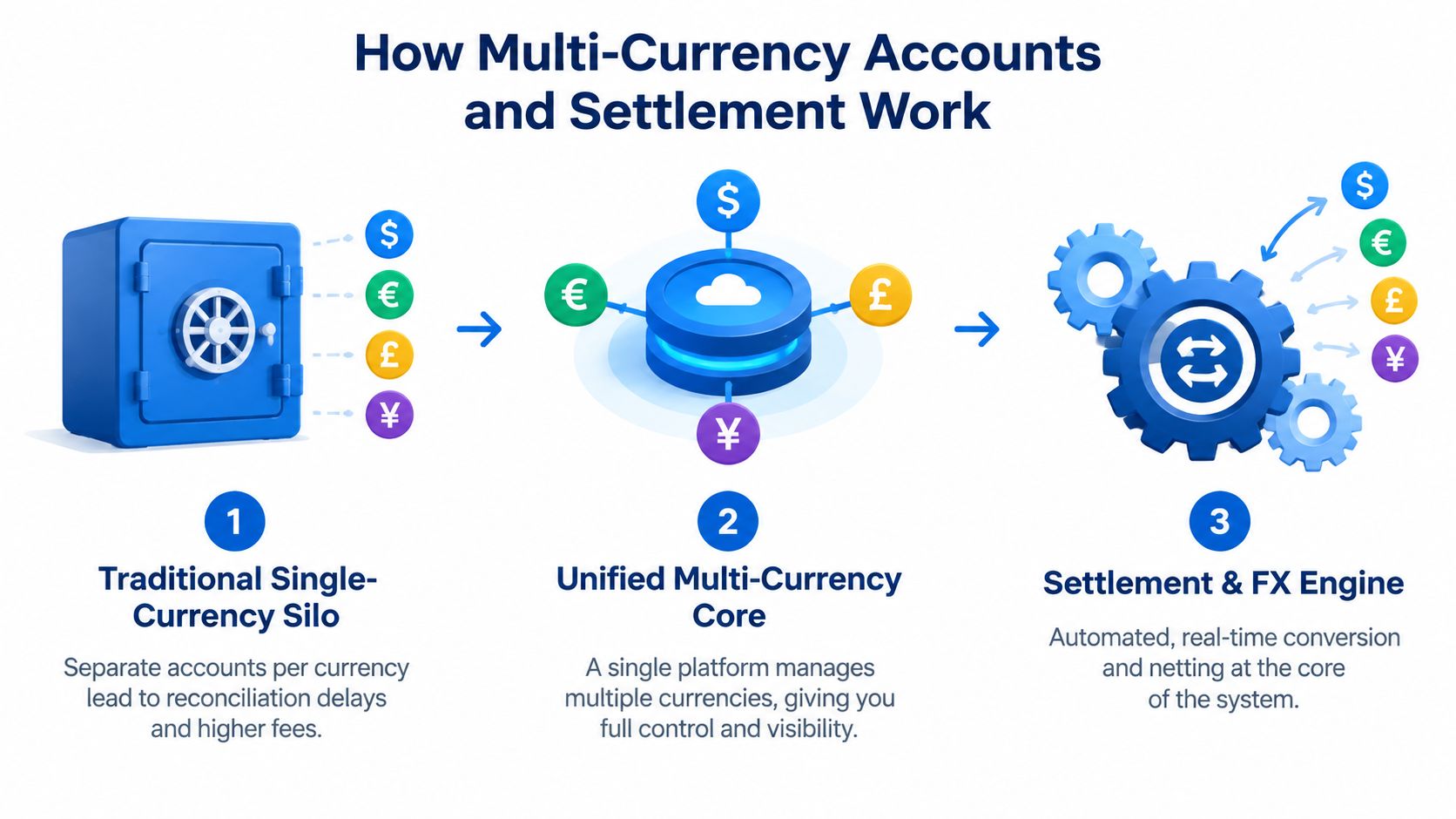
The balance layer
In a segregated model, the balance layer is easy to understand but can become operationally dense. Treasury must decide how much liquidity to keep in each currency, monitor expected inflows and outflows, and avoid leaving idle funds in a currency with no near-term use. Reconciliation should preserve both the original currency amount and the business's reporting-currency equivalent.
The cross-currency model simplifies the number of accounts but doesn't remove the underlying decision. Someone still has to provide liquidity, quote the exchange rate, manage settlement windows, and absorb or pass through market movement. A clean user interface can hide that work, but it can't eliminate the economics.
The message layer
Money moves with information. Payment messages identify the payer, beneficiary, invoice context, purpose, and compliance details. ISO 20022 is designed to carry richer, structured data across payments, foreign exchange, securities, and cards. Swift reports that the coexistence period between legacy MT and ISO 20022 messages for cross-border payments ended in November 2025, while the ISO organization says the standard is used by payment systems in over 70 countries and is expected to support 80% of global volumes and 87% of global transaction value. Those figures and the operational implications are described in Swift's ISO 20022 overview.
Structured fields help compliance teams screen payments and help banks route them without relying on ambiguous free text. They also reduce repair work when an address, purpose, or beneficiary identifier is incomplete. For a business, the result should be fewer manual interventions, but only if its accounting and payment systems preserve the structured data throughout the workflow.
Teams assessing account design can also review multi-currency business accounts as one example of how a platform can present balances, conversions, and payments through a unified interface.
What Cross-Border Finance Actually Costs
A multi-currency account does not automatically make international payments cheaper. It changes where the business can control cost. Evaluate the FX spread, receiving method, settlement corridor, intermediary charges, cut-off times, and the work required to reconcile each transaction.
The account fee is usually the most visible line item. FX margin is harder to identify. A provider may advertise a low transfer charge while applying a less favourable exchange rate. Another may offer local receiving details but convert the balance automatically, limiting the company's ability to retain or time the currency. Neither structure is universally right. The better choice depends on the company's payment pattern and its need to coordinate fiat balances with crypto conversions.
The 2025 G20 roadmap progress report says global cross-border payment indicators improved only slightly, while average global costs remained sticky. It also notes that limited transparency data prevents a complete picture. A provider should therefore be assessed across the full payment path, not from one fee line.
Audit the payment path
For each important corridor, document the complete path:
- Receipt: Which currency does the customer or platform send?
- Conversion: Is the exchange optional, automatic, or applied at withdrawal?
- Settlement: Does the beneficiary receive a local transfer, an international wire, or a stablecoin?
- Timing: Which cut-off, review, or liquidity conditions affect arrival?
- Reconciliation: Can finance match the original amount, applied rate, fees, and final beneficiary amount?
Central Bank of Ireland data illustrates the scale of this activity. In 2025, cross-border payment value outside the EEA reached €4.17 trillion, while volume rose 12.2% year over year. The same data recorded value growth of 0.9%. These figures do not predict what one business will pay, but they show why corridor design and transparent pricing matter at institutional scale.
Compare the provider's quoted rate with the rate applied, then record the difference as a recurring treasury cost. Test refunds, failed payments, beneficiary changes, and weekend or holiday settlement as well. A platform that appears inexpensive during a weekday transfer can cost more when the workflow requires urgent conversion, manual review, or an unsupported local rail.
For a broader view of the mechanics, review cross-border payments as a payment workflow rather than a single transfer product.
Strategic Benefits for Treasury and Operations
The strongest multi-currency setup connects balances to the decisions the team makes every day. Treasury sees where liquidity sits. Operations controls who can spend it. Accounting receives enough transaction detail to reconcile the original currency, conversion, fees, and settlement result.
That creates value in several layers:
- Centralized liquidity: Finance can monitor fiat and supported digital-asset balances without moving between unrelated portals.
- Controlled spending: Corporate cards can use spend limits, merchant controls, roles, and approval policies instead of relying on informal reimbursement rules.
- Faster conversion decisions: A Web3 company can convert stablecoins into fiat when it needs to fund an obligation, rather than converting everything at receipt.
- Simpler invoicing: Invoices can be issued and settled in the currency that makes sense for the customer or vendor.
- Cleaner reconciliation: Payment records, wallet movements, card transactions, and account balances can follow one operational trail.
The strategic shift is from “holding currencies” to assigning each balance a job. A euro balance might fund European contractors. A dollar balance might cover cloud services. USDC might remain a treasury reserve until the next payroll or vendor run. This approach reduces unnecessary conversions and makes cash forecasting more meaningful because the forecast reflects usable liquidity, not just a single base-currency total.
Stablecoins add another route, but they don't remove governance requirements. Teams still need wallet permissions, transaction approvals, counterparty screening, conversion controls, and a clear record of when a digital asset became fiat. For a grounded overview of where stablecoins are used outside trading, Coiner Blog's discussion of real-world stablecoin use cases offers useful context.
A corporate card can also be part of the same treasury design. Instead of issuing a card with no relationship to company liquidity, finance can define who may spend, which merchants are permitted, and how transactions are funded. The benefit isn't just convenience. It's the ability to connect an employee purchase to a currency balance, policy, approval, and accounting record.
A short visual overview can reinforce the operating model:
Real-World Examples for Web3 and Global SMEs
Consider a DAO whose treasury holds stablecoins while its core vendors bill in fiat. The DAO may pay software subscriptions, legal providers, analytics services, and contractors that don't accept digital assets. The weak workflow is to send assets to an exchange whenever an invoice arrives, rely on a single signer, and reconcile the resulting fiat payment manually.
A stronger workflow separates treasury permission from payment execution. The DAO approves an operating budget, assigns roles, converts only the amount required for upcoming fiat obligations, and retains the transaction record alongside the invoice. The treasury doesn't need to treat every stablecoin balance as immediately spendable payroll cash. It needs a policy for what may be converted, by whom, at what point, and for which payment purpose.
An offshore technology company incorporated in the Cayman Islands or BVI faces a different problem. Its legal entity may be offshore, but its contractors can work across Europe, Asia, North America, and other regions. Paying everyone from one domestic bank account can create conversion steps, beneficiary friction, and inconsistent arrival times.
The company can map contractors by payment currency and corridor. It may hold the currency used most often by a recurring group, receive customer funds into a suitable balance, and convert the remainder through a controlled approval process. The key is not the company's place of incorporation. It's whether the provider understands the entity's ownership, business model, source of funds, and digital-asset exposure during KYB review.
For a team hiring internationally, researching best remote staffing agencies can help with the people and contractor side of the operating model. Payment infrastructure still needs to match the resulting worker locations and currencies.
An international ecommerce SME has another pattern. Customers may pay in local currencies, while the business pays suppliers and advertising platforms in different currencies. If every customer receipt converts immediately into the company's base currency, the business may later convert back to pay a supplier. That creates avoidable exposure to two conversion events.
A more deliberate setup keeps receipts in currency where there's a predictable outgoing need, subject to accounting, compliance, and liquidity controls. The business can also separate customer pricing from treasury settlement. Local pricing improves payment clarity, while settlement policy determines whether the merchant holds the currency, converts at receipt, or nets it against future obligations.
These examples share a principle: multi-currency is a workflow design choice. The right balance depends on invoice currency, payroll obligations, supplier corridors, asset type, approval structure, and reporting requirements.
Evaluating Multi-Currency Platforms and Providers
Start with the payment map, not the provider's currency list. List the currencies you receive, the currencies you pay, the countries involved, the expected settlement routes, and the events that trigger conversion. A platform supporting many currencies may still be a poor fit if it lacks the local receiving method or payment corridor your business needs.
Then test five areas.
Pricing transparency comes first. Ask for the applied FX rate, spread methodology, transfer fee, intermediary treatment, card conversion cost, and any withdrawal charge. Request a sample transaction statement that shows the original amount, conversion rate, fees, and beneficiary receipt.
Settlement mechanics deserve equal attention. Confirm whether the account is segregated by currency or whether the platform converts across currencies. Ask who supplies liquidity, whether conversion is optional, what happens during review, and how cut-off times affect delivery.
Security and governance should fit the asset mix. For crypto-compatible operations, examine custody arrangements, wallet approval controls, transaction limits, address management, and mandatory MFA. For fiat operations, review user roles, beneficiary controls, audit logs, and approval workflows.
Onboarding and compliance are practical product features for Web3 companies. The provider should be able to assess the entity's ownership, activities, jurisdictions, token exposure, and source of funds without forcing the team into an unsuitable banking category. Fast onboarding is useful only when it still produces a durable compliance relationship.
Integration quality determines whether the account becomes part of finance operations or another portal to check. Look for exports or integrations that preserve transaction currency, applied rates, fees, payment references, card data, and digital-asset movements.
| Evaluation Category | Traditional Bank | Modern Fintech Platform |
|---|---|---|
| Account structure | Often organized around separate country or currency accounts | Commonly presents multiple balances through one interface |
| FX visibility | May require manual rate and fee reconciliation | Usually emphasizes transaction-level pricing visibility |
| Payment rails | Strong domestic infrastructure, with international processes that can be fragmented | Often combines local, international, and digital-asset workflows |
| Web3 compatibility | May restrict or separately review digital-asset activity | May design KYB and workflows for crypto-native businesses |
| Spending controls | Available through established banking products, often across separate systems | Frequently combines cards, limits, roles, and approvals in one dashboard |
| Treasury reporting | Can depend on account aggregation and manual consolidation | Usually provides centralized balance and transaction views |
OneSafe is one example of a platform positioned around multi-currency business accounts, global payments, corporate cards, web3 invoicing, and crypto-to-fiat workflows through a single interface. Its regulated banking services are delivered by partner institutions, so a prospective customer should still verify eligibility, supported corridors, terms, and compliance requirements for its specific entity.
Building a Unified Global Treasury Strategy
A useful treasury strategy starts with evidence from your own payment history. Group incoming and outgoing transactions by currency, corridor, settlement method, conversion point, and operational owner. Then identify where the business converts unnecessarily, waits for funds, pays avoidable intermediary costs, or loses visibility between a wallet and the general ledger.
Keep balances in currency when there's a clear near-term obligation or a reliable recurring flow. Convert when the business needs another currency, when exposure exceeds policy limits, or when holding the original balance creates more risk than value. The decision should follow cash requirements and risk controls, not a provider's default setting.
Build a small operating policy around:
- Liquidity: Define which balances fund payroll, vendors, cards, and reserves.
- FX authority: Specify who can convert, which approvals apply, and how rates are recorded.
- Settlement: Document cut-offs, beneficiary verification, failed-payment handling, and escalation paths.
- Digital assets: Separate custody, conversion, and payment permissions.
- Accounting: Preserve original currency, reporting-currency value, applied rate, fees, and settlement evidence.
The broader goal is a connected treasury layer that joins fiat accounts, crypto balances, cards, invoices, and payment rails without hiding the cost of conversion. Guidance on global treasury management can help frame that work around liquidity visibility, control, and cross-border execution.
Audit the last payment cycle before changing providers. Calculate the actual FX margin, list every manual reconciliation step, and test the corridors that matter most. A multi-currency account earns its place when it gives the business better control over timing, settlement, and usable liquidity, not only when it displays more currency symbols.
If your company needs to connect multi-currency accounts, global payments, corporate cards, and crypto-to-fiat workflows in one operating environment, review what OneSafe offers for global and Web3 businesses. Map your key payment corridors first, then use the platform's account, conversion, card, and approval capabilities to design a treasury workflow around real obligations.


