Table of Contents
- meta_description: "Circle acquires Tazapay to boost stablecoin payments for B2B cross-border transactions. Learn how this deal impacts global businesses, cuts costs, and what it means for your payment stack."
- Circle Acquires Tazapay: A New Chapter for B2B Stablecoin Payments
- Why This Deal Matters for Global Businesses and Fintech Innovators
- The Rapid Evolution of Stablecoin Payments: A Primer for Founders
- What the Circle-Tazapay Deal Means for Your Payment Stack
- How Neo-Banking Platforms Like OneSafe Bridge the Gap
- The Road Ahead: Adoption, Regulation, and What to Watch Next
- Key Takeaways
meta_description: "Circle acquires Tazapay to boost stablecoin payments for B2B cross-border transactions. Learn how this deal impacts global businesses, cuts costs, and what it means for your payment stack."
Stablecoin Payments Get a Boost with Circle-Tazapay Deal
Circle Acquires Tazapay: A New Chapter for B2B Stablecoin Payments
The deal at a glance: what we know as of September 11, 2026
Circle Internet Group signed a definitive acquisition agreement for Singapore-based Tazapay, a cross-border payments platform, according to a Digital Commerce 360 report published September 11, 2026. The move accelerates USDC adoption in stablecoin payments, with emphasis on B2B use cases. CoinDesk reported on September 8, 2026 that the deal is valued at approximately $400 million.
Circle’s official announcement frames the acquisition as embedding USDC into Tazapay’s existing network of merchants, processors, and financial institutions. Tazapay had already integrated USDC for settlement in late 2024. The signal for B2B stablecoin payments: Circle intends to own the rails, not just issue the token.
How Tazapay’s compliance infrastructure completes Circle’s cross-border loop
Tazapay operates a proprietary compliance engine that automates buyer and seller verification across 170+ countries — the biggest friction point for B2B cross-border stablecoin payments. By acquiring that infrastructure, Circle can offer businesses a compliant onboarding and settlement layer baked into USDC rails, collapsing KYC/KYB, sanctions screening, and transaction monitoring into the transaction flow. Fiinance Yahoo noted this positions Circle to control the full lifecycle: issuance, transfer, compliance, and settlement.
Why This Deal Matters for Global Businesses and Fintech Innovators
The growing urgency for fast, low-cost cross-border B2B money movement
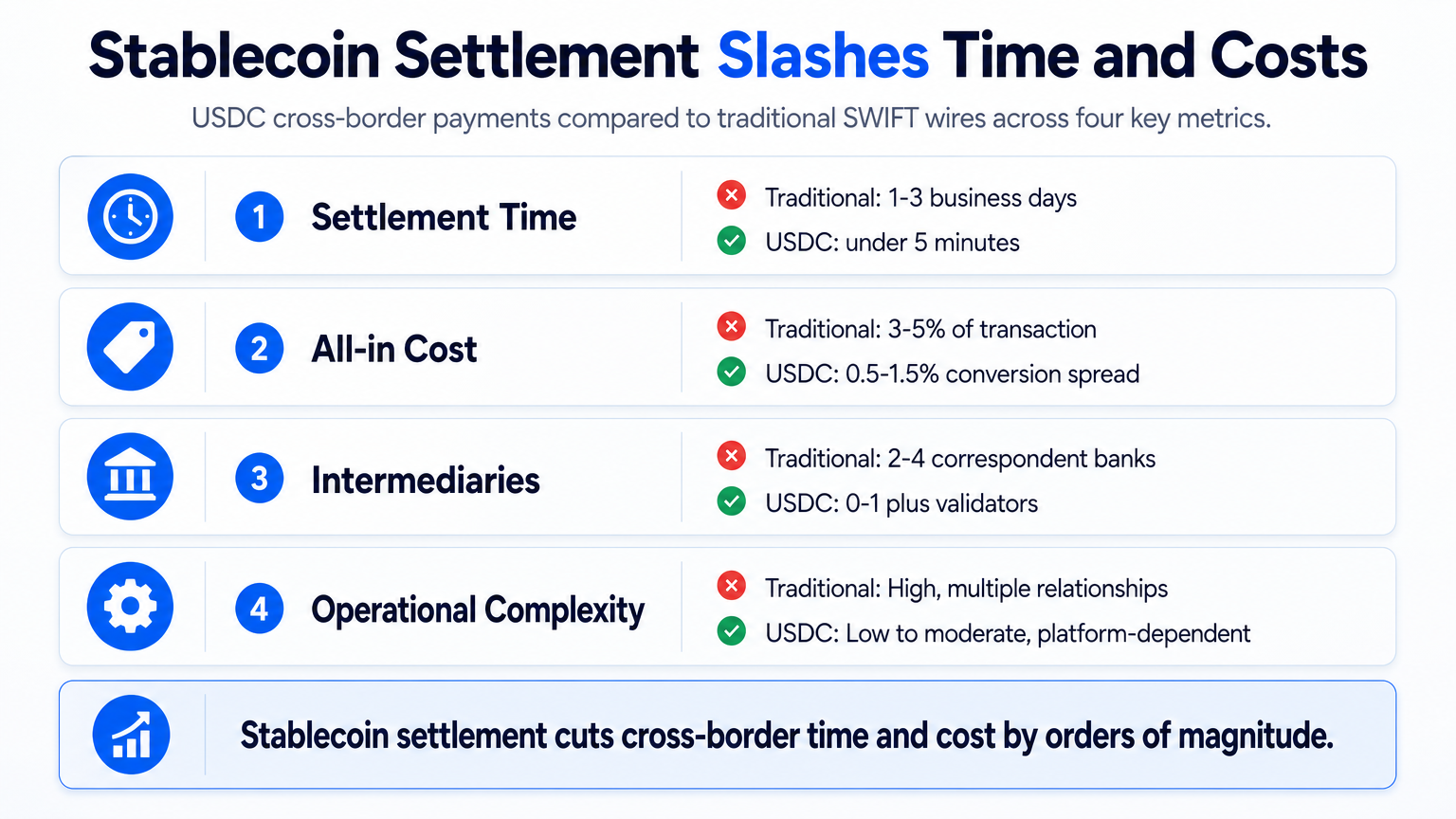
A McKinsey analysis on stablecoin payments infrastructure for modern finance identifies cross-border transactions as the use case where tokenized cash delivers the most measurable advantage: settlement finality drops from T+2 to near-instant, and multiple intermediary fees evaporate. Traditional correspondent-banking paths can cost 3-5% all-in; stablecoin settlement — with an attached compliance layer — can compress that to under 1% with settlement in minutes. The stablecoin payments surge on Polygon earlier this year confirmed high-throughput, low-fee chains can support B2B volumes.
Stablecoins as the settlement layer — squeezing intermediaries and SWIFT costs
Every correspondent bank and currency converter in a SWIFT payment takes a cut. USDC on a high-performance chain like Solana settles for fractions of a cent in under five seconds, stripping out those intermediaries. Circle-Tazapay signals the infrastructure is mature enough for institutional-grade volumes. The opportunity cost of maintaining legacy rails alone is rising: each quarter of delay means margin compression versus competitors who have shifted at least a portion of cross-border payables to stablecoin rails.
The Rapid Evolution of Stablecoin Payments: A Primer for Founders
Where stablecoin payments stand today (and what the SERP already agrees on)
Stablecoin payments cut cross-border settlement from days to minutes; costs are an order of magnitude lower than SWIFT equivalents. USDC and USDT dominate, with the GENIUS Act and other frameworks evolving. A complete guide to stablecoin payments from Fipto walks through three delivery models: direct wallet-to-wallet, payment processor APIs, and stablecoin-native platforms. The urgent question — what a B2B acquisition like Circle-Tazapay changes about the integration decision — is where the SERP remains fractured.
Common models — from direct wallet acceptance to embedded APIs
Direct wallet acceptance cuts intermediary costs but demands in-house crypto expertise. Crypto Banking Scams Hit $15.9B in 2025, making key management a top risk. Processor APIs abstract compliance for a per-transaction fee of 0.5-1.5%. Stablecoin-native platforms like Circle’s merchant tools bridge fiat and crypto. The acquisition pushes the market toward a model where the issuer itself provides compliance, custody, and conversion, potentially shrinking cost stacks.
What the Circle-Tazapay Deal Means for Your Payment Stack
Immediate implications: broader USDC acceptance, faster supplier onboarding
The near-term change is faster onboarding of international suppliers. Tazapay’s network covers Asia, the Middle East, and Africa — regions with thin banking relationships. Once its compliance layer integrates with USDC rails, businesses can onboard a supplier, verify them, and settle invoices in USDC within a single interface. This narrows the operational wedge between stablecoin efficiency and deployment.
For businesses straddling fiat and crypto, the hybrid advantage is now non-negotiable
Most companies must pay salaries and taxes in fiat, requiring reliable crypto-to-fiat conversions. A platform that natively integrates both eliminates the manual reconciliation of moving funds between crypto platforms and bank accounts. The neo-banking stablecoins model offers segregated global accounts holding both stablecoins and fiat side by side.
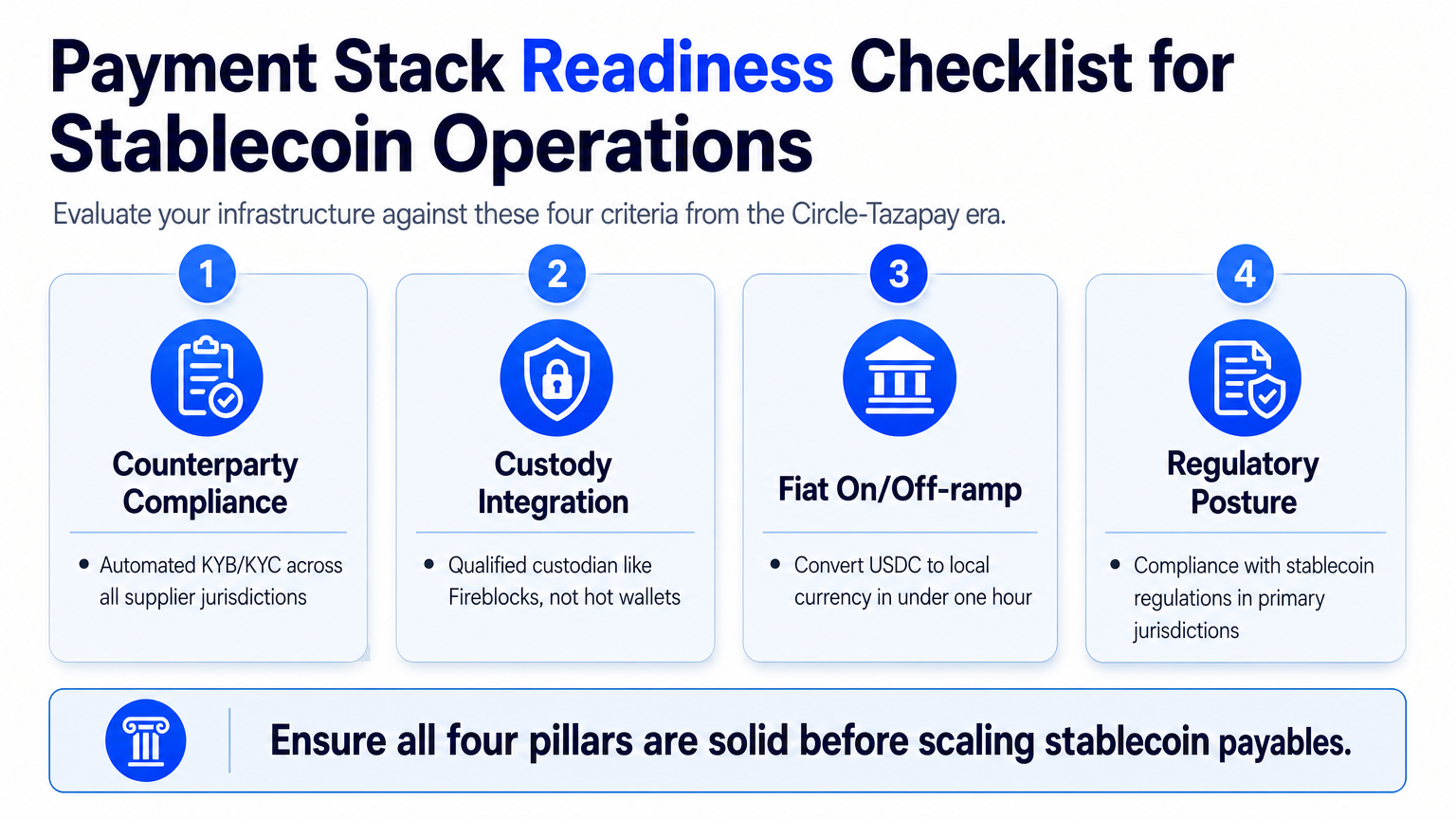
Checklist: Payment stack readiness for stablecoin operations
- Counterparty compliance: Does your onboarding process support automated KYB/KYC across the jurisdictions where your suppliers operate?
- Custody integration: Are stablecoin funds held with a qualified custodian (e.g., Fireblocks) rather than in self-custodied hot wallets?
- Fiat on/off-ramp: Can your treasury team convert USDC to local currency and route it to your operating accounts in under an hour?
- Multi-currency support: Do your accounts handle USD, EUR, and at least one Asian or African corridor currency alongside stablecoins?
- Regulatory posture: Does your provider maintain compliance with evolving stablecoin regulation in your primary jurisdictions?
How Neo-Banking Platforms Like OneSafe Bridge the Gap
Real-world stablecoin workflows: instant crypto-to-fiat, multi-currency accounts, and one-platform treasury
A Web3 startup receiving a $50,000 USDC payment from a European client this week needs to do more than hold that USDC. It needs to convert a portion to USD for US-based contractor payments, keep a reserve in USDC to settle a supplier invoice to Singapore, and maintain EUR liquidity for a team member in Berlin. On a fragmented stack, that means one platform for crypto custody, a separate FX provider for conversion, and a traditional bank for fiat payouts — with settlement lags at each boundary.
A platform that natively supports both fiat and stablecoin operations collapses those steps. The USDC arrives in a segregated account. A portion is converted to USD at 0.25% FX cost and routed via ACH the same day. Another portion stays in USDC and is sent to a supplier’s wallet address — with USDC deposits and withdrawals carrying zero platform fees on the crypto side. The EUR allocation converts at the prevailing spot rate and lands in a Euro-denominated account for SEPA transfer.
This is the operational reality platforms like OneSafe deliver for over 1,000 businesses across 30-plus countries, having processed more than $800 million in transaction volume. The key architectural advantage is that digital assets are secured via Fireblocks custody, while fiat operations flow through traditional banking partners — giving businesses a single interface without forcing them to compromise on either speed or security.
What a stablecoin-ready financial partner must deliver in 2026 — security, speed, and transparency
Three non-negotiables define a financial partner that can credibly support stablecoin payments this year.
First, custody must be institutional-grade. Self-custody is operationally risky for any team without dedicated blockchain security personnel; a platform that uses Fireblocks or an equivalent qualified custodian separates key management from daily operations and reduces the surface area for both internal fraud and external attack.
Second, conversion speed must be near-instant. The whole value proposition of stablecoin settlement collapses if the off-ramp takes two days. Real-time crypto-to-fiat conversion that routes to local payment rails the same day is the baseline expectation for B2B stablecoin payments in 2026.
Third, compliance transparency is non-negotiable. Multi-Factor Authentication enforced at signup, state-of-the-art encryption, and a clear, documented onboarding process that respects KYB standards — typically completed within a week — give finance leads an audit trail they can show to regulators and auditors. Platforms that operate worldwide except for OFAC-sanctioned jurisdictions demonstrate the jurisdiction-aware posture that global businesses require.
The Road Ahead: Adoption, Regulation, and What to Watch Next
GENIUS Act and the shape of payment stablecoin regulation
The GENIUS Act establishes federal chartering pathways, reserve requirements, and consumer protection mandates for stablecoin issuers. Circle, a US-domiciled entity pursuing federal oversight, is positioning itself as the compliant default for regulated B2B stablecoin payments. The UK stablecoin regulation shift prioritizes stablecoin payments infrastructure, and the UAE stablecoin regulation framework has drawn multiple issuers. The global signal: compliance-forward infrastructure will receive accommodation; opaque alternatives will face ramp friction.
Open questions for operators: interoperability, counterparty risk, and how fast competitors will follow
Three strategic questions remain. Interoperability between issuer platforms — institutional-grade cross-chain settlement that preserves compliance data is nascent. Counterparty risk concentration — consolidating onto a single issuer’s infrastructure introduces new risk if that issuer faces operational or regulatory stress. Competitor velocity — Tether’s payment processing ambitions, banking consortium tokenized deposits like the DBS and Citi tokenized deposit pilot, and 21 banks issuing stablecoins all represent evolving threats.
The sensible posture: begin routing a defined portion of cross-border payables — perhaps 10-20% — through USDC rails on a fiat-and-stablecoin integrated platform, monitoring how regulation and competition shift risk/cost profiles over the next 6-12 months.
| Dimension | Traditional SWIFT/Wire | Stablecoin Settlement (USDC) |
|---|---|---|
| Settlement time | 1-3 business days | < 5 minutes (network dependent) |
| All-in cost (mid-market corridor) | 3-5% of transaction value | 0.5-1.5% (includes conversion spread) |
| Intermediary count | 2-4 banks | 0-1 (plus blockchain validators) |
| Compliance layer | Varies by bank correspondents | Automated via integrated platforms |
| Fiat conversion | Inherent to the rail | Requires off-ramp integration |
| Operational complexity | High (multiple banking relationships) | Low to moderate (platform dependent) |
What does the Circle-Tazapay deal change for businesses using stablecoin payments?
It shifts the integration from “assemble your own stack” to a single-provider option for issuance, compliance, and settlement. Acquiring Tazapay’s compliance engine and merchant network makes B2B stablecoin payments operationally viable for businesses that couldn’t justify building multi-vendor stacks.
Which stablecoins and blockchains matter for cross-border B2B?
USDC and USDT remain dominant. High-throughput, low-fee chains — Solana, Polygon, Ethereum layer-2s — handle the bulk of volumes. USDC’s multi-chain support lets treasury teams ride the most cost-effective network per transaction.
How do stablecoin conversions and fees compare to traditional wires?
Network fees are fractions of a cent, plus a conversion spread of 0.25-1.5% when off-ramping to fiat. All-in stablecoin costs contrast with 3-5% for traditional wires. Settlement in minutes means leaner working capital.
What does a modern platform need to handle both fiat and stablecoin operations securely?
Institutional-grade custody (Fireblocks), real-time fiat on/off-ramp, multi-currency accounts handling both asset types, and jurisdiction-aware compliance. Any gap forces multi-provider complexity that erodes stablecoin advantages.
Ready for what's next — how should a finance team act on this news?
Start a 20% pilot on a high-cost supplier corridor, routing that volume through USDC on a fiat+crypto platform. Over 90 days, compare settlement speed, all-in cost (including FX), and reconciliation overhead against your wire process. Use results to expand stablecoin payables share before regulatory clarity and competition narrow the window.
Key Takeaways
- The Circle-Tazapay acquisition transforms B2B stablecoin payments from multi-vendor assembly to a single-provider solution with integrated compliance, reducing barriers for mid-market businesses.
- Finance teams should immediately pilot USDC cross-border payments on a fiat-and-stablecoin platform — settling 20% of payables can yield 2-4% cost savings on those corridors.
- Platform selection criteria center on institutional custody (Fireblocks-grade), real-time crypto-fiat conversion, multi-currency accounts, and jurisdiction-aware compliance.
- Regulatory tailwinds (GENIUS Act, UK, UAE) align behind compliant stablecoin payments infrastructure, making 2026 the window to build operational capability ahead of competitors.
Get started with a financial platform built for businesses that move money across borders and between fiat and crypto — explore OneSafe’s neo-banking solution today.