For a global business, a wire transfer is the payment rail you use when the money has to move with bank-level control and the records have to stand up to treasury review. A supplier may be waiting for release of inventory, an overseas contractor may be holding work until funds arrive, and a finance team may need the transfer to settle without creating reconciliation gaps, FX surprises, or approval issues. That is why finance leaders still need to ask, what is wire transfer doing for the business, and where does it fit alongside newer payment methods?
A wire transfer is the long-standing bank-to-bank rail for moving funds when speed, finality, and control matter. Its history traces back to the early telegraph era of remittances, which helped establish electronic funds transfer as part of global money movement (Remitly history of remittances). For a finance lead, the practical question is not only what the term means. It is how the rail works in real operations, where settlement delays and fees create friction, and how a modern treasury stack can use tools like cross-border payments to reduce risk for international teams, including crypto-native businesses that need to move between traditional banking and digital asset workflows.
Table of Contents
- Sending Money Across the World Instantly
- Domestic wires and the Fedwire path
- International wires and SWIFT messaging
Sending Money Across the World Instantly
Your team has already approved the invoice. The warehouse shipment is waiting on cleared funds. The vendor will not release the goods until the payment lands. A wire transfer fits that situation because it is built for urgent, high-value business payments where delay creates a real operating problem.
For a finance lead, the value of a wire is speed plus certainty. The payment goes directly to a named recipient account, the instruction is handled through bank rails, and treasury can track the movement as a distinct transaction rather than as part of a bulk batch. That matters when you need to close a purchase order, release inventory, or confirm a cross-border settlement before a deadline slips.
A slower rail can handle routine expenses, but it is a poor fit for time-sensitive commitments. An international contractor invoice due before a product launch can often wait for a lower-cost transfer method if the work is not blocked by settlement. A customs payment, a large supplier deposit, or a last-minute funding transfer usually cannot wait, because one missed settlement can stall shipping, compliance, or payroll coordination.
Wire transfers also matter for businesses that operate across fiat and digital asset workflows. Treasury teams often need a payment method that can move value into a specific bank account, in a specific currency, with less ambiguity around final receipt. For teams comparing rails, OneSafe's guide to cross-border payments is a useful reference for how those choices affect settlement timing, fees, and operational control.
How Wire Transfers Work
A wire transfer starts with a bank instruction, not with money moving freely through a payment app. One bank receives a request to send funds to a named recipient, checks the details and available balance, then passes that instruction through the banking rail until the receiving bank credits the account.
Domestic wires and the Fedwire path
In the United States, domestic wires primarily run on Fedwire, a Real-Time Gross Settlement system that settles each payment individually and immediately (Peak Frameworks). Each payment is processed on its own, so the bank does not wait to combine it with other transfers before settlement. The instruction is verified, forwarded, and settled one transaction at a time.
Practical rule: If the payment is high-value and same-day finality matters, the process is designed to favor certainty over batching.
That structure is why wire transfers are used for transactions where settlement lag creates risk. A treasury team does not want a large vendor payment sitting in a queue while finance and operations wait for confirmation. They want immediate visibility, immediate bank-level settlement, and a clear end state.
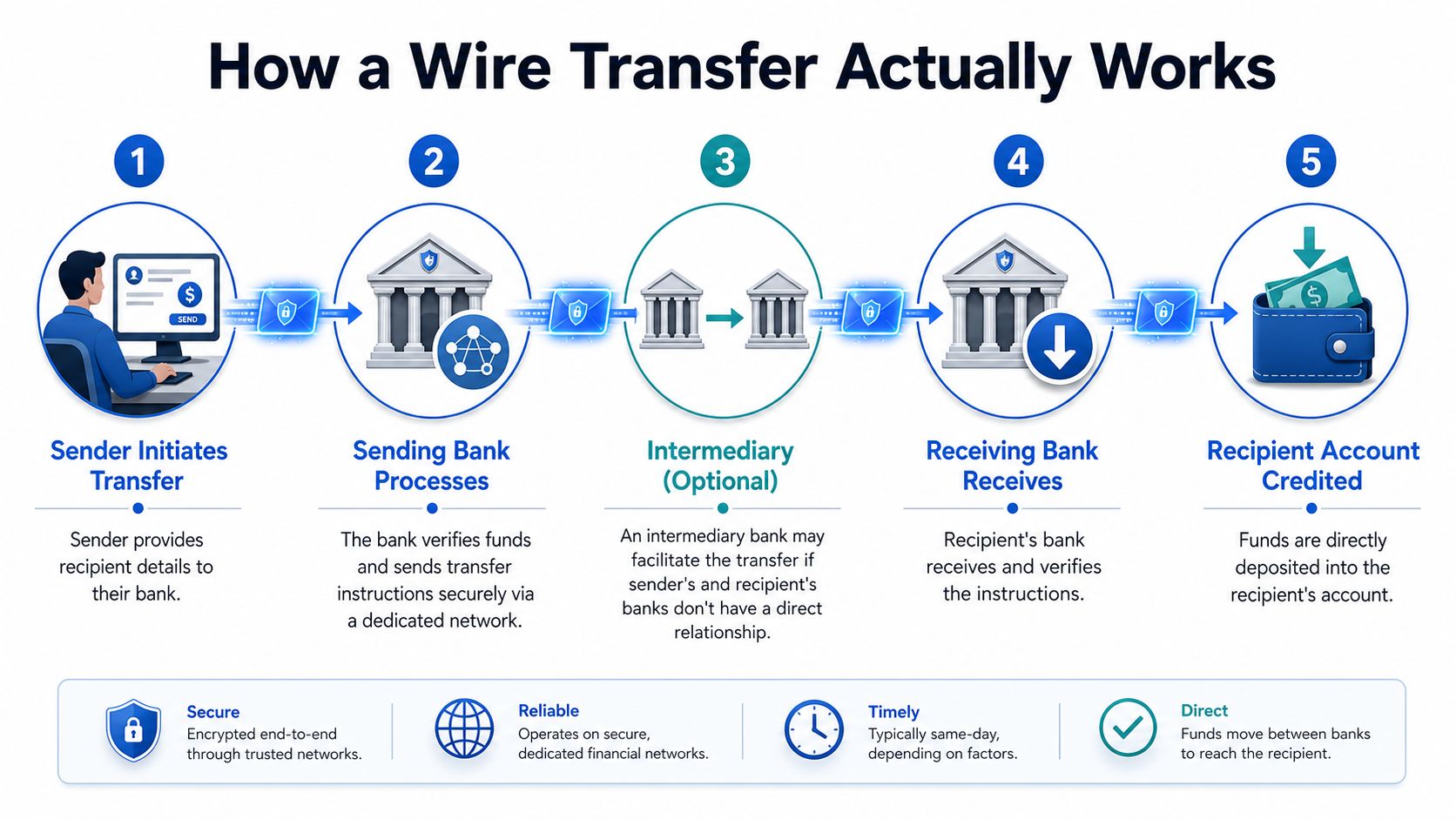
The flow is usually straightforward. The sender initiates the transfer, the sending bank checks the instructions and available funds, and the bank sends the payment details onward. If the banks do not have a direct relationship, an intermediary bank may relay the payment. The receiving bank then credits the recipient's account.
International wires and SWIFT messaging
International wires are where many teams start to lose the thread. A cross-border wire is not one simple path from one account to another. The payment often travels through SWIFT messaging, which carries the payment instructions, while the actual funds may move through correspondent banks and several internal checks before final crediting (Citizens Bank).
That distinction matters. Fedwire is the settlement system, the part that moves and settles domestic funds inside the U.S. banking system. SWIFT is the messaging network, the part that helps banks communicate payment instructions across borders. A finance team can send a SWIFT message without immediate settlement, which is why an international wire can be slower and less predictable than a domestic wire.
For treasury management, the difference is practical, not academic. A domestic wire gives you settlement inside one banking system with immediate finality. An international wire may pass through several banks, each one adding its own checks, timing, and fee layers before the recipient sees the money.
The basic takeaway is simple. A wire transfer is a controlled bank-to-bank settlement instruction. Depending on the route, it may be settled directly through Fedwire or communicated through SWIFT with one or more intermediary banks involved. That difference affects timing, fee visibility, and how much certainty finance has while the payment is in flight. For a closer look at how banks waive or reduce wire charges, see this guide to banks with no wire transfer fees.
Understanding Wire Transfer Speed Costs and Limits
Wire transfers are popular because they're fast, but “fast” doesn't mean uniform. A domestic payment can settle much sooner than a cross-border payment, and the fee story is rarely just the fee the sending bank advertises. Finance leads need to think in terms of total payment cost, not just initiation cost.
Why businesses still use wires
Wire transactions are overwhelmingly a business tool. In 2018, 64% of all wire transactions were business payments, 25% were financial institution settlements, and only 11% were consumer-initiated (First Utah Bank). That mix tells you where wires belong, large settlements, treasury operations, and payments where precision matters more than convenience.
For operating teams, the practical benefit is control. You know who sent it, which bank touched it, and whether it landed. That's very different from the behavior of consumer payment apps or card flows, which are built for everyday spend instead of corporate settlement.
Costs, timing, and hidden friction
The friction usually shows up in three places. First is the sending fee. Second is the receiving fee or intermediary charge. Third is foreign exchange, which can subtly alter the economics of the payment even when the nominal wire fee looks tolerable. International wires also tend to take longer, and that creates timing risk for companies that need to settle vendor obligations in fiat but don't want their exposure to sit open during the transfer window.
A useful way to think about it is this, wires are often worth the cost when the payment is material, urgent, or operationally critical. They're much less attractive for routine payouts that can wait.
One practical comparison resource for fee structures and banking tradeoffs is this guide on banks and wire transfer fees, especially if your team is budgeting recurring payouts across multiple entities.
A wire is expensive only when you use it for the wrong job. For a mission-critical settlement, the cost may be small compared with the risk of delay.
Navigating Security Risks and Preventing Fraud
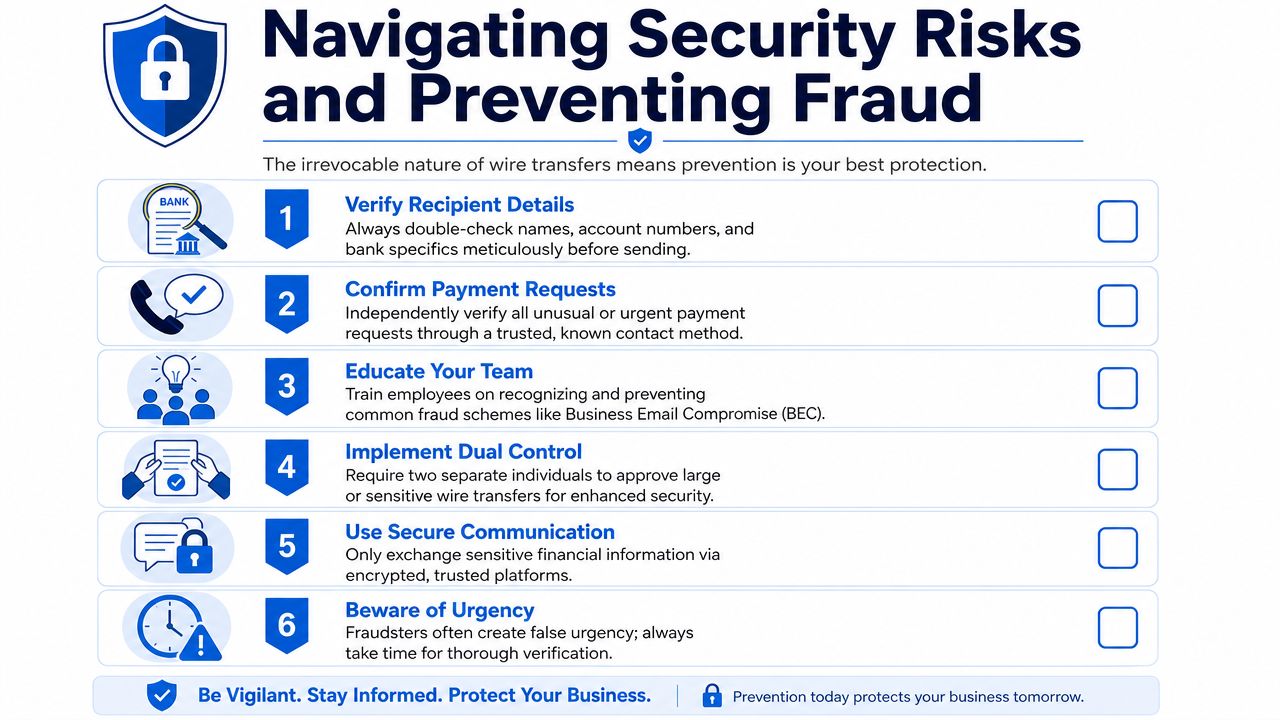
A wire transfer is secure in the narrow banking sense. It moves through controlled channels, and banks verify details along the way. That doesn't mean it's safe from fraud once your team authorizes it. The hard truth is that wire transfers are typically irrevocable once completed, even when a business was tricked into sending the payment (JPMorgan Treasury insights).
Why authorization is the danger zone
That finality creates the biggest risk for companies, especially in cases of Business Email Compromise or vendor impersonation. A bad actor doesn't need to break the banking network if they can get someone inside your company to approve the wrong recipient. Once the payment goes out, recovery is difficult.
The usual “watch for scams” advice falls short. The issue isn't only external fraud. It's also internal process weakness. If one person can approve and release a high-value payment by themselves, your treasury function is exposed.
Controls that actually help
The strongest defense is a set of boring, repeatable controls that make fraud harder to execute:
- Verify recipient changes out of band: If a vendor sends new banking details, confirm them through a known phone number or previously trusted channel.
- Use dual control: Require two employees to approve a wire, especially for large or unusual payments.
- Slow down urgent requests: Fraudsters often create pressure by inventing emergencies, missing shipments, or last-minute bank changes.
- Keep payment data private: Limit who can see bank instructions, approval logs, and payment templates.
- Train finance and operations together: Accounts payable, treasury, and procurement need the same fraud playbook, not separate assumptions.
In corporate settings, the most reliable protection isn't a promise of reversibility. It's segregation of duties, clear approvals, and disciplined verification before release. If your business pays vendors across time zones, those controls matter even more because urgency is easier to manufacture when people are scattered.
Wire Transfers vs Other Payment Rails
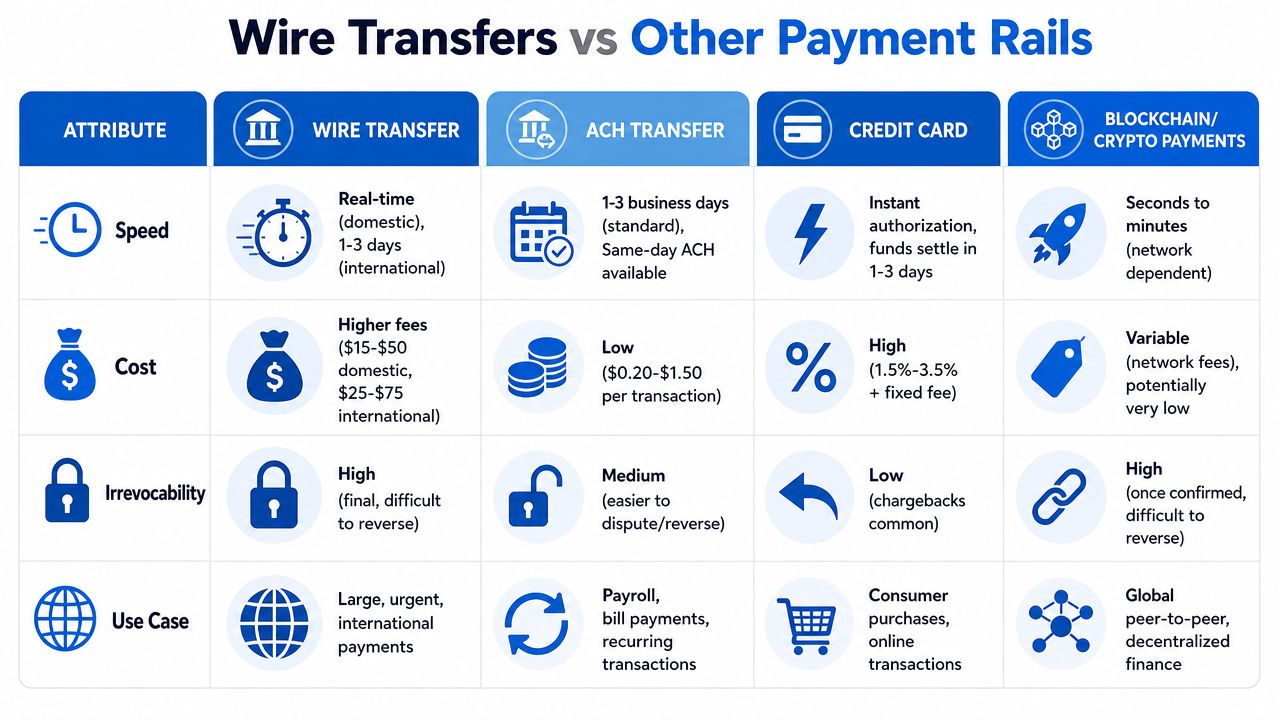
Choosing the right rail is a treasury decision, not just a payments decision. A wire is strong when you need finality and bank-grade settlement. It's weaker when your team needs low cost, frequent movement, or easy reversibility. That's why the right comparison is with ACH, SWIFT-based international wires, and crypto or stablecoin rails that can bridge fiat and digital workflows.
A practical comparison for finance teams
| Feature | Wire Transfer | ACH Transfer | Crypto (Stablecoin) |
|---|---|---|---|
| Speed | Fast for domestic settlement, slower across borders | Usually slower, better for routine domestic flows | Often very fast, depending on network and conversion path |
| Typical cost profile | Usually higher than ACH | Usually lower than wires | Variable, can be efficient for cross-border settlement |
| Reversibility | Typically difficult to reverse once completed | More flexible for disputes and recalls | Generally difficult to reverse once confirmed |
| Best use case | Large, urgent, high-value payments | Payroll, recurring bills, routine vendor payments | Global settlement where speed and conversion flexibility matter |
The table makes the tradeoff clear. ACH is usually the right choice for recurring domestic payables. Wires make more sense when the payment is urgent, large, or tied to a hard deadline. Crypto rails become interesting when a team needs faster cross-border movement and wants to reduce some of the friction around settlement timing and FX exposure.
The hidden SWIFT problem
A lot of teams still speak loosely about “international wire” as if every cross-border transfer behaves the same way. That's a mistake. Businesses often conflate all international wires with SWIFT and then underestimate the delays and cost leakage that can appear during settlement (Citizens Bank). For companies operating globally, that creates timing risk, especially when vendor invoices, payroll, or treasury rebalancing depend on the funds arriving at the right moment.
If you're weighing bank rails against crypto settlement, this analysis of Bank of America wire transfer fees versus crypto costs is a helpful starting point.
How OneSafe Optimizes Wire Workflows
A modern treasury stack shouldn't force your team to jump between a bank portal, a crypto exchange, and a spreadsheet every time a payment needs to move. OneSafe is one example of a platform that brings ACH, domestic wires, international wires, SWIFT transfers, and crypto workflows into one interface, with multi-currency accounts and policy controls built for global operations. It also supports USDC deposits and withdrawals and near-instant crypto-to-fiat and fiat-to-crypto conversions, which matters when timing risk or FX volatility can distort a settlement window.
What that changes operationally
The main benefit is visibility. Instead of treating fiat and crypto as separate finance worlds, a team can see them as connected payment paths. That helps when a startup invoices in fiat but holds part of its treasury in digital assets, or when a DAO needs to settle operations with both traditional vendors and crypto-native counterparties.
Controls matter too. Multi-user approvals, spending policies, and role-based access reduce the chance that one person can push a payment without review. That's the same internal discipline covered earlier, but implemented through software rather than manual gatekeeping.
For teams building more mature AP workflows, Jumpstart Partners has a useful overview of the advantages of AP automation, especially if you're thinking about approval flow, vendor consistency, and fewer manual payment errors.
Where it fits in a global stack
A platform like this is most relevant when your business is juggling several realities at once. You may need domestic bank payments for local obligations, international wires for regulated counterparties, and digital asset rails for faster settlement between crypto-native entities. A single system doesn't remove the need for judgment, but it does reduce fragmentation.
Frequently Asked Questions About Wire Transfers
Can a wire transfer be reversed?
Usually not once it's completed. That's why payment verification and approval controls matter so much before you release the funds.
Are wire transfers only for large companies?
No, but they're used mostly in business settings. The transaction profile leans heavily toward corporate and institutional settlement, which is why finance teams see them more often than consumers do.
What's the biggest mistake new finance teams make?
Treating wire finality like protection against fraud. The rail is controlled, but once an authorized payment leaves the bank, recovery becomes difficult.
How do I reduce the risk of paying the wrong vendor?
Use dual control, confirm bank changes through a known contact method, and never approve a last-minute change without independent verification.
When should I choose a wire instead of ACH?
Use a wire when the payment is urgent, large, or time-sensitive enough that slower settlement would create operational or contractual risk. Use ACH for routine domestic flows that don't need immediate finality.
What's the main issue with international wires?
Cross-border settlement can introduce delay, extra charges, and FX uncertainty, so treasury teams need to plan for the full landed cost, not just the transfer initiation.
A CTA for OneSafe.