Most international wire transfers take 1 to 5 business days, although modern SWIFT gpi data shows 90% of cross-border payments reach the destination bank within one hour on the network. That apparent contradiction is the key to understanding why your money can move quickly between banks yet still take days to reach your account.
The popular answer to “how long international wire transfer” is incomplete. A wire may leave the sender's bank quickly, then wait at an intermediary, pause during currency conversion, or remain under review at the recipient bank. The payment message and the final account credit don't always move at the same speed.
A practical baseline still matters. Banking guidance commonly places international wires in the 1 to 5 business day range, with ordinary corridors often taking 2 to 4 business days, depending on currencies, cutoffs, holidays, compliance checks, and correspondent banks. But that range describes the whole journey, not the individual stage causing the delay. (Stripe's international wire transfer guide explains why SWIFT wires remain non-instant by default.)
Table of Contents
- From instruction to bank release
- Routing, conversion, and local credit
- The records that make tracing possible
The Real Question Behind How Long an International Wire Transfer Takes
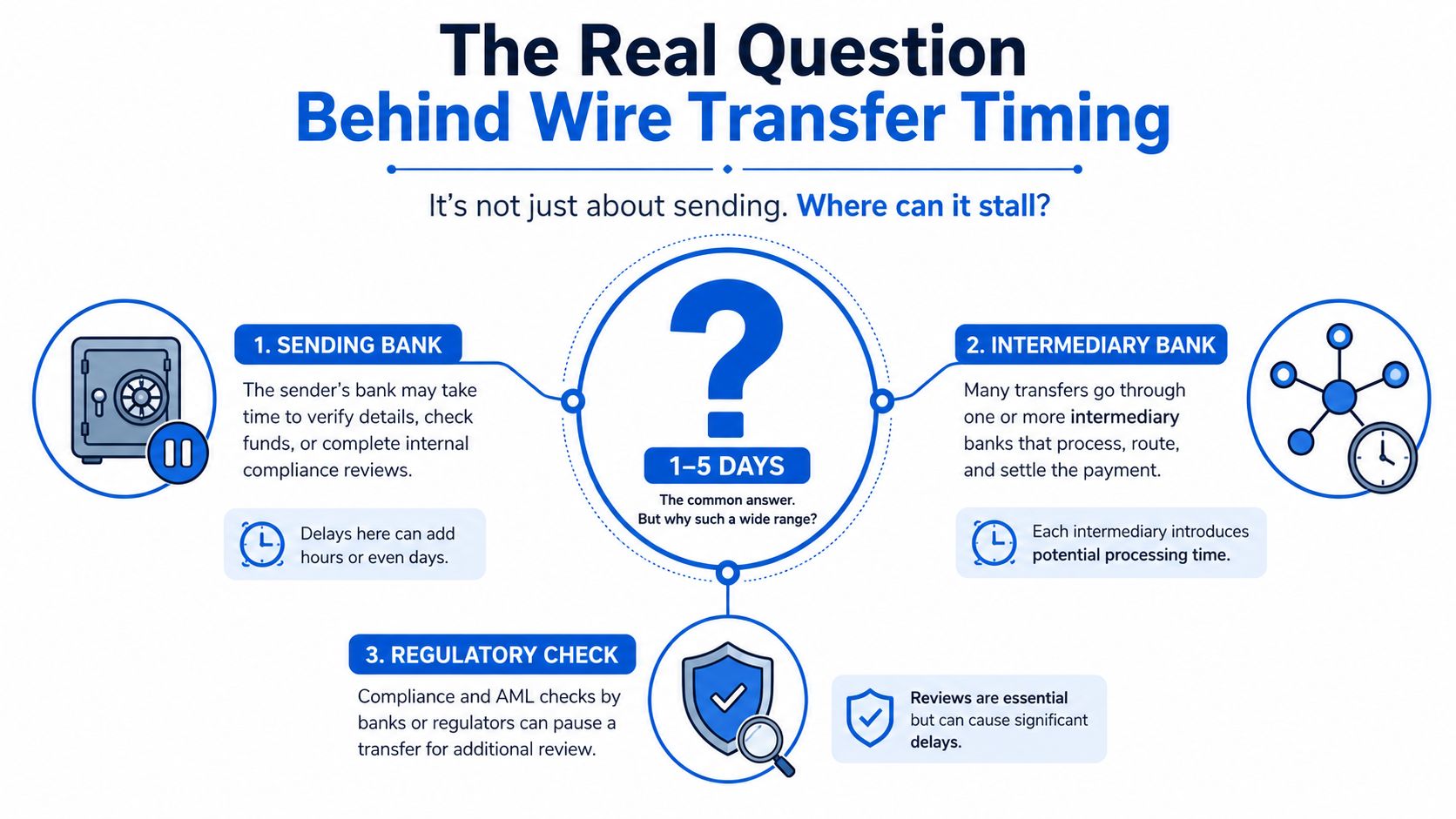
The useful question isn't “how many days does an international wire take?” It's where is the payment currently waiting?
A bank can approve a wire on the same day you submit it. The payment can then travel through the SWIFT network, pass through correspondent banks, undergo currency conversion, and reach a recipient bank that applies its own screening and posting procedures. A delay at any one of those points produces the same frustrating customer-facing status, pending.
Modern network data makes the old blanket answer even less useful. SWIFT reported in October 2024 that 90% of cross-border payments sent over its network reached the destination bank within one hour. Yet the beneficiary-leg one-hour rate varied from 24.7% in Africa to 81.8% in North America, while one-day settlement ranged from 75.6% in Africa to 98.8% in North America. (The Financial Stability Board's 2024 report shows why the final domestic leg and geography still matter.)
That means a wire can reach the destination institution quickly without appearing in the recipient's available balance. The recipient bank may still need to match beneficiary details, complete local checks, convert currency, or wait for its next posting cycle.
The four places a wire usually slows down
- Sending bank: The originating institution validates the instruction, checks available funds, and screens the payment before release.
- Intermediary bank: A correspondent may hold or reroute the payment, especially when the two banks lack a direct relationship.
- Recipient leg: The destination bank may receive the payment message but credit the account later through its local clearing process.
- Compliance review: Sanctions screening, anti-money-laundering checks, or inconsistent beneficiary information can stop normal processing.
For operations teams, this distinction changes the response. Instead of waiting passively for the generic window to expire, ask the sender's bank whether the payment was released, which correspondent banks handled it, and whether the recipient bank acknowledged it. Businesses evaluating alternatives can also review practical resources on getting started with P2P exchanges when a bank corridor repeatedly creates operational friction.
The 1 to 5 business day rule remains a safe planning baseline, but it shouldn't be mistaken for a diagnosis. The corridor, provider, and final credit process determine the answer.
What Happens to a Wire From Send to Credit
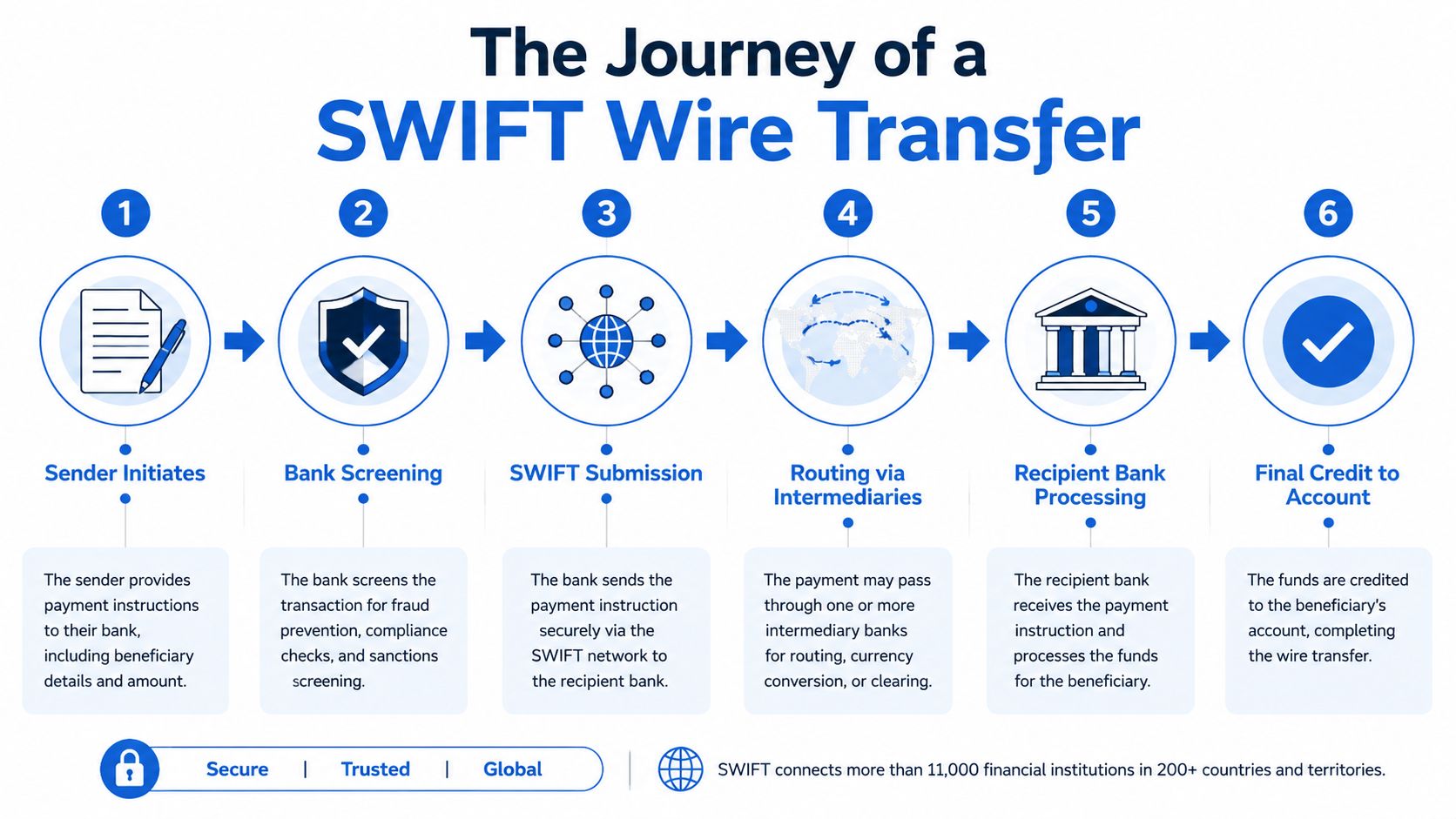
A wire can leave the sender's account and still be hours or days away from usable funds. To find the delay, trace four stages: instruction, bank release, routing, and beneficiary credit.
From instruction to bank release
The sender submits the beneficiary's legal name, account or IBAN details, bank identifier, currency, amount, and payment purpose. The sending bank validates the instruction, checks available funds, and may verify the sender, beneficiary, source of funds, and destination.
The bank then sends a payment message through SWIFT or another supported banking channel. SWIFT carries instructions between institutions. The corresponding funds move through accounts banks maintain with one another, commonly called correspondent or nostro accounts.
A direct corridor removes handoffs. A less-established route may involve one or more intermediary banks, each with its own operating hours, screening rules, and repair procedures. A payment submitted after a bank's cutoff can wait before this chain even begins.
Routing, conversion, and local credit
After release, a correspondent bank may debit one institution and credit another. Currency conversion introduces another control point. The receiving bank validates the incoming funds, sends them through the relevant local process, and then credits the beneficiary.
For a USD-to-EUR payment, check whether the banks have a direct relationship and whether the receiving bank can post euros without a separate conversion or manual review. A direct SWIFT transfer with no intermediary banks can arrive in about 15 hours, while routes through intermediaries average about 1 day 11 hours. Adding currency conversion can extend average completion to about 4.6 days, according to analysis of delayed bank transfers from Statrys.
These are route-level benchmarks, not guarantees for every account. The local credit stage can add time after the payment reaches the beneficiary institution, especially when the destination bank applies a separate posting schedule.
The records that make tracing possible
Ask the sending bank for the MT103, the payment confirmation containing key transaction details. Request the payment's UETR as well, the unique end-to-end tracking reference used to identify the transaction across the SWIFT chain.
The MT103 does not prove that the recipient has usable funds. It establishes what the sending bank sent, when it sent it, the instructed beneficiary, and the route used. The recipient bank can search its incoming records with those details.
Document this chain before a payment becomes urgent. Guidance on business-to-business cross-border payments helps finance teams separate payment initiation, bank settlement, and beneficiary credit when setting operating procedures.
The Five Variables That Move Transfer Timing
Not every timing variable deserves equal attention. In practice, corridor design and compliance create the largest swings, while cutoffs often determine whether a payment starts today or on the next banking day.
Ranked timing variables
Corridor and currency pair. A major USD-to-EUR route may have established correspondent relationships and predictable settlement. A less-supported currency pair can require more routing decisions, local clearing steps, or manual handling.
Intermediary banks. Each correspondent adds another processing hop and another institution that can hold, repair, reject, or reroute the payment. Statrys' transfer-delay analysis reports about 15 hours for a direct SWIFT route, about 1 day 11 hours when intermediaries are involved, and about 4.6 days when currency conversion is added.
Currency conversion. Same-currency settlement removes an FX operation. When conversion is required, the bank must apply its exchange process, confirm the amount, and complete the resulting ledger entries.
Cutoff times and time zones. A payment submitted after the originating bank's cutoff may not enter processing until the next business day. A late-day instruction in New York can arrive outside operating hours for a bank in Europe or Asia, and holidays in either jurisdiction can extend the wait.
Compliance and sanctions screening. Screening can examine the parties, banks, jurisdictions, payment purpose, and transaction pattern. A name mismatch or missing documentation can move a payment from automated handling to manual review.
| Rank | Variable | Typical Time Impact | Example |
|---|---|---|---|
| 1 | Corridor and currency pair | Can range from rapid processing to several business days | A direct major-currency route versus a less-established exotic-currency corridor |
| 2 | Intermediary banks | Each added hop increases processing time and variance | A payment routed through multiple correspondents |
| 3 | Currency conversion | Can extend completion to about 4.6 days in the cited analysis | USD converted to EUR during the transfer |
| 4 | Cutoffs and time zones | Can defer processing to the next business day | A Friday instruction submitted after the sender's cutoff |
| 5 | Compliance screening | Can add 1 to 3 business days or more when review is required | Beneficiary details trigger manual sanctions or AML checks |
For a broader comparison of local and international payment methods, the ACH versus SWIFT guide is useful. The operational conclusion is straightforward: choose direct, same-currency corridors when possible, submit before cutoff, and collect complete beneficiary information before the payment enters review.
Realistic Timing Scenarios by Corridor
The corridor determines the delivery risk. A payment from New York to Frankfurt can follow a highly connected route, while New York to Manila may depend on PHP conversion, correspondent banks, and local posting. Same-currency payments within Europe can use a local rail, but only when both banks and the instruction qualify.
| Corridor | What to check before sending | Where delay usually occurs |
|---|---|---|
| USD to EUR, New York to Frankfurt | Whether the banks have a direct or highly connected relationship, and whether FX is handled before or after delivery | Recipient-bank posting, FX handling, or compliance |
| USD to PHP, New York to Manila | The chosen PHP payout route, local banking hours, and the provider's cutoff for conversion | Intermediary queues, currency conversion, and local credit |
| EUR to EUR, Berlin to Paris | Whether the payment qualifies for an instant European local rail, and whether both banks participate | Beneficiary-data errors, eligibility checks, or recipient-bank controls |
Network delivery and usable balance are separate milestones. SWIFT's 2024 reporting found that 81.8% in North America reached the beneficiary leg within one hour, while the same measure was 24.7% in Africa. The FSB report shows why a corridor average cannot stand in for the recipient's actual credit time.
For the Manila route, confirm the payout currency before submitting the wire. If the beneficiary needs PHP, ask whether the sender, an intermediary, or the recipient bank performs the conversion. That choice changes the institutions involved and can create an extra review or posting step. Send supplier payments early enough to cover local banking hours, especially when the instruction crosses time zones or arrives near a cutoff.
Frankfurt to Paris is operationally simpler when the payment stays in EUR. Check instant-payment eligibility, participation, transaction limits, and the recipient bank's posting rules before promising immediate funds. A local rail shortens the route, but it does not remove account-validation or compliance checks.
Use a corridor-specific service commitment when one exists. Otherwise, plan against the slowest normal handoff in that route, not the fastest transfer your team has observed.
For bank wires versus specialist providers, compare money transfer apps by supported corridors, tracking detail, conversion workflow, and recipient-credit behavior. Advertised speed matters less than knowing which institution controls the final posting step.
Operational rule: Ask where the payment will wait, then build your cash-flow deadline around that handoff.
Troubleshooting a Wire That Is Stuck or Delayed
Stop treating “sent” as proof that the beneficiary has been credited. A payment can be released by the originating bank and still wait at an intermediary or recipient institution.
Start with the evidence
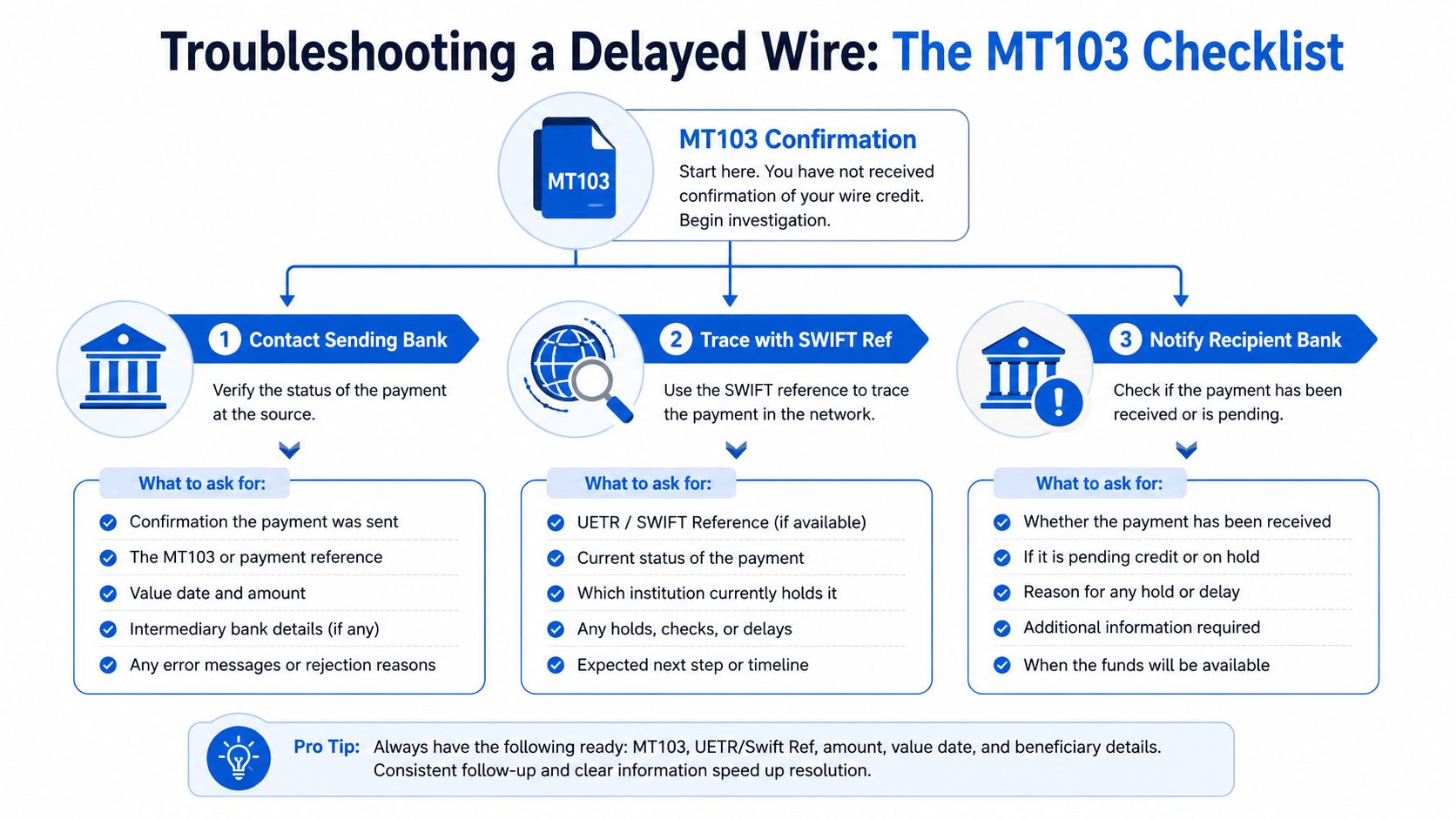
Ask the sender's bank for the MT103 and UETR. Capture the value date, currency, instructed amount, beneficiary name, beneficiary account or IBAN, sending bank, and every intermediary listed in the payment record.
Then ask direct questions:
- Confirm release: Has the sending bank released the payment, or is it still pending internal approval?
- Identify the route: Which correspondent banks received or handled the instruction?
- Check repair status: Did any institution flag an incorrect account, SWIFT code, beneficiary name, or payment purpose?
- Request screening status: Is the wire under sanctions, AML, or source-of-funds review?
- Confirm recipient action: Has the beneficiary bank received and accepted the payment for posting?
Follow the escalation path
If the sending bank hasn't released the wire, resolve its verification request there. If it has released the payment, give the bank the UETR and ask for a formal trace through the correspondent chain. If the recipient bank says it can't find the payment, provide the MT103 and ask its wire operations team to search incoming SWIFT records.
Cutoff timing should be checked before escalation. A payment submitted after cutoff, before a weekend, or during a holiday in either country may not have started the processing window you're counting.
Compliance delays require a different response. Don't repeatedly resubmit the same payment, because duplicate instructions can create reconciliation and review problems. Ask what documentation the bank needs, then provide consistent invoices, contracts, beneficiary information, and business-purpose details.
For Spanish-language operational guidance, the international transfer banking guide offers additional context. Keep one case file containing all bank messages, tracking references, timestamps, and requested documents. That record gives your bank's investigations team something actionable instead of another general “where is my money?” request.
How Multi-Currency and Crypto Rails Speed Things Up
The fastest wire is often the wire you don't need to send. If a business already holds funds in the destination currency, it can remove the conversion decision from the payment journey and reduce dependence on correspondent routing.
Multi-currency accounts can also connect a payment to local rails. Depending on the corridor and eligibility, businesses may use systems such as SEPA Instant, FedNow, Faster Payments, PIX, or NPP instead of sending every payment through a traditional international chain. These systems still have participation, compliance, and posting requirements, but they can eliminate intermediary-bank hops.
Crypto rails take a different path. A business can send a supported stablecoin such as USDC, then convert it into local currency on the recipient side. This can provide same-day or same-hour settlement in supported workflows, but the recipient still needs a compliant conversion and payout process. The trade-offs include exchange spread, wallet and counterparty controls, transaction documentation, and the recipient's ability to accept local funds.

OneSafe is one option for businesses that need fiat and crypto workflows in one interface. Its platform provides multi-currency business accounts, ACH, domestic and international wires, SWIFT transfers, corporate cards, USDC deposits and withdrawals, and fiat-to-crypto or crypto-to-fiat conversions. Its stated account currencies include USD, EUR, and CAD, while supported availability, onboarding, KYB, and documentation requirements depend on the business and jurisdiction.
The right comparison isn't “bank versus crypto.” It's multi-hop payment versus direct local settlement. Use the rail that matches the recipient's currency, compliance profile, and operational needs, and keep a documented fallback for corridors where the faster route isn't available.
Planning Wire Timing Into Your Cash Flow
Treat international wire timing as a cash-flow variable, not a customer-service footnote. Build payment commitments around the slowest corridor your business uses, then add a practical buffer for intermediary handling and compliance review.
Create a payment calendar that records:
- Invoice due dates: Schedule recurring vendor payments before the last acceptable arrival date.
- Bank cutoffs: Record the sending bank's cutoff in the sender's time zone and the recipient's banking hours.
- Holiday exposure: Check public and banking holidays in both jurisdictions.
- Currency needs: Pre-position destination-currency balances when predictable vendor payments justify it.
- Escalation owners: Assign one person to request the MT103, UETR, intermediary chain, and formal trace.
- Liquidity protection: Separate operating cash from settlement funds and contingency reserves.
Track your actual corridor performance over time. Record submission time, release time, intermediary updates, recipient acknowledgment, and final credit. That evidence will improve your forecast and give you a stronger position when negotiating payment terms with suppliers.
Use the benchmark to trigger action, not anxiety. If a payment exceeds the normal behavior of its corridor, escalate with documentation rather than sending another instruction and hoping it arrives.
OneSafe brings multi-currency accounts, international wires, local payment options, and crypto-compatible workflows into one business platform. Visit OneSafe to assess whether direct-corridor payments and unified fiat-to-crypto operations can make your cross-border cash flow more predictable.