On November 18, 2026, Swiss crypto bank AMINA added Sui (SUI) and NEAR Protocol (NEAR) to its staking service, bringing its total of stakeable assets to ten. The move, reported by CoinMarketCap, signals that crypto banking is absorbing DeFi-like features—and forcing businesses to re-evaluate whether a regulated bank or a crypto-native neobank better fits their needs.
Table of Contents
- What happened with AMINA Bank and staking?
- What is crypto banking?
- How does staking in a bank account work?
- Should businesses use a bank or a neobank for crypto?
- What Changes Now—and What Stays the Same
- Open Questions and What to Watch Next
- Key Takeaways
What happened with AMINA Bank and staking?
AMINA, a FINMA-regulated Swiss bank, announced on November 18, 2026, that clients can now stake SUI and NEAR directly from their AMINA accounts. Both tokens were already available for custody and trading; staking extends the service to earning protocol rewards while the assets remain in segregated bank custody. Staked positions can also be pledged as collateral for AMINA’s lending products—clients can borrow against staked assets without losing the staking yield.
The announcement makes AMINA’s staking lineup what the bank calls “the most comprehensive among Swiss regulated banks.” While AMINA didn’t list its other eight stakeable assets, the expansion is a concrete step toward a model where a single regulated entity handles custody, trading, staking, and lending.
What is crypto banking?
Crypto banking moves beyond simple custody or exchange services. A crypto-friendly bank or neobank integrates cryptocurrency capabilities with traditional fiat accounts, payments, and reporting. At minimum, that means the ability to hold crypto alongside cash, convert between them, and make transfers. More advanced offerings—staking, crypto-collateralized loans, or multi-currency treasury tools—are what differentiate a full crypto-friendly bank from a conventional bank that merely tolerates crypto transactions.
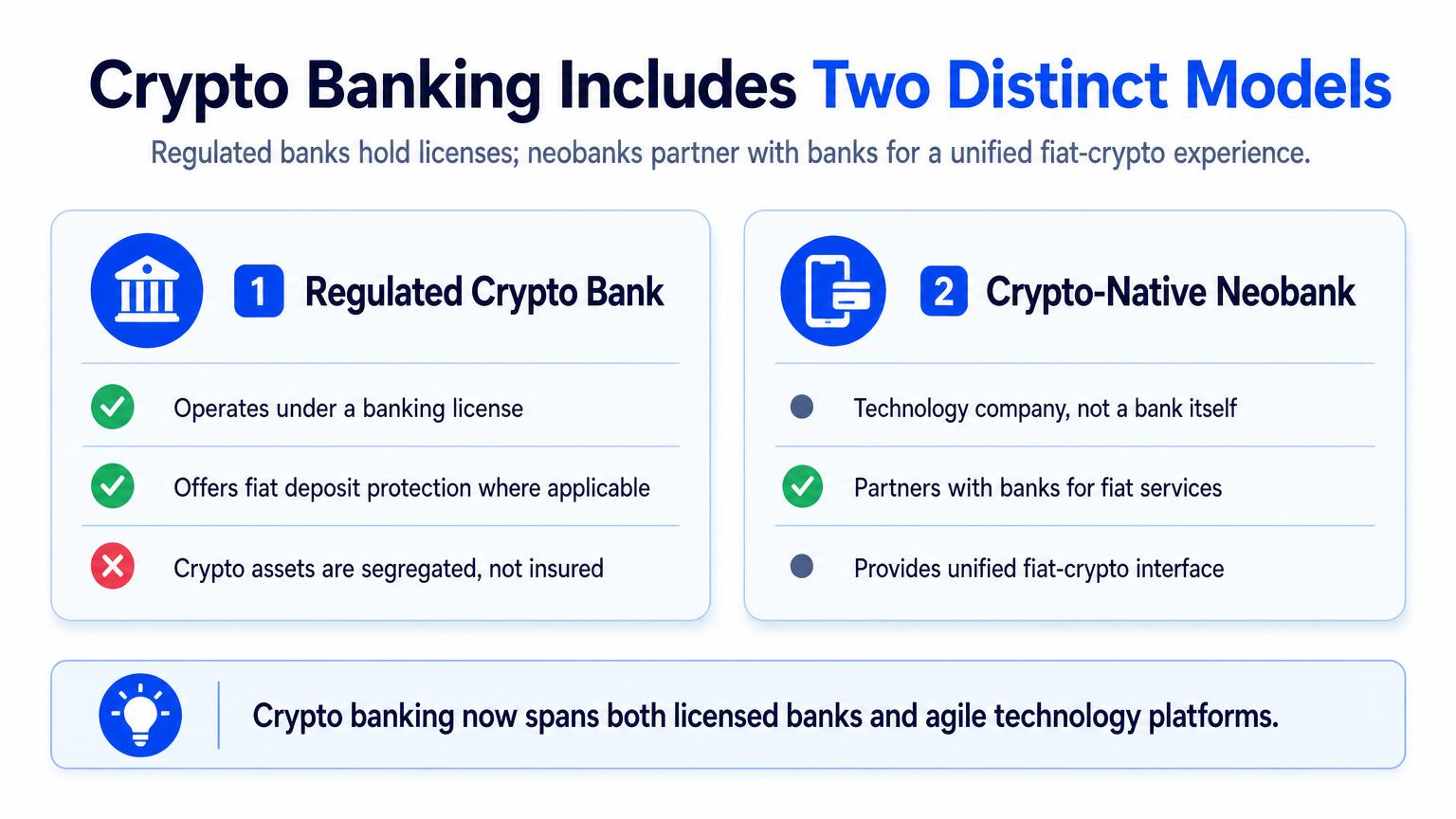
The term now covers two distinct models:
- Regulated crypto banks like AMINA, which operate under a banking license and offer fiat deposit protection where applicable, but keep crypto assets segregated and not insured by deposit guarantee schemes.
- Crypto-native neobanks (or neobanking platforms) like OneSafe, which are technology companies that partner with banks to provide a unified fiat-and-crypto interface. These platforms are not banks themselves, but they handle the entire operational layer: onboarding, payments, invoicing, treasury management, and crypto-fiat conversion—often with fewer geographic restrictions.
How does staking in a bank account work?
Staking through a regulated bank differs fundamentally from staking via a non-custodial wallet or a DeFi protocol. The bank holds the assets in its own custody infrastructure, stakes them on behalf of the client, and credits the rewards to the client’s account. Because the assets never leave the bank’s segregated, audited environment, the client avoids private key management and the smart-contract risks of direct DeFi interaction.
AMINA’s structure, as described by Chief Product Officer Myles Harrison, is that “every staked asset remains in AMINA custody with full segregation from our balance sheet in compliance with Swiss banking regulations.” That means the assets are not lent out or rehypothecated to fund the bank’s own activities. And because the bank offers lending against those staked assets, a business can access liquidity without unstaking—a capability that until recently was confined to specialized crypto lenders or DeFi protocols.
Should businesses use a bank or a neobank for crypto?
The choice turns on a handful of trade-offs that every business should assess.
What are the risks and benefits of staking with a regulated bank?
Benefits
- Custodial safety: Assets remain with a licensed, audited institution; the bank is liable for operational security.
- Collateral flexibility: At AMINA, staked assets can back loans, preserving both liquidity and staking yield.
- Regulatory clarity: Regulated banks must maintain capital buffers and reporting standards, which can help with audits and investor confidence.
- Simplified accounting: Staking rewards are credited to a bank account, reducing the complexity of tracking multiple blockchain-based yields.
Risks
- Counterparty exposure: The bank could face insolvency, and because crypto is not covered by deposit insurance, an AMINA client’s staked crypto is not protected by the Swiss depositor protection scheme.
- Slashing risk: If the bank’s node infrastructure misbehaves, the underlying protocol may slash a portion of staked assets; the bank’s terms will dictate whether it indemnifies clients for such losses.
- Limited asset selection: Even with ten assets, the staking menu is a fraction of what’s available in DeFi; businesses that need niche ecosystem yields will find it insufficient.
- Concentration of control: A single entity holds both the private keys and the staking infrastructure—any operational failure could freeze access.
How does this affect businesses that need both fiat and crypto management?
For a business operating across fiat payroll, supplier payments, and crypto treasury, the decision comes down to integration depth. A regulated crypto bank like AMINA can be a solid choice if the business mostly needs crypto staking bank services and occasional fiat payouts through a traditional SWIFT/IBAN interface. But companies that routinely switch between fiat and crypto—paying freelancers in USDC, settling vendor invoices in USD, holding a treasury in multiple stablecoins—often find that a bank’s digital interface is not built for that velocity.
That’s where a crypto-fiat neobank fills the gap.
The Unbundling: Traditional Banks, Crypto Banks, and Neobanking Platforms
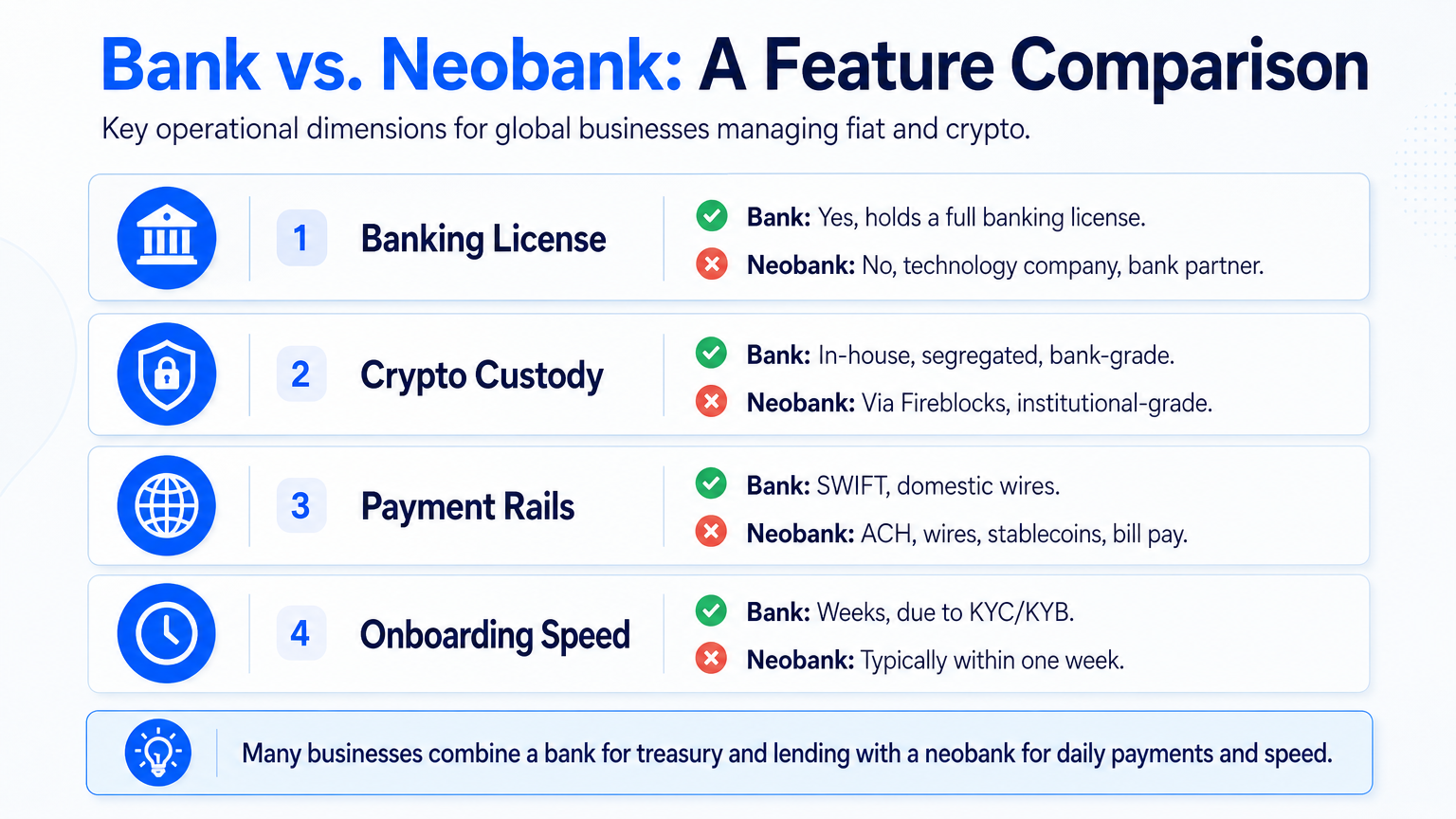
To make the trade-offs concrete, the table below compares a regulated crypto bank like AMINA with a neobanking platform like OneSafe on operational dimensions that matter for a global business.
| Dimension | Regulated Crypto Bank (e.g., AMINA) | Crypto-Native Neobank (e.g., OneSafe) |
|---|---|---|
| Banking license | Yes; holds client fiat deposits | No; technology company, banking services via partners |
| Crypto custody | In-house, segregated, bank-grade | Via Fireblocks custody, institutional-grade |
| Crypto staking | 10 assets; collateralizable loans | Not offered; platform handles on/off-ramp and payments |
| Multi-currency fiat accounts | Limited to core currencies (CHF, EUR, USD typically) | USD, EUR, CAD; more currencies added |
| Payment rails | SWIFT, domestic wires | ACH, domestic & international wires, bill payments, stablecoin payments |
| Onboarding speed | Weeks, due to bank KYC/KYB | Typically within one week |
| Crypto-to-fiat conversion | Integrated, but often less automated | Instant conversions; free USDC deposits/withdrawals |
| DAO-specific tools | Not available | Customizable roles, permissions, automated payment workflows |
| Fee transparency | Varies; relationship-based pricing often opaque | Published: fiat deposit 0.15%, wire $25, SWIFT 0.35%+$50, USDC free |
The table underscores the core difference: a business crypto account at a regulated bank provides deeply integrated custody-and-lending services, while a neobanking platform offers operational flexibility and speed for organizations that live at the intersection of fiat and crypto rails. Many Web3 startups and DAOs use both: a bank for longer-term treasury holdings and a neobank like OneSafe for day-to-day payments, payroll, and crypto treasury management.
What Changes Now—and What Stays the Same
For Crypto Banking Users
AMINA’s staking expansion sets a new bar: a bank offering staking with collateral loans means businesses no longer have to choose between safety and yield. This was previously a gap that forced companies into DeFi or centralized lending platforms. Now a regulated bank can serve as a single counterparty for custody, staking, and borrowing.
Yet the fundamental constraints haven’t changed. Crypto held at a bank is still not insured against loss in value or insolvency. The bank’s staking rewards are net of its own fees, which are typically less transparent than on-chain yields. And opening an account still requires passing through a full bank KYC process, which can take weeks—unlike neobanks that onboard in hours or days.
For Businesses That Need More Than a Bank
The expansion doesn’t solve the fragmentation that businesses face when they hold fiat in one institution and crypto in another. A DAO banking operation, for instance, might need to pay contributors worldwide in both USDC and local fiat, manage invoice flows, and maintain segregated, auditable treasuries. No regulated crypto bank offers that breadth today.
That’s why the emergence of bank-offered staking may actually increase the appeal of a blockchain business bank layer—a neobanking platform that unifies fiat accounts, FX, cards, and on-chain payments without the overhead of a bank charter. As banks absorb DeFi features, stablecoin infrastructure will become the next battleground for businesses that need instant settlement and programmable money.
Open Questions and What to Watch Next
Will other regulated banks follow AMINA? The move puts pressure on Swiss and European crypto banks to add staking. If a wave of banks begin offering staking-and-lending packages, the line between bank and yield platform will blur further. But each jurisdiction’s regulator will set the pace; the U.S., for example, has yet to approve similar integrated services from a federally chartered bank. However, some U.S. banks are ready to accept crypto payments, indicating a shift in appetite.
How will staking rewards be treated for tax and accounting? Businesses earning staking rewards through a bank will need to determine whether those rewards count as income at the time of receipt or only upon sale. The answer varies by country, and the bank’s reporting will heavily influence what’s practical for a business to defend in an audit. This is an under-explored area, made more urgent by the new ease of institutional staking.
Can neobanks sustain an edge as banks catch up? Banks are adding DeFi features, but neobanking platforms are adding compliance-grade custody, stablecoin payments, and DAO-native governance tools faster than any licensed bank can. The question is whether businesses will prioritize the safety of a banking license over the speed and integration of a fintech platform. For many, the answer will be both: a layered financial stack where a bank provides long-term custody and lending, and a neobank handles the daily movement of money across fiat and crypto networks—exactly the approach that OneSafe was designed to enable.
What about collateralized staking risks? Pledging staked assets as loan collateral introduces a new correlation: if the staked token’s price drops sharply, the loan-to-value ratio can breach thresholds, triggering a margin call. The bank’s terms will determine how quickly a business must add collateral or repay. Without clear risk disclosures, a bank-offered staking loan could expose a business to the same liquidation dynamics it sought to avoid by staying off DeFi.
Key Takeaways
- The AMINA Bank staking expansion (November 18, 2026) means businesses can now earn staking rewards inside a regulated bank while using those assets as loan collateral—a model that was previously exclusive to DeFi or specialized lenders.
- Staking with a regulated bank trades off DeFi yield and asset diversity for institutional custody and auditability; the core risk is that crypto is not insured against bank failure or slashing.
- A crypto-friendly bank and a neobanking platform serve different parts of the stack—banks are best for custody and credit, while platforms like OneSafe excel at speedy onboarding, multi-currency payments, and unified fiat-crypto operations.
- Businesses that need robust crypto treasury management, DAO banking, or automated cross-border payments will still need a neobank layer even as banks add staking, because no licensed bank currently delivers the full operational interface that digital-native organizations demand.
- Watch for regulatory treatment of bank-offered staking rewards and the ripple effect as other regulated banks race to match AMINA’s offering—the convergence of banking and yield will accelerate, but the how matters as much as the what.
For crypto banking platforms looking to maintain a steady stream of educational content and organic traffic, Joyrise offers a service that analyzes your site and writes and publishes SEO articles to Webflow, WordPress or Shopify daily, with the first article written before you pay.
Ready to simplify how your business moves money between fiat and crypto? Open an account on OneSafe and see a unified platform in action.