DTCC launched blockchain tokenization, moving $114T settlement on-chain. On-chain treasury and crypto treasury management are now essential for businesses. What follows is what happened, why it matters, and how a business without a Wall Street-sized budget can act on it today.
Table of Contents
- The $114 Trillion Signal: DTCC Embraces On-Chain Settlement
- Crypto Treasury Management 101 — What Every Founder Needs to Know
- From Wall Street to Your Wallet: What the DTCC Move Means for Business Treasuries
- The Startup & DAO Playbook: Practical Crypto Treasury Management Right Now
- What Changes Now (and What Doesn’t)
- Open Questions and What to Watch Next
- Key Takeaways
The $114 Trillion Signal: DTCC Embraces On-Chain Settlement
On November 17, 2026, the Depository Trust & Clearing Corporation (DTCC) moved a crucial piece of its settlement machinery onto the Canton Network, enabling tokenized asset settlement directly on-chain. The DTCC’s blockchain tokenization service replaces siloed batch systems with a shared, immutable, real-time ledger.
For a decentralized autonomous organization (DAO) or a startup, that matters. The same guardian of traditional settlement is adopting on-chain rails, so crypto-native treasury operations stop being fringe and start being infrastructure. Every corporate treasury will eventually plug into a similar stack.
Crypto Treasury Management 101 — What Every Founder Needs to Know
What is crypto treasury management?
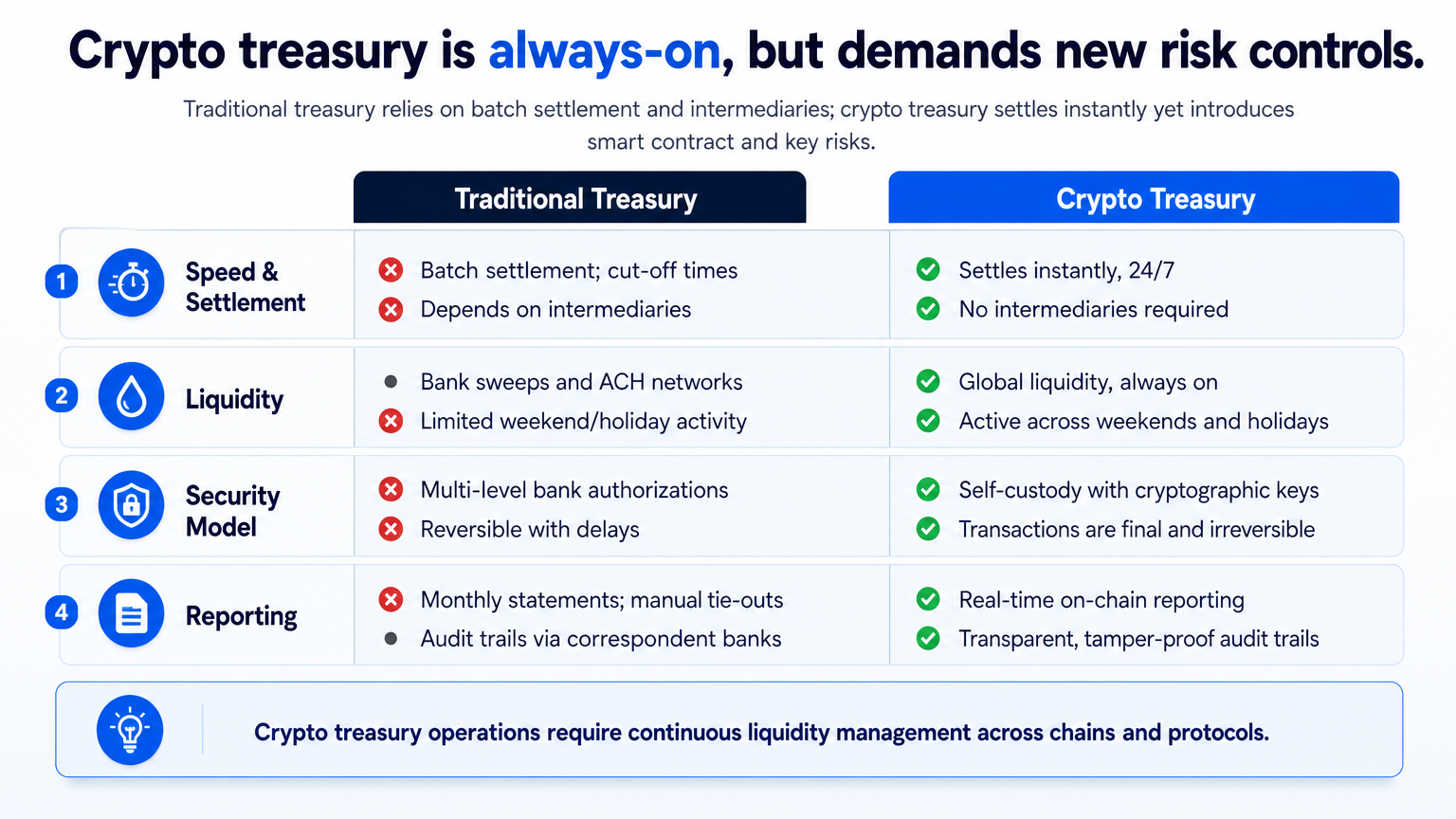
Crypto treasury management means overseeing digital assets — stablecoins, native tokens, liquid staking derivatives — alongside fiat, with 24/7 markets, programmability, and near-instant settlement. It encompasses liquidity, risk controls, on-chain governance, and integration with traditional banking. As Stripe explains, it’s about managing digital assets “as part of broader treasury operations.”
How is treasury management for crypto different from traditional?
Fiat treasuries depend on cut-off times and intermediaries. A crypto treasury operates with always-on finance — a USDC payment settles in seconds at any hour. But that speed introduces smart contract risk, irreversible transfers, and private-key compromise. You manage liquidity across protocols, chains, and bridges, not just bank sweeps.
The core components you can’t ignore
- Liquidity buffers in stablecoins for working capital.
- Custody infrastructure with multisig and vaults, not a single hot wallet.
- Risk frameworks for key management, smart contract exposure, and regulation.
- Reporting that generates audit-proof records for fiat and on-chain balances simultaneously.
From Wall Street to Your Wallet: What the DTCC Move Means for Business Treasuries
Does the future of treasury management require support for crypto assets?
Yes. When the DTCC tokenizes settlement, it reshapes expectations around speed and finality. Payment providers and banks will follow, and businesses already running a unified fiat-crypto platform gain a structural edge. The DTCC’s move removes the “wait and see” argument.
How do digital assets fit into always-on corporate treasury?
Always-on finance means liquidity flows continuously. Stablecoins are the native fuel. A team pays a contractor in USDC at midnight; the fiat leg settles next morning. Tokenized money market funds will move the same way. The infrastructure handles execution while the treasury team sets policies and automates reconciliation.
The Startup & DAO Playbook: Practical Crypto Treasury Management Right Now
What are the biggest risks in running a crypto treasury?
Custody and access control: one compromised key can drain a treasury. Volatility management: working capital should never sit in volatile tokens. Regulatory ambiguity: stablecoin rules differ by jurisdiction, as Canada’s proposed stablecoin payment regulations highlight.
One camp demands institutional custodians and legal wrappers — expensive for a small company. The other insists on self-custody — secure but operationally heavy. The practical middle path is a unified platform that delivers institutional security without the overhead.
OneSafe, a fintech platform (not a bank), combines fiat accounts, ACH, wires, cards, and crypto wallets in one interface. Digital assets are secured on Fireblocks, while the platform handles fiat. That gives multisig-grade security without building an internal custody operation.
One integration instead of four: the unified-account advantage
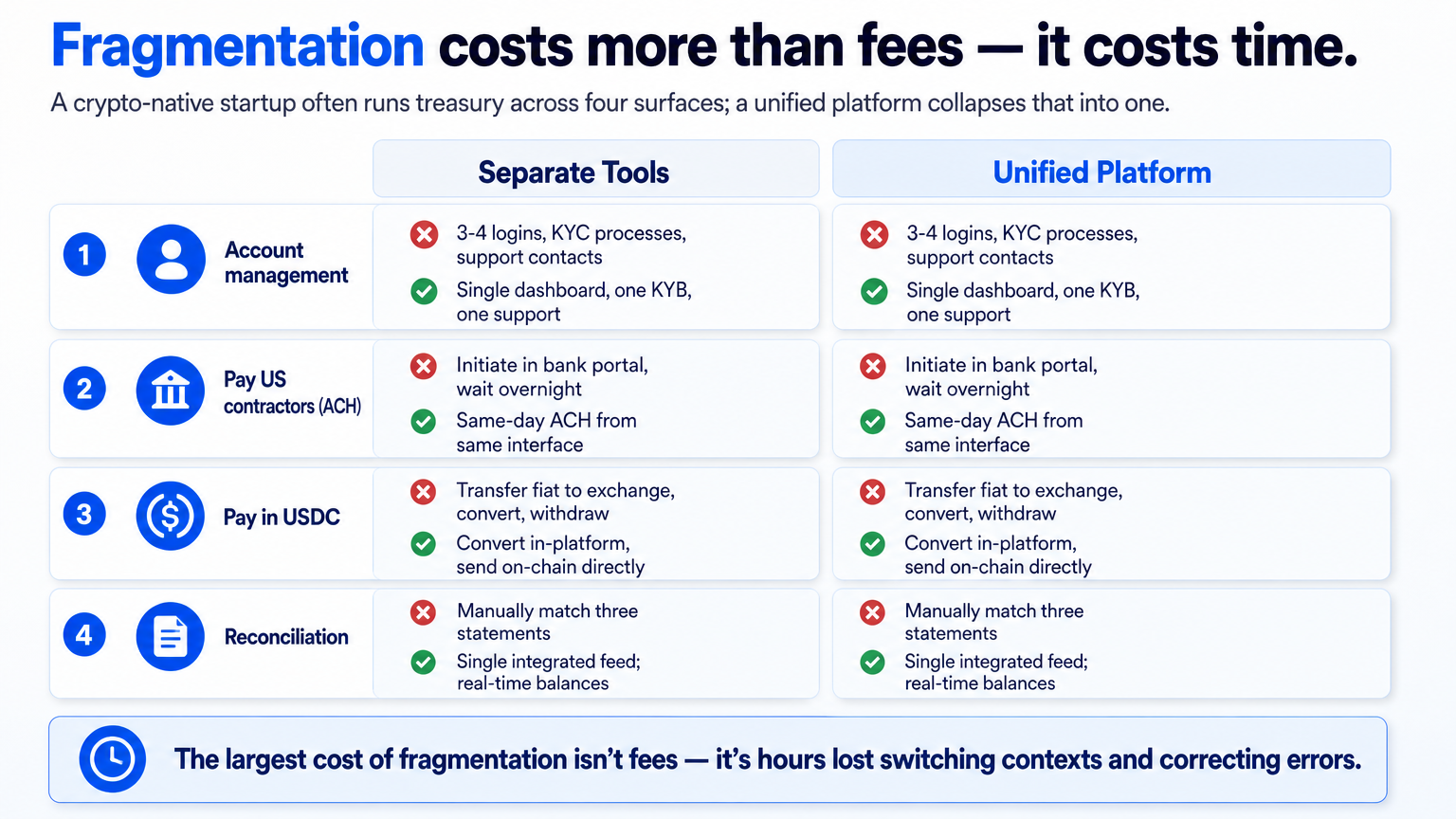
A crypto-native startup often runs treasury across four surfaces: a bank, an exchange/OTC desk, a wallet, and a separate ledger. A unified platform collapses that into one account, slashing reconciliation cycles and fees.
| Task | Separate fiat bank + exchange + wallet | Unified fiat-crypto platform (e.g., OneSafe) |
|---|---|---|
| Account management | 3-4 logins, KYC processes, support contacts | Single dashboard, one KYB onboarding, one support |
| Pay US contractors (ACH) | Initiate in bank portal, wait overnight | Same-day ACH from same interface |
| Pay in USDC | Transfer fiat to exchange, convert, withdraw to wallet | Convert in-platform, send on-chain directly |
| International wire | $25–$50 fee + FX spread | $25 wire fee, competitive FX |
| Reconciliation | Manually match three statements | Single integrated feed; real-time balances |
| Custody security | Different security models; hot wallets common | Fireblocks custody, MFA enforced; no exposed hot wallets |
The largest cost of fragmentation isn’t fees — it’s the hours spent switching contexts and correcting errors.
DAO-specific workflows: roles, permissions, and automated payouts
DAOs need more than a multisig. They need customizable roles so a core team proposes, a multisig group approves, and a contributor views balances. They need automated recurring payouts in stablecoins or fiat, and permission boundaries that reflect governance. OneSafe offers customizable roles and permissions that mirror on-chain governance, closing the gap between a vote and payroll execution without Zapier gymnastics.
How does a treasury team prove its onchain balances to an auditor?
Auditors need evidence of existence, ownership, and valuation. On-chain assets can provide cryptographic certainty, but screenshots won’t cut it. A responsible digital asset management setup produces:
- Address attestations signed by the private key.
- Time-stamped balance statements exported from custody.
- Fiat-equivalent valuations from a reliable price feed at period-end.
A unified platform managing fiat and crypto can generate a consolidated report — USDC on Ethereum, USDC on another chain, USD checking, EUR — from Fireblocks-powered custody. The auditor verifies balances on-chain independently. The leap from “we hold crypto” to auditor-ready evidence shrinks from weeks to minutes.
What Changes Now (and What Doesn’t)
What changes: The DTCC’s move accelerates institutional adoption. On-chain settlement is no longer theoretical. Startups and DAOs that treat crypto treasury management as optional will fall behind. Stablecoins for payments, on-chain proof of reserves, and real-time reconciliation become hygiene.
What doesn’t change: Prudent principles endure. Liquidity must be protected; speculation has no place. Segregation of duties, dual control, and auditable records are non-negotiable. Operational risk shifts from settlement failures to smart contract and key management, but a well-run treasury still needs clear policy and regular reporting.
Open Questions and What to Watch Next
- Will tokenized securities settlement require the Canton Network’s native token, or will stablecoins suffice? No mandate yet.
- How will auditors standardize proof-of-reserves across chains and custodians? Templates are emerging, but no single standard has been adopted.
- Will small businesses get direct on-chain settlement access, or will the DTCC’s service remain gated behind broker-dealers?
- Regulatory alignment: conflicting stablecoin definitions (see stablecoin payments pilots) could fragment markets.
Joyrise — which promises to “grow organic traffic while you sleep” — analyzes your site, then writes and publishes SEO articles to Webflow, WordPress, or Shopify every day. Your first article is written before you pay.
Key Takeaways
- The DTCC’s tokenization launch signals that on-chain settlement is now infrastructure, making crypto treasury management a near-term requirement.
- Startups and DAOs skip complexity with a unified fiat-crypto platform that delivers institutional-grade custody and real-time reconciliation.
- DAO treasuries need more than multisig: customizable roles, automated payouts, and auditor-ready reporting are the baseline.
- The biggest risks — custody, volatility, regulation — are best managed with Fireblocks-class security in a simple interface.
- Fundamentals don’t change: liquidity first, strict permissions, and evidence an auditor can trust.
Ready to run a treasury that handles USD, USDC, and everything in between from a single account? Open a OneSafe account today.