The conversation around crypto banking has shifted decisively. On November 17, 2026, PYMNTS.com published an analysis that reframes where value actually accrues in the digital dollar economy: stablecoins are becoming commodities, and the infrastructure around them—currency conversion, liquidity provision, compliance screening, and payment routing—is where the next wave of winners will be built. Companies that never issue a stablecoin may capture the greatest upside.
Table of Contents
- Stablecoins Become Commodities—The Infrastructure Isn't
- Why This Redefines Crypto Banking for Growing Businesses
- Who Wins in the Infrastructure Layer
- What This Means for Your Operations
- Where to Focus Now: Actions for Finance Teams
- Open Questions and What to Watch
- Key Takeaways
- Sources
Stablecoins Become Commodities—The Infrastructure Isn't
The PYMNTS analysis documents a structural shift: stablecoins behave like commodities, with thin margins on issuance, while the surrounding infrastructure layer is where durable competitive advantages form.
The report names JPMorgan, DBS, and Visa as institutions building faster settlement while competing to retain control over deposits, customer relationships, and payment infrastructure. It signals that investors are backing companies that provide currency conversion, liquidity, compliance, and payment routing, not new token issuers. And it surfaces a critical tension: cheaper settlement does not automatically mean cheaper payments—banks may capture much of the savings unless businesses seek platforms that pass those savings through.
Why the distinction matters
Issuing a stablecoin is technically straightforward. Far harder and more valuable is building the infrastructure that lets a business accept, convert, hold, and move stablecoins alongside fiat without touching a token contract, managing liquidity pools, or navigating fragmented compliance alone. The token is the commodity; the moat is the infrastructure.
Why This Redefines Crypto Banking for Growing Businesses
A platform that simply offers custody and a fiat on-ramp was sufficient in 2024. Now the expectation is stablecoin settlement integrated into everyday operations—paying a contractor in Vietnam in USDC at 10 a.m. and settling the fiat leg through a multi-currency account by 10:01.
This trend echoes the World Bank's recent pilot, which tested stablecoin rails for cross-border disbursement as a settlement mechanism, not a speculative treasury holding. For finance leads, a platform that treats stablecoins as an investment product rather than a payment rail is already behind.
The infrastructure checklist every finance lead needs now
Five capabilities define a serious crypto banking platform today:
- Native stablecoin settlement—routing logic that treats USDC and USDT as first-class payment rails alongside ACH and SWIFT.
- Integrated crypto-fiat conversion that executes in seconds with transparent FX pricing.
- Multi-currency fiat accounts that receive, hold, and send the currencies your suppliers and employees actually use.
- Automated compliance at the infrastructure layer—KYB/KYC, transaction monitoring, sanctions screening.
- Custody architecture separating operational wallets from cold storage, with institutional-grade security like Fireblocks.
If your setup is missing two or more, you're paying for infrastructure gaps in higher fees and slower settlement.
Who Wins in the Infrastructure Layer
Platforms that never issue a stablecoin—and why that matters
The PYMNTS report is explicit: "The next stablecoin winners may never issue a token." The most defensible positions are being built by companies that create conversion engines, compliance middleware, and liquidity networks that make existing stablecoins useful.
For a platform like OneSafe—a financial technology company that provides neo-banking services through bank partnerships—this validates an architectural choice. A unified platform handling fiat and crypto natively, supporting ACH, wire, bill payments, and instant crypto-to-fiat conversions while securing digital assets through Fireblocks custody, is infrastructure. It benefits from the commodity status of stablecoins by being better at moving and converting them.
The winners make stablecoin settlement invisible: a finance manager initiates a payment in USD, the platform routes it via USDC for speed and cost, and the recipient receives EUR in their local bank account. The stablecoin was the rail, not the product.
How a DAO or global startup taps this infrastructure today
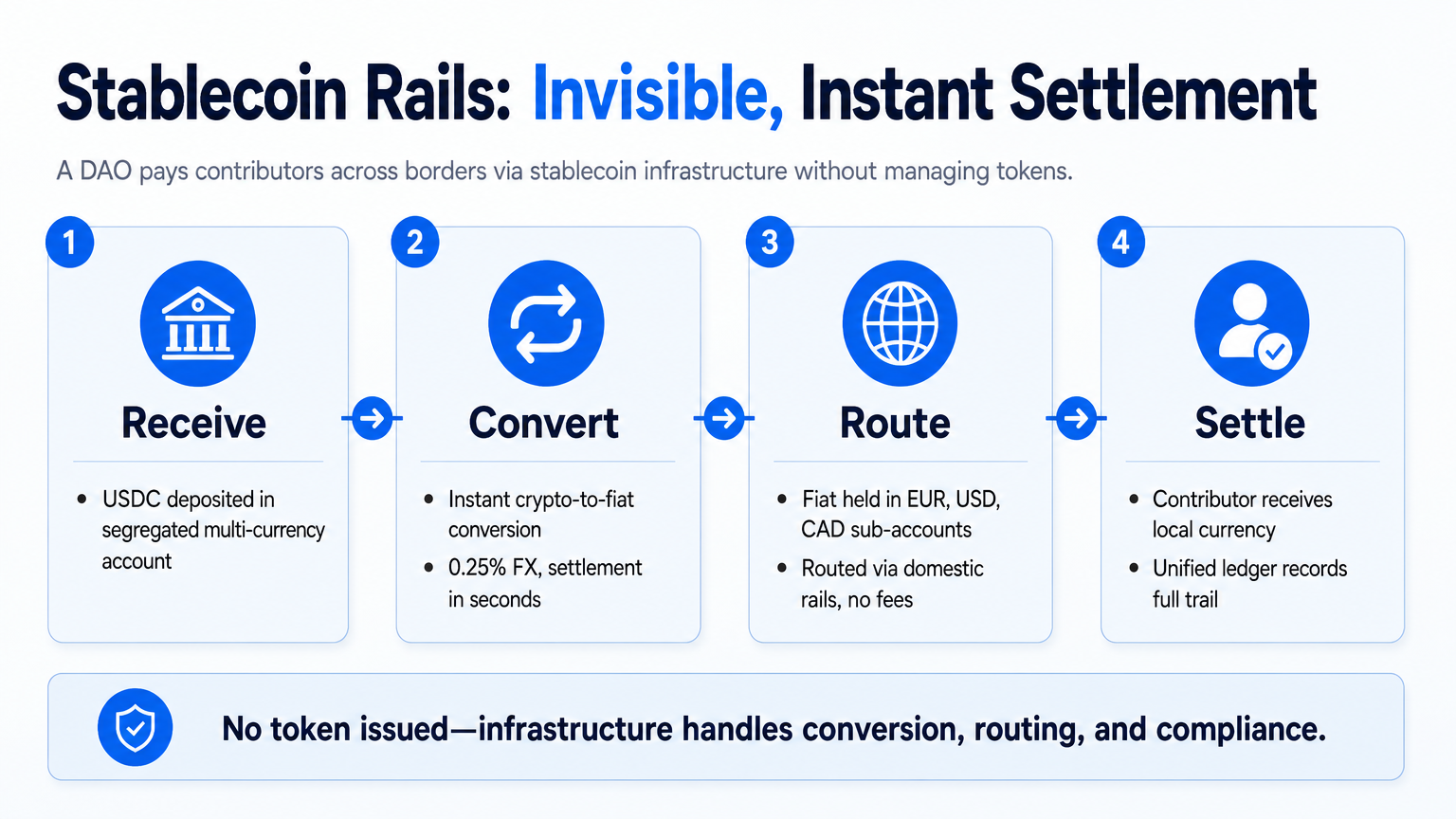
Consider a DAO with contributors in Argentina, the Philippines, and Germany. Its treasury holds USDC. Monthly, it pays contributors in local currencies, reimburses expenses, and retains a working capital buffer.
The stablecoin infrastructure workflow:
- Receive: USDC arrives in a segregated account within a platform supporting crypto custody and multi-currency fiat accounts.
- Convert: The platform executes crypto-to-fiat conversion at competitive rates (e.g., 0.25% FX), with settlement in seconds.
- Route: Fiat is held in EUR, USD, or CAD sub-accounts, then routed via domestic rails to avoid correspondent bank fees.
- Settle: The contributor receives local currency; the DAO sees a unified ledger entry tracking stablecoin inflow, conversion, and disbursement.
No token was issued. No liquidity pool was managed. The infrastructure handled it. For startups, the pattern is similar: collect payments via card or wire, convert a portion to USDC for yield or diversification, and use the same platform to pay suppliers—all while meeting KYB requirements and maintaining an audit trail.
What This Means for Your Operations
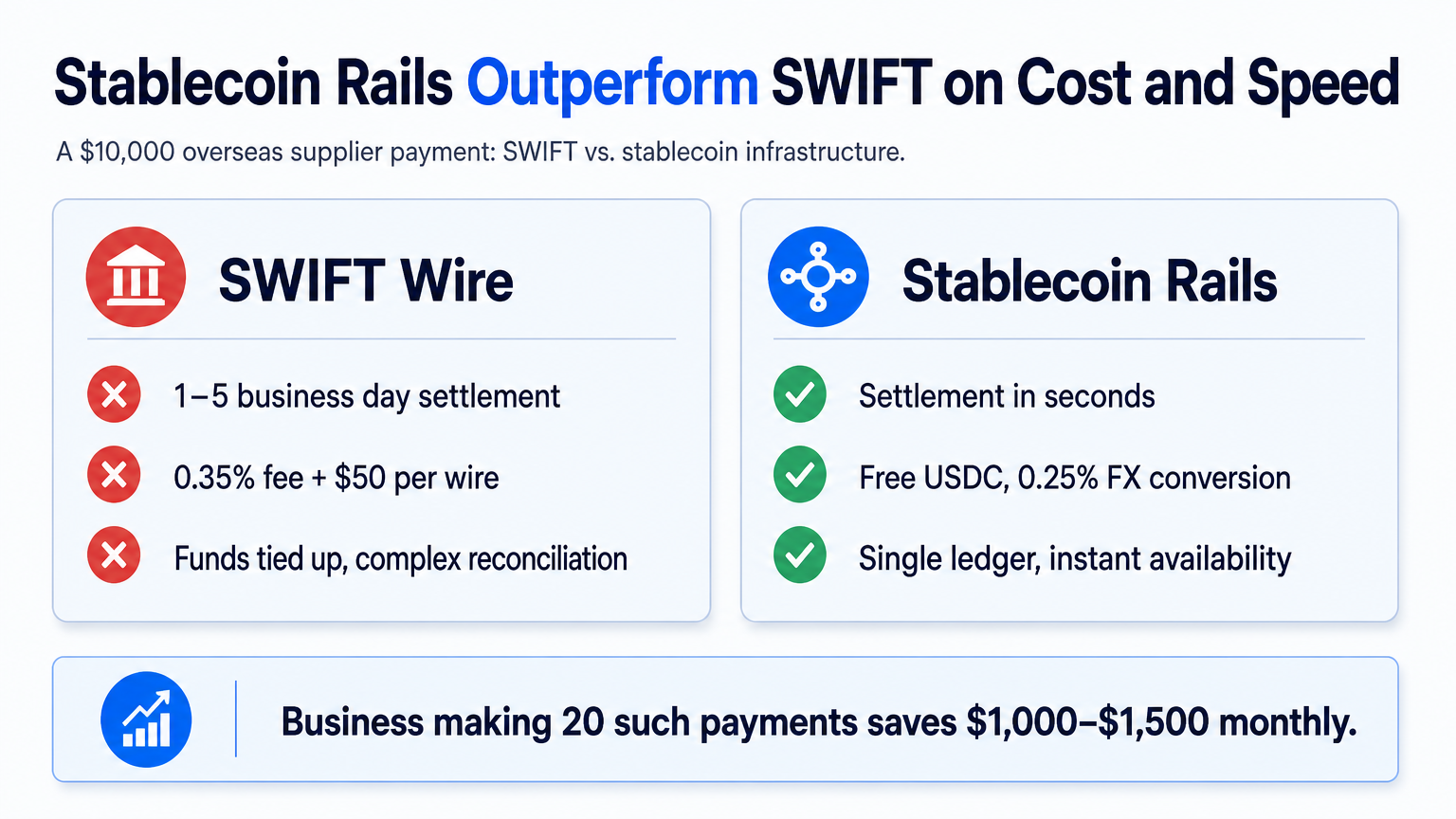
Cost, speed, and complexity: stablecoin rails vs. SWIFT
A $10,000 payment to an overseas supplier illustrates the operational difference.
| Factor | SWIFT Wire | Stablecoin Infrastructure |
|---|---|---|
| Settlement time | 1–5 business days | Seconds to minutes |
| Cost | 0.35% + $50 | Free USDC deposits/withdrawals; 0.25% FX |
| Intermediary banks | 1–3, each taking fees | None if platform routes to domestic fiat rails |
| Working capital impact | Funds tied up for days | Near-instant availability post-conversion |
| Reconciliation complexity | Multiple notifications, unclear settlement | Single ledger entry, on-chain traceability |
A business making twenty such payments monthly saves roughly $1,000–$1,500 in direct wire fees alone, before factoring in working capital benefits. The PYMNTS report warns that banks may capture these savings, but platforms that price USDC transactions at zero and FX transparently pass the savings through—a metric finance teams should benchmark.
The compliance anchor
Leaning on third-party infrastructure for stablecoin settlement concentrates operational risk. The minimum security bar: institutional-grade custody (Fireblocks or equivalent), mandatory MFA, KYB that verifies beneficial ownership, and real-time OFAC sanctions screening. OneSafe’s approach—encryption, compliance protocols, Fireblocks custody, MFA enforced at signup—illustrates what the infrastructure model requires. For businesses, custody architecture is no longer a checkbox; it's the difference between auditable infrastructure and hidden risk.
Where to Focus Now: Actions for Finance Teams
- Audit your payment stack. Identify every cross-border payment still traveling via SWIFT without a stablecoin alternative. Calculate time, fee, and working capital cost for each.
- Evaluate platforms on infrastructure, not feature lists. Ask: "What is the end-to-end settlement path for a USDC payment from my account to a supplier's local currency account, and what does it cost?"
- Pressure-test compliance architecture. Ask who performs KYB, which custody provider secures assets, and whether transaction monitoring is automated or manual.
- Negotiate for pass-through pricing. If your platform charges high crypto deposit or withdrawal fees, benchmark against free USDC transactions.
- Prepare for regulatory convergence. Canada's stablecoin payment rules and Thailand's proposed daily transfer cap signal more compliance requirements ahead. Your platform should have a track record of adapting without disruption.
While your team focuses on this audit, you can use Joyrise, which analyzes your site, then writes and publishes SEO articles to Webflow, WordPress or Shopify every day—your first article is written before you pay.
Open Questions and What to Watch
Will banks capture the infrastructure savings?
The PYMNTS analysis raises this directly. Competition from non-bank platforms that pass savings through will counterbalance banks that bundle stablecoin into premium treasury products. Watch for divergence: business-optimized platforms competing on transparent, low-cost stablecoin settlement versus incumbents bundling at a premium.
Regulatory convergence and platform consolidation
Two forces will reshape the landscape through 2027. First, regulations in Canada, the EU under MiCA, and Asia are converging around reserve requirements, redemption rights, and compliance obligations. Second, the infrastructure layer is consolidating: platforms with deep investments in custody, compliance, and multi-currency fiat rails are pulling ahead. The Custodia Bank ruling reinforced that direct access to central bank infrastructure isn't guaranteed for crypto-native firms, making the non-bank infrastructure model even more critical.
Key Takeaways
- Stablecoins are commodities now: value has shifted from token issuance to the infrastructure handling conversion, compliance, and payment routing.
- Your banking platform should treat stablecoins as a settlement rail, not an asset class: integrated crypto-fiat conversion with transparent FX pricing is the new baseline.
- The cost case is concrete: stablecoin settlement eliminates intermediary bank fees, reducing cross-border payment costs by roughly $50–$100 per transaction, with settlement in seconds.
- Security architecture is non-negotiable: institutional custody via Fireblocks or equivalent, mandatory MFA, and auditable compliance are minimum requirements.
- You do not need to issue a token to benefit: connecting to a platform that provides the infrastructure layer lets any business or DAO leverage stablecoin economics without operational complexity.
To see how a unified platform handles fiat and crypto natively—with free USDC transactions, multi-currency accounts, and institutional custody—open a OneSafe account and start onboarding today.
Sources