Stablecoin Payments: Citi-Coinbase Deal Shifts Landscape
On September 28, 2026, Citigroup Inc. (Citi) and Coinbase Global Inc. announced a partnership that lets the bank’s institutional clients accept stablecoin payments—a first-of-its-kind move by a global systemically important bank to embed this settlement rail directly into its corporate offering. The news, reported by Bloomberg, signals that the infrastructure for crypto merchant payments is finally reaching mainstream business banking. For global startups and DAOs, stablecoin payment processing is no longer an experiment; it’s a competitive necessity. This article breaks down what the deal means, why it matters now, and how businesses can start integrating stablecoin payments alongside their fiat operations today.
Table of Contents
- Citi and Coinbase Join Forces for Stablecoin Payments (September 28, 2026)
- Why Stablecoin Payments Are Gaining Traction
- What This Means for Your Business
- How to Prepare for Stablecoin Payments Today
- What to Watch Next
- Key Takeaways
Citi and Coinbase Join Forces for Stablecoin Payments (September 28, 2026)
What is the Citi-Coinbase partnership and why does it matter?
According to Bloomberg on September 28, 2026, Citi is partnering with Coinbase to allow the bank’s institutional clients to accept payments in stablecoins. The two firms will test a pilot that integrates Coinbase’s digital asset infrastructure with Citi’s global payment rails, enabling merchants to settle transactions in USD Coin (USDC) and other regulated stablecoins. A joint blog post from Coinbase and a press release from Citi confirm the initiative is designed to reduce friction in cross-border commerce, with settlement times measured in minutes rather than days.
Why it matters: This is not a peripheral crypto trial. Citi is building a pathway for its corporate clients to receive stablecoin payments without forcing them to manage private keys or convert assets manually. For the first time, a major U.S. bank is treating stablecoin settlement as a native treasury function, not an off-to-the-side digital asset experiment. That normalization reshapes expectations for what a business bank account should offer—and pushes neobanks and fintech platforms that already unify fiat and crypto closer to the center of the financial landscape.
The deal and its immediate scope
The initial rollout targets a select group of Citi’s institutional clients, with Coinbase providing custody, wallet infrastructure, and the stablecoin payment API. The service funnels customer stablecoin payments into a business stablecoin wallet managed by Coinbase, and Citi handles the fiat conversion and onward settlement if desired. A merchant can receive USDC from a buyer in another country, have it instantly converted to fiat via Citi’s foreign exchange desk, and see the funds appear in their operating account the same day. Citi’s existing correspondent network routes traditional wire and ACH transfers when needed, but the core novelty is the direct stablecoin on-ramp.
Why this partnership matters
Until now, most large banks approached stablecoins cautiously, participating in pilots or offering indirect access through third-party gateways. Citi’s move changes the calculus. It signals that a bank with over $2 trillion in assets sees stablecoin adoption as a durable trend, not a fad. The partnership also addresses a longstanding pain point: businesses that wanted to accept stablecoin payments had to rely on standalone crypto processors or hold balances outside their primary banking relationship. That complexity is now being dismantled by the very institution that could have resisted it.
Why Stablecoin Payments Are Gaining Traction
Cheaper, faster cross-border transactions
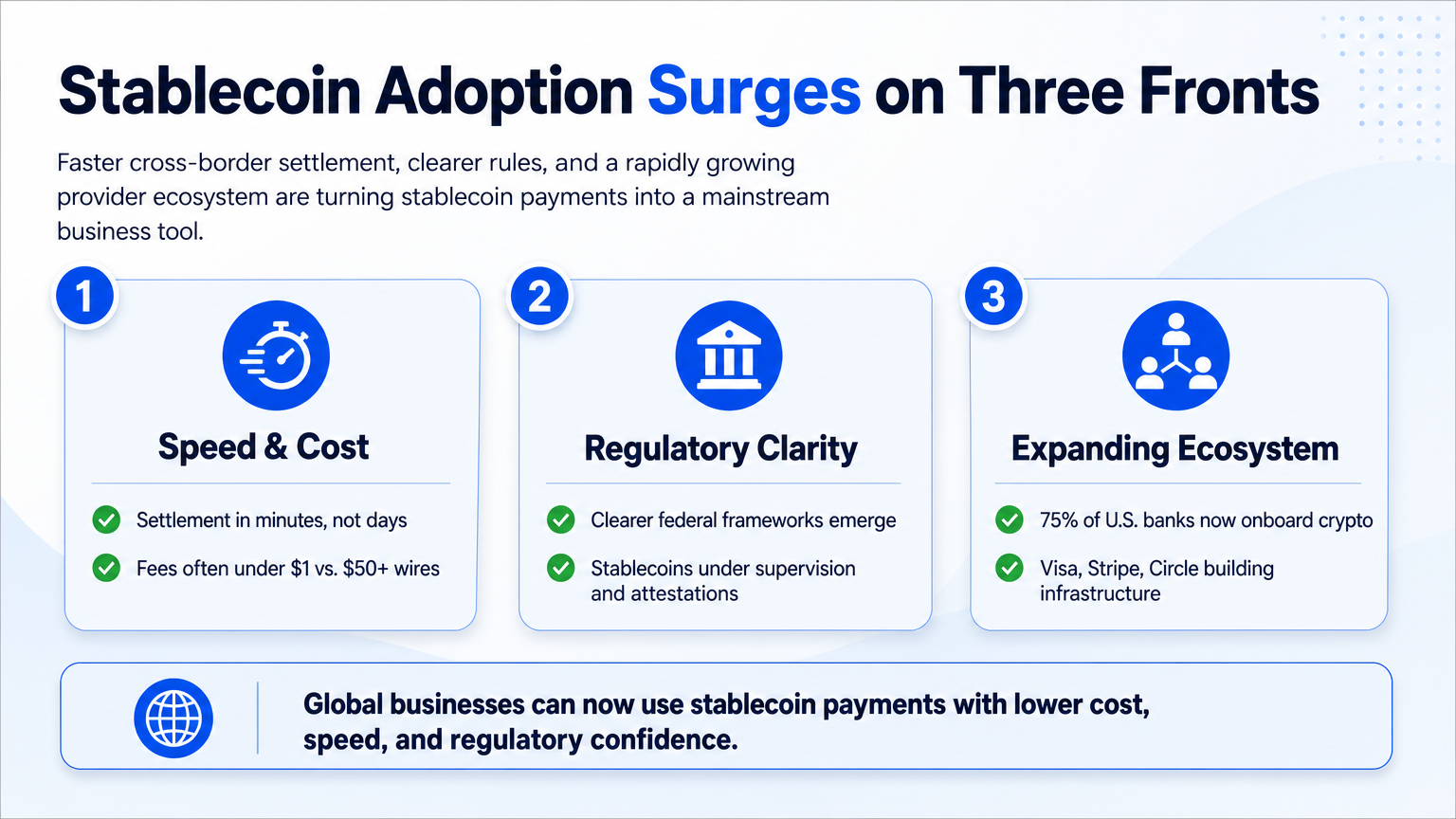
The economics of cross-border stablecoin payments are well documented: settlement in minutes instead of three to five business days, fees often below a dollar compared to wire charges that can reach $50 or more. Analysis in Stablecoin Payments Hit $220B: Why HIFI’s $37M Matters shows quarterly stablecoin transfer volumes exceeding $220 billion. For businesses paying suppliers in multiple jurisdictions or serving remote freelancers, that speed and cost advantage is no longer theoretical. The Citi-Coinbase partnership extends these benefits to the bank’s existing client base, removing the requirement to open separate accounts with crypto-native platforms.
Growing regulatory clarity
Uncertainty around stablecoins has long been a barrier. Frameworks like the GENIUS Act in the U.S. and comparable legislation elsewhere are providing issuers and users with clearer obligations around reserves, redemption, and anti-money laundering controls. US Stablecoin Regulation Push Abroad: What It Means details how regulatory momentum is giving banks the confidence to onboard stablecoin payments without running afoul of examiners. Citi’s move is possible because the 2026 regulatory environment is more defined, with USDC and similar products operating under supervision and transparent attestations.
Expanding ecosystem of providers
Stripe, Visa, and Circle have already integrated stablecoin payment processing into their networks. The Volante-Circle Deal Makes Stablecoin Payments Bank-Ready earlier in 2026 demonstrated how banks can plug into Circle’s USDC settlement infrastructure via established middleware. And with Crypto Banking Tipping Point: 75% of U.S. Banks Now Onboard, a business that isn’t preparing for stablecoin payments now risks being left behind. The Citi-Coinbase partnership is the most visible evidence yet that legacy banking is no longer waiting on the sidelines.
What This Means for Your Business
The end of crypto payments’ complexity for merchants
Accepting stablecoin payments used to mean juggling separate wallets, manual conversions, and mismatched ledgers. Citi’s offering—and similar solutions from neobanks—eliminates much of that overhead. With a single platform, a merchant can generate a stablecoin payment API endpoint, display a QR code at checkout, and have funds settled into a fiat account automatically. No separate cold storage device or exchange-rate timing is required. Fiat to stablecoin conversion happens in the background, and accounting entries reflect the final fiat amount, making it compatible with existing ERP systems.
New opportunities for global startups and DAOs
Startups that operate across borders and DAOs that manage treasuries in multiple tokens stand to benefit disproportionately. A DAO can receive USDC from contributors, pay vendors in fiat through a unified dashboard, and maintain on-chain transparency—without fragmenting funds across five banking relationships. Platforms like OneSafe, built for exactly this use case, already offer customizable roles and permissions, automated payment workflows, and Fireblocks custody, bridging the gap between on-chain governance and off-chain expenses. The Citi-Coinbase deal adds another traditional on-ramp, making the entire model more legitimate.
The fiat-to-crypto bridge becomes mainstream
When a systemically important bank offers stablecoin settlement as part of its commercial banking suite, the fiat-to-crypto bridge stops being niche infrastructure. It becomes a feature businesses expect from their primary financial provider. That shift pressures every other bank and fintech to build or buy equivalent capabilities—accelerating universal acceptance, lowering barriers for small and mid-sized enterprises, and reducing the cost of stablecoin payment processing across the board.
What are the benefits of stablecoin payments for global businesses?
- Speed: Settlement in minutes improves cash flow visibility and reduces working capital trapped in transit.
- Cost: Fees are often a fraction of traditional wire fees, especially for cross-border payments.
- Access: Reaches customers and suppliers in jurisdictions where card networks are sparse or expensive.
- Reduced fraud risk: Irreversible on-chain settlement virtually eliminates chargebacks.
- 24/7 operation: Stablecoin networks run continuously, unlike batch-processing bank rails.
How to Prepare for Stablecoin Payments Today
Assess your treasury and payment workflows
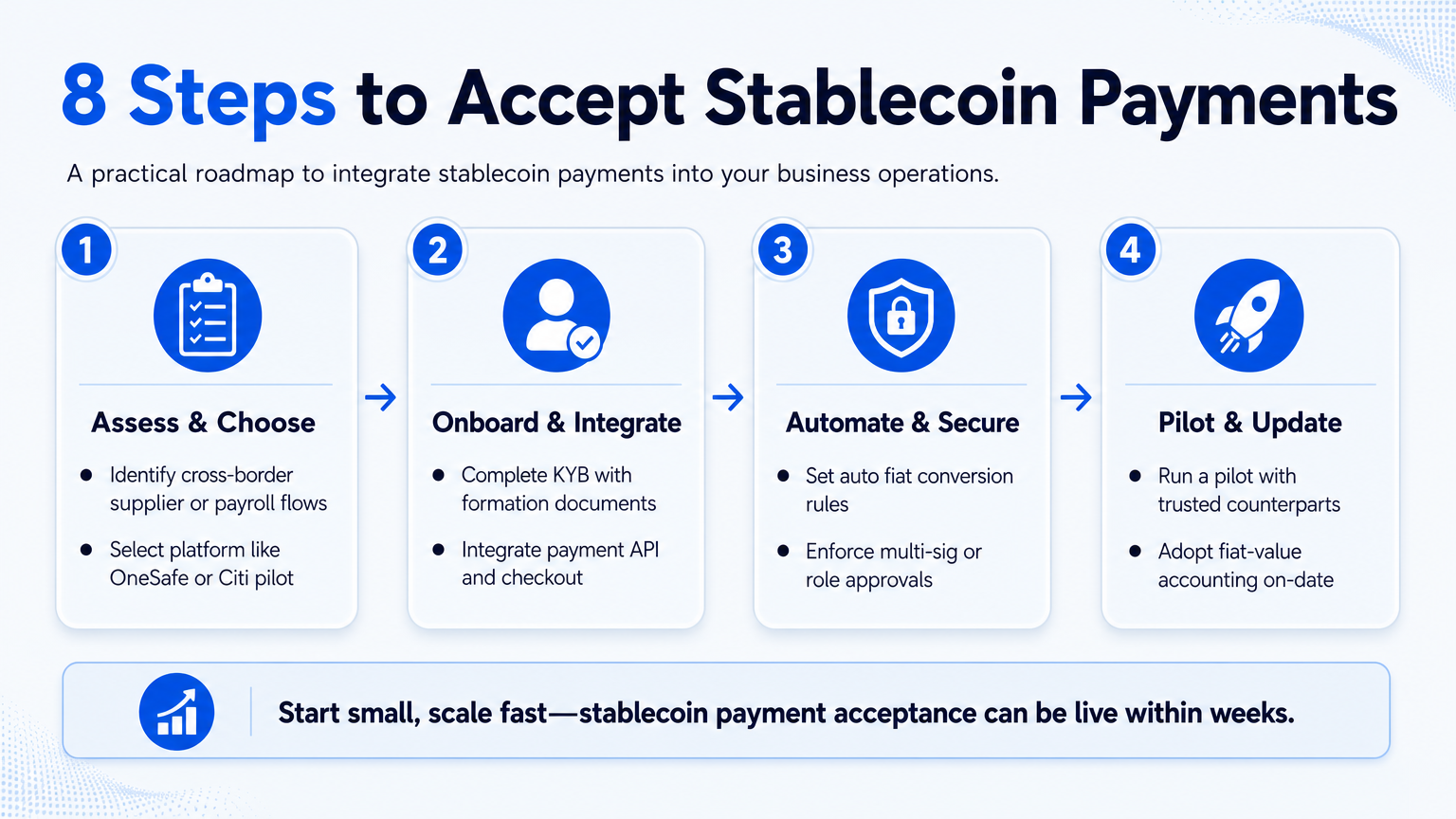
Before touching technology, map where stablecoin payments could replace or augment existing rails. Identify vendors who already accept USDC, employee payroll runs in crypto-friendly jurisdictions, or customer segments that prefer paying with digital assets. Quantify the current cost of those flows—wire fees, FX spreads, float days—to build a clear business case for integration.
Choose a platform that unifies fiat and crypto (like OneSafe)
Operating separate bank and crypto accounts creates reconciliation nightmares. A neo-banking platform that natively handles both—offering ACH, wire, bill payments, and instant crypto-to-fiat conversions in one interface—simplifies audits and month-end close. OneSafe, for example, delivers multi-currency accounts (USD, EUR, CAD), corporate cards with spend controls, free USDC deposits/withdrawals, and a fiat-to-stablecoin conversion pipeline that settles in the same account. For DAOs, secure custody via Fireblocks and customizable role-based permissions keep treasury governance intact. Treat stablecoin payments as another currency within a unified ledger, not a separate silo.
Which platforms support stablecoin payments and fiat-crypto integration?
Several options exist, but they fall into three buckets:
- Neobanks operating as technology companies with banking partners: OneSafe, which combines fiat accounts, crypto on/off-ramps, and stablecoin invoicing under one login.
- Pure crypto processors: BitPay and Coinbase Commerce—strong crypto settlement but limited fiat banking features.
- Traditional bank platforms with add-ons: Citi’s new pilot and similar integrations from J.P. Morgan’s Onyx. These may offer tight integration but often require existing banking relationships and higher minimums.
For most global startups and DAOs, a neobank that unifies fiat and crypto will provide the fastest time to value because onboarding is digital, typically completed within a week, and there is no need to manage separate custody partners.
Implement custody and compliance controls
Stablecoin payments introduce new risk vectors. Funds should be held with a qualified custodian such as Fireblocks, and every transaction must pass through AML and sanctions screening. Multi-factor authentication is mandatory, and treasury policies should mirror fiat controls—no individual signer should move large sums without internal approval. Platforms like OneSafe build these controls in: digital assets are secured on Fireblocks, MFA is required at signup, and customer funds are segregated from operating accounts.
What are the risks and compliance issues with stablecoin payments?
- Regulatory divergence: Not all jurisdictions treat stablecoins the same. Businesses must confirm the specific stablecoin accepted is permissible in both sender and receiver jurisdictions.
- Reserve transparency: Not all stablecoins guarantee 1:1 backing with liquid assets. USDC’s monthly attestations provide confidence; lesser-known tokens may not. The collapse of TerraUSD in 2022 remains a cautionary tale.
- KYC/AML on the blockchain: On-chain payments are pseudonymous. Accepting stablecoins obligates the business to know its counterparty. Tools like Chainalysis help, but the responsibility lies with the receiver.
- Operational risk: Handling private keys in-house exposes the business to theft or loss. Use a trusted custody provider with insurance and SOC 2 certification.
Streamline invoicing and reconciliation in stablecoins
One hidden friction point is getting stablecoin transactions to appear correctly in the general ledger. Generate invoices that display amounts in both fiat and stablecoin, with the stablecoin settlement value locked at the invoice date to avoid FX fluctuations. Platforms that offer invoicing in multiple fiat and stablecoins—such as OneSafe—automatically record the fiat equivalent at receipt, simplifying reconciliation.
How do stablecoin payments impact cash flow and treasury management?
When settlement times drop from days to minutes, the entire cash conversion cycle shortens. A business can collect from overseas customers on Monday and use those same funds to pay a vendor on Tuesday—without borrowing against a credit line. Multicurrency treasury reporting becomes real-time, idle correspondent balances shrink, and liquidity forecasting models must reflect near-instant inflows and outflows. Net effect: more efficient working capital and reduced reliance on short-term financing.
How can my business start accepting stablecoin payments?
| Step | Action | Key Consideration |
|---|---|---|
| 1 | Identify high-impact payment flows | Look for cross-border supplier payments, remote payroll, or customer segments already holding USDC. |
| 2 | Select a unified fiat-crypto platform | Choose a provider that combines business bank accounts with stablecoin wallets and on/off-ramp capabilities (e.g., OneSafe, or Citi’s pilot if eligible). |
| 3 | Complete onboarding and KYB | Submit formation documents, EIN, and government ID. Onboarding typically takes a few days to a week. |
| 4 | Integrate the stablecoin payment API | Use the platform’s API to generate payment requests, embed checkout buttons, or set up recurring billing. |
| 5 | Enable automatic fiat settlement | Configure rules to convert incoming stablecoins instantly or on a schedule to avoid crypto volatility. |
| 6 | Establish custody and approval policies | Enforce multi-signature or role-based approvals for large stablecoin movements, and ensure the custodian is insured. |
| 7 | Test with a small cohort | Run a pilot with one or two trusted counterparties before rolling out broadly. |
| 8 | Update accounting and tax processes | Confirm the accounting system captures stablecoin transactions at fiat value on transaction date. |
What to Watch Next
Will other major banks follow Citi’s lead?
The pressure is now on. J.P. Morgan, Bank of America, and others have been building blockchain capabilities, but none have yet offered a direct stablecoin acceptance product to their commercial clients on this scale. Expect announcements within the next 12 to 18 months as first-mover advantage becomes clear.
How will stablecoin regulation evolve in 2026-2027?
With the GENIUS Act providing a federal framework, the conversation will shift from “can banks touch stablecoins” to “how should stablecoin issuers integrate with the Fed’s master account system.” A crucial watchpoint is whether U.S. regulators allow non-bank stablecoin issuers to access central bank liquidity directly, which could accelerate adoption further.
Stablecoin volatility risks and reserve transparency
Not all stablecoins are created equal. The market is still sorting out which assets are safe for business treasury use. Expect more granular attestation standards and, potentially, mandatory insurance for custodians. Businesses should stick to the largest, most transparent stablecoins—USDC, PYUSD—and avoid holding material balances overnight unless they are in a fully reserved, regulated instrument.
Key Takeaways
- The Citi-Coinbase partnership, announced September 28, 2026, brings stablecoin payment acceptance directly into a major commercial bank’s offering, normalizing the rail.
- Stablecoin payments slash cross-border settlement times from days to minutes, reduce costs, and are now backed by clearer regulation and a rapidly expanding ecosystem.
- Global startups and DAOs can integrate stablecoin payments today by using a neo-banking platform that unifies fiat and crypto, avoiding separate banking and custody relationships.
- Practical adoption starts with auditing existing treasury workflows, selecting a compliant fiat-to-stablecoin platform, and updating reconciliation and liquidity practices.
- While risks remain—including regulatory fragmentation and reserve transparency—they are manageable with the right controls and well-regulated stablecoins.
Explore how a unified fiat-crypto platform can simplify your stablecoin payment operations by opening an account at OneSafe.