You’re a founder who needs to open a business bank account online—a real, functional account that handles fiat payroll and crypto treasury from day one. This guide explains what online business banking means in 2026, who the real players are, and how to choose an account that matches how your business actually operates. It covers DAO treasury setup, multi-currency fee structures, and cross-border operations: the gaps most ranking pages miss.
Table of Contents
- What Does “Open a Business Bank Account Online” Actually Mean?
- Why Business Bank Accounts Matter (and Why Online Wins)
- What You’ll Need to Get Started
- Fast Answers: Requirements, Timeline, and Account Fit
- Choosing an Online Business Account: The New Decision Matrix
- Step-by-Step: Opening Your Account in a Week or Less
- Can I Open an Online Business Bank Account for a DAO or Web3 Company?
- What’s the Difference Between a Bank and a Fintech Platform for Business Accounts?
- How Do Global Businesses Handle Multi-Currency and Crypto Transactions Online?
- The Hidden Pitfalls of Online Business Banking
- Is a Neo-Banking Platform Right for Your Business?
- Key Takeaways
What Does “Open a Business Bank Account Online” Actually Mean?
A provider claiming “online account opening” is making a claim about its entire onboarding workflow: identity verification, business filing validation, and approval must happen without paper or branch visits.
The shift from branch visits to digital onboarding
Just a few years ago, “online application” meant filling out a PDF you’d still mail in. As of September 28, 2026, that is no longer the norm. On September 24, Provident Bank went live with MANTL digital business and retail account opening across its 135 branches, showing that fully digital business onboarding is now standard for institutions of every size.
Still, the promise breaks for specific entity types. A US LLC with a single member and a clean EIN can often complete the process in under an hour on platforms such as Novo built for online-only business checking. A Cayman Islands foundation company, a DAO with multi-sig governance, or a startup with directors across three continents will stress-test the “online” label.
Banks vs. fintech platforms: who offers true online opening?
Traditional banks market “online account opening” but may require an in-person visit to finalize, especially for non-standard risk profiles. Major business banks such as Bank of America and PNC list online business account options, but founders can still complete a full digital application and then be asked to visit a branch with original documents. That’s online-adjacent, not fully online.
Fintech platforms operate differently. They build onboarding as a digital process from the ground up, partnering with chartered banks to hold deposits while the interface, verification, and approval stay remote. The trade-off: you’re not banking with a high-street name, and you need to research the partner institution holding your deposits.
Verification signal: if a provider’s support page lists documents you should “bring to your appointment,” it is not fully online.
Why Business Bank Accounts Matter (and Why Online Wins)
Running business transactions through a personal account is the most common early-stage mistake. It pierces the liability shield your entity structure exists to provide, creates tax preparation chaos, and gives auditors a reason to recharacterize business expenses as personal. A dedicated business account is not optional.
Online business bank accounts remove branch scheduling entirely. Distributed finance teams need 24/7 access to transaction data, wire approvals, and virtual cards. Modern platforms also bundle multi-currency sub-accounts, accounting integrations, and permissioned team roles that branch accounts treat as add-ons.
What You’ll Need to Get Started
For any provider, expect to submit: government-issued photo ID for all beneficial owners, company formation documents, and proof of tax identification. In the US, that means an EIN confirmation letter from the IRS. Many providers also want a physical business address, though fintech platforms serving remote-first companies increasingly waive this.
Special cases: A DAO doesn’t have traditional articles of incorporation. It has a governance framework, multi-sig wallet addresses, and possibly a legal wrapper like a Cayman Foundation Company or Wyoming DAO LLC. Most online banks will reject that application because their KYB systems can’t parse on-chain governance. Platforms purpose-built for DAO banking accept governance documentation and map account permissions to on-chain voting structures.
International founders face a related problem. Many US banks demand a US physical address and an in-person visit from beneficial owners. A non-resident business bank account is achievable online only through providers with remote identity verification and international document acceptance.
Fast Answers: Requirements, Timeline, and Account Fit
What do I need to open a business bank account online? At minimum: formation documents, a tax identification number, and photo ID for all beneficial owners. For US entities, that specifically means an EIN confirmation letter. Non-US businesses need their local equivalent. DAOs need governance documentation and multi-sig wallet addresses.
How long does it take? Anywhere from 10 minutes to two weeks. A straightforward US LLC with one member and a clean EIN can complete the application in under 10 minutes and gain approval within hours. DAOs, international entities, and regulated industries take longer because manual review is involved. OneSafe’s fully digital process is typically completed within a week.
Can I use a personal account for my business? Technically possible, operationally damaging. Mixing funds erodes limited liability, creates accounting burdens, and signals to investors that you don’t take your corporate structure seriously. Open a dedicated account before processing your first revenue dollar.
Is there a minimum deposit requirement? Many providers advertise $0 minimum deposit, but that’s a distraction. The real cost of operating the account comes from wire fees, FX markups, and transaction charges. A $0 opening deposit means little when a single international wire costs $50 plus a hidden 3% FX spread.
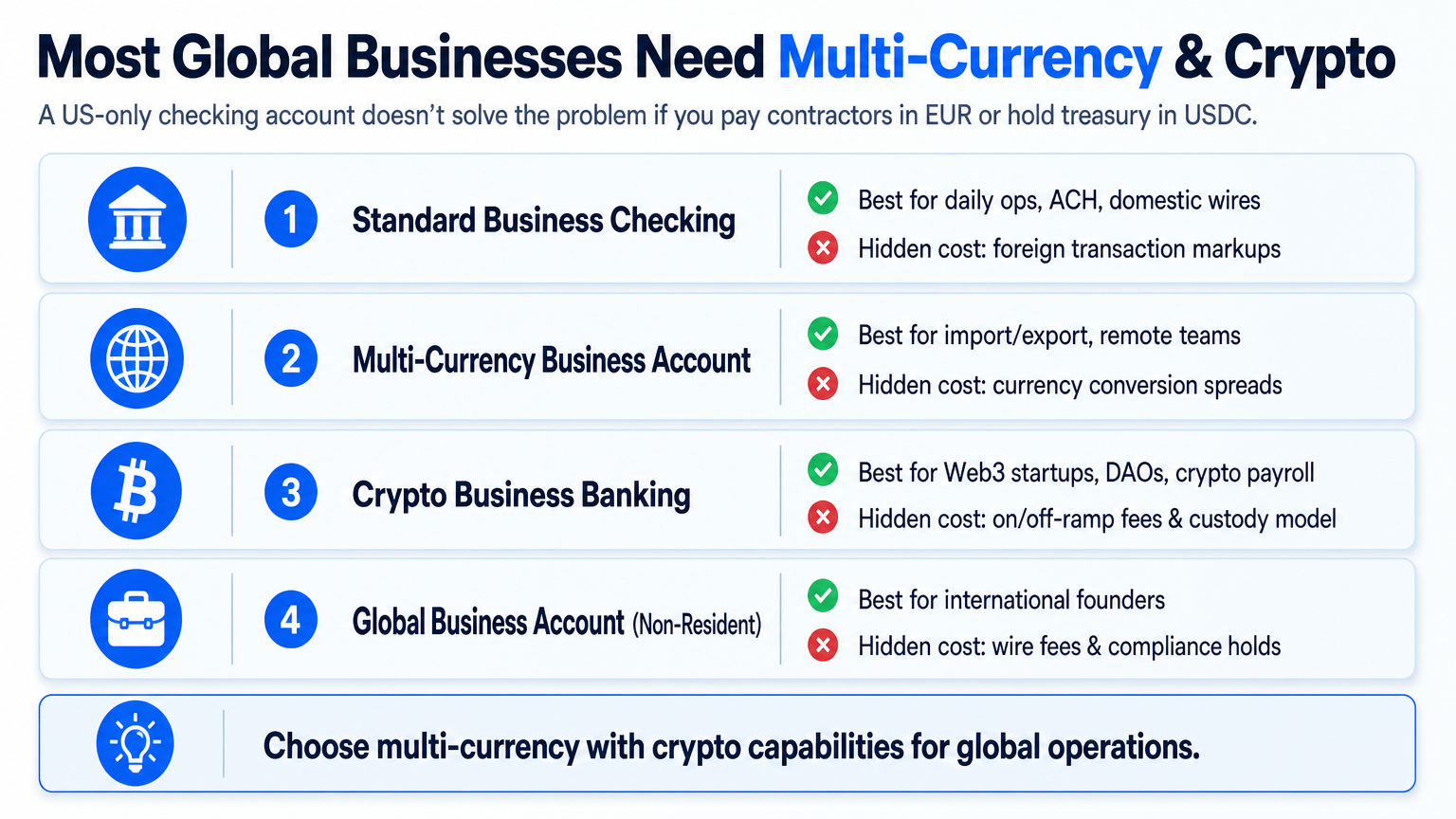
What types of business bank accounts exist?
| Account Type | Best For | Hidden Cost to Watch |
|---|---|---|
| Business checking online (standard) | Daily operations, ACH, domestic wires | Foreign transaction markups |
| Multi-currency business account | Import/export, remote teams paid in local currencies | Currency conversion spreads |
| Crypto business banking account | Web3 startups, DAOs, crypto payroll | On/off-ramp fees, custody model |
| Global business account (non-resident) | International founders, remote entities | Wire fees, compliance holds |
Most global businesses need a multi-currency account with crypto capabilities, not a basic checking account. A US-only checking account doesn’t solve the problem if you pay contractors in EUR or hold treasury in USDC.
Choosing an Online Business Account: The New Decision Matrix
The comparison pages online will tell you to compare monthly fees and ATM access. For a global business, those are the wrong variables.
Fees that actually matter: wire, FX, and crypto conversion costs
For any business operating across borders, the dominant cost is the accumulated friction on every payment. A $25 domestic wire fee and a $50 SWIFT fee plus 0.35% SWIFT fee might not sound dramatic in isolation. Run fifty cross-border payments a month and you’re looking at thousands of dollars in fees that domestic businesses never see. Even “free” accounts often bury costs in an FX rate that’s 2-3% worse than interbank.
For crypto-native businesses, the equivalent is the on/off-ramp spread. Some platforms quote 0% crypto conversion fees but take their margin on the exchange rate. Fee transparency determines whether your financial operations are predictable or bleeding money.
Multi-currency and crypto capabilities: do you need them?
If you have remote contractors paid in non-USD currencies, suppliers invoicing in EUR or GBP, international revenue, or a treasury that includes stablecoins, the answer is yes. A single-currency business checking online forces separate FX conversions for every non-USD transaction, creating a second layer of cost and reconciliation.
Security, custody, and what “insured” really means
Here’s a distinction every founder needs to internalize: FDIC insurance protects deposits held at chartered banks, not funds held on fintech platforms. Fiat deposits on a fintech account may qualify for pass-through FDIC insurance through a partner bank, but you must verify that arrangement. Crypto is not FDIC insured; it’s protected by the platform’s custody infrastructure. OneSafe secures digital assets through Fireblocks custody with mandatory multi-factor authentication (MFA). That’s institutional-grade asset protection, not deposit insurance.
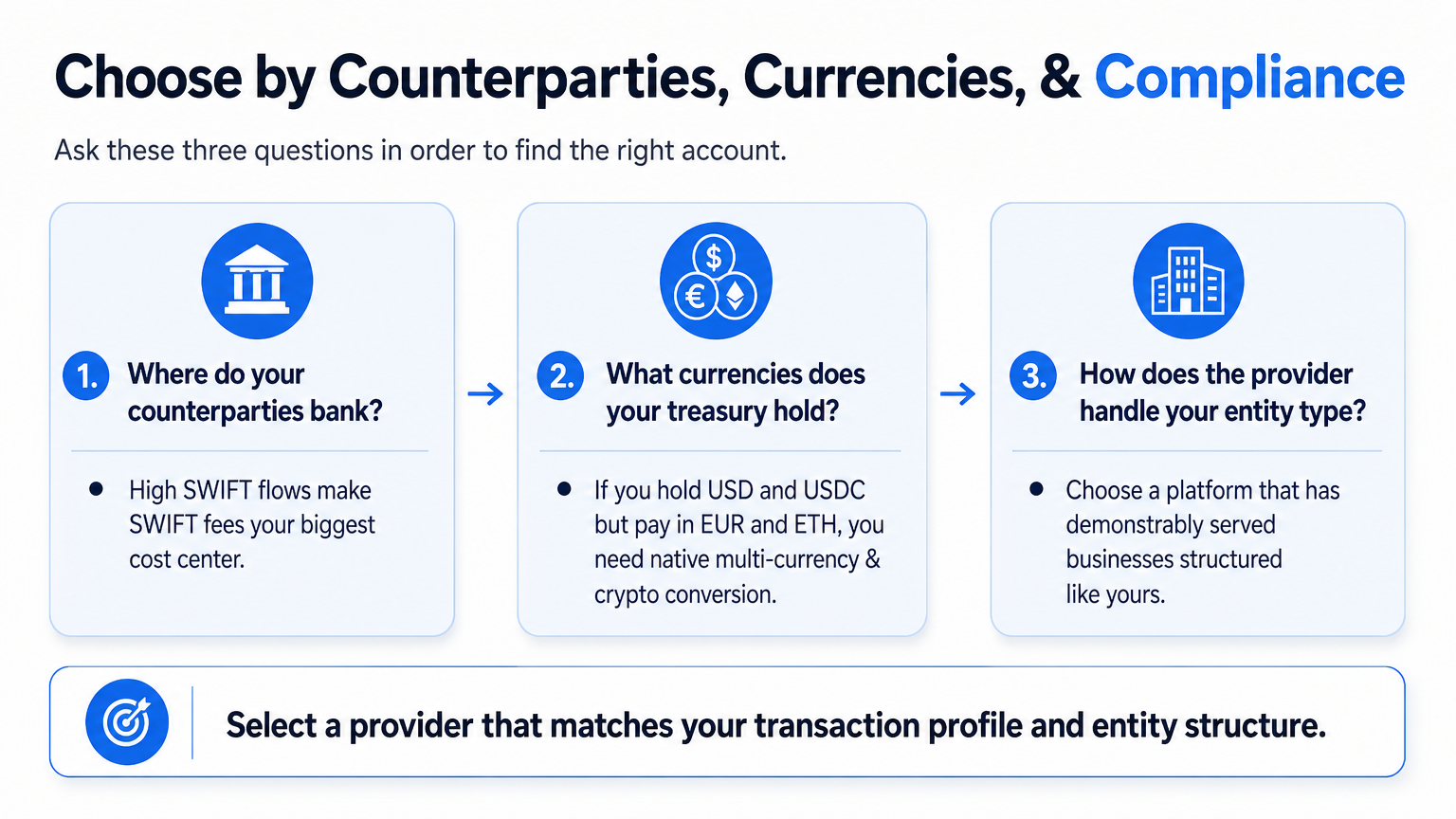
How do I choose the right online business account for a global startup?
Ask three questions in order: (1) Where do my counterparties bank? SWIFT-heavy flows make high SWIFT fees your biggest cost center. (2) What currencies does my treasury hold? If you hold USD and USDC but pay in EUR and ETH, you need native multi-currency and crypto conversion. (3) How does the provider handle compliance for my entity type? Choose a platform that has demonstrably served businesses structured like yours.
Step-by-Step: Opening Your Account in a Week or Less
- Entity preparation: Gather digital copies of formation documents, tax ID letter, and photo ID. For a DAO, document governance and multi-sig wallet addresses.
- Provider shortlisting (1-2 days): Filter by entity support, currency coverage, and transparent fees. If you need fiat and crypto, eliminate platforms that don’t natively handle both.
- Application submission (10-30 minutes): Upload documents and complete identity verification via live selfie or video check.
- Verification and approval (hours to days): Straightforward entities can be approved the same day. Complex structures take longer because human reviewers are involved.
- Funding: Transfer initial operating capital. For crypto, plan for on-ramp settlement time.
- Transaction setup: Configure team permissions, accounting integrations, and payment templates before you need them.
Worked example: A Web3 startup incorporated as a Delaware C-Corp with co-founders in Berlin and Singapore needs a global account. Co-founder A submits the EIN letter and incorporation documents; co-founder B uploads a German passport. Both verify via mobile in 30 minutes. Approval takes three days for cross-border compliance review. They fund the account with USDC, convert a portion to EUR, and pay contractors. Total time to first contractor payment: four days.
Can I Open an Online Business Bank Account for a DAO or Web3 Company?
Yes—on a platform built for it. A traditional business bank will not open a DAO account because its KYB system has no field for “multi-sig governance” or “token holder voting.” Crypto-native platforms designed for DAO banking accept governance documentation and verify signer identities against the multi-sig configuration. OneSafe provides customizable roles that map to a DAO’s governance, Fireblocks custody, and automated payment workflows for fiat and crypto. If the platform doesn’t mention DAOs by name in its documentation, expect rejection or a six-week compliance review.
What’s the Difference Between a Bank and a Fintech Platform for Business Accounts?
A chartered bank holds your deposits directly and, in the US, provides FDIC insurance up to $250,000. It operates under a federal or state charter with strict capital requirements. A fintech platform is a technology company that provides banking services through partnerships with chartered banks. The interface, support, and features come from the fintech; the underlying deposit custody and regulatory status come from the partner bank. For fiat deposits, this distinction matters for insurance. For crypto, it’s irrelevant because no deposit insurance scheme covers digital assets.
How Do Global Businesses Handle Multi-Currency and Crypto Transactions Online?
The standard 2026 pattern: hold operating capital in a stablecoin (typically USDC) to avoid bank-hour settlement delays, convert to fiat on demand, and use multi-currency sub-accounts for local payments. Stablecoin payment volumes crossed $220 billion earlier this year. Infrastructure now allows instant crypto-to-fiat conversion with the fiat leg settled via domestic rails rather than SWIFT. OneSafe charges 0.25% or the prevailing FX rate, and settlement time shrinks from days to minutes or less.
The Hidden Pitfalls of Online Business Banking
“No monthly fee” is not “free”
A provider that advertises no monthly fee can still generate significant revenue through wire charges, FX markups, and transaction fees. Evaluate total cost by modeling your expected transaction volume against the published fee schedule.
When “online” still means a branch visit
The tell: a provider’s online application ends with “visit your nearest branch to complete verification.” Before you invest time, search the support documentation for “visit a branch” or “in person.” If those phrases appear, it’s a hybrid process.
The limits of non-bank platforms for regulated industries
Certain industries—cannabis, firearms, gambling—face restrictions that make fintech banking difficult. Even platforms that support high-risk categories may require extensive compliance documentation and manual review. Verify acceptance explicitly before applying.
Is a Neo-Banking Platform Right for Your Business?
When global and crypto-native beats traditional banking
If your business operates across borders, holds crypto, or is structured as a DAO, a neo-banking platform is the only functional option. Traditional banks can’t custody crypto, can’t parse DAO governance, and treat international wires as premium services. The trade-off: you’re relying on a technology layer over partner banks. For most global startups, that’s an acceptable trade given the alternative is five separate banking relationships and a spreadsheet to track them.
The trade-offs: fewer physical services, evolving regulations
You won’t get a safety deposit box, a dedicated relationship manager, or cash-handling services. You will get 24/7 digital access, lower fees on the transactions you actually run, and an integration layer connecting accounting software, crypto wallets, and payment rails. On regulation, standards for stablecoin settlement and crypto custody are still evolving—the US stablecoin regulation push has accelerated through 2026. Platforms that stay ahead of those requirements will have an operational advantage.
Key Takeaways
- Open a business bank account online through a provider that handles your specific entity type. DAOs, international founders, and crypto-native businesses cannot rely on standard bank onboarding.
- Ignore the opening deposit and focus on total cost of operations: wire fees, FX markups, and crypto on/off-ramp spreads are where real money leaks.
- FDIC insurance covers deposits at chartered banks, not fintech platforms or crypto assets. Know where your money sits and what protects it.
- A $0 monthly fee account can cost more than a premium plan depending on cross-border and crypto volume; model expected usage before choosing.
- If your business touches both fiat and crypto, split banking relationships create drag. A unified platform reduces reconciliation, compliance complexity, and settlement delays.
For global startups, DAOs, and businesses operating across fiat and crypto, OneSafe provides a unified platform to manage multi-currency accounts, corporate cards, and on-chain transactions—open your account today and start onboarding in minutes.