
On October 11, 2026, Argentina’s central bank confirmed it will keep crypto banking out of the national payment system for the foreseeable future. The BCRA’s statement kills any near-term hope of local banks offering digital-asset accounts. For founders, DAOs, and finance leads exposed to Argentina, the signal is blunt: you cannot wait for a local licensed crypto bank. You need a working treasury setup now—one that bridges local pesos, global stablecoins, and partner-bank accounts without requiring BCRA approval.
Table of Contents
- What just happened: BCRA holds crypto banking integration back
- Why it matters for founders, DAOs, and finance leads
- Background: how the crypto banking conversation got here
- Concrete implications and recommended actions
- What to watch next
- Key Takeaways
What just happened: BCRA holds crypto banking integration back
BCRA Superintendent Juan Curutchet told an Argentine Payment Chamber event that there will be no changes regarding crypto and digital assets in banking and payment channels in the near future. “Nothing is going to happen this year. But I do see it as a possibility during a second Milei presidency,” Curutchet said, as reported by Cryptonews.net on October 11, 2026. The 2022 BCRA ban on financial institutions offering crypto services remains fully in force, officially ending speculation that a deregulatory draft was about to open the door.
Why it matters for founders, DAOs, and finance leads
Argentina crypto banking is a jurisdiction‑by‑jurisdiction puzzle, not a global toggle. The U.S. banking agencies are only now shifting toward clearer frameworks (CLS Blue Sky Blog, May 8, 2025), while the EU’s MiCA is tightening stablecoin rules (ESMA deadline). Even high‑adoption countries like Argentina can block bank‑level integration, so founders cannot assume a universal “crypto banking” standard.
Most businesses still manage a fragmented stack: a local peso account for tax, a non‑resident USD account abroad, a crypto exchange, and an OTC desk. This fragmentation adds compliance risk and delays. With the BCRA holding the line, companies that want a single interface for fiat and crypto must turn to non‑bank platforms offering crypto‑friendly business accounts through partner banks. In other words, crypto banking for businesses in Argentina must happen outside the licensed banking system.
Curutchet tied any change to a second Milei presidency. The earliest a shift could materialise is late 2027—far too long for a treasury roadmap. Actionable steps must work now, under the 2022 ban.
Background: how the crypto banking conversation got here
The 2022 BCRA ban and the distinction that matters
In 2022 the BCRA prohibited all crypto‑related services inside financial institutions. Throughout 2025‑2026, bank‑source drafts hinted at relaxation, but Curutchet’s October 11 statement shut that door. The 2022 ban is the operative rule.
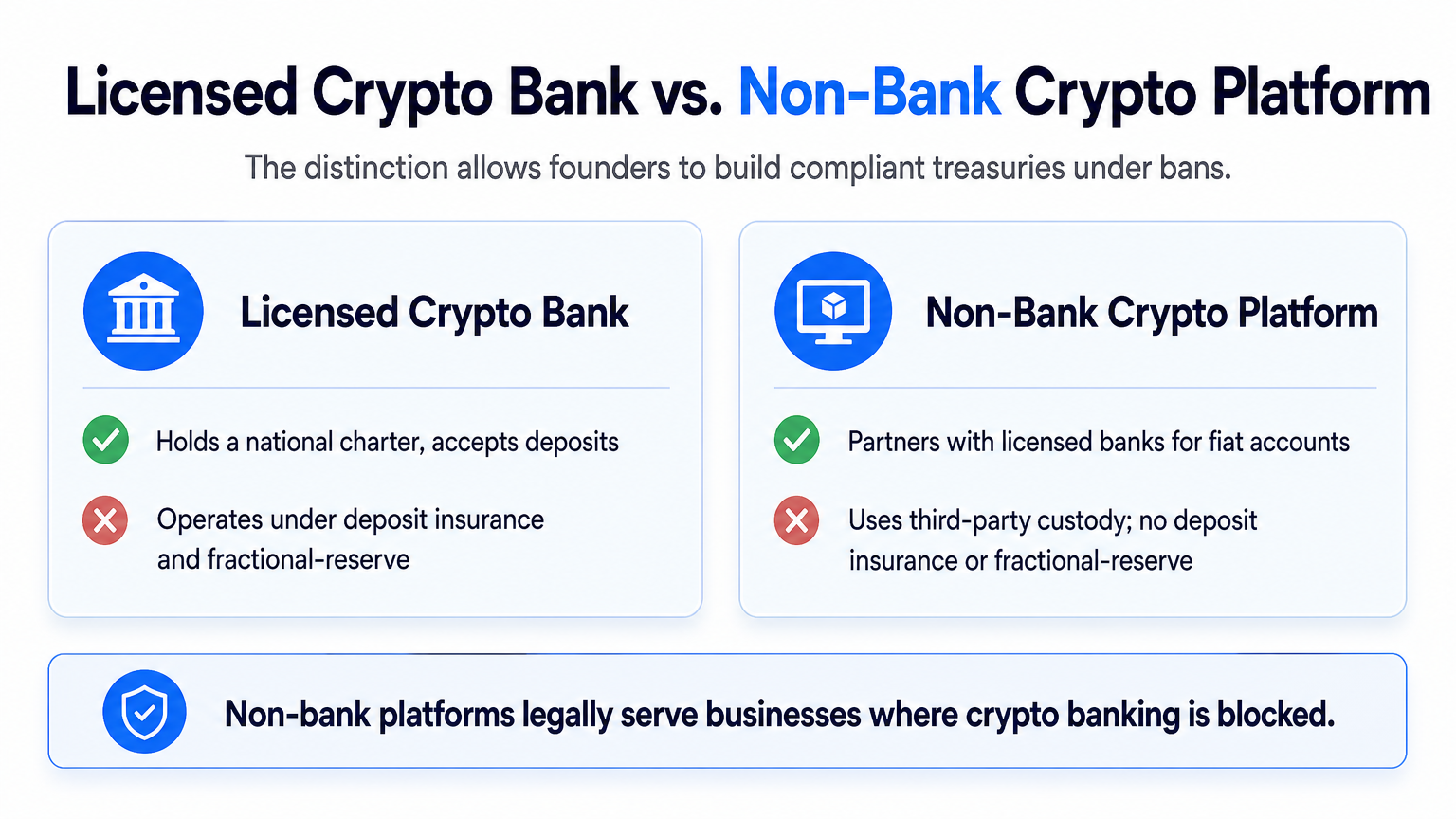
Most ranking pages treat any product that handles fiat and crypto as “crypto banking.” In fact, a licensed crypto bank holds a national charter, can accept deposits, and operates under deposit insurance. A non‑bank crypto platform is a technology company that partners with licensed banks for fiat accounts and uses third‑party custody for digital assets. It cannot engage in fractional‑reserve banking, and fiat holdings are not insured. This gap is what lets founders build compliant, resilient treasuries when a jurisdiction blocks banking integration.
If the BCRA had permitted integration, Argentine banks could have offered multi‑currency accounts holding pesos and USDC, direct crypto‑to‑fiat conversion, and stablecoin payrolls via the local payment system. Instead, all crypto activity must stay outside the local banking perimeter.
Concrete implications and recommended actions
Split local fiat banking from crypto operations
Keep a peso account for tax and local expenses, but place USDC and other crypto in a separate, non‑bank account structure. This ensures you are never relying on a single institution that cannot legally touch digital assets under BCRA rules.
Use a crypto‑friendly business account with partner banks and stablecoin rails
A non‑bank fiat and crypto platform issues segregated global accounts (USD, EUR, CAD) alongside native USDC wallets. Convert between fiat and crypto inside the same interface, and pay suppliers via wire, ACH, or on‑chain. The conversion—a crypto to fiat conversion at the platform level—happens outside the BCRA’s reach. For Web3 startups and DAOs, such setups become the operational backbone for DAO banking without a local cryptocurrency charter.
Re‑check onboarding, jurisdiction coverage, and USDC on/off‑ramp costs
Not all platforms serve Argentinian entities, and stablecoin on/off ramp fees vary widely. Benchmark three items:
- USDC deposit/withdrawal fees (some charge nothing)
- Fiat wire costs (domestic vs. SWIFT)
- Exchange spreads on crypto‑to‑fiat swaps
As a comparison baseline, OneSafe offers free USDC deposits and withdrawals, 0.15% on fiat deposits/withdrawals, and $25 domestic or 0.35% + $50 for SWIFT. Using transparent pricing like this prevents hidden spread erosion.
What a non‑bank platform can and cannot replace
A non‑bank platform can provide multi‑currency fiat accounts, instant crypto‑fiat conversion, corporate cards, and automated payment workflows—including granular roles and Fireblocks custody for DAOs. It cannot replace:
- A locally licensed Argentine bank for peso‑denominated tax payments
- Deposit insurance on fiat balances
- Credit services that require a banking charter
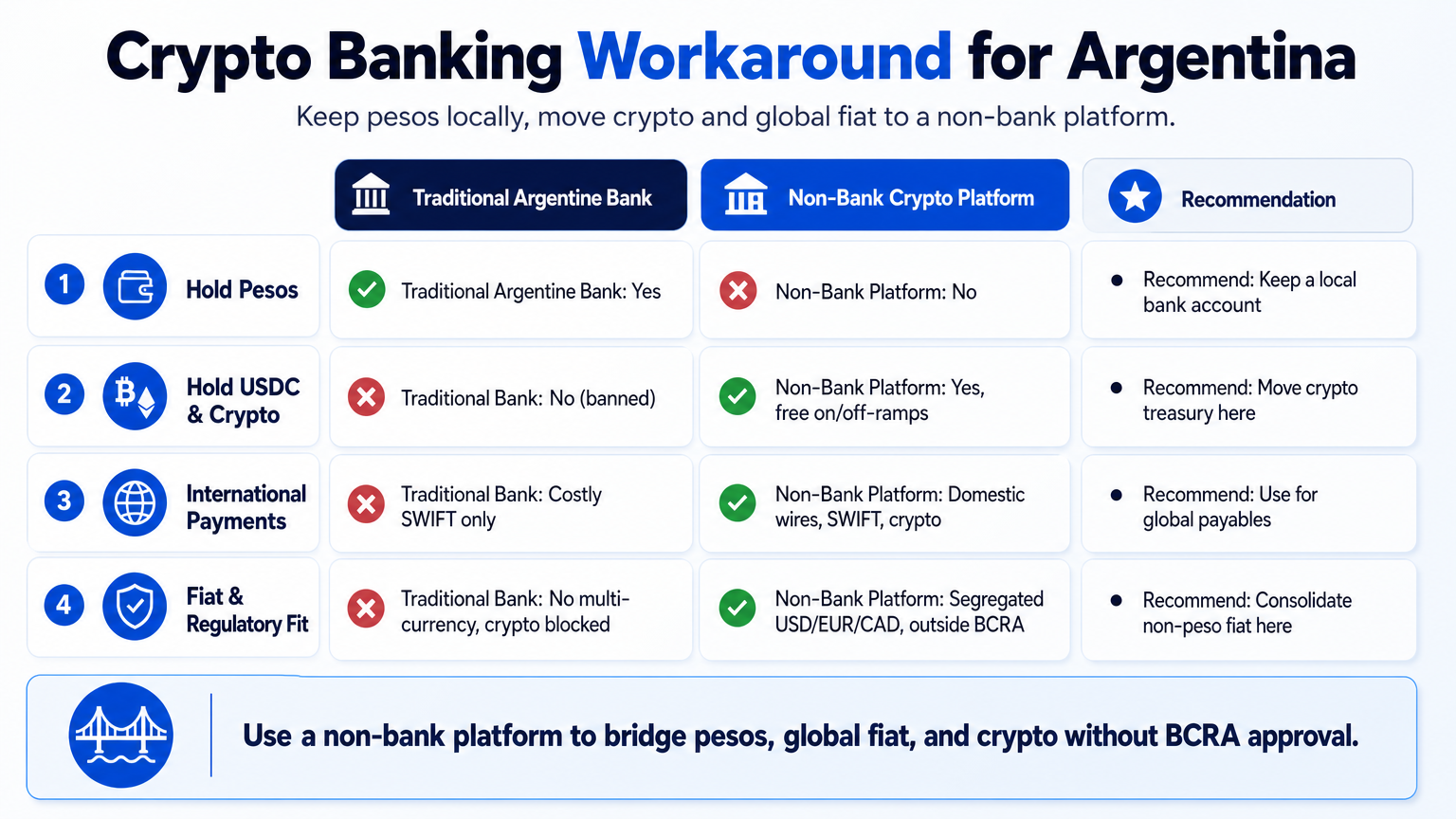
| Requirement | Traditional Argentine Bank | Non-Bank Crypto Platform | Recommendation |
|---|---|---|---|
| Hold Argentine pesos | Yes | No | Keep a local bank account |
| Hold USDC & crypto | No (banned) | Yes, free on/off‑ramps | Move crypto treasury here |
| Pay international invoices | Limited, costly SWIFT | Domestic wires, SWIFT, crypto | Use platform for global payables |
| Partner‑bank fiat accounts | No multi‑currency | Segregated USD/EUR/CAD accounts | Consolidate non‑peso fiat here |
| Regulatory coverage in Argentina | Under BCRA (crypto blocked) | Not a bank; crypto transactions outside BCRA scope | Verify platform serves your entity type |
What to watch next
- BCRA communications: Only formal notices mentioning “activos digitales” will shift the landscape. The October 11 statement is the sole official guide.
- Election timeline: A second Milei administration could move quickly on deregulation—monitor polling, not anonymous draft leaks.
- Cross‑border scrutiny: Regulators elsewhere, such as France (stablecoin swap tax from 2027), are tightening oversight, and the BCRA will watch these trends. Ensure any non‑bank platform maintains robust compliance and partner-bank asset segregation.
Key Takeaways
- The BCRA’s October 11, 2026 statement confirms no near‑term crypto banking integration; the 2022 ban stands.
- Founders must split local peso banking from global crypto operations and use a fiat and crypto platform that delivers partner‑bank accounts and stablecoin rails.
- A licensed crypto bank and a non‑bank crypto platform are fundamentally different—the latter legally serves businesses in blocked jurisdictions by keeping crypto to fiat conversion outside the local banking system.
- USDC acts as the treasury anchor, providing liquid, free on/off‑ramps without touching restricted banks.
- Act on formal BCRA rules only; drafts are not operational signals.
Open an account with OneSafe to manage fiat and crypto in one global platform, with free USDC rails and partner‑bank accounts, at onesafe.io.