Meta description: ESMA’s October 8, 2026 opinion gives MiCA‑authorised crypto firms three months to halt services for non‑compliant stablecoins. Deadline: January 8, 2027.
Stablecoin Regulation: ESMA’s New Compliance Deadline
European stablecoin regulation just acquired a harder edge. ESMA’s October 8 opinion directs MiCA‑authorised crypto firms to halt services for non‑compliant stablecoins for EU clients. That makes compliance a dated operational problem: January 8, 2027.
Table of Contents
- What Just Happened: ESMA Expands Stablecoin Regulation
- Why This Matters Now for Global Businesses
- Stablecoin Regulation 101: A Quick Primer
- Concrete Implications and What You Should Do
- What to Watch Next and Open Questions
- Key Takeaways
What Just Happened: ESMA Expands Stablecoin Regulation
The October 8 Opinion and Three‑Month Deadline
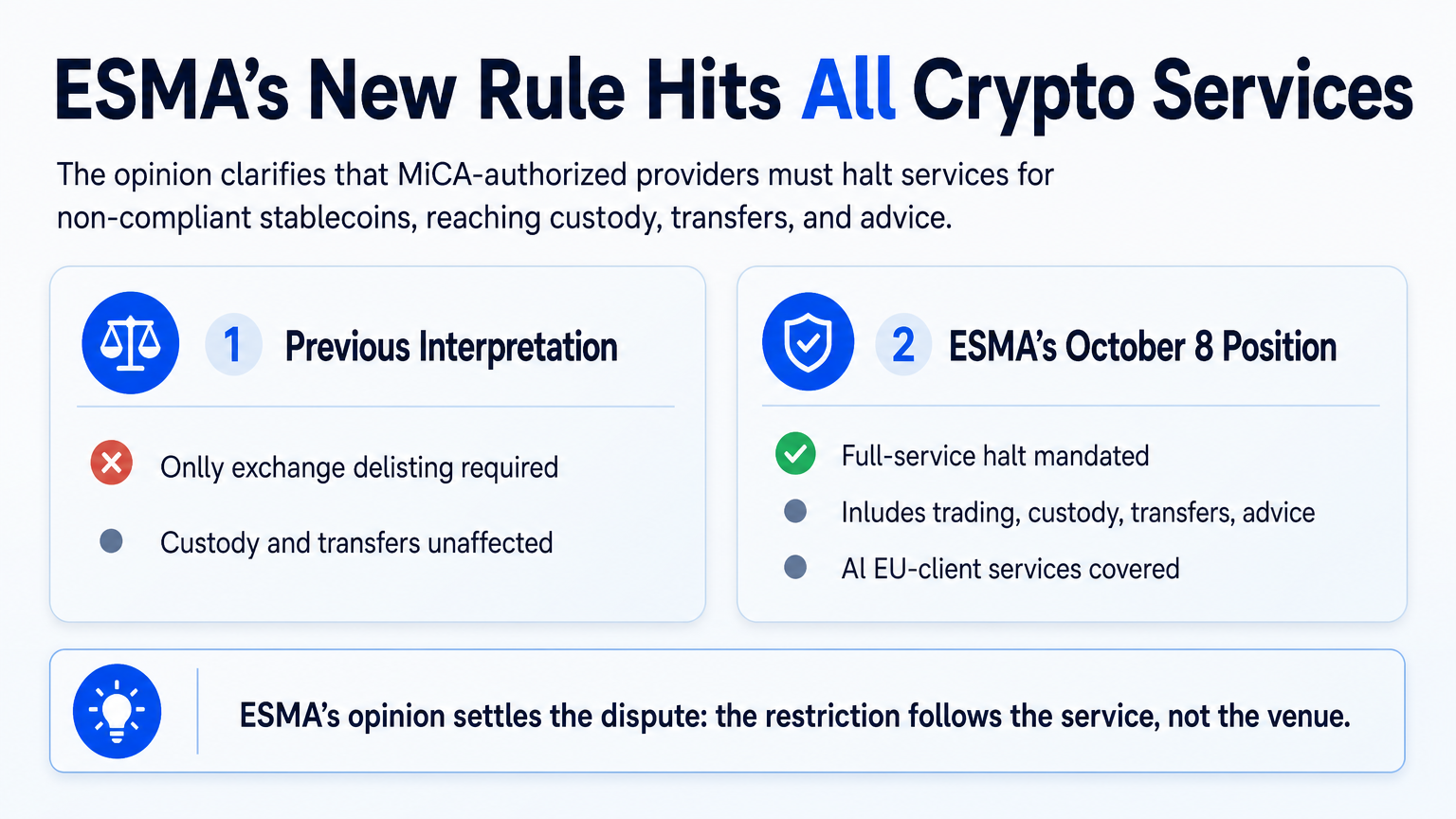
ESMA’s October 8, 2026 opinion clarifies expectations for asset‑referenced tokens (ARTs) and e‑money tokens (EMTs). According to The Cryptonomist’s October 11 report, MiCA‑authorised crypto‑asset service providers should cease services involving non‑compliant stablecoins for EU clients. Existing exposure must be resolved “as soon as possible,” with an outer limit of three months—January 8, 2027. For a fuller timeline, see the EU Stablecoin Regulation 2027 compliance deadline breakdown.
What just changed with stablecoin regulation in the EU?
Previously many operators treated MiCA compliance as an exchange-level delisting issue. ESMA’s opinion now makes clear the restriction follows the service, not the venue. It reaches custody, transfers, exchange, order execution, investment advice, and portfolio management. A MiCA‑authorised provider can no longer custody or transfer a non‑compliant token and claim compliance simply because it no longer lists it.
Beyond Trading: Custody, Transfers, and Full Service Halt
The scope settles a live dispute: some firms had read MiCA as requiring only exchange delisting; ESMA now says that interpretation is indefensible. Custody and transfer services that keep moving non‑compliant stablecoins for EU clients are carrying exactly the exposure ESMA wants terminated—even if the token never touches an order book. The Ccoinbase EU stablecoin ban survival notes outline the same pressure across the service stack.
Why This Matters Now for Global Businesses
The End of Grandfathering for Non‑Compliant Stablecoins
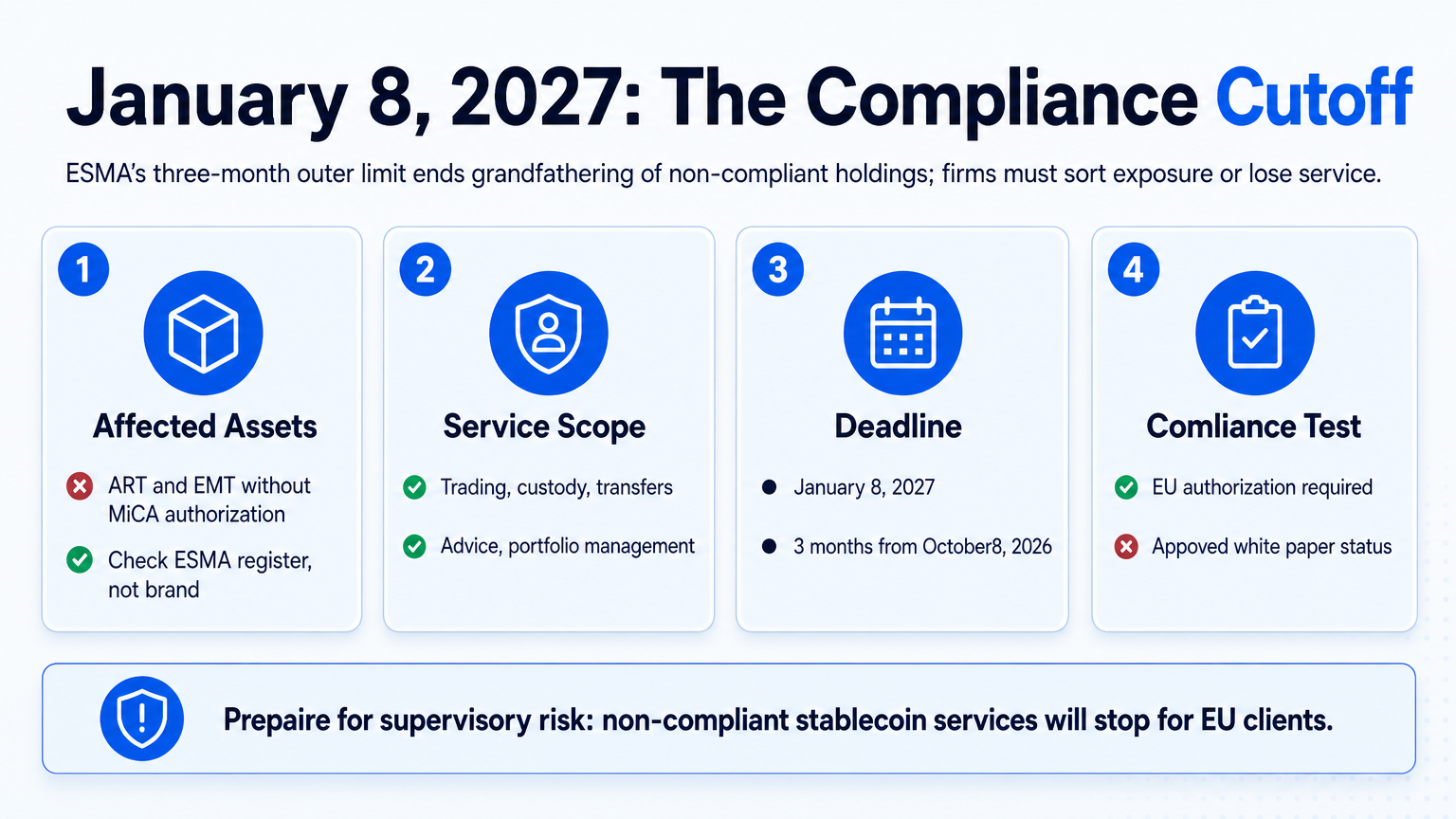
ESMA’s three‑month outer limit ends any de facto grandfathering of non‑compliant holdings. Providers will likely pass the constraint to customers through conversion windows, freezes, and forced exits. EU treasury teams are no longer deciding whether to migrate—only how quickly., as detailed in USDT 90‑day EU countdown coverage.
Do I need to stop using all stablecoins?
No. The opinion targets non‑compliant ART and EMT stablecoins,, not the entire asset class. MiCA‑compliant stablecoins remain usable for payments, custody, and treasury. The operational task is to verify each token’s status against the ESMA register., not brand reputation.
Impact on Web3 Startups and DAOs
DAOs stablecoin treasuries are disproportionately exposed because they rarely hold stablecoins as speculative positions but as working capital—payroll, vendor payments. The opinion’s reach into transfers and custody means DAOs stablecoin holdings at MiCA‑authorised custodians can lose serviceability. The immediate step: identify who custodies the assets, which regulated services those parties provide, and whether those services appear on ESMA’s list. For a broader view, the Web3 crypto business guide to finance is useful orientation.
How does this affect my business’s crypto payments and treasury?
A business holding non‑compliant stablecoins with an EU‑facing provider could see payments paused, transfers blocked, and forced conversions on the provider’s schedule. The key points:
| Key point | ESMA’s October 8, 2026 position | Business action |
|---|---|---|
| Affected assets | ART and EMT that are not MiCA‑compliant | Inventorry every holding,, not just exchange balances |
| Service scope | Trading, exchange, order execution, transfers, custody, advice, portfolio management | Review every provider relationship |
| Deadline | January 8, 2027 — three months from October 8 | Convert or exit non‑compliant positions before this date |
| Compliance test | EU authorisation status, not brand | Check the ESMA MiCA register |
| Penalties | Varies; opinion does not set a penalty schedule | Prepaire for supervisory risk |
Stablecoin Regulation 101: A Quick Primer
What Are Stablecoins and How Are They Used?
Stablecoins are pegged to fiat currencies, used for payments, trading collateral, remittances, and DeFi. MiCA splits them into ART (referencing other assets or a basket) and EMT (referencing a single fiat currency). The policy concern is the risk of runs and systemic spillovers, hence increasingly banking‑style supervision, as Elliptic’s guidance explains.
The Patchwork of U.S. Regulation
The US position remains fragmented—state trust charters and federal proposals like the GENIUS Act have not yet produced a deadline‑driven regime like Europe’s. Circle’s GENIUS Act compliance page tracks the status for USD.C. The NCUA’s digital‑assets compliance resources show regulators still defining lanes.
How MiCA Sets the Global Standard
MiCA regulation, applied since mid‑2024, requires ART and EMT issuers to be EU‑authorised and have an approved white paper, and service providers must be MiCA‑authorised. ESMA’s October 8 opinion is a direct exercise of that framework: it tells MiCA‑authorised providers that continuing to touch non‑compliant stablecoins is outside the rules. ESMA’s MiCA activity page is the reference point.
What are stablecoins and how are they regulated elsewhere?
The EU has chosen comprehensive, deadline‑driven stablecoin regulation; the US has a patchwork of state charters and pending federal legislation; other jurisdictions are watching. For operators with EU clients, only the EU model matters today. The practical filter: client location, token, and regulated service provided. Operational teams can implement that through KYC, Travel Rule, and transaction‑monitoring controls Fireblocks outlines.
Concrete Implications and What You Should Do
Audit Your Stablecoin Holdings Immediately
Run a same‑week inventory across every account, wallet, and payment rail. Rule: if a token lacks EU authorisation and is held for an EU client, treat it as non‑compliant until the register says otherwise. Map each holding to a service category—all are covered.
A same‑week self‑check:
- List every stablecoin across custodians, wallets, payment rails, and exchange accounts.
- Record the client or entity jurisdiction for each position.
- Check each token’s EU authorisation in the ESMA MiCA register—do not rely on brand names.
- Flag any ART or EMT held for an EU client without authorisation.
- Freeze new inflows of flagged tokens into EU‑facing accounts.
Transition to MiCA‑Compliant Tokens
Once flagged positions are clear, execute the transition: convert legacy balances to MiCA‑compliant stablecoins or fiat, document the conversion path, and re‑point recurring payment rails before January 8, 2027. The ESMA opinion allows tightly supervised activity to clear existing holdings—but it is an exit ramp, not a parking space.
Which stablecoins are MiCA‑compliant?
Compliance is authorisation‑based, not brand‑based. A stablecoin is MiCA‑compliant if its issuer holds EU authorisation for the relevant ART or EMT class and has an approved white paper. Check the ESMA register; do not infer status from market cap, exchange listings, or brand recognition.
Leverage Crypto‑Native Banking Partners Like OneSafe
OneSafe is a financial technology company (banking services through partners). It provides multi‑currency accounts (USD, Euro, CAD), instant crypto‑to‑fiat conversion, free USDC deposits and withdrawals, and on/off‑ramp infrastructure. For a forced conversion window, an integrated platform can shorten the path from non‑compliant treasury to compliant stablecoin or fiat without multiple intermediaries. OneSafe’s stablecoin on/off‑ramps remove a conversion step; digital asset custody sits on Fireblocks—matters that reduce execution friction when reconciling a payment stack on short notice.
Can a neobank like OneSafe help with compliance and migration?
Within limits, yes. It supports stablecoin‑to‑fiat shifts, hosts compliant stablecoin rails, and keeps payroll and vendor payments running while you unwind legacy positions. Onboarding typically completes within a week. The compliance classification decision remains yours; the execution friction can be reduced.
What to Watch Next and Open Questions
Other Jurisdictions Following Suit?
ESMA’s move makes the EU the most concrete test of full‑service stablecoin enforcement. The US GENIUS Act process is still ongoing; if it settles on narrower, exchange‑focused obligations, asymmetric compliance duties will arise for businesses serving both markets.
Enforcement and Penalties
The October 8 opinion is supervisory guidance, not a penalty schedule. National competent authorities will calibrate enforcement, so penalty exposure varies by member state. The binding constraint is the January 8, 2027 service cutoff, not a specific fine.
The Future for Decentralized Stablecoins
MiCA’s ART and EMT categories assume an issuer that can be authorised. Purely decentralized or algorithmic stablecoins without a clear issuer may not fit cleanly. Service providers touching such tokens for EU clients may still be told to stop if the tokens are presented as stable. Expect further ESMA guidance to clarify whether the full‑service halt reaches these instruments.
Key Takeaways
- The October 8, 2026 ESMA opinion turns exchange‑level delisting into a full‑service stablecoin compliance obligation covering custody, transfers, advice, and execution for EU clients.
- Businesses have a practical January 8, 2027 deadline—three months from the opinion—to resolve existing EU‑held non‑compliant stablecoin exposure.
- MiCA compliance is authorisation‑based: check the ESMA register for each token rather than relying on brand recognition or exchange listings.
- DAOs and Web3 startuops should audit stablecoin treasuries now, freeze non‑compliant inflows, and re‑point payroll and vendor rails to compliant tokens or fiat before the cutoff.
- Crypto‑native banking platforms can speed migration execution, but the compliance classification decision remains with the operator.
If your team needs faster fiat‑crypto migration through this EU compliance window, open an account built for dual fiat and stablecoin operations.