Table of Contents
- Executive Summary: Why Web3 Crypto Matters for Your Business
- The Fundamentals: Blockchain, Tokens, and Ownership
- How Web3 Crypto Reconfigures Financial Operations
- The Financial Infrastructure Landscape in 2026
- A Practical Framework for Your Web3 Financial Stack
- Regulatory Shifts: SEC Custody Rules and Tokenized Trading
- Pitfalls, Myths, and What Comes Next
- Key Takeaways
Executive Summary: Why Web3 Crypto Matters for Your Business
Web3 crypto is now operational infrastructure. By October 2026, companies hold treasury in stablecoins, pay contractors across borders on-chain, and answer to token-holding communities. The question has shifted from "should we touch this?" to "how do we run it without a mess?"
Two developments this month make that shift concrete. On October 8, 2026, The Paypers reported that the SEC proposed a tailored custody framework for registered investment advisers and regulated funds. On October 5, 2026, Reuters reported that OKXICE — a joint venture between OKX and Intercontinental Exchange — filed with the SEC to launch a tokenized trading platform. Both moves pull Web3 crypto into regulated, institutional-grade financial rails.
This guide covers treasury, payments, and compliance across fiat and crypto in 2026, with a framework you can execute this quarter.
The Fundamentals: Blockchain, Tokens, and Ownership
What is Web3?
Web3 is a version of the internet built on blockchains, where users control assets and data through wallets rather than accounts held by intermediaries. Wikipedia describes it as a decentralized web with token-based economics, distinct from Web 2.0's platform-dominated model. For business, the practical meaning is narrower: assets move peer-to-peer, settlement is verifiable on a public ledger, and software — not a bank — enforces the rules.
Why is Web3 important?
PwC's analysis frames Web3 as a way to "revolutionize your business model" by giving companies direct access to programmable money and trusted, auditable transactions. For finance leads, importance comes down to three things: near-instant cross-border settlement, reduced counterparty risk on payments, and the ability to automate financial logic through smart contracts. It matters less as ideology and more as a faster, cheaper rail for specific jobs.
Web1 to Web3: What Changed?
Web1 was read-only. Web2 added user-generated content — and centralized platforms that monetized the data. Web3 changes the ownership layer: assets like money, identity, and credentials are stored in wallets controlled by private keys, not in a platform's database. For a business, a payment or a contract can execute without a bank in the middle.
What are the core ideas of Web 3.0?
Decentralization, user ownership, and native value transfer. A network of validators operates the ledger, users hold private keys to their assets, and value — stablecoins or network tokens — moves with the same settlement certainty as the data itself. You don't need to operate a node; you can use these rails through third-party services.
What are the main technologies in Web 3.0?
Three layers matter for business operations:
- Blockchains — distributed ledgers like Ethereum and Solana that record transactions permanently and publicly.
- Smart contracts — self-executing code that moves funds or data when conditions are met, replacing manual approvals.
- Tokens — programmable assets: stablecoins (pegged to fiat), utility tokens, governance tokens, NFTs, and security tokens. Track the top Web3 tokens by market capitalization on CoinMarketCap for a current snapshot of liquidity.
Most finance work involves stablecoins, because they remove volatility while keeping on-chain speed.
Core Tech: Blockchains, Smart Contracts, and Tokens
The operational fact: every on-chain asset can be programmed. A treasury can enforce spending rules in code; an invoice can settle automatically; a payment can split across wallets without an intermediary. That programmability separates Web3 crypto from a database of debits and credits.
How Web3 Crypto Reconfigures Financial Operations
How can businesses use Web3 crypto for financial operations?
Three practical areas: treasury, payments, and invoicing. Hold working capital in stablecoins, pay a contractor in Manila with USDC settled in minutes, and issue an invoice that auto-settles on payment. The key enabler is crypto fiat integration — a financial stack that treats both assets as first-class and lets you convert at the edges.
Treasury Management: From Bank Accounts to Multi-Sig Wallets
A Web3 treasury typically lives in a multi-signature wallet — a smart-contract account requiring multiple signers to approve any movement of funds. This replaces single-authority bank accounts with governance: a DAO can require 3 of 5 signers for large withdrawals, enforced by code, not a bank's risk committee.
The trade-off: multi-sig wallets handle crypto natively but don't connect to ACH, wires, or vendor card rails. Most businesses run a hybrid: a fiat account for payroll and tax, plus a multi-sig for on-chain operations. That's DAO financial management in 2026 — segmented permissions, automated approvals, and an audit trail. Regulations now shape this too; the U.S. Bitcoin reserve treasury debate shows how quickly treasury policy becomes a compliance matter.
Payments: Stablecoins, Cross-Border, and On-Chain Invoicing
Cross-border payments are where Web3 crypto shows measurable advantage. A wire can take days and cost 3–5% on worst corridors. A USDC transfer settles in under a minute for a fraction of a percent. Companies are treating this as default: Samsung's push to put USDC on 82 million phones, covered in OneSafe's analysis, signals stablecoin acceptance becoming consumer infrastructure. CFOs running stablecoin payments through enterprise systems should treat on-chain invoicing as part of the same automation wave.
The Financial Infrastructure Landscape in 2026
Traditional Banks vs. Crypto Exchanges vs. Neo-Banks
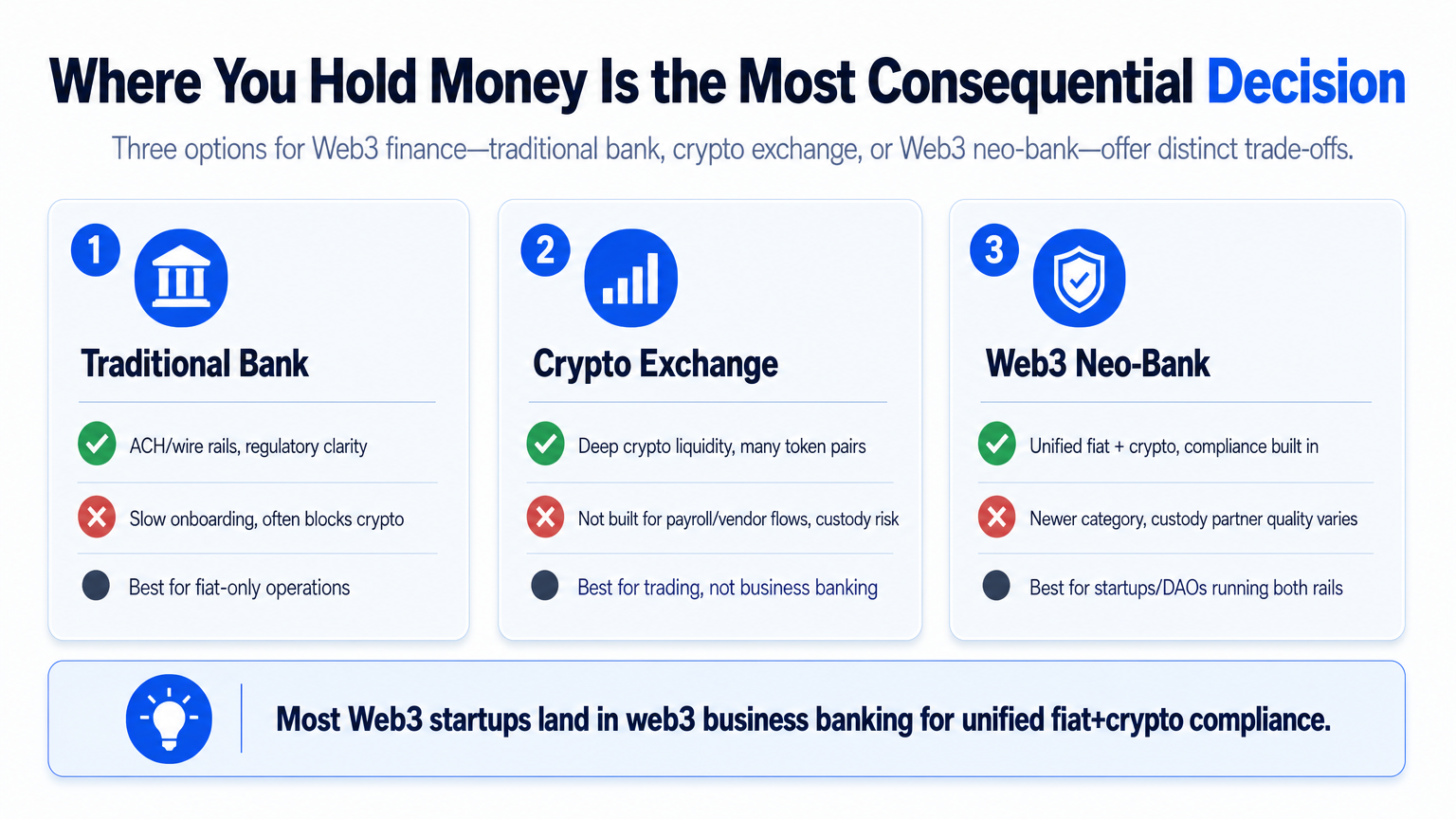
Where you hold money is the most consequential Web3 finance decision. Three options exist:
| Option | Strengths | Weaknesses | Best for |
|---|---|---|---|
| Traditional bank | ACH/wire rails, regulatory clarity | Slow onboarding, often blocks or freezes crypto activity | Fiat-only operations |
| Crypto exchange | Deep crypto liquidity, many token pairs | Not built for payroll/vendor flows, custody risk | Trading, not business banking |
| Web3 business banking / crypto neo-banking | Unified fiat + crypto, compliance built in, fast onboarding | Newer category, custody partner quality varies | Startups and DAOs running both rails |
The third category — what Mercury frames as business banking for crypto companies — is where most Web3 startups land. A crypto neo-banking platform acts as a financial operating system: segregated fiat accounts, on-chain custody, and payment rails in one interface.
Custody: Self-Custody vs. Third-Party Solutions
Web3 custody solutions split into two philosophies. Self-custody means you hold private keys; nobody can freeze funds, but a lost key or phishing attack destroys them. Third-party custody — like OneSafe's use of Fireblocks for DAO assets — transfers key management to an institutional-grade system with compliance protocols and MFA. The trade-off is control versus safety. A common midpoint: self-custody for low-value experiment funds, third-party custody for anything operationally critical.
A Practical Framework for Your Web3 Financial Stack
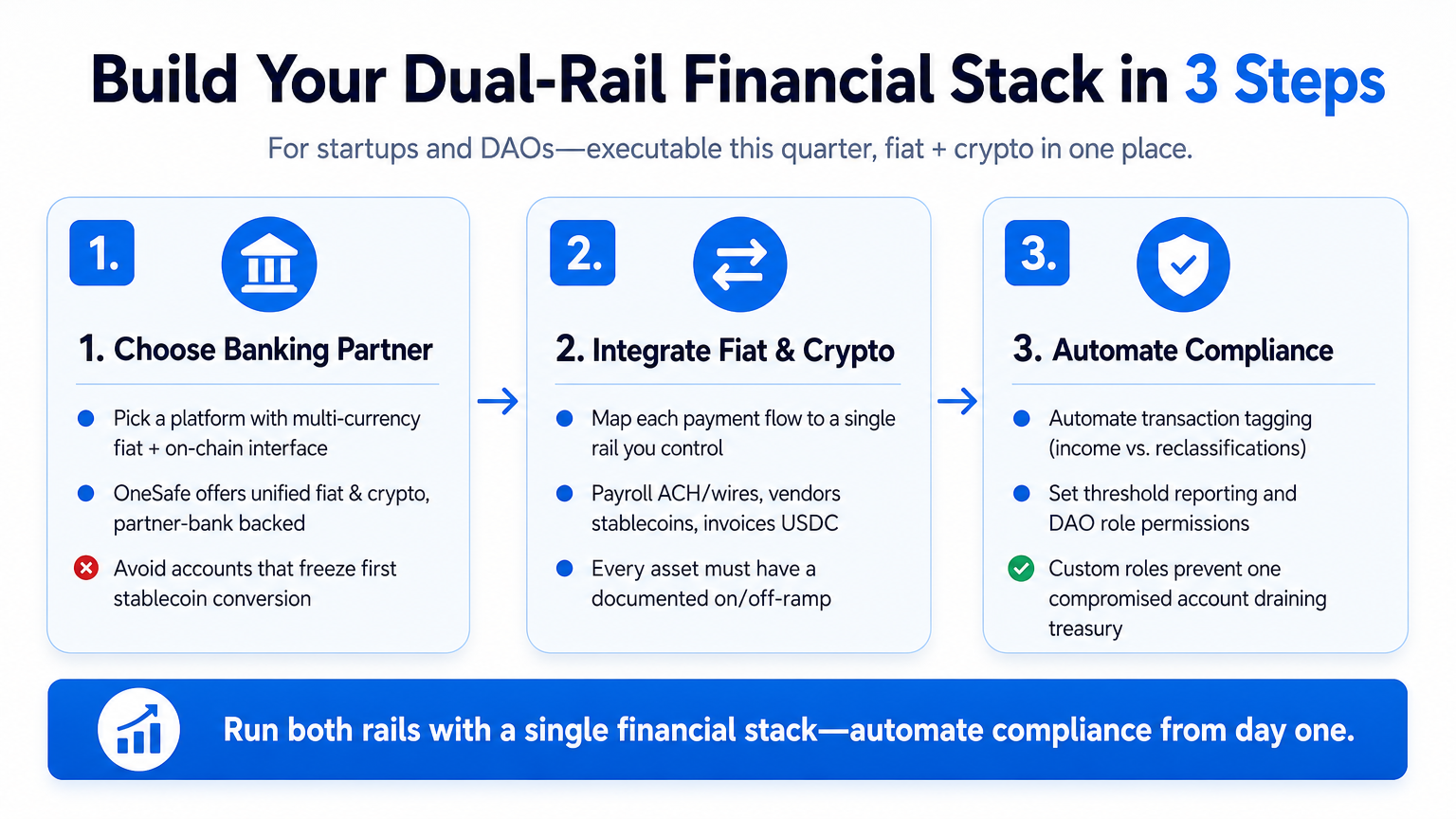
This framework is for a startup or DAO that needs fiat and crypto in one place by end of quarter.
Step 1: Choose Your Banking Partner
Start with the banking partner, not the wallet. You need a platform that holds multi-currency fiat accounts and interfaces with on-chain assets. OneSafe, a financial technology company rather than a bank, provides a unified platform for fiat and cryptocurrency transactions, with banking services delivered through partner banks. For Web3 startup finance, that removes the single biggest pain: opening a business account that won't freeze your first stablecoin conversion.
Step 2: Integrate Crypto and Fiat Operations
Map every payment flow to one rail you control. Payroll and taxes run through ACH and wires. Vendor payments in stablecoins go through your multi-sig or crypto-enabled account. Cross-border contractor invoices can be issued in USDC. The rule that matters: every asset must have a documented on-ramp and off-ramp before you hold it. If you can't convert an asset to dollars when payroll hits, you don't hold it — you're stuck.
Step 3: Automate Compliance and Reporting
Web3 regulatory compliance is now table stakes. The SEC's custody proposal, reported by The Paypers on October 8, 2026, shows advisers and funds pulled into the compliance fold — and your counterparties will expect the same from you. Automate three things: transaction tagging (income vs. reclassifications), threshold reporting, and permission controls for DAO roles. Customizable roles and permissions aren't a nice-to-have; they're how you avoid one compromised account draining the treasury.
Regulatory Shifts: SEC Custody Rules and Tokenized Trading
What the SEC's New Proposal Means for Your Business
On October 8, 2026, The Paypers reported that the SEC proposed a tailored custody framework under the Investment Advisers Act of 1940 and the Investment Company Act of 1940. The proposal would let registered investment advisers and regulated funds use compliant crypto custody options, widening the range of strategies advisers can offer clients.
For a business treasury, this matters even if you're not an adviser. When the SEC defines "compliant custody," custody standards set the floor. Banks, custodians, and platforms converge on that standard. Expect your custody partner to advertise compliance posture more explicitly, and expect counterparties to ask about yours. The EU has its own parallel track — the 2027 EU stablecoin deadline is already forcing decisions on which stablecoins to hold.
The Rise of Tokenized Trading Platforms
On October 5, 2026, Reuters reported that OKXICE — a joint venture between crypto exchange OKX and Intercontinental Exchange, the parent of the New York Stock Exchange — filed with the SEC to launch a tokenized trading platform. That's not a crypto-native startup; it's exchange infrastructure heritage entering on-chain markets.
The operational implication: tokenized versions of traditional assets — securities, funds, real-world instruments — are moving onto the same rails you use for stablecoins. A tokenized trading platform closes the loop between operating capital and investment capital. If your treasury holds idle cash, the distance between that cash and a tokenized money-market exposure shrinks.
Pitfalls, Myths, and What Comes Next
What are some Web 3.0 implementation challenges?
Scalability and UX are less painful in 2026. The harder challenges are operational: custody risk exposure, key management discipline, accounting for volatile token payments, and a patchwork of global rules. SAP's Web3 innovation materials catalog the ambition; the gap is that process maturity lags tool maturity. Most teams fail on process, not technology.
Common Mistakes
The most damaging mistake is the quiet one: using a personal wallet or personal bank account for business funds. It commingles assets, destroys the audit trail, and can trigger account freezes or tax recharacterization. OneSafe's guide on why a personal account is a bad idea for business details the risks. Other mistakes: holding payroll reserves in a volatile token, skipping transaction tagging until tax season, and having no documented recovery plan if a signer leaves.
Myths
Two myths are expensive. "Web3 is unregulated" was never true and is now actively false — the SEC custody proposal shows regulators drafting rules in real time. "Crypto is anonymous" is wrong in the way that matters: blockchains are pseudonymous but permanently public. Every transaction is audit-friendly; that's a feature for finance, not a grey area to exploit.
The Road Ahead: Embedded Finance and DAO Treasury Management
The direction is embedded: crypto rails folded into the same interfaces that process ACH and cards, so Web3 startup finance stops being a special category. DAOs are maturing from on-chain-only treasuries to dual-rail operations with structured permissions, stablecoin reserves, and real reporting. The winners will treat Web3 crypto as an operational tool — not an experiment.
Key Takeaways
- Treat Web3 crypto as treasury infrastructure, not a bet: hold operational capital in stablecoins with documented on/off-ramps; keep speculative tokens segregated.
- Choose one platform that handles fiat and crypto natively — a crypto neo-banking solution beats a patchwork of bank plus exchange.
- Watch the custody standard set by the SEC's October 2026 proposal; whatever it defines as compliant becomes the floor for counterparties.
- Automate permissions, tagging, and reporting from day one — the audit trail you don't build now is the cost you pay later.
- Separate personal and business wallets with zero exceptions, and require multi-signature controls on any treasury above payroll-level cash.
Ready to run both rails in one stack? Open an account to bring your fiat and crypto operations into a single financial stack built for Web3 businesses and DAOs.