
If you’re searching for the biggest neobanks right now, you’ll get a list of consumer apps. But that picture is incomplete. The largest neobanks in 2026 aren’t just mobile-first checking accounts — they’re quietly powering startups, scale-ups, DAOs, and global enterprises that need to move money across borders, currencies, and blockchains without the friction of old banking. This guide maps the whole landscape: consumer giants, business‑focused platforms, and the crypto neobanks that are redefining what a neobank can be. By the end, you’ll have a practical framework to choose the right neobank for cross‑border, multi‑currency, and crypto operations — no hype, just a practitioner’s view.
What Is a Neobank? (And What It Isn’t)
The core definition: digital-only, app-based financial services
A neobank is a financial services provider that delivers banking through an app or website — with no physical branches. Typically, it offers checking‑like accounts, debit cards, payments, and often budgeting or analytics. The whole experience is designed around a smartphone, which is why these platforms are sometimes called “challenger banks.” But that term can be misleading, because many neobanks aren’t banks at all. For a deeper dive, see What Is a Neobank? A Guide for Businesses & Crypto.
Most neobanks partner with a licensed bank to hold deposits and provide transaction rails, as Wikipedia’s Neobank overview details. That means you get a slick interface, fast onboarding, and lower fees, but the actual money sits with a bank you may never interact with. This model lets neobanks launch quickly across geographies without applying for a full banking licence themselves.
Neobank vs. digital bank vs. virtual bank: clearing up the jargon
The terms get thrown around interchangeably, but there are meaningful differences, especially when you’re deciding where to place your business’s money.
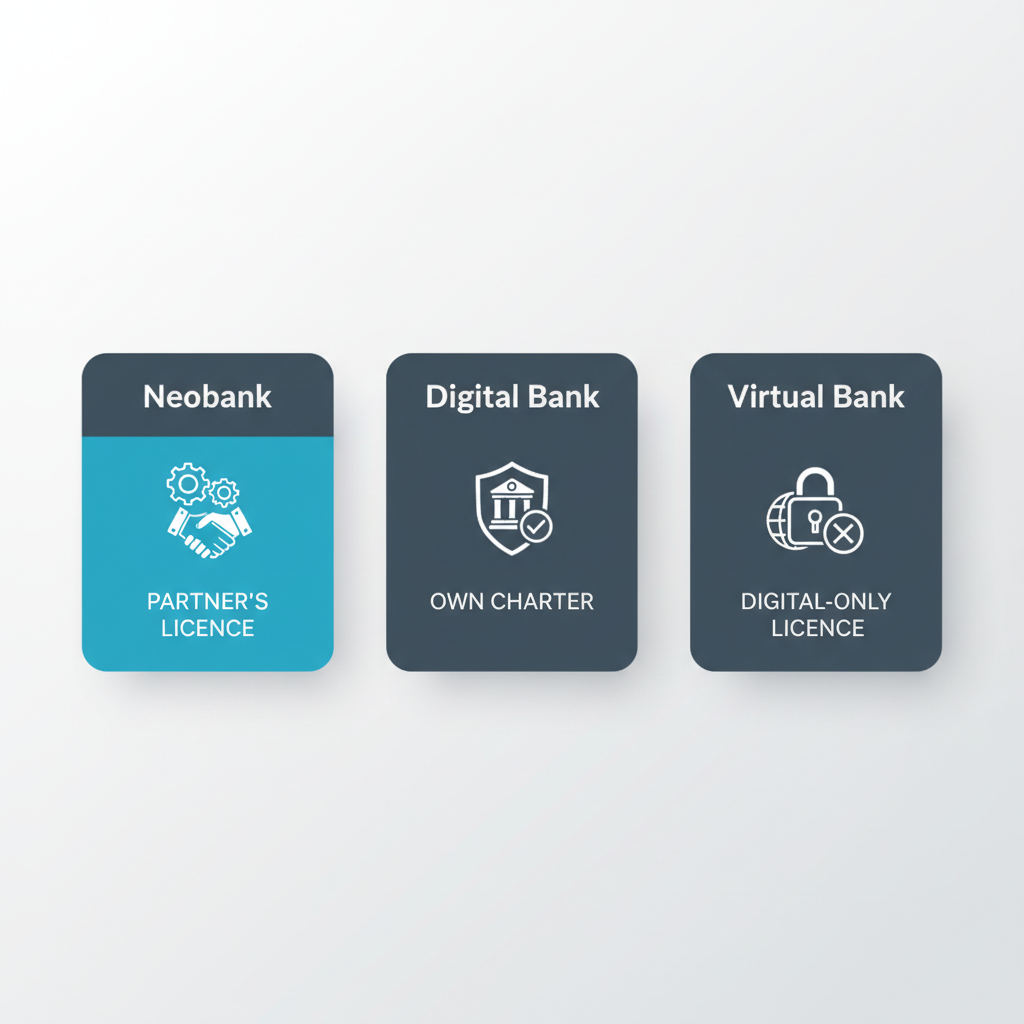
- Neobank: A fintech company that offers banking‑like services built from scratch, usually on top of a partner bank’s licence. Examples: Chime, Revolut (in many markets), Mercury.
- Digital bank: Often a fully licensed bank that operates entirely online, with its own charter. Think of Starling Bank or Monzo in the UK. They hold deposits directly and are subject to the same capital and regulatory requirements as any traditional bank.
- Virtual bank: A term more common in Asia and the Middle East, describing a bank with a restricted licence issued by a central bank specifically for digital‑only operations. Hong Kong’s ZA Bank is a classic example.
What is the difference between a neobank and a virtual bank?
A neobank is generally a technology company that leans on a banking partner’s licence, while a virtual bank holds its own banking licence, albeit one tailored for digital‑only operation. This distinction matters because it affects how your deposits are protected and which financial regulations apply directly to the entity you’re dealing with. For a more detailed comparison, read Neobank vs Digital Bank: Which Is Right for Your Business?.
The Biggest Neobanks by Valuation and Users (2026)
As catalogued in Fintech Magazine’s Top 10 list and cross‑referenced with the 2025 rankings from neobanque.ch, the largest neobanks span three categories: consumer, business, and crypto‑integrated.
Consumer giants: Revolut, Nubank, Chime, WeBank
These names dominate the neobank market cap rankings. Nubank has over 100 million customers across Latin America, Chime remains the most‑valued US neobank with tens of millions of active accounts, and Revolut has surpassed 45 million retail users globally while pushing into business banking. WeBank, backed by Tencent, serves over 300 million users in China and is often classified as a digital bank due to its licence structure.
Business-focused neobanks: Mercury, Brex, and the rise of B2B
The best neobanks for business are a different breed. Mercury (US) and Brex (US) built their products specifically for startups. They provide instant virtual cards, expense controls, API‑first banking, and integrations with accounting tools. For cross‑border companies, however, they often lack native multi‑currency accounts or direct crypto rails — forcing you to maintain additional relationships. Other global neobanks like Airwallex and Wise have stepped into the B2B space with competitive FX and multi‑currency accounts, but they are typically fiat‑only.
Crypto-integrated platforms: OneSafe, Juno, and the new money stack
For Web3 startups, DAOs, and businesses that operate with stablecoins alongside traditional currencies, a new class of platform has emerged: the crypto neobank. These services bridge fiat and cryptocurrency in a single interface. OneSafe, for example, is a financial technology company (not a bank) that combines multi‑currency accounts in USD, Euro, and CAD with free USDC deposits and withdrawals, instant crypto‑to‑fiat conversions, and corporate cards — all with custodial security via Fireblocks. It’s built for companies that need to pay a contractor in stablecoins one day and a supplier via wire the next.
Juno takes a more consumer‑ and freelancer‑oriented approach, offering a checking account where users can receive pay in crypto and spend through a debit card. The broader point: these platforms are moving beyond “buy Bitcoin in an app” to become the primary comprehensive crypto bank list for 2026 for serious operators who need both fiat and on‑chain rails.
What is the largest neobank?
If you measure by total users, WeBank leads with more than 300 million customers. By valuation, Nubank and Revolut jostle for the top spot — both valued above $30 billion in recent private markets. For purely business‑focused neobanks, Mercury has become the largest in the US by deposit volume, but no single player dominates globally because business needs vary so dramatically by jurisdiction and currency mix.
How Neobanks Actually Work: Licensing, Partnerships, and Revenue
The partner-bank model and why it matters
Most neobanks do not hold a banking licence. Instead, they partner with a chartered bank (in the US, often a community bank like Evolve Bank & Trust or Sutton Bank) to store customer deposits and access payment networks. The neobank builds the front‑end experience, compliance layer, and customer support, while the partner bank handles regulatory capital, deposit insurance, and settlement.
This licensing patchwork explains why a neobank available in Europe might not be accessible in the US — it would need a new partner bank and local regulatory approvals.
Where neobanks make money (and why some don’t)
Many consumer neobanks still lose money. Their main revenue comes from interchange fees, subscription tiers, and ancillary services like trading or credit builder loans. Without a lending business — something licensed banks can do easily — profitability is tough. Business‑focused neobanks typically charge transparent subscription fees or FX mark‑ups, serving customers who maintain higher balances and generate more transaction volume. Long‑term viability matters: if a neobank never turns a profit, it may suddenly restrict features or close entirely, leaving you scrambling to move funds.
Are neobanks real banks?
Most are not. A real bank holds a full banking charter (or a restricted deposit‑taking licence like a virtual bank). It can lend, issue credit, and hold deposits directly. A neobank is usually a fintech company that builds a better customer experience but relies on a partner bank for the core regulated activities. This doesn’t make them unsafe — but it does mean you’re dealing with two entities: the neobank (service, support, UI) and the underlying bank (where your money actually sits).
Are Neobanks Safe? Regulation, Insurance, and Risk
Neobank safety depends on regulatory structure, not brand recognition. As Nerdwallet’s guide to neobanks explains, a neobank’s FDIC coverage — if any — comes from its partner bank, but if the fintech itself fails from fraud or operational collapse, the FDIC does not cover losses of the fintech’s software; it only steps in if the partner bank goes under. Always check the neobank’s website for clear language about who provides FDIC insurance and in what scenarios.
How to verify a neobank’s security posture
Look for these signals:
- Custody of digital assets: If the platform handles crypto, it should use a regulated custodian like Fireblocks or Anchorage, not a hot wallet.
- Encryption and MFA: State‑of‑the‑art encryption and mandatory multi‑factor authentication (MFA) are table stakes.
- Penetration tests and certifications: SOC 2 Type II or ISO 27001 reports show that an independent auditor has reviewed security controls.
- Transparent partner bank disclosures: The neobank should clearly name the bank holding your deposits and provide the bank’s routing number so you can independently verify its FDIC membership.
Are neobanks safe?
Yes — if you choose one with a strong partner bank, transparent insurance coverage, and robust security practices. The risk surface is different from a traditional bank: you’re less likely to lose money to a bank run and more likely to face issues from a cybersecurity incident or a fintech’s mismanagement. A neobank comparison of safety features should be part of your evaluation, not an afterthought.
Choosing the Right Neobank for Your Business
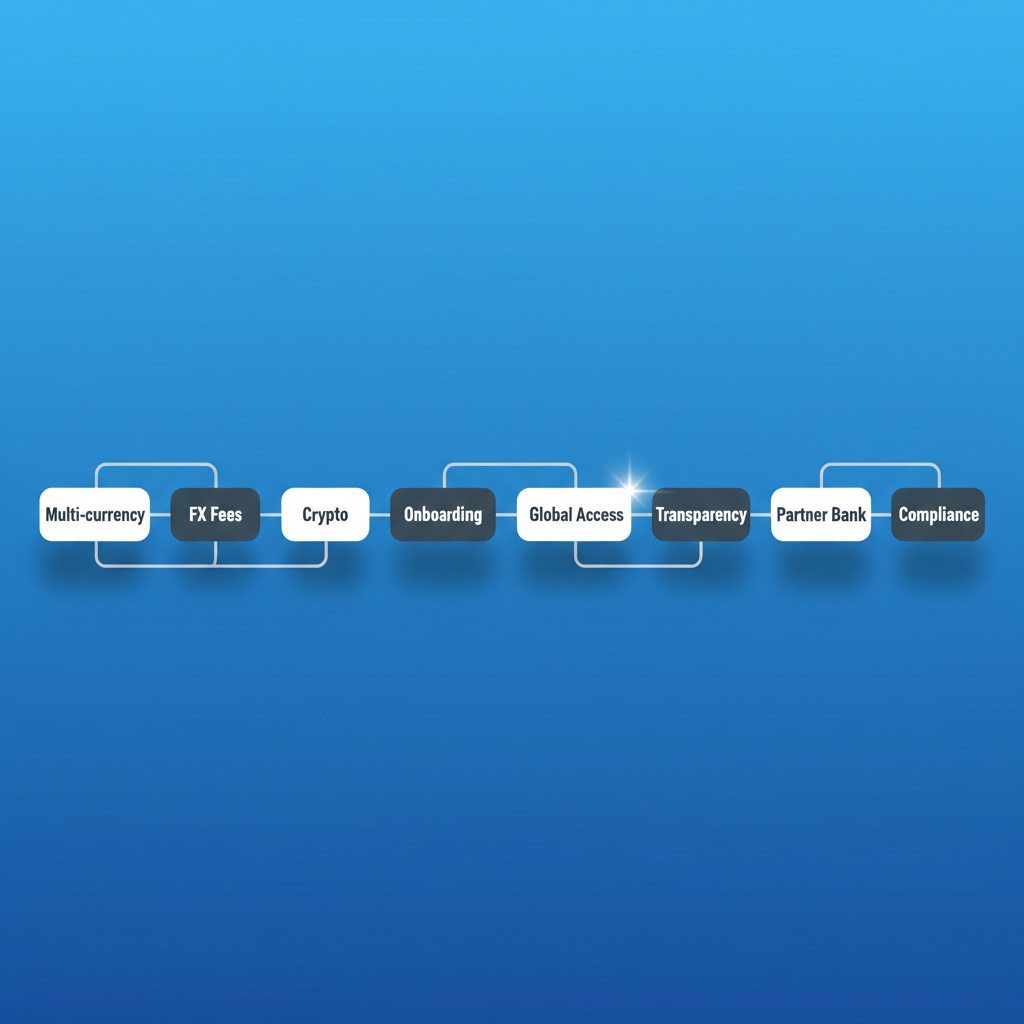
This is where most guides stop. But if you’re a founder or finance lead, you need a practical way to sort through the noise. Use the checklist below as a scorecard for any neobank comparison you perform.
Neobank Selection Scorecard
| Criterion | What to check |
|---|---|
| Multi‑currency accounts | Does it support holding and transacting in the currencies your business uses (USD, EUR, GBP, CAD, etc.)? |
| FX fees | What’s the markup over mid‑market rate for conversions? Are there hidden wire or SWIFT fees? |
| Crypto integration | Can you send/receive USDC or other stablecoins natively? Is custody segregated and insured? |
| Onboarding speed | How long from application to active account? Are business documents required, and is it fully digital? |
| Global accessibility | Does it support your incorporation country and the jurisdictions where your counterparties are? |
| Fee transparency | Are subscription costs clear, or do interchange/card fees pile up? Watch for inactivity fees. |
| Partner bank & insurance | Which bank holds deposits? Is FDIC or equivalent insurance clearly explained? |
| Compliance features | For DAOs and Web3 entities, are there customizable roles, permissions, and audit trails? |
Feature checklist for global businesses: multi-currency, FX, and cross-border rails
If your business pays suppliers abroad or invoices in multiple currencies, you need a platform that goes beyond a single‑currency checking account. Look for the ability to hold, convert, and send in the currencies you actually use. Global neobanks like Wise and Airwallex shine here for fiat‑only operations; if crypto is part of your treasury, options narrow. Platforms like OneSafe allow you to hold USD, Euro, and CAD simultaneously, convert at 0.25% or the prevailing rate, and pay contractors via domestic wire or USDC without switching apps.
The crypto integration factor: when fiat-only isn’t enough
Web3 companies, DAOs, and even traditional freelancers are increasingly paid in stablecoins. If your neobank cannot receive USDC directly and convert it to fiat, you’ll end up maintaining a separate exchange account and manually moving money — a compliance and reconciliation headache. The question Does Web3 Payment Require a Bank? gets at the heart of this shift. A platform that natively supports both sides removes a layer of operational complexity.
Onboarding speed and documentation requirements
A fully digital onboarding that takes a week — not weeks — has become the norm for business neobanks. You’ll need your business formation documents, government‑issued photo ID for beneficial owners, and (for US companies) an EIN. If a platform promises instant account opening with no verification, treat that as a red flag: it likely means weak KYB controls, which can lead to account closures later.
What are the best neobanks in the US?
The answer depends entirely on your use case. For consumer accounts, Chime and Current top the charts. For startups, Mercury is the default, followed by Brex for spend management. For cross‑border e‑commerce, Airwallex or Wise. If you need to mix fiat and crypto, US‑domiciled options are still limited, which is why many businesses turn to platforms built for global incorporation and stablecoin on‑/off‑ramps. A neobank comparison that ignores crypto capability will miss this growing segment.
What’s Next for Neobanking: AI, Global Licenses, and Beyond
Revolut’s Australian banking licence and what it signals
On August 9, 2026, Revolut Australia was granted a full banking licence by the Australian Prudential Regulation Authority. This makes Revolut the country’s first licensed digital challenger to the big four banks. It signals a maturation of the neobank model: instead of forever relying on a partner, the largest platforms are seeking their own charters to control the entire stack and offer lending, deposits, and full‑fat banking. Expect more neobanks to follow this path in Asia and Latin America, blurring the line between “fintech” and “bank” even further.
AI-driven features and the future of business banking
According to a Built In report published on August 6, 2026, AI assistants, predictive cash‑flow tools, and advanced cybersecurity are now table stakes among the top neobanks 2026. For businesses, this means your neobank might soon flag anomalous transactions before you see them, auto‑categorize international payments for accounting, or even suggest optimal timing for FX conversions based on treasury trends. The practical result: fewer hours spent on manual reconciliation and a real‑time view of global cash positions.
AI is moving from gimmick to infrastructure. On the security side, machine‑learning models detect fraud patterns that rule‑based systems miss. On the user side, natural‑language interfaces let finance teams generate reports or approve payments by typing a sentence. For crypto‑integrated platforms, AI can correlate on‑chain activity with fiat transaction history to create a single, compliant audit trail. As the landscape evolves, platforms featured on lists like the Product Hunt best neobanks in 2026 increasingly differentiate on these capabilities.
In 2026, the biggest neobanks are no longer a niche experiment. They’ve become essential infrastructure for global businesses that need to move money across borders, currencies, and even blockchains — without the cost and clutter of traditional banking. Whether you’re a startup founder, a DAO treasurer, or a finance lead scaling into new markets, the right neobank isn’t the one with the flashiest UI; it’s the one that fits your operational reality and grows with you. Start with the scorecard, verify the licence and neobank safety practices, and you’ll skip the painful lessons many early adopters learned the hard way.