The choice between a neobank vs digital bank has sharpened in 2026. Founders and finance leads once treated the terms as interchangeable. A wave of fintech charter approvals and crypto-native treasury needs have redrawn the line. Your decision now hinges on whether you need a digital bank license, how you manage multi-currency accounts, and the true cost of moving money across borders. This gives you a concrete framework—not a feature list—to decide.
2026 Regulatory Shake-Up: Neobanks Are Getting Licensed
The charter wave — what the data shows
In April 2026, the American Banker reported that over two dozen non-bank fintechs were in the bank charter process—including neobanks, digital asset firms, and payments providers. The OCC is issuing conditional approvals at an accelerating pace. Outside the U.S., the ConnectPay and GenToo partnership in August 2026 (FF News) launched a compliance-first digital banking app, showing this isn’t a U.S.-only shift.
How a license changes cost and trust
A fintech charter 2026-style reshapes customer relationships. A neobank business account operating under a partner bank today could soon hold deposits directly, with FDIC insurance under its own license. That changes the trust calculus for cautious CFOs. But it also introduces capital requirements and compliance overhead that may narrow fee advantages. For businesses evaluating a banking partner now, a neobank on the charter path may offer the best of both worlds in the next 18 months.
The Bottom Line: Neobank or Digital Bank for Your Business?
When a neobank wins
A neobank fits best when your business needs to move between fiat and crypto quickly, with low overhead. A Web3 startup, DAO, or global service company sending international wires, holding stablecoins, and paying contractors in multiple currencies benefits from a unified platform. Onboarding within a week and predictable flat fees cut friction.
When a digital bank makes more sense
A licensed digital bank suits a business that values lending products, a full suite of deposit accounts, and direct FDIC insurance. If your cash management is entirely fiat, you never touch crypto, and you want a line of credit or interest-bearing accounts from the same institution, a digital bank with a charter is the clear choice.
Our Evaluation Criteria: What We Measured
To compare honestly, we used five factors that operators care about in 2026:
- Licensing and insurance – Own charter vs. partner bank.
- Multi-currency and crypto support – Fiat and crypto in one interface.
- Fees – Real costs for wires, FX, and crypto conversions.
- Global payments reach – Countries and methods supported.
- Onboarding speed – Time until first wire.
This framework exposes trade-offs generic comparisons miss.
Feature-by-Feature Comparison Table
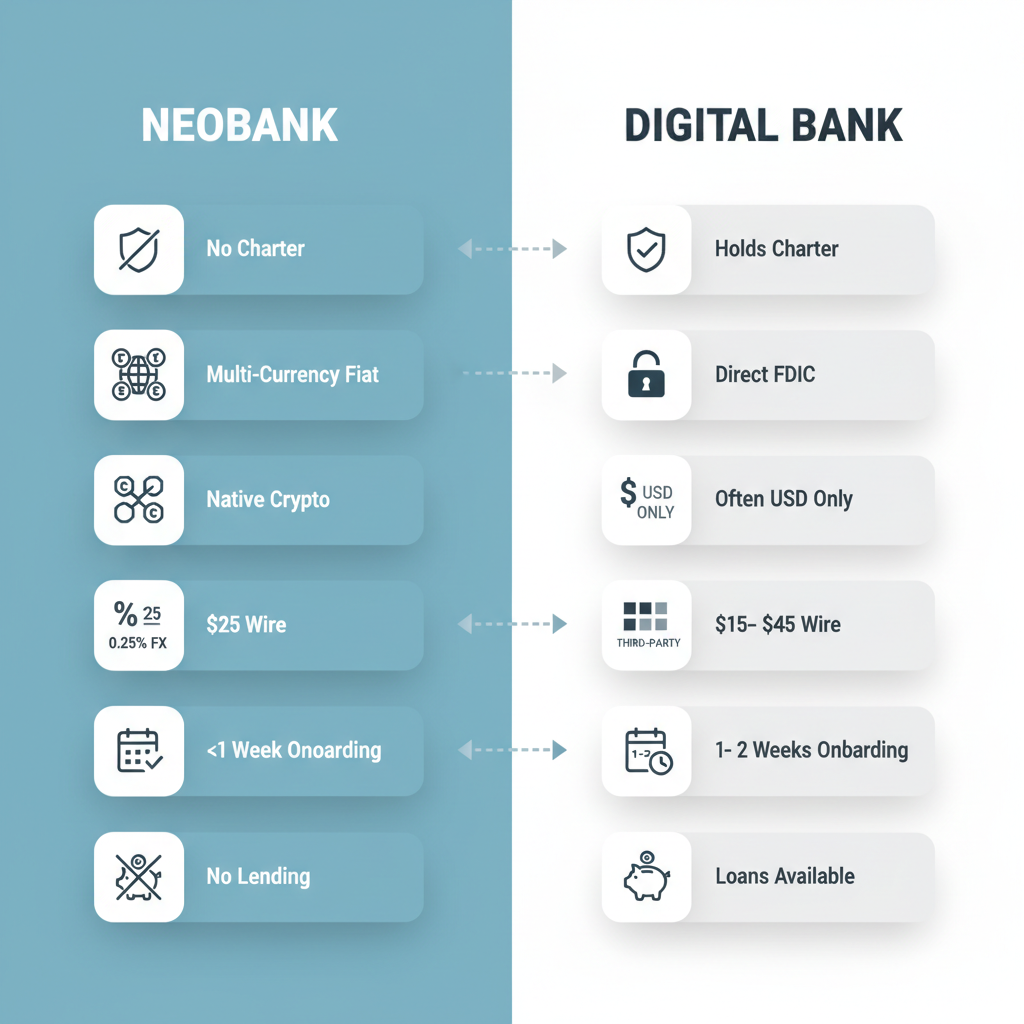
Neobank vs. digital bank side-by-side
| Criteria | Typical Neobank (e.g., OneSafe) | Licensed Digital Bank (e.g., Novo, Bluevine) |
|---|---|---|
| License | No; partners with banks | Holds bank charter |
| Deposit insurance | Pass-through FDIC (partner bank) | Direct FDIC |
| Multi-currency fiat | USD, EUR, CAD; more coming | Often USD only; EUR/GBP via third-party |
| Crypto support | Native USDC, crypto-to-fiat, free deposits/withdrawals | None or exchange integration |
| Int'l wire fees (out) | $25 per wire; SWIFT: 0.35% + $50 | $15–$45 plus currency markup |
| FX conversion | 0.25% or prevailing rate | 1%–3% hidden markup |
| Corporate card FX | 3% | Varies; some 0% abroad (premium) |
| Onboarding | Under a week, fully digital | 1–2 weeks, more documentation |
| Lending | None | Lines of credit, term loans |
| Security | Encryption, MFA, Fireblocks (crypto); partner bank (fiat) | Bank-grade encryption, FDIC |
Sources: OneSafe fee schedule; Novo, Bluevine, Mercury public pricing pages (August 2026). "Varies" used where not disclosed.
Real Costs: Neobank vs Digital Bank Pricing
Neobank fee card (OneSafe example)
OneSafe’s free tier has no monthly subscription; a premium plan costs $29/month. Fiat deposit/withdrawal fees are 0.15%. A domestic wire costs $25, international SWIFT: 0.35% + $50. FX conversion costs 0.25% or the prevailing rate. Corporate card abroad: 3% FX fee. Crypto deposits/withdrawals in USDC are free. A $10,000 SWIFT payment totals $85 (0.35% + $50), before any FX markup.
What licensed digital banks charge
Licensed digital banks like Novo advertise free business checking, but international payment tools are often absent or outsourced (e.g., Wise integration). When they do process wires, fees range from $15–$45, and FX markups of 1–3% are common—far above a neobank’s 0.25%. Traditional digital banks with multi-currency accounts may charge monthly maintenance. The total cost for a cross-border payment can be 2–4x a neobank’s, especially when crypto rails are involved. For a deeper look, see our neobanking financial services guide.
Strengths and Weaknesses
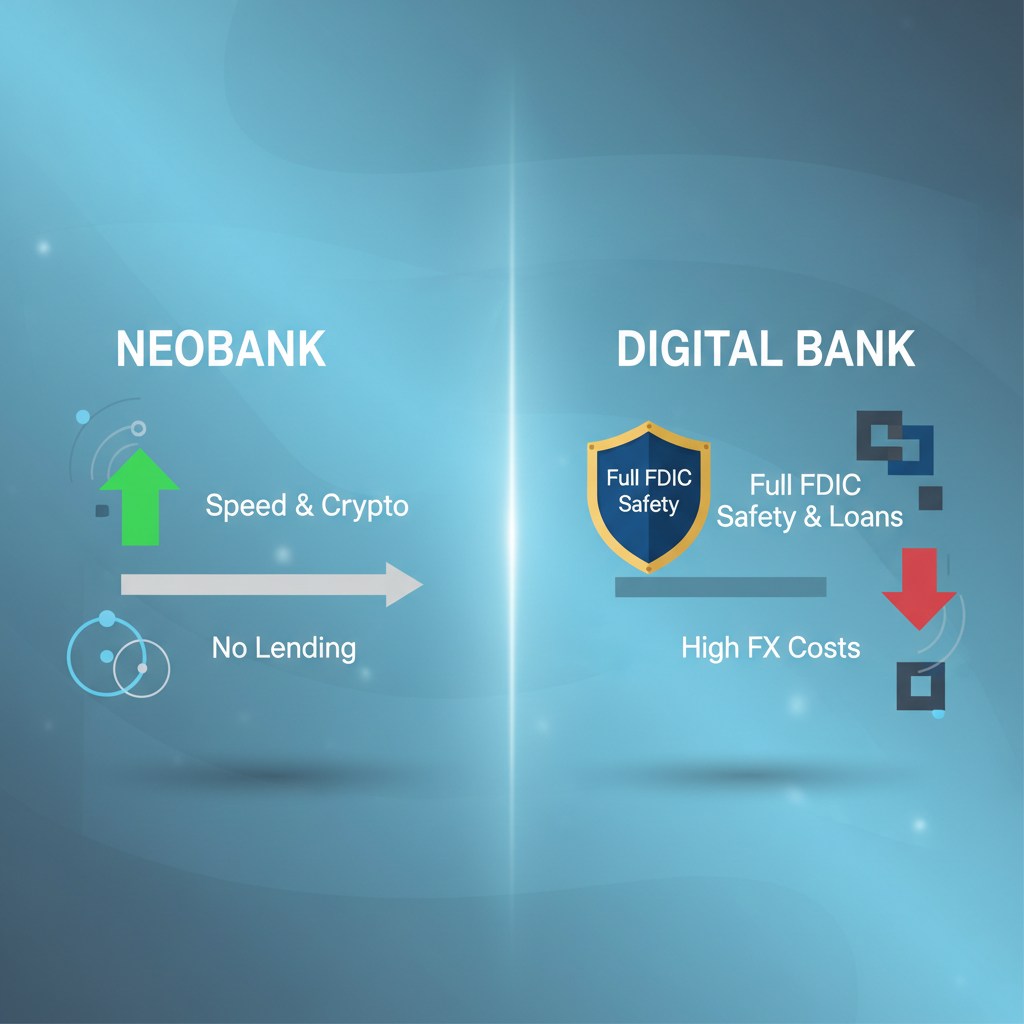
Neobank advantages and trade-offs
Advantages:
- Fast onboarding (under a week).
- Built-in crypto-fiat bridge—free USDC, Fireblocks custody.
- Low, transparent FX for cross-border payments.
- Multi-currency business accounts without complexity.
Trade-offs:
- No lending products.
- Pass-through deposit insurance (not direct) unsettles some treasurers.
- Reliance on partner banks for core fiat holding.
Plaid’s primer on neobanks confirms that while they excel at UX, product depth is narrower.
Digital bank advantages and trade-offs
Advantages:
- Direct FDIC insurance from the charter.
- One-stop shop for checking, savings, and business loans.
- Often integrated with accounting and payroll.
Trade-offs:
- Crypto support is almost nonexistent; you’ll need an exchange.
- Higher international wire fees and FX markups.
- Slower onboarding with more documentation.
According to Javelin’s 2026 Digital Banking Scorecards, even top-ranked digital banks struggle to engage customers beyond routine transactions—a gap neobanks fill with purpose-built features like multi-currency and crypto.
Final Recommendations by Business Scenario
Crypto-native startup or DAO? Go neobank
A neobank business account natively supporting fiat and crypto eliminates juggling a bank and an exchange. For a DAO, role-based permissions, automated crypto-to-fiat payroll, and Fireblocks custody while paying vendors via ACH or wire are invaluable. (See banking for Web3 app.) The trade-off: no loans, but most crypto-native businesses don't use traditional credit anyway.
Traditional business with lending needs? Digital bank
A marketing agency or manufacturer that only touches fiat and needs a line of credit should choose a licensed digital bank like Novo or Bluevine. You get direct FDIC insurance, lending products, and familiar treasury tools. International wire costs matter only if you send them frequently; otherwise the lending relationship outweighs the fee gap.
Global service company managing multiple currencies? Neobank
A consultancy or SaaS company paying contractors across regions needs a global business account that holds USD, EUR, CAD and more with near-instant FX at 0.25%. The neobank’s flat fees and crypto on/off-ramp let you manage payroll without multiple bank accounts abroad. Lending perks are irrelevant if you don't borrow.
What is a digital bank?
A digital bank is a fully licensed bank operating primarily online, with no physical branches. It holds its own charter, offers direct FDIC insurance, and provides a full suite of products including checking, savings, and lending. Incumbents like U.S. Bank have deep digital offerings, while newer institutions like Novo and Bluevine are built digital-first.
What is a neo-bank?
A neo-bank (or neobank) is a financial technology company that offers banking-like services via app but does not hold a banking license. It partners with licensed banks for deposits and pass-through insurance. Neobanks focus on seamless digital experience, fast onboarding, and niche features like multi-currency or crypto support. OneSafe is a neobank platform; it is not a bank.
How are neobanks and digital banks different?
The core difference is the license. A digital bank has its own digital bank license; a neobank relies on a partner bank. This affects deposit insurance, product scope, and regulatory oversight. Neobanks innovate faster with lower fees for cross-border and crypto; digital banks offer a full safety net and credit products. The distinction is binary: no charter, it’s a neobank.
What are the downsides of neobanks?
Neobanks lack lending and often can't offer interest-bearing deposits directly. Pass-through FDIC insurance can confuse customers. Partner bank risk exists, and cash deposits aren't supported. As NerdWallet notes, neobanks may not offer all products of a traditional bank, especially loans. However, many are pursing charters—mitigating this.
What are some advantages of neobanks?
Neobanks excel at speed and cost. Onboarding takes days, not weeks, and fees are transparent with low FX markups. For crypto business banking, neobanks are often the only option that combines fiat and crypto in one account. They offer modern security like Fireblocks custody, providing a single pane of glass for global treasury that reduces headcount and reconciliation hours.
Are neobanks and digital banks the same?
No. While terms are used interchangeably, a neobank is not a bank; a digital bank is. The distinction matters for deposit insurance, lending, and regulatory treatment. In 2026, the line is blurring as neobanks obtain charters, but for now the difference is real. (See neobanking financial services guide.)
What does the 2026 charter wave mean for business banking?
As the American Banker reported in April 2026, over two dozen fintechs are in the charter pipeline. A licensed neobank can offer direct FDIC insurance, hold deposits itself, and possibly extend credit. This could lower funding costs and increase trust. For businesses, today’s neobank could become a full-fledged digital bank tomorrow—negating the safety argument.
Which is better for a business that handles crypto?
A neobank. Licensed digital banks are extremely unlikely to offer native crypto custody, free USDC on/off-ramps, or on-chain transaction support. Neobanks built for Web3 provide exactly that—like OneSafe with USDC holdings, instant conversion to fiat, and international wires in one platform. To get the same with a digital bank, you’d need an exchange, fragmenting your workflow. See our crypto bank list for 2026.
How do neobank fees compare to digital bank fees?
Neobank fees for international wires and FX are consistently lower. A neobank may charge 0.25% for FX and a flat $25 wire, while a digital bank charges 1–3% markup plus $15–$45 per wire. Crypto transactions are often free at neobanks but unsupported by digital banks. The total cost difference on a typical cross-border payment can be 50% or more, structural, not promotional.
Can a neobank replace a traditional business bank account?
Yes—for many businesses. A neobank handles payroll, vendor payments, multi-currency receivables, and crypto settlements, but cannot provide loans, cash deposits, or certain escrow services. If you don’t need those, a neobank can be your primary financial hub. Many businesses keep a small legacy account as backup while daily operations run through the neobank.