On October 22, 2026, Cardano proposed an ADA-denominated payroll vision, injecting fresh volatility into the crypto payroll conversation. The move, analyzed by OneSafe on October 23, 2026, challenges the stablecoin-first orthodoxy that has defined crypto payroll software. For founders and finance leads, this forces a recalibration of payroll math when token prices can swing 5% in a day.
Table of Contents
- What just happened: Cardano’s October 22 ADA payroll vision
- Why founders and finance leads need to rerun crypto payroll math now
- The consensus background: how crypto payroll works before Cardano’s pitch
- The disagreement the SERP won’t settle
- The payroll math founders should run
- Concrete implications and recommended actions
- What to watch next and open questions
- What just changed with Cardano's ADA payroll vision?
- Is it legal to pay wages in crypto?
- How is crypto payroll taxed?
- What happens if an employee is paid in ADA and the price drops before conversion?
- How do stablecoins reduce crypto payroll risk?
- Do crypto payroll platforms require KYC and AML checks?
- How should finance leads account for crypto payroll in their books?
- Can a startup or DAO run hybrid fiat/crypto payroll without a dedicated payroll provider?
- What crypto rails and tokens are practical for payroll?
- Key Takeaways
- Sources
What just happened: Cardano’s October 22 ADA payroll vision
Cardano’s ecosystem advocates outlined an ADA payroll framework on October 22, 2026, envisioning salary payments in the native token ADA. As reported in OneSafe’s October 23 analysis, the pitch positions ADA as a viable medium for regular employee compensation. This arrives at a moment when the broader crypto payroll industry has coalesced around stablecoin settlement to insulate wages from price swings.
Most crypto payroll platforms—from Acctual to BVNK—market solutions that convert fiat salaries into stablecoins like USDC at the point of payment. That model preserves the fixed dollar value of a wage and sidesteps the volatility that can shrink a paycheck between processing and conversion. Cardano’s pitch implies a single, non-stable asset as the base unit of compensation, breaking with the established playbook and introducing a risk dimension that standard payroll compliance frameworks were not designed to absorb.
Why founders and finance leads need to rerun crypto payroll math now
Payroll is a repetitive, fixed-dollar obligation. Employees expect the same purchasing power they agreed to, regardless of overnight crypto market moves. ADA can drop 10% in the hours between approval and on-chain settlement, instantly converting a compliant salary into a wage-and-hour headache. The volatility-adjusted cost of paying in a single token must be factored into any payroll calculation—and that number is missing from the current discussion.
Until recently, the conversation around paying employees in crypto centered on feasibility: finding a platform, handling tax forms, and ensuring KYC/AML compliance. Cardano’s move reframes the question. Now, the cost analysis must include not just platform fees but also the implicit cost of price risk. A $5,000 monthly salary paid in ADA that loses 8% before conversion effectively costs the employer $400 to buy back the intended wage value if they guarantee a top-up—or risks violating wage laws if they don’t.
The consensus background: how crypto payroll works before Cardano’s pitch
Crypto payroll typically refers to disbursing employee or contractor payments using cryptocurrency. The dominant workflow, described in guides from Rise and Globalli, involves the employer funding a platform with fiat, converting it to a stablecoin (usually USDC or USDT), and transferring that stablecoin to the recipient’s wallet. The employee then off-ramps to fiat via an exchange or a crypto-friendly neobank. This stablecoin payroll model has been adopted widely because it preserves the dollar peg while unlocking the speed and borderless advantages of blockchain rails.
Every explainer shares the same pros: cross-border speed, lower fees compared to legacy correspondent banking, and financial inclusion for workers without bank accounts. Cons are equally uncontroversial: price volatility (even for stablecoins, depegs are a risk), regulatory fragmentation, complex tax reporting, and wage-and-hour compliance exposure. A volatile asset payroll amplifies the cons to a degree that stablecoin-first models were designed to avoid.
The disagreement the SERP won’t settle
Some platforms and Cardano’s own messaging suggest that direct token payment can be workable payroll. On the other side, compliance-focused providers and legal analysts treat volatile crypto as an employee-elected benefit, not a default salary rail. Volatile tokens should not be the default salary settlement. A fiat-value-based base salary (stabilized via stablecoin or traditional banking) with an optional allocation into ADA or BTC after the base is established avoids the worst of the valuation and wage-clock problems. This is the approach many DAO payroll structures take: base in USDC, discretionary bonus in a native token.
Legality for paying wages in crypto is jurisdiction-specific and depends on worker classification. In the U.S., the Fair Labor Standards Act requires that non-exempt employees be paid a fixed wage in a form that can be immediately spent or converted at par. The Department of Labor has not issued definitive guidance on volatile crypto wages, but multiple analyses suggest paying in a fluctuating token creates significant compliance risk. For independent contractors, the rules are less strict, and payment in crypto is widely practiced. Stablecoin settlement is less contentious than volatile token salary payments because it mirrors the economic reality of a fiat wage more closely.
Platform marketing often touts “low fees, no hidden costs.” In practice, total payroll cost is the sum of conversion fees, wire fees, network fees, and timing risk. For a hybrid fiat crypto payroll, a real fee stack might look like: 0.25% for FX conversion, free USDC deposits and withdrawals, a $25 domestic wire withdrawal, $10 wire deposit, and 0.35% plus $50 for SWIFT transfers—facts drawn from the pricing of a neobank like OneSafe. Dedicated crypto payroll providers may charge a platform fee of 1% or more per transaction on top of network costs. The headline rate rarely captures the full drain.
The payroll math founders should run
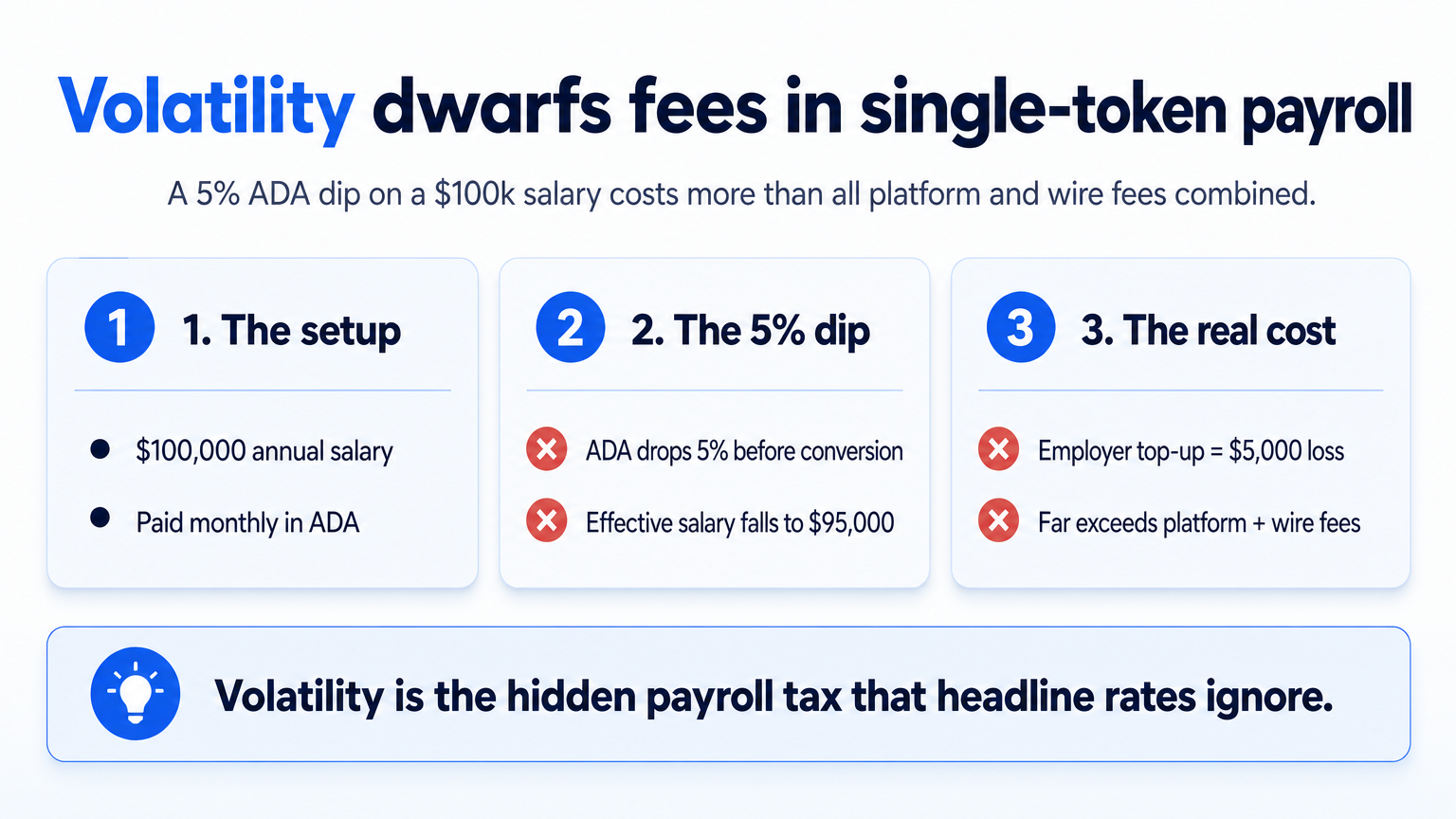
Consider a $100,000 annual salary paid in ADA on a monthly basis. If ADA dips 5% between the moment the payroll run is initiated and the employee’s conversion to fiat, the effective salary drops to $95,000. The employer who wants to make employees whole must carry a buffer or pay an extra $5,000—a cost that could exceed all platform and wire fees combined. Multiply across a team, and the risk becomes material. This simple scenario shows that the implicit cost of volatility often dwarfs explicit transaction fees.
A hybrid approach—where the employer holds fiat and stablecoin balances, converts to USDC for blockchain transfer, and allows employees to off-ramp immediately—incurs specific, quantifiable costs. Using the OneSafe fee schedule as a model: a business funding a payroll account via domestic ACH (0.15% deposit fee) converts to USDC (0.25% FX), sends USDC to employees (free), who then withdraw to their bank via wire ($25). For a $5,000 payment, the employer-side cost is $7.50 + $12.50 = $20 in fees, plus the employee’s $25 wire cost if they bear it. A full breakdown across 10 employees, including occasional international wires, would look meaningfully different from a platform’s “1% crypto payroll fee”—and cheaper in many scenarios.
For U.S. W-2 employees, the employer must withhold income and payroll taxes based on the fair market value of the payment at the time of payment. Crypto payroll software typically tracks this by generating a W-2 with the USD value on the payment date, but the employer remains responsible for accurate reporting. If an ADA payment is made and the token price changes by the time the employee reports it, a mismatch can trigger an audit. For independent contractors, the employer issues a 1099-NEC. Regardless, KYC/AML checks are mandatory for any platform that moves funds into fiat. A unified platform that integrates banking and crypto rails can streamline this reporting because all transactions live in a single ledger.
Finance leads face a choice among three architectures:
- Crypto-friendly neobank (e.g., OneSafe): Handles fiat and stablecoin accounts, FX, and crypto on/off-ramps. Good for startups and DAOs that want to combine payroll with treasury management and corporate cards. Does not replace tax calculation tools, so you’ll still need an accounting integration for tax filings.
- Dedicated crypto payroll software (e.g., Acctual, BVNK, Rise): Offers a compliance wrapper around stablecoin payroll, including tax form generation. However, fees are higher, and they rarely support volatile token payroll directly.
- On-chain smart contract (DAO native): Automates recurring payments in tokens directly from a treasury. Lacks tax withholding capability, KYC enforcement, and off-ramp. Best for protocol-native roles where contractors handle their own compliance.
| Payroll Approach | Key Fee Components | Best For |
|---|---|---|
| Hybrid neobank | FX 0.25% or prevailing, free USDC, wire $25/$10, SWIFT 0.35%+$50; no monthly fee for base | Startups, DAOs needing combined fiat/crypto treasury |
| Dedicated crypto payroll provider | Platform fee typically 1% per tx + network costs; monthly SaaS fees vary | Companies wanting built-in tax compliance, multi-jurisdiction W-2 handling |
| On-chain smart contract | Network gas only; no custody or tax support | Protocol contributors accepting token payments and managing own taxes |
Concrete implications and recommended actions
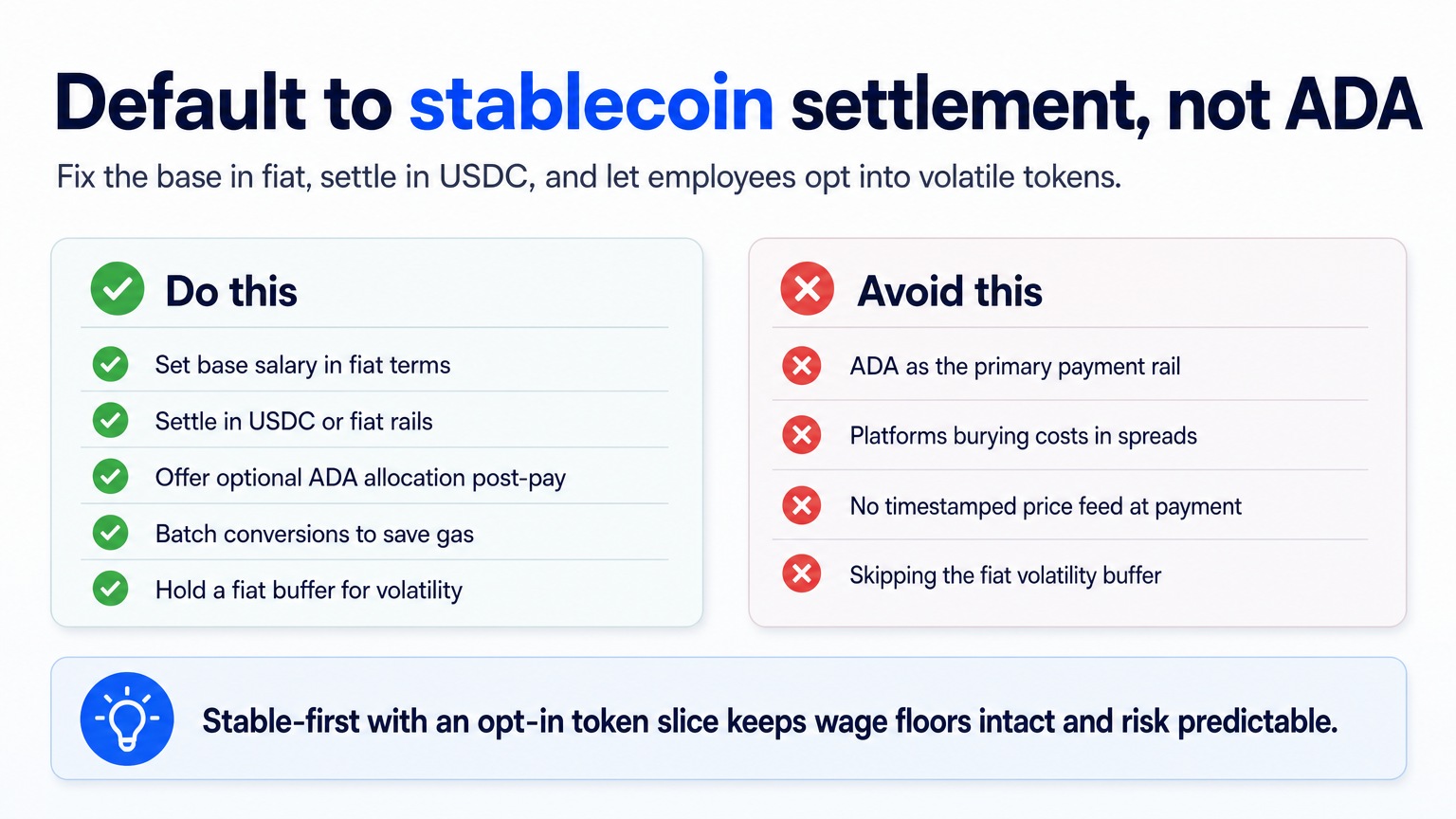
Don’t build payroll around ADA as the primary payment rail. Set the base salary in fiat terms, settle in USDC or fiat, and offer an optional percentage of net pay that the employee can elect to receive in ADA or another volatile token. This keeps the wage-and-hour floor intact and moves speculative exposure to the employee’s decision point.
If you do allow a portion of salary to be swapped into a token, batch the conversion to a single on-chain transaction once per pay period to minimize network fees. Hold a fiat buffer sufficient to cover any short-term volatility if you commit to a fixed-dollar value. Record the fair market value at the moment of payment using a timestamped price feed, a practice that platforms like Deel are now integrating with AI-driven valuation feeds.
A neobank that offers free USDC on/off-ramp, transparent FX, and multi-currency accounts reduces the variable cost of hybrid payroll. For example, OneSafe’s USDC transfers incur zero fee, and FX conversions are priced at 0.25%—numbers that make a recurring payroll run predictable. Avoid platforms that bury conversion costs in spreads.
What to watch next and open questions
As of October 23, 2026, Cardano’s vision remains a concept. No specific custody partner, smart contract standard, on/off-ramp integration, or fee schedule has been released. Until those details materialize, founders should treat it as an early signal, not an operational option.
Recent regulatory shifts, such as the OCC’s finalization of the GENIUS Act for stablecoins in October 2026 and MiCA’s implementation, suggest that stablecoin payroll may soon get clearer rules. But no agency has yet issued a ruling on the permissibility of volatile token wages for non-exempt employees. The GENIUS Act may accelerate stablecoin adoption as a compliant payroll rail, indirectly influencing the ADA payroll debate. If regulators provide a clear framework for stablecoin payment of wages, the inertia behind stablecoin-first platforms will likely harden into a de facto standard, relegating single-token payrolls to the fringes—viable only for contractor relationships where the recipient explicitly opts in and bears the risk. The production usage of stablecoins in business payments has already reached 18%, a trend that points toward stablecoin default.
What just changed with Cardano's ADA payroll vision?
Cardano’s October 22, 2026 proposal to pay employees in ADA, a native blockchain token, broke the stablecoin-only mold that has dominated crypto payroll. Unlike stablecoin settlement, this introduces significant price volatility into a fixed-value obligation, forcing businesses to reconsider risk and compliance.
Is it legal to pay wages in crypto?
The answer depends on jurisdiction and worker status. In the U.S., paying W-2 employees in volatile crypto may violate minimum wage and overtime requirements if the value falls below the legal floor at conversion. For independent contractors, crypto payments are generally permitted, but the tax treatment differs. Stablecoin settlement is under less legal scrutiny than volatile token payroll.
How is crypto payroll taxed?
The IRS treats crypto as property. Employers paying employees in crypto must report the fair market value at the time of payment on a W-2 or 1099 and withhold income and payroll taxes accordingly. For employees, the crypto later sold may trigger capital gains. Detailed record-keeping is essential—a task that often leads employers to crypto payroll compliance platforms with integrated tax modules.
What happens if an employee is paid in ADA and the price drops before conversion?
The employee receives less purchasing power. If the employer guaranteed a dollar-equivalent wage, the employer must cover the shortfall, adding an immediate cost. If not, the employee bears the loss, which could lead to morale issues and potential wage claims if the effective rate dips below minimums. This is why volatile tokens are a poor default for recurring salary obligations.
How do stablecoins reduce crypto payroll risk?
Stablecoins like USDC are designed to maintain a 1:1 peg with the U.S. dollar, so a $5,000 salary sent as 5,000 USDC retains its nominal value until the employee converts it. They eliminate the intraday volatility risk of a single-token payroll, making them the settlement asset of choice for risk-averse crypto payroll operations.
Do crypto payroll platforms require KYC and AML checks?
Yes. Any platform that interfaces with fiat banking or facilitates conversions typically runs KYC on employers and often on employees, especially if it provides off-ramps. Know Your Business (KYB) checks are standard for corporate accounts. As MiCA and other frameworks extend their reach, these requirements are becoming more uniform across providers.
How should finance leads account for crypto payroll in their books?
Record the USD value of the payment at the time of transfer as a compensation expense. If a stablecoin is used, the value is straightforward. For volatile tokens, you must use a verifiable price feed. Any difference between the booked value and the eventual sale by the employee is not the employer’s concern unless a top-up guarantee was made. Many crypto payroll taxes tools will timestamp and record the value automatically.
Can a startup or DAO run hybrid fiat/crypto payroll without a dedicated payroll provider?
Yes, if the entity uses a crypto-friendly neobank with fiat accounts, stablecoin custody, and accounting integrations. For W-2 employees, you’ll still need to manage tax calculations manually or with a third-party service. For contractor-heavy DAOs, a neobank can handle both fiat and crypto payments, but you must maintain your own records for tax filing, following cross-border treasury best practices.
What crypto rails and tokens are practical for payroll?
For payroll, stablecoins on low-cost networks (USDC on Ethereum L2s, Solana, or Polygon) are the most practical. Tokens like USDT and DAI also work, but USDC has the broadest institutional support. Native volatile tokens like ADA, ETH, or BTC are only practical as supplemental, employee-elected allocations, not as the primary salary rail. The fee and speed profile of the network matters as much as the token itself.
Key Takeaways
- Cardano’s ADA payroll pitch adds fresh urgency to a cost analysis that stablecoin-first platforms often skip: the implicit expense of volatility.
- Founders should default to stablecoin or fiat settlement, reserving volatile token payroll as an optional, employee-directed benefit after the base salary is fixed.
- Total payroll cost includes FX, wire, and network fees—not just a platform’s headline rate—so a neobank with transparent pricing can simplify the math.
- Regulatory clarity for crypto payroll is still absent for non-stablecoin wages, making volatile token payroll a compliance risk for W-2 employees.
- Hybrid fiat/crypto flows using free USDC rails and known FX rates are currently the most cost-predictable option for global teams.
Ready to run payroll with predictable costs and stablecoin settlement? Explore OneSafe’s hybrid fiat/crypto platform.
Sources