On October 22, 2026, Hackread reported that the Cardano ecosystem is making a direct case for paying salaries in ADA (Hackread, October 22, 2026). For finance and operations leads, the announcement forces a choice most SERP comparisons ignore: denominate compensation in a volatile L1 token, or run payroll on blockchain rails while settling in stablecoins or fiat. That decision changes crypto payroll taxes, FX cost, custody architecture, and DAO governance.
Table of Contents
- What just happened: Cardano’s ADA payroll pitch
- Why it matters now: two definitions of crypto payroll collide
- The crypto payroll baseline a newcomer needs
- What the SERP misses: the hybrid fiat/crypto operations layer
- Concrete implications and recommended actions
- What to watch next and open questions
- What is crypto payroll software?
- Can employers pay employees in crypto?
- How are crypto payroll taxes handled?
- What does crypto payroll compliance require?
- How does crypto-to-fiat payroll work?
- Can a DAO run crypto payroll without a traditional bank?
- Key Takeaways
What just happened: Cardano’s ADA payroll pitch
The October 22, 2026 Hackread report, dated and attributed
The Hackread piece, published October 22, 2026, highlights that Cardano proponents believe ADA can serve as a salary token, citing the network’s scalability and growing acceptance of digital assets. The report does not describe a new software launch or partnership. It is an ecosystem advocacy document.
What the ADA payroll argument is — and what it is not
The argument is that a maturing digital economy needs payroll infrastructure denominated in the native assets people already hold and use, and that ADA’s proof-of-stake design makes it a more defensible candidate than earlier proof-of-work tokens. It is not a claim that ADA solves crypto payroll compliance, withholding, or accounting integration. The report does not address how an employer would reconcile a W‑2 with a volatile token or manage a crypto-to-fiat payroll conversion. It positions ADA payroll as a cultural and strategic stance, without a product to operationalize it.
Why it matters now: two definitions of crypto payroll collide

Crypto-funded payroll versus crypto-denominated salary
Most crypto payroll vendors split. Bitwage and BitPay treat crypto as the funding rail: the worker might receive fiat, or sees crypto only briefly before conversion. Deel and now Cardano’s ADA pitch treat employees receiving crypto directly — an employer choosing to pay employees in crypto — often with an option to hold. That is crypto-denominated salary, and it re‑denominates the employment obligation in an asset whose value can move sharply between pay periods.
Why a native token salary changes withholding, FX, and volatility exposure
When a US employer pays an employee in ADA, the Fair Labor Standards Act still requires that wages meet the minimum wage in US dollars at the time they are paid (Thomson Reuters tax blog). The employer must calculate crypto payroll taxes on the dollar value at the moment of payment, remit payroll taxes in fiat, and manage the difference if the token’s value drops before disbursement. For non-US employees, converting ADA to local currency triggers taxable events and may push the effective salary below statutory thresholds.
The crypto payroll baseline a newcomer needs
What crypto payroll software actually does
Crypto payroll software automates salary, contractor, and contributor payments on blockchain rails. Most platforms calculate gross-to-net in fiat, convert the designated amount into crypto at the moment of transfer, handle on-chain settlement, and provide compliance records with transaction hashes and time-stamped USD values.
Legal, tax, and KYC/AML reality in a paragraph
Employers remain responsible for all employment taxes, withholding, and local labor law compliance even when payouts happen in crypto (Rise, Bvnk). KYC and AML checks are standard. The legality of paying wages in crypto varies: the US Department of Labor permits it if the employee receives at least the minimum wage in US dollars for the pay period, but several states have additional restrictions. Crypto payroll taxes are applied on the fair market value of the crypto at the time of payment.
Why stablecoins became the default risk control
Stablecoins let an employer denominate salary in a familiar unit of account while still using crypto rails for speed, programmability, and cross‑border settlement. That decouples settlement advantage from price risk. It is why 18% of stablecoin payments are now in production, not just pilots, and why most payroll guides list stablecoin payroll as the safest starting point (Acctual, ZenGo).
What the SERP misses: the hybrid fiat/crypto operations layer
No ranking page models what happens when a company or DAO holds its operating capital in fiat but pays contributors in crypto — or vice versa.
DAO contributor payroll: permissions, custody, and recurring approvals
A DAO running crypto payroll needs role-based permissions so multiple signers approve a payroll run, secure custody so contributor funds are not exposed to a single compromised key, and automated recurring payments that respect governance votes. OneSafe’s customizable roles and Fireblocks-backed custody let DAOs set multi‑signer thresholds for payroll disbursements while maintaining fiat sub‑accounts for treasury management. Without that architecture, a DAO reverts to a single-signer hot wallet or cobbled-together Gnosis Safe scripts.
Volatile-token timing risk after a payroll run
Even if an employer values ADA at the precise moment of transfer, the employee may not liquidate until hours or days later. In a drawdown, a salary paid at $1.20/ADA could be worth $0.80 by conversion. That post‑run devaluation risk is what stablecoin payroll avoids: USDC may depeg briefly, but the deviation is typically under 1%, while an L1 token can lose 20% or more in a single trading day.
Fee math when payroll crosses fiat and crypto
A crypto-to-fiat payroll or fiat-to-crypto payroll run introduces multiple cost layers. Below is a simplified model for a $50,000 monthly payroll batch.
| Cost category | USDC payroll (via OneSafe) | ADA payroll (L1‑denominated) |
|---|---|---|
| Crypto deposit/withdrawal | Free (USDC) | Variable on-chain gas + exchange spread |
| Fiat on‑ramp (deposit) | 0.15% fee | 0.15% fee + wire fees ($10–$25) |
| FX conversion to token | None (1:1 peg) | 0.25%‑1% spread, plus possible liquidity slippage |
| Wire/SWIFT out to recipients | $0 if crypto settlement only | N/A — employees receive ADA |
| Volatility buffer (employer) | None | Must hold extra ADA to cover price drop between grant and settlement |
| Custody/approval overhead | Included in platform role‑based controls | Requires separate multisig setup or hot‑wallet risk |
The settlement layer is cheap; the denomination choice is expensive.
Accounting integration and reimbursement workflows
When payroll runs in a token like ADA, the USD value recorded at payment may differ from the value when the employee liquidates, but the employer’s books must reflect the original fair value. A platform with accounting integration — OneSafe’s, for example — can auto‑tag each transaction with a timestamped fiat equivalent and generate reports for tax filings. Without that integration, crypto payroll becomes a reconciliation nightmare.
Concrete implications and recommended actions
If you are weighing ADA or another volatile L1 for payroll
Separate the settlement layer from the compensation currency. Use stablecoin payroll — USDC is the current default — to preserve speed and programmability without forcing contributors into speculative positions. If contributors want ADA exposure, offer it as an optional allocation after base salary is settled in a stablecoin or fiat.
If you want crypto speed without taking volatility
Choose a platform that handles both fiat and crypto natively. US employers paying contractors in Latin America or Asia can fund a USDC payroll from a USD balance, avoid SWIFT delays, and let the recipient withdraw to a local bank account. OneSafe’s free USDC deposits and withdrawals, combined with 0.25% FX on fiat conversions, remove much of the fee friction.
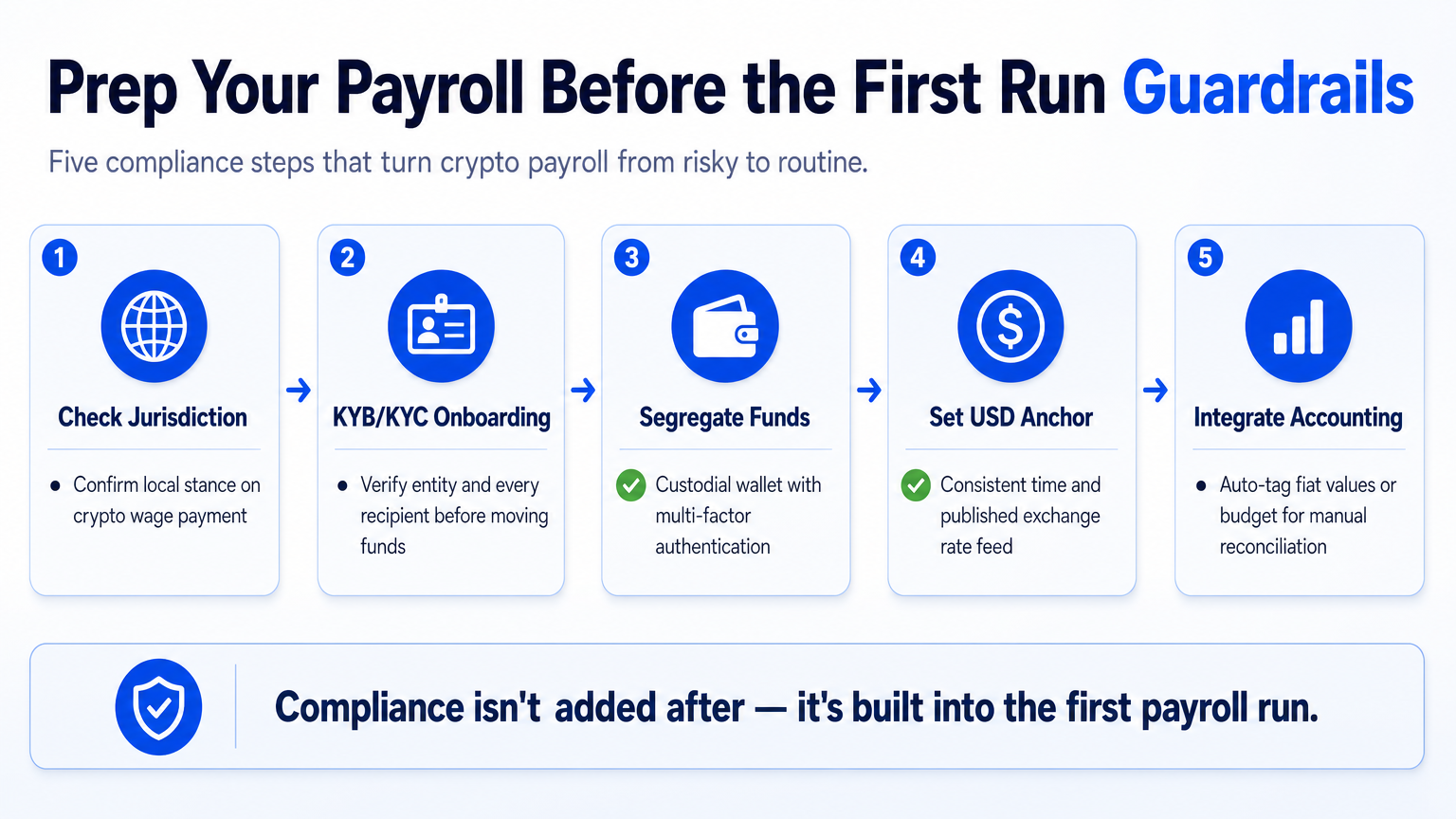
Compliance guardrails to set before the first payroll run
- Confirm the jurisdiction’s stance on wage payment in crypto — consult local employment counsel.
- Set up KYB and KYC for the entity and every recipient before a single satoshi moves.
- Insulate payroll funds in a segregated, custodial wallet with multi‑factor authentication.
- Schedule payroll at a consistent time and tie the USD value to a single oracle or exchange rate feed with a published methodology.
- Integrate accounting from day one. If your crypto payroll platform does not offer automated fiat‑value tagging, budget for manual reconciliation or switch providers.
What to watch next and open questions
Will other L1 ecosystems follow Cardano’s payroll push?
Cardano’s ADA payroll advocacy is unlikely to be the last. Solana, Avalanche, and Bitcoin L2 ecosystems have discussed payroll but not yet mounted a coordinated campaign.
Will tax authorities issue stablecoin-specific payroll guidance?
The US is moving, but not on payroll explicitly. In October 2026, the OCC finalized the GENIUS Act rule for stablecoin regulation, providing clarity on reserves and redemption — but it did not address employment tax treatment (OneSafe analysis). South Africa has revised cross‑border crypto treasury rules but not payroll-specific guidance (Treasury management update). The gap between stablecoin payment adoption and payroll-specific tax guidance remains wide.
How will DAO payroll standards formalize?
DAOs currently operate in a governance gray zone. As DeFi compliance frameworks harden — catalyzed by MiCA in Europe and the recent $1B flash loan attack — expect DAO payroll to converge on mandatory multi‑signer approval, stablecoin denomination by default, and real‑time audit trails that link on‑chain payments to off‑chain contributor agreements.
What is crypto payroll software?
Crypto payroll software automates the calculation, conversion, and on‑chain disbursement of salary, contractor, or contributor payments in cryptocurrency. It typically handles fiat‑to‑crypto conversion at the moment of transfer, generates transaction records for tax reporting, and integrates with accounting tools (Rise, Bvnk).
Can employers pay employees in crypto?
Yes, with conditions. US employers must comply with FLSA minimum wage requirements, withhold federal and state payroll taxes on the USD equivalent, and ensure the payment method does not violate state‑specific rules. Because the tax obligation is on the employer, paying in a volatile asset creates administrative complexity.
How are crypto payroll taxes handled?
In the US, crypto payroll is taxed like any other wage: the fair market value of the crypto at the time of payment is subject to federal income tax withholding, Social Security, and Medicare. Employers file the same W‑2 or 1099 forms, with the crypto value reported in USD.
What does crypto payroll compliance require?
Crypto payroll compliance requires KYC/KYB onboarding for the entity and recipients, tax withholding on the fiat value at payment, minimum wage compliance, and transaction records that link on‑chain payments to payroll runs. Running payroll without KYC/AML is a regulatory red flag in nearly every major jurisdiction.
How does crypto-to-fiat payroll work?
A crypto-to-fiat payroll converts crypto into fiat, or fiat into crypto, at the moment of settlement. The employer or platform applies a conversion spread, records the fiat value, and settles the recipient in the chosen currency. The conversion is what triggers taxable events and FX cost — not the blockchain settlement itself.
Can a DAO run crypto payroll without a traditional bank?
Yes. A DAO can use a neo‑banking platform that supports both fiat and crypto to pay contributors in stablecoins or tokens. The missing pieces are usually governance and custody: multi‑signer approval workflows, role‑based permissions, and secure custody that does not rely on a single individual’s wallet. OneSafe provides customizable roles and Fireblocks custody specifically for DAOs.
Key Takeaways
- Crypto payroll now demands a clear choice: use crypto as a settlement rail with stablecoins, or denominate salaries directly in a volatile L1 token like ADA.
- Volatile-token payroll introduces post‑run timing risk that stablecoin payroll eliminates, and the employer remains responsible for minimum wage and withholding regardless of asset price movements.
- DAO payroll requires multi‑signer approvals, role‑based permissions, and segregated custody — operational needs that generic wallet tooling does not solve.
- A hybrid fiat/crypto operations platform that integrates accounting, supports both fiat and USDC with low or zero fees, and offers DAO‑grade controls makes crypto payroll practical without forcing speculation.
- The Cardano ADA payroll announcement (October 22, 2026) is not a product but a cultural signal; the operational gap it exposes will be filled not by a token, but by compliant, multi‑currency financial infrastructure.
For businesses and DAOs that need to run crypto payroll securely, with multi‑currency accounts, automated compliance, and role‑based governance, set up a free OneSafe account today.