On October 22, 2026, American Banker reported that Visa and Mastercard both released AI and blockchain-related products in recent days—and that an unconfirmed rumor circulated of a potential $2.5 billion Visa-Fireblocks acquisition. For crypto banking in 2026, the signal isn’t whether that deal closes. It’s that the legacy card networks are now racing to build the same fiat-plus-crypto infrastructure that operating businesses and DAOs are already using through neo-banking platforms.
Table of Contents
- The Visa–Fireblocks Signal: Crypto Banking’s Inflection Week
- What It Means for Web3 Startups and DAOs—Right Now
- The Real-World Stack: Accounts, Cards, Wires, and Stablecoin Rails
- Onboarding a DAO or Global Business in Under a Week
- What to Watch Next: Earnings, Regulation, and the Stablecoin Layer
- Key Takeaways
The Visa–Fireblocks Signal: Crypto Banking’s Inflection Week
What Actually Dropped
American Banker’s John Adams reported that both card brands had released services in the preceding days. Visa introduced tools for agentic commerce and digital assets, including new analytics for supplier payments. Mastercard also released AI and blockchain-related products. Separately, a rumor circulated that Visa could acquire Fireblocks for $2.5 billion. Visa declined to comment. A Fireblocks spokesperson said the rumor “is news to us, and not true.”
On the regulatory side, an undated FDIC publication on FDIC.gov clarifies the process for banks to engage in crypto-related activities—another sign that crypto banking is no longer an off-limits category.
The takeaway: Card networks don’t ship agentic-commerce tools and custody-adjacent infrastructure in the same week unless they believe programmable money is becoming a payments revenue line. The denial matters less than the cadence.
Build vs. Buy in Crypto Infrastructure
Visa’s agentic-commerce and supplier-payment analytics imply a build-first strategy—extending existing rails. A $2.5 billion Fireblocks acquisition rumor implies a buy-over-build appetite for custody. The practical answer: the rumor is unconfirmed; the product releases are not. Visa can build payment intelligence in-house while still exploring strategic acquisitions. Both paths point to the same destination: legacy infrastructure absorbing crypto-native rails. That’s the consolidation pattern covered in Web3 Payments Consolidate: Key M&A Signals for DAOs.
Why October 2026 Matters
Visa and Mastercard report third-quarter earnings next week. Investors will be watching value-added services revenue, including the new AI and blockchain products. Meanwhile, institutional outlooks from Deutsche Bank’s Outlook for digital assets 2026 and Coinbase Institutional’s 2026 Crypto Market Outlook frame digital assets as a maturing treasury and payments layer—not a speculative sidecar. For operating businesses, the window is closing on the excuse that “banks aren’t ready.” The infrastructure already exists outside the legacy bank charter.
What It Means for Web3 Startups and DAOs—Right Now
The Crypto Banking Gap
For most Web3 startups and DAOs, the daily problem is not whether Visa buys Fireblocks. It’s that legacy banks still treat crypto as a compliance exception rather than a treasury default. A DAO may hold operational funds in stablecoins but still needs to pay a contractor in EUR, settle a vendor invoice in USD, or issue a corporate card with spend limits. Acquisition headlines don’t open accounts. That practical gap is the same lesson from Kraken Buys a Bank: What Crypto Banking Means Now: a bank charter or custody deal doesn’t automatically create an operating stack for decentralized teams.
A Single Fiat+Crypto Platform
A unified fiat and crypto platform collapses the fragmented workflow: one interface for multi-currency accounts, wires, cards, on/off-ramps, and crypto custody. Instead of maintaining a traditional bank account, a crypto exchange, a card issuer, and a custody provider, a DAO can manage Web3 financial operations in one place with role-based permissions and automated payment workflows. This is neo-banking for DAOs: not a bank charter, but a financial operating system built on partner banks and crypto-native custody.
Fireblocks Custody Without an Acquisition
Fireblocks custody does not require Visa to acquire Fireblocks. Multiple financial platforms already use Fireblocks to secure digital assets today. A global business or DAO can hold assets with institutional-grade digital asset custody without waiting for a legacy network to close a deal. The working model—bank-grade fiat rails plus Fireblocks custody in a single platform—already exists.
Regulatory Tailwinds
The FDIC crypto banking guidance clarifies how banks can engage in crypto-related activities. The GENIUS Act in 2026 is described as a strategic inflection point for US banks, and the White House’s May 2026 action on fintech innovation pushes regulators to integrate innovation. For DAOs, the compliance edge is real: platforms that already run KYB, transaction monitoring, and segregated accounts are closer to what the new rules will require. The OCC’s stablecoin rule (OCC GENIUS Act Final Rule: Stablecoin Regulation Update) reinforces that direction.
The Real-World Stack: Accounts, Cards, Wires, and Stablecoin Rails
Global Multi-Currency Accounts
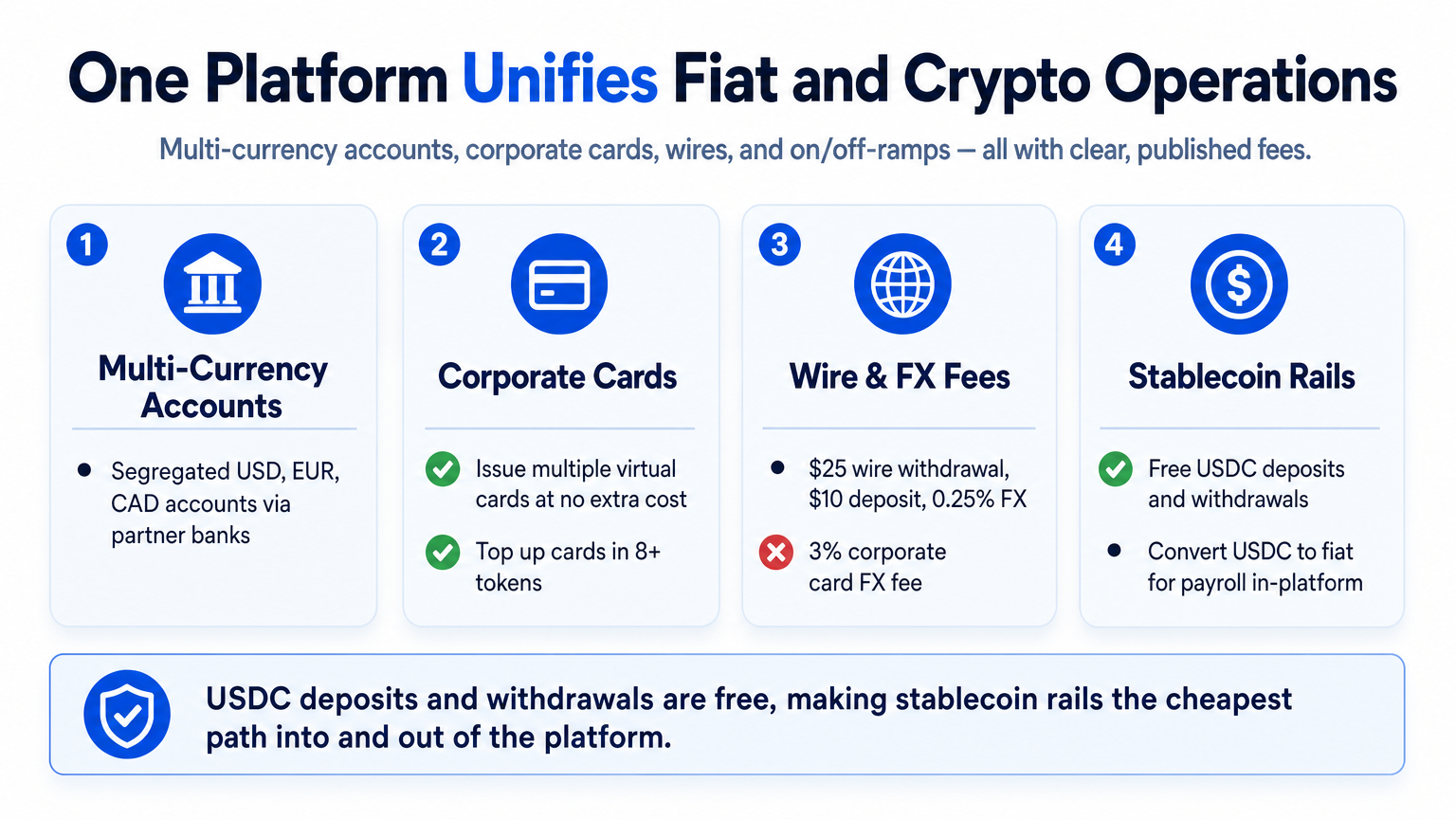
A financial technology company can offer global business crypto accounts through partner banks without being a licensed bank itself. Segregated accounts in USD, EUR, and CAD, with local payment rails and international wires, are delivered as software. For a Web3 startup incorporated in one country but paying contractors in three currencies, this removes the need for multiple banking relationships.
Corporate Cards and Crypto Top-Ups
Crypto corporate cards bridge on-chain assets to real-world spend. Teams can issue multiple virtual cards at no extra cost, set spend limits, and top up cards in 8+ tokens. Vendor payments, software subscriptions, and travel expenses don’t require a manual off-ramp first.
Wire and FX Fees
Here is a concrete fee schedule from a fiat and crypto platform:
| Fee type | Published fee |
|---|---|
| Fiat deposit / withdrawal | 0.15% |
| Wire withdrawal | $25 |
| Wire deposit | $10 |
| SWIFT deposit / withdrawal | 0.35% + $50 |
| FX conversion | 0.25% or prevailing FX rate |
| Corporate card FX fee | 3% |
| USDC deposit / withdrawal | Free |
For a DAO moving $50,000 from crypto to fiat via USDC and then sending a $50,000 international wire, the primary costs are the wire fee and the FX conversion—not a hidden custody or on-ramp margin. USDC deposits and withdrawals are free, making stablecoin rails the cheapest path into and out of the platform.
On/Off-Ramp as Everyday Treasury
When on/off-ramp functionality is embedded in the same account, converting USDC to USD for payroll or converting EUR revenue to USDC for treasury is a routine transaction—not a multi-day exchange workflow. That’s the shift described in Stablecoin Payments Cross a New Border in 2026: stablecoins are becoming corporate treasury plumbing.
Onboarding a DAO or Global Business in Under a Week
KYB That Feels Like Onboarding
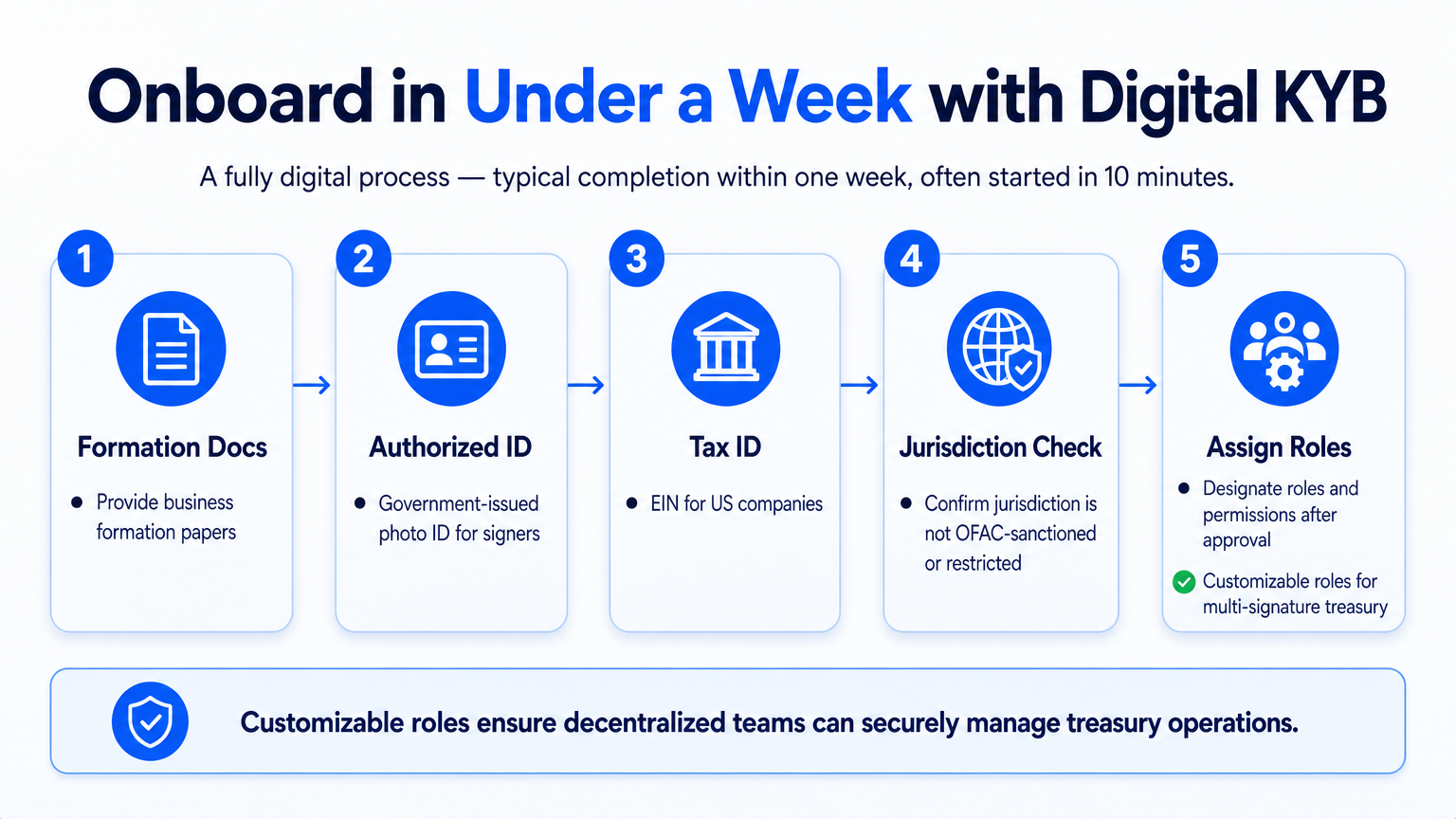
Onboarding still requires Know Your Business (KYB), but it’s fully digital, typically completed within a week, with the initial application often started in 10 minutes or less. A practical checklist:
- Business formation papers
- Government-issued photo ID for authorized signers
- EIN for US companies
- Confirmation that the operating jurisdiction is not OFAC-sanctioned or a restricted US state
- Designation of roles and permissions after approval
Permissions for Decentralized Teams
DAOs need more than a login. Customizable roles let a treasury team separate who can view balances, approve payments, and initiate wires. Secure custody and automated payment workflows mean a multi-signature approval process maps to the platform rather than being improvised across chat tools. That’s the operational layer most banks still don’t offer to decentralized organizations.
What to Watch Next: Earnings, Regulation, and the Stablecoin Layer
Visa and Mastercard Q3 Earnings (Next Week)
According to the October 22 American Banker report, both companies announce third-quarter earnings next week. Watch value-added services revenue, any commentary on digital-asset or agentic-commerce product uptake, and whether either addresses acquisition strategy. For DAOs, earnings guidance is a signal of how fast legacy rails will chase the same flows stablecoin banking already captures.
Agentic Commerce Meets Programmable Money
Visa’s supplier-payment analytics point to a future where software agents initiate, approve, and settle payments. When agentic commerce meets programmable money, the distinction between a bank account and a smart contract becomes an implementation detail. For DAOs, automated payment workflows and invoice matching are becoming table stakes.
The Stablecoin Bridge
If corporate treasuries begin using stablecoins for cross-border settlement, the legacy correspondent banking layer loses its toll booth. Stablecoin banking is the bridge corporate treasury teams will cross before consumers do. For a DAO perspective on incumbent moves, see Standard Chartered Crypto Banking Move: What It Means.
Key Takeaways
- The Visa–Fireblocks rumor is unconfirmed, but the October 22, 2026 product releases confirm AI and blockchain are now core card-network strategy.
- For operating Web3 startups and DAOs, the day-to-day gap is having one platform for fiat accounts, cards, wires, and crypto custody.
- A single fiat and crypto platform can deliver multi-currency accounts, corporate cards, Fireblocks custody, and on/off-ramps today, with onboarding typically under a week.
- Transparent cost: 0.15% fiat deposits/withdrawals, $25 wire withdrawals, 0.25% or prevailing FX rates, and free USDC deposits/withdrawals.
- Watch Q3 earnings next week for signals on how Visa and Mastercard monetize agentic commerce and stablecoin flows.
To bring your DAO or global business onto a fiat and crypto platform built for Web3 financial operations, start onboarding here.