On October 5, 2026, a quiet update to Circle’s legal terms surfaced that upends a core assumption of stablecoin regulation: that a fully authorized issuer will always honor redemptions at par, on demand. The news, reported by CryptoRank that same day, reveals that Circle can temporarily delay European USDC redemptions if reserve assets cannot cross borders during a failed rebalancing under MiCA stablecoin rules. This Circle USDC redemption delay isn’t a theoretical edge case; it’s a live clause in the terms of the second-largest regulated stablecoin, and it immediately raises the urgency for any business that relies on USDC for crypto cross-border payments, treasury, or payroll. Below, we unpack exactly what changed, why it matters, and the concrete steps you can take to de-risk your stablecoin operations without abandoning the efficiency of crypto payments.
Table of Contents
- What just changed with Circle and USDC redemptions in Europe?
- How are stablecoins regulated in the US and abroad right now?
- What does this mean for my business’s crypto cross-border payments and treasury?
- How can I build a business stablecoin strategy to protect my company?
- What should I look for in a stablecoin partner post-MiCA?
- Is OneSafe a way to manage stablecoin operations safely?
- Open Questions & What to Watch Next
- Key Takeaways
What just changed with Circle and USDC redemptions in Europe?
Circle’s MiCA license, obtained through its French entity, allows it to co-issue USDC across the European Economic Area while keeping a substantial portion of reserves in U.S. Treasuries held outside the Eurozone. The clause, found in Circle’s publicly posted USDC Terms, states that if redemptions require moving reserve assets across borders—for instance, from U.S. custodians to European banks—and that transfer is blocked, Circle may pause redemptions until the USDC reserve rebalancing is completed. This isn’t discretionary; it’s a mechanical consequence of MiCA’s requirement that reserves be “located” consistent with local law. In practice, a sudden surge of European redemption requests could outstrip the onshore reserve buffer, forcing a multi-day wait as assets move abroad.
MiCA stablecoin rules were sold as a guarantee of bank-like protections, but this clause shows that stablecoin compliance reduces—not eliminates—operational liquidity risk. A European business expecting same-day conversion to euros could face settlement delays that disrupt supplier payments or payroll.
How are stablecoins regulated in the US and abroad right now?
MiCA’s Bold Promise and Its First Stress Test
The EU’s Markets in Crypto-Assets regulation imposes strict reserve requirements, segregation of funds, and redemption-at-par obligations. Yet, as Circle’s delay clause illustrates, MiCA’s cross-border provisions introduce a subtle tension: token holders are protected, but moving reserves between jurisdictions can create temporary bottlenecks. The European Parliament’s 2021 briefing flagged this risk, noting that cross-border co-issuance requires “additional safeguards” for continuous redemption liquidity. Now, those safeguards materialize as a permissible delay, not a prohibition.
US Regulation: Waiting for the Genius Act
In the United States, stablecoin regulation remains a patchwork. The Genius Act stablecoin framework (Guiding and Establishing National Innovation for US Stablecoins Act) was introduced in 2025 and would create a federal licensing regime with oversight split between the Federal Reserve and state regulators. But as of October 2026, it hasn’t passed. States like New York continue to regulate through their own frameworks, leaving issuers to navigate a multi-state environment that doesn’t mirror MiCA’s harmonization. The SEC’s 2025 stablecoin regulatory framework paper warned that fragmented oversight could cause “asymmetric redemption risks”—a warning now prescient.
The Global Patchwork and Its Compliance Burden
Jurisdictions from Singapore to Switzerland are crafting bespoke regimes, forcing multi-jurisdictional issuers to maintain parallel compliance stacks. This fragmentation means where you hold a stablecoin can dictate how quickly you can access its value, as Circle’s regional redemption terms now show.
What does this mean for my business’s crypto cross-border payments and treasury?
Firms that use USDC as a float for weekly payroll, supplier settlements, or inter-company transfers now face a new counter‑party risk: not solvency, but liquidity timing. During a market stress, a wave of European redemptions could delay conversions for hours or even days, turning a predictable cash‑management model into a scramble for bank lines. As enterprises embed stablecoin rails deeply into their payment stacks—see stablecoin payments news from US Bank, Marqeta, and BVNK—any friction directly feeds into real‑world settlement failure. The cross‑border dependency introduced by USDC reserve rebalancing means that a 48‑hour lag in crypto cross-border payments can cascade into missed payroll or broken supply-chain settlements.
How can I build a business stablecoin strategy to protect my company?
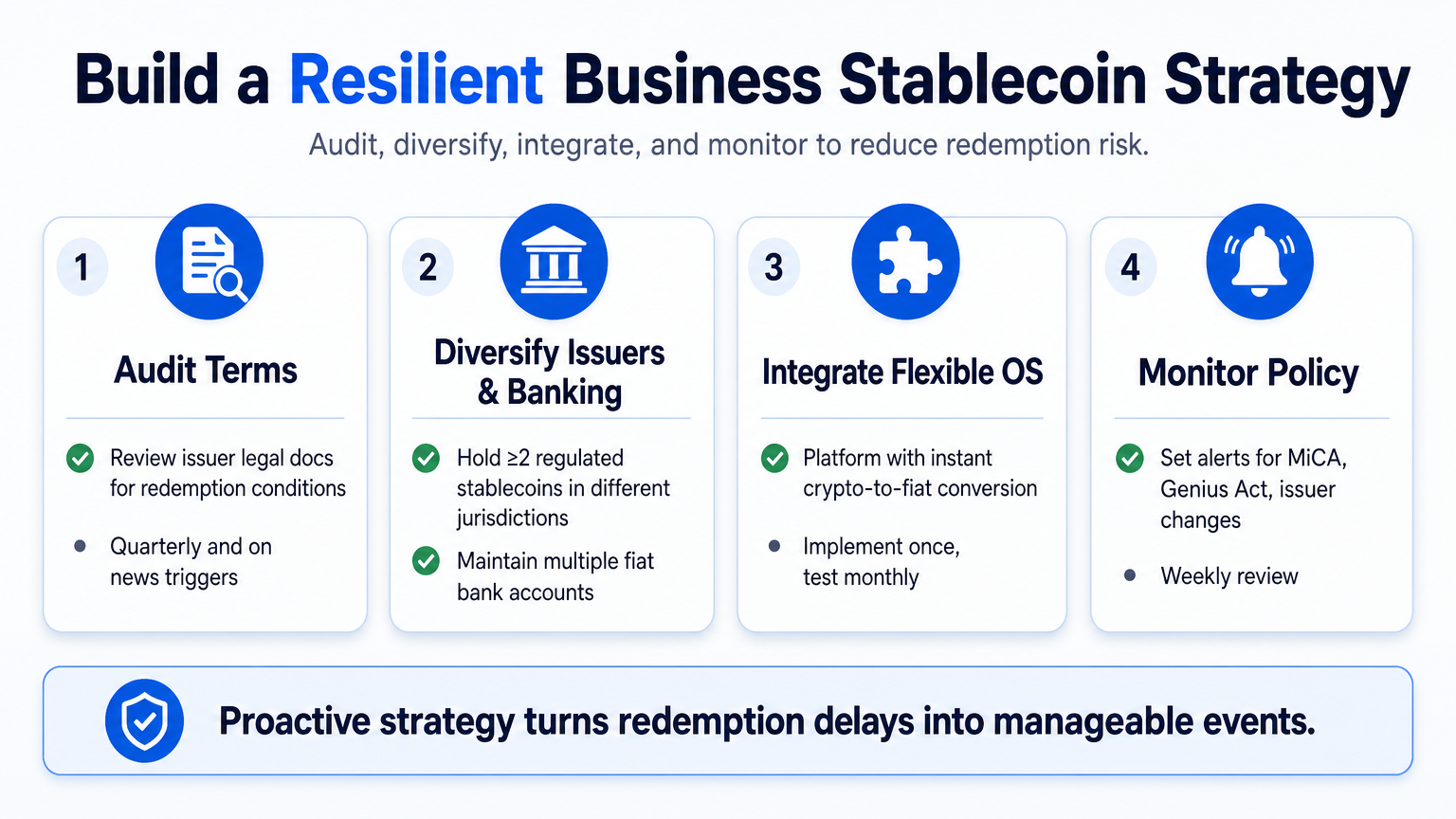
Audit Your Stablecoin Exposure and Issuer Terms
Map every stablecoin holding across entities, wallets, and exchanges. For each, read the current legal terms—not the marketing summary—to identify redemption conditions and cross‑border rebalancing clauses. Repeat quarterly.
Diversify Issuer and Banking Relationships
Concentrating liquidity in a single issuer magnifies any delay. Hold portions in regulated alternatives (e.g., EURC) and in different geographic wrappers. Similarly, maintain fiat accounts with multiple banks to avoid compounding redemption delays with a single SWIFT pipeline. The crypto banking risk uncovered by Tether’s EQIBank exposure shows how counterparty concentration is a hidden vulnerability.
Integrate a Flexible Financial OS
A unified platform that handles fiat and crypto natively—like OneSafe—can absorb redemption timing shocks. By enabling instant swaps between stablecoins, fiat currencies, and payment rails, it reduces the operational friction of moving funds from a delayed redemption into an urgent wire transfer.
Monitor Policy Movements and Set Triggers
Track regulatory developments from ESMA, the Fed, and US congressional committees. Set Google Alerts for “USDC terms update” and “cross‑border redemption delay.” Our MiCA review analysis outlines a similar vigilance framework for DeFi compliance.
| Step | Concrete Action | Frequency |
|---|---|---|
| Audit terms | Review issuer legal docs for redemption conditions | Quarterly and on news triggers |
| Diversify issuers | Hold at least two regulated stablecoins in different jurisdictions | Ongoing |
| Diversify banking | Maintain fiat accounts with multiple banks and neobank platforms | At least two active relationships |
| Integrate flexible OS | Use a platform that supports instant crypto‑to‑fiat conversion and multi-currency payments | Implement once, test monthly |
| Monitor policy | Set alerts for MiCA, Genius Act, and issuer term changes | Weekly review |
What should I look for in a stablecoin partner post-MiCA?

Post-MiCA, stablecoin compliance evaluation must move beyond reserve attestations. Key criteria:
- Redemption guarantees: Are they unconditional, or do they contain rebalancing caveats? Demand the legal language.
- USDC reserve rebalancing speed: How quickly can the issuer mobilize reserves across jurisdictions? Does it disclose reserve composition and custodians by region?
- Onshore reserve depth: Does the issuer maintain enough local reserves to handle redemption surges without cross-border transfers?
- Regulatory alignment: Is it fully licensed under MiCA, and does it have a clear path to compliance under the proposed Genius Act stablecoin framework?
- Operational transparency: Real‑time or daily attestations, coupled with proactive communication of term changes, are non-negotiable.
The Circle episode underscores that passporting a stablecoin under MiCA is not seamless, and your partner must demonstrate infrastructure that can withstand a liquidity stress without leaning on delay clauses.
Is OneSafe a way to manage stablecoin operations safely?
OneSafe doesn’t control issuer reserves, so it can’t prevent a Circle USDC redemption delay. But it provides a critical layer of operational resilience. Its unified fiat and crypto platform—with multi-currency accounts, free USDC deposits/withdrawals, and real‑time crypto‑to‑fiat conversions—lets you pivot quickly when a particular stablecoin rail stalls. For example, if a USDC redemption is delayed, you can immediately convert other stablecoin holdings to euros and send a wire, all within the same interface. With Fireblocks‑secured custody and mandatory MFA, you get crypto bank wallet-grade security without juggling separate exchanges and bank portals. For DAOs and global startups that need business continuity across fiat and crypto, a flexible financial OS becomes a strategic de‑risking tool.
Open Questions & What to Watch Next
- Will other issuers adopt similar clauses? If Circle’s clause becomes a template, other MiCA‑licensed stablecoins may embed rebalancing exceptions, eroding the trust MiCA was designed to build.
- The CFTC vs. SEC turf war continues to stall U.S. stablecoin regulation. Until the Genius Act stablecoin bill passes, the ambiguity over whether certain stablecoins are securities or commodities persists, potentially creating parallel redemption risks.
- Global harmonization looks distant. Without U.S. legislation that mirrors MiCA’s onshore reserve mandates, businesses may be incentivized to hold stablecoins in the jurisdiction with the most favorable liquidity terms.
Key Takeaways
- Circle’s MiCA‑required USDC redemption delay clause proves that regulated stablecoins are not always as liquid as bank deposits.
- Treat issuer redemption terms as a live operational risk, not a legal footnote.
- A business stablecoin strategy demands auditing exposure, diversifying issuers and banking rails, and integrating a flexible financial platform.
- Choose partners based on redemption guarantee language, onshore reserve depth, and multi‑jurisdictional liquidity, not just licenses.
- Platforms like OneSafe can’t prevent issuer‑side delays but reduce their operational impact by giving treasury teams agility to route around a stuck redemption.
Start future-proofing your cross-border treasury today by exploring a unified fiat and crypto financial platform at onesafe.io.