If you’re running a business or DAO that moves between fiat and crypto, “which bank is best for crypto?” is a daily operating decision. The answer isn’t a single institution—it’s a set of capabilities that few traditional banks offer, and that a dedicated business crypto account delivers. This guide gives finance leads and founders a practical scorecard for evaluating your options, using OneSafe’s verified fee and security data as a worked example.
Table of Contents
- The short answer
- Why most “best bank” pages miss the question
- What a crypto-friendly bank account is — and isn’t
- Questions founders and finance leads ask before choosing
- Evaluating a crypto bank in 2026: decision checklist
- OneSafe’s answer, with trade-offs
- Troubleshooting by symptom
- Bottom line
The short answer
For most Web3 startups, global businesses, and DAOs, the best crypto bank for business isn’t a chartered bank—it’s a crypto-friendly neobank like OneSafe that combines multi-currency fiat accounts, a corporate crypto card, and a native crypto on-ramp and off-ramp inside one platform. It isn’t a licensed bank, so your dollars sit in partner banks (with standard FDIC insurance), while digital assets are secured by institutional crypto custody for business from Fireblocks. The model now handles over $800 million in volume across 1,000+ businesses in 30+ countries—and it’s available without legacy bank overhead.
A global business bank account that unifies fiat and crypto rails works differently depending on your treasury:
- U.S. LLCs that only touch fiat might do fine with a fintech-backed account like Mercury (
mercury.com/web3), though it doesn’t custody crypto. - DAOs that pay contributors in USDC, hold treasury in multiple tokens, and need multi-sig role permissions find a purpose-built platform like OneSafe the closest fit.
- Enterprises needing direct market access often turn to custody-first providers like Coinbase Business (
coinbase.com/business), but they frequently lack the fiat rails (wires, ACH, bill pay) a full business account requires.
In short, the best choice is the platform where fiat and crypto operations meet with transparent fees, strong custody, and onboarding that fits your entity type.
Why most “best bank” pages miss the question
Pages that rank for “which bank is best for crypto” are nearly always consumer-banking homepages—checking accounts, savings APYs, branch maps. Forbes published its Best Online Banks Of 2026 analysis just hours ago (forbes.com/advisor/banking/best-online-anks/), and it’s entirely about APY and fees—nothing on crypto. These pages treat “safe” as synonymous with FDIC coverage, which doesn’t apply to digital assets.
Meanwhile, the infrastructure is moving on-chain: Yahoo Finance reported four days ago that Quant crypto surged 178% after securing a role in The Clearing House’s on-chain payments infrastructure (finance.yahoo.com/markets/crypto/articles/quant-crypto-alsts-3x-eek-162203311.html). Two days ago The Motley Fool noted that Jack Dorsey’s Block submitted paperwork for an uninsured national trust bank built for custody, particularly its Bitcoin business (fool.com/investing/2026/09/29/jack-dorsey-lock-s-ooking-t-reate-a-national-/). When the rails themselves are going on-chain, old-world bank lists are answering a question nobody’s really asking. A business crypto account demands a scorecard built around custody models, on-chain transaction support, DAO banking, and cross-border wires—none of which appear on a conventional rankings page.
What a crypto-friendly bank account is — and isn’t
The phrase “crypto bank” often confuses. A licensed bank holds a charter, takes deposits, and may lend. A fintech or neobank builds software on top of partner banks’ charters. OneSafe is a financial technology company, not a bank; its fiat accounts are provided through partner banks. That distinction matters for insurance and custody.
Are crypto deposits FDIC-insured?
No crypto deposit—at OneSafe or anywhere—is FDIC-insured. FDIC insurance covers only fiat deposits at member banks, up to $250,000 per depositor per bank. Digital assets held on OneSafe are not insured by the FDIC. Instead, crypto safety depends on the custody partner. OneSafe secures digital assets on Fireblocks, an institutional custody platform that uses multi-party computation (MPC) wallets, hardware isolation, and insurance policies on the custody infrastructure. This is the industry standard for crypto custody for business—akin to a bank vault for on-chain assets. (Detailed breakdown: OneSafe’s Crypto Bank Wallet: Definitive Guide for Businesses & DAOs.)
Questions founders and finance leads ask before choosing
Can a traditional bank run crypto payroll or vendor payments?
Rarely. Most won’t originate payments to a crypto wallet address or settle stablecoin invoices natively. A business crypto account closes that gap by letting you convert and pay from one interface, often with no USDC withdrawal fee.
What should I check in custody and security?
- Fiat custody: Is your dollar balance at an FDIC-insured partner bank? (For OneSafe, yes.)
- Crypto custody: Who holds the private keys? A qualified custodian or regulated infrastructure provider? (OneSafe uses Fireblocks.)
- Access controls: Multi-factor authentication (MFA) mandatory for every user.
- Insurance: What’s covered on the custody side and what’s explicitly not.
More in OneSafe’s First Crypto Bank: Definition, Claims, and What Businesses Need to Know.
What are the fees for wires, FX, and crypto?
| Transaction type | Fee |
|---|---|
| Fiat deposit / withdrawal | 0.15% |
| Wire withdrawal (domestic) | $25 |
| Wire deposit | $10 |
| SWIFT deposit / withdrawal | 0.35% + $50 |
| FX (currency conversion) | 0.25% or prevailing FX rate |
| Corporate card foreign exchange | 3% |
| Crypto deposit / withdrawal (USDC) | Free |
Zero USDC withdrawal fees matters when paying global contributors. For side-by-side comparisons, see 5 Best Crypto-friendly Business Bank Accounts in 2026.
How fast is onboarding?
Fully digital, typically within a week. Application starts in 10 minutes; KYB checks run in the background. No notarized signatures required.
What do DAOs need in a banking partner?
DAO banking requires three things traditional accounts lack:
- Customizable roles and permissions to mirror on-chain multisig governance.
- Secure treasury custody with a qualified custodian.
- Automated fiat/token payment workflows for contributor payroll in USDC and vendor invoices from one dashboard.
OneSafe was built with these in mind: granular permissions, Fireblocks custody, and automated cross-border payouts. For more, see Business Banking for Crypto Companies (mercury.com/web3) and Crypto-Friendly Business Bank Account: A Web3 Guide.
Who can open an account?
Registered businesses, startups, and DAOs globally, except OFAC-sanctioned countries and a few restricted US states. Over 1,000 businesses across 30+ countries.
Evaluating a crypto bank in 2026: decision checklist
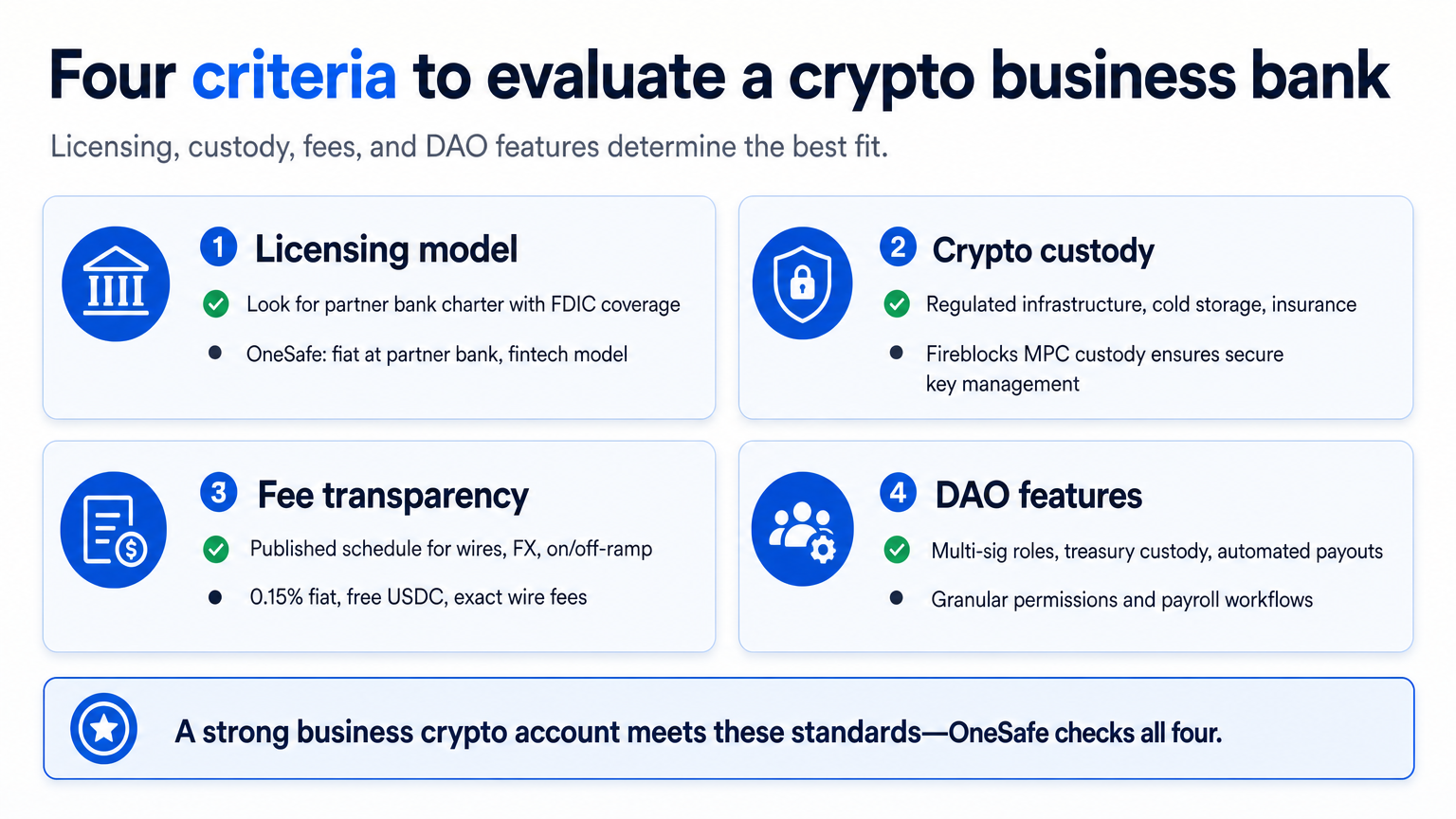
| Criterion | What to look for | OneSafe’s approach (example) |
|---|---|---|
| Licensing model | Partner bank charter; fiat FDIC coverage | Fiat at partner bank; OneSafe is a fintech |
| Crypto custody | Regulated infrastructure, cold storage, insurance | Fireblocks MPC custody |
| Fee transparency | Published schedule for wires, FX, on/off-ramp | 0.15% fiat, free USDC, exact wire fees |
| DAO features | Multi-sig roles, treasury custody, automated payouts | Roles & permissions, automated payments |
| Onboarding time | Digital, <two weeks | Within a week |
| Excluded jurisdictions | SANCTIONED countries, limited US states | Available worldwide except OFAC-sanctioned and select states |
Fee figures and availability per OneSafe’s October 2026 pricing; always check latest terms.
OneSafe’s answer, with trade-offs
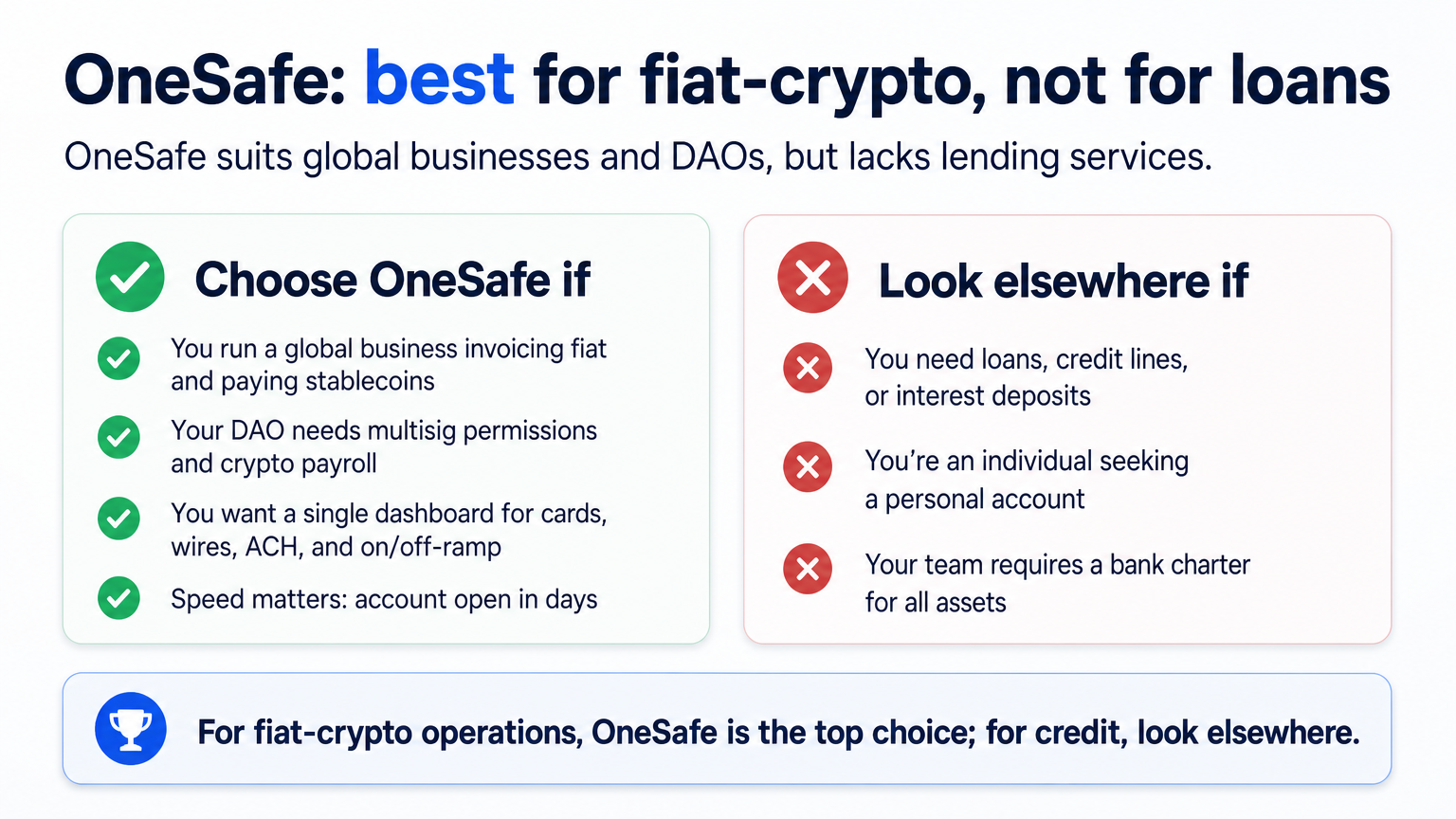
Choose OneSafe if:
- You run a global business or startup invoicing in fiat and paying in stablecoins.
- Your organization is a DAO that needs multisig-like permissions and automated crypto payroll.
- You want a single dashboard for corporate cards, wires, ACH, bill pay, and crypto on-ramp and off-ramp.
- Speed matters: account open in days, not months.
Look elsewhere if:
- You need loans, credit lines, or interest-bearing deposits (not offered).
- You’re an individual looking for a personal account (businesses and DAOs only).
- Your team insists on a bank charter and in-house FDIC for all assets, including crypto.
For a deeper comparison between production-ready crypto banking and pilots, read Crypto Banking’s New Split: Production vs. Pilots.
Troubleshooting by symptom
- Onboarding stuck: Verify you uploaded a valid government ID and complete formation documents; a missing EIN for US companies will stall. Contact
support@onesafe.io. - State/nation restriction: Not available in certain US states or OFAC-santioned countries; email support to check.
- Wire deposit missing: Allow 1–3 business days; confirm reference matches your account.
- USDC withdrawal not processing: Ensure the receiving wallet is whitelisted; if address correct and network clear, withdrawals are instant.
Bottom line
The best crypto bank for business isn’t a brand—it’s a platform that unifies fiat rails, institutional crypto custody for business, transparent fees, and DAO-ready controls. As the financial world moves on-chain—with The Clearning House’s infrastructure deal, the EC’s Pontes bridge for tokenized settlements, and Block’s trust bank application—platforms that handle both worlds are becoming the default operating system for modern treasuries. Ready to open a global business bank account that bridges fiat and crypto under one roof? Explore OneSafe’s global platform today.