A US asset seizure at Tether’s partner bank EQIBank has exposed a critical blind spot in crypto banking: counterparty risk that can freeze your funds. On October 5, 2026, The Paypers reported Tether’s exposure was less than 0.034% of total assets after US authorities moved on $84.2 million in assets tied to payments processor Capstone. The episode is a real-world stress test for the crypto fiat bridge Web3 startups, DAOs, and stablecoin users depend on daily.
Table of Contents
- What Just Happened: The Tether-EQIBank Asset Seizure
- Why It Matters Now for Crypto Banking Users
- The Background Every Founder Needs to Follow This Story
- Concrete Implications and Recommended Actions
- What to Watch Next
- What Does This Mean for Your Business? Direct Answers to Key Questions
- Key Takeaways
What Just Happened: The Tether-EQIBank Asset Seizure
The event: US seeks forfeiture of $84.2M, Tether confirms limited exposure
In July 2026, the US Department of Justice filed a civil forfeiture complaint targeting roughly $84.2 million in property connected to Capstone. A court order in September identified seized assets: $79.11 million in a Wells Fargo Securities account, $1.86 million in a Wells Fargo bank account, $2.06 million at JPMorgan Chase, and USDT at two crypto addresses. EQIBank had acted as Capstone’s banking partner.
Tether, which banks with EQIBank, confirmed on October 5 that its exposure was less than 0.034% of total group assets and that it was unaware of the alleged conduct (The Paypers, October 5, 2026). CoinDesk earlier reported Tether was “downplaying” the impact, as the seized funds belonged to Capstone, not Tether directly (CoinDesk, September 25, 2026).
EQIBank’s stance: claims innocent owner, fights to recover seized funds
EQIBank claims innocent-owner status, stating approximately $89 million in funds tied to its payment processing were seized. It is fighting to recover the assets. The forfeiture case is pending, accounts frozen, so no party can access funds while litigation unfolds.
Why It Matters Now for Crypto Banking Users
Systemic risk in crypto-fiat bridges exposed by a partner bank’s legal trouble
Most crypto banking risk assessments focus on platform security. The EQIBank seizure highlights counterparty risk at the banking partner level. Platforms—neobanks, processors, stablecoin operators—depend on traditional banks for fiat on/off-ramps. When a partner bank’s accounts are frozen, all users with funds in transit or pooled accounts feel it. Neobanks like OneSafe are fintech companies using partner banks, not licensed depositories; a partner bank seizure can halt client fund movement regardless of the neobank’s security architecture.
Direct impact on DAOs and Web3 startups that rely on crypto banking platforms for treasury and payroll
For DAO banking and Web3 startups, this is critical. DAOs hold stablecoin treasuries and convert to fiat for payroll, vendor payments, or grants. If the fiat leg is frozen at a partner bank, the DAO can’t access dollars, even if stablecoins are solvent. Similarly, startups using crypto banking for multi-currency accounts face payroll delays, halted AP, and covenant breaches from a downstream legal action. Digital asset seizure at the fiat ramp is a risk most teams haven’t stress-tested.
The Background Every Founder Needs to Follow This Story
How crypto-friendly banks and neobanks became the backbone of Web3 finance
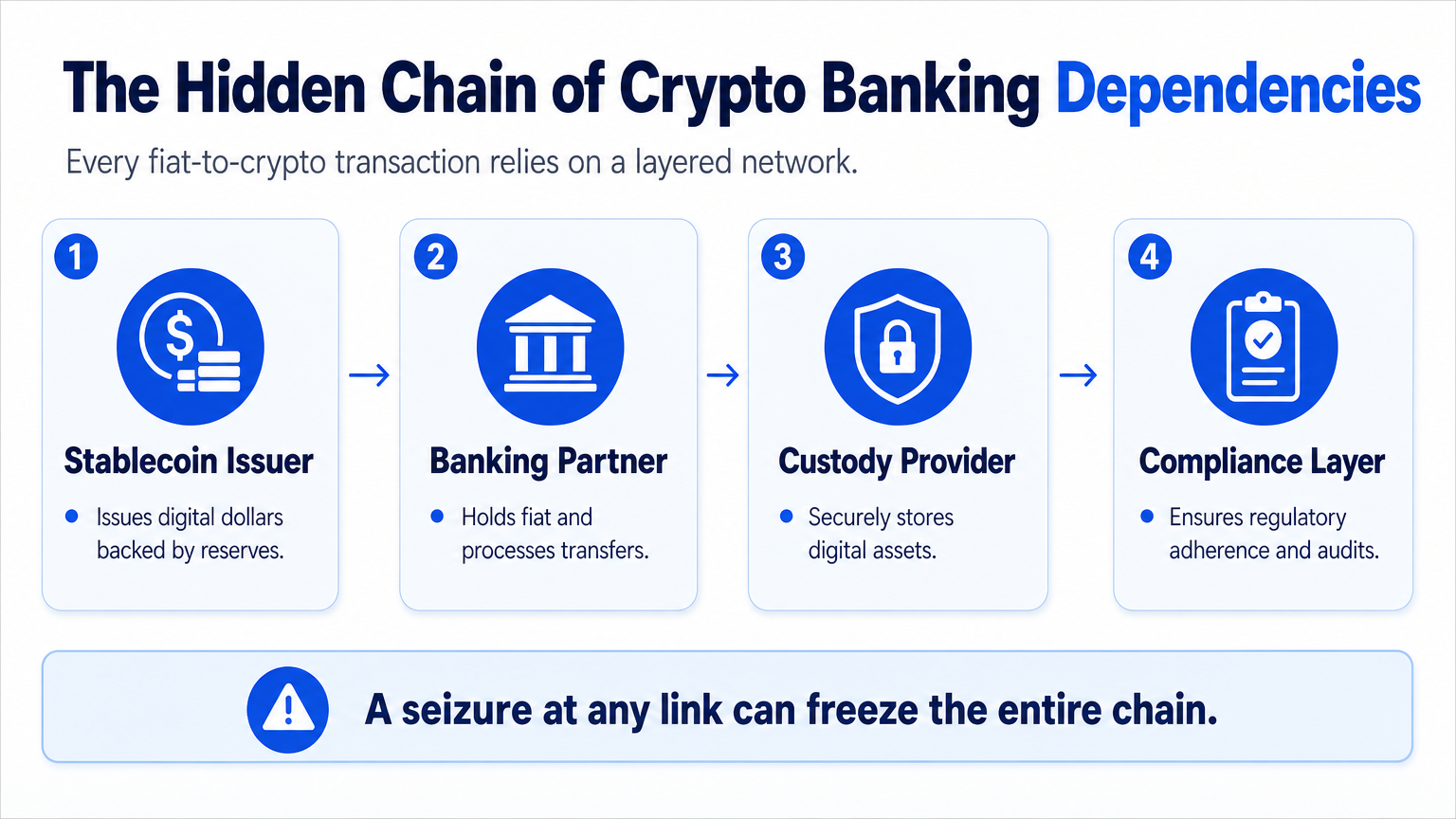
Crypto banking emerged as the compliant bridge between fiat and digital assets. Traditional banks serving crypto companies (like once-offered SVB crypto banking) and neobanks that package those rails now process billions daily. The operational reality is a chain of dependencies: stablecoin issuer, banking partner, custody provider, compliance layer.
The regulatory pressure building on banking partners of stablecoin issuers
Regulators are applying pressure. The FDIC’s 2025 Financial Institution Letter requires banks to get specific approval for crypto activities, clarifying that the safety net doesn’t automatically cover digital assets (FDIC, 2025). Meanwhile, the Fed’s stablecoin regulation and Europe’s MiCA push issuers to hold reserves at regulated banks, concentrating stablecoin exposure among fewer partners. When one partner faces a forfeiture, contagion risk is real.
Concrete Implications and Recommended Actions
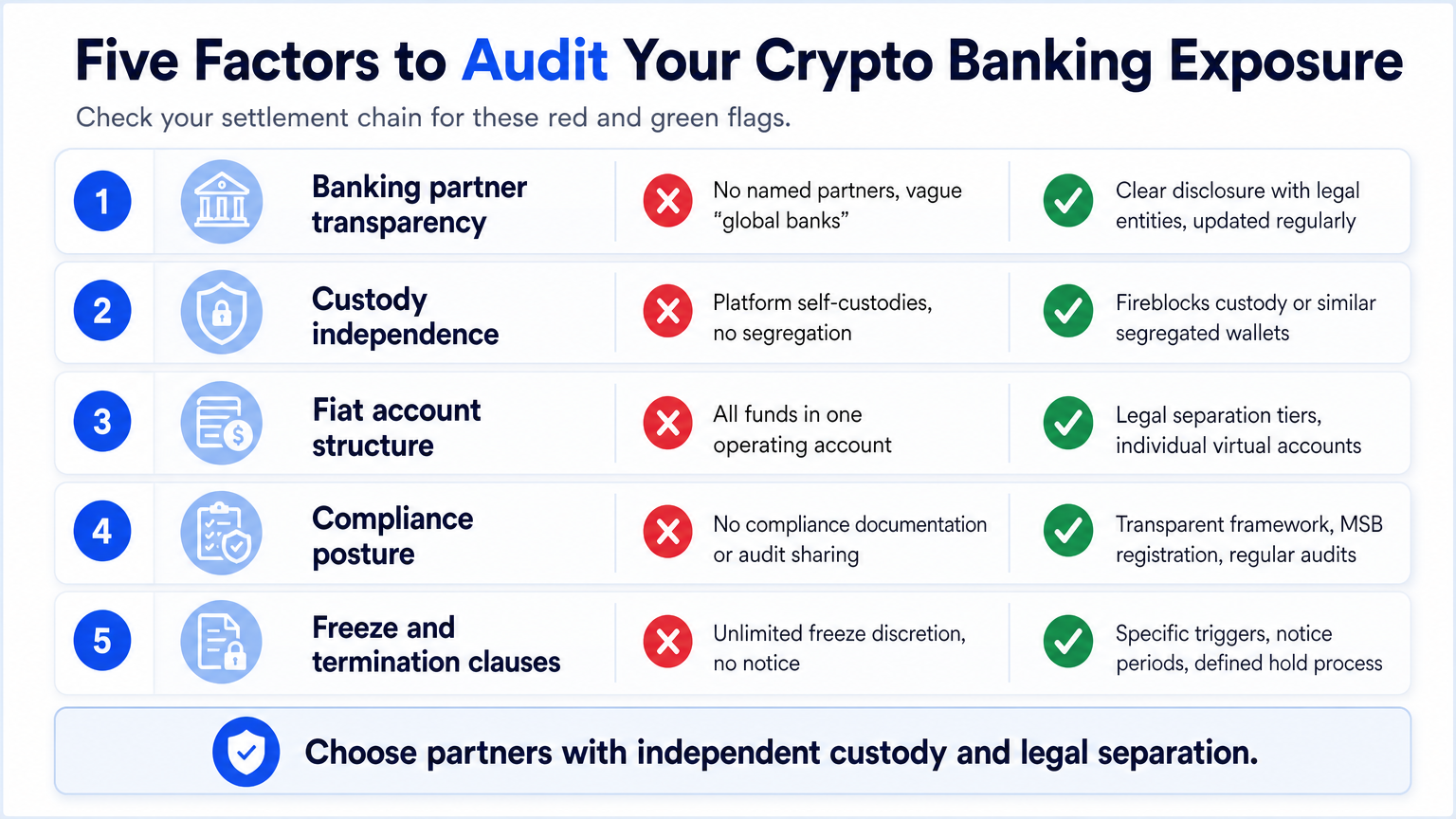
Immediate audit: what businesses should check right now to gauge exposure
Every team that touches a crypto banking service should run a quick diagnostic:
- Map your fiat settlement chain: List every entity touching your dollars from withdrawal to bank account—platform, its banking partners, intermediary processors.
- Identify custody segregation: Check if digital assets are held with an independent custodian and if fiat is in accounts titled in your name or the platform’s.
- Review freeze terms: Look for clauses on how funds are treated during third-party claims or regulatory actions. Some platforms offer “safeguarded” accounts; others don’t.
- Test a withdrawal: Move a small amount of fiat now to confirm the corridor is open and no hidden holds exist.
| Factor | What to check | Red flag | Green flag |
|---|---|---|---|
| Banking partner transparency | Does the platform name its bank partners publicly or in your agreement? | No named partners or refuses to disclose; vague “global banks” | Clear disclosure with legal entities, updated regularly |
| Custody independence | Are digital assets held with a third-party custodian like Fireblocks, separate from banking accounts? | Platform custodies itself with no segregation | Fireblocks custody or similar institutional-grade segregated wallet infrastructure |
| Fiat account structure | Are pooled client accounts titled such that a seizure at the bank could sweep up all client funds? | All funds in one operating account | Legal separation tiers (e.g., individual virtual accounts, underlying trust accounts) |
| Compliance posture | Does the platform maintain active KYB/AML programs and share audit reports? | No compliance documentation or refusal to share | Transparent compliance framework, MSB registration where applicable, regular audits |
| Freeze and termination clauses | Under what conditions can the platform suspend withdrawals? | Unlimited discretion with no notice; blanket “regulatory action” | Specific triggers, notice periods, and a defined process for legal holds |
What to look for in a crypto banking partner: custody independence, compliance, transparency
Resilient partners isolate risk. For example, OneSafe separates digital asset custody via Fireblocks custody, maintains transparent compliance, and uses partner banks with distinct legal tiers, so a seizure at one partner doesn’t freeze all client assets. While OneSafe is a fintech, not a bank, this architecture reduces the blast radius. Prioritize:
- Custody independence: assets held by a recognized custodian, separate from platform funds.
- Legal entity separation: platform and banking partner are different entities; each tier bears its own liability.
- Auditable reporting: real-time dashboards, on-chain proof of reserves.
A deeper dive into choosing a banking partner that understands these risks is in our crypto banking production vs. pilots analysis.
What to Watch Next
Forfeiture case timeline and its potential to set a precedent for crypto banking
The court hasn’t ruled on EQIBank’s innocent-owner claim. A ruling in the bank’s favor could establish that conduit banks can recover seized funds; a ruling against would signal substantial legal risk for crypto banking partners. The outcome will shape how crypto fiat bridge operators manage relationships and reserves.
Regulatory ripple effects: will stablecoin issuers and banks start decoupling?
Decoupling is under discussion. The Fed’s draft stablecoin regulation would push issuers to hold reserves directly at the Fed, bypassing commercial banks (Stablecoin Regulation: Fed's 2-Day Payout Rule Explained). MiCA aligns. If issuers move reserves to central banks, counterparty risk shrinks, but crypto banking platforms lose access to those reserves—narrowing the bridge.
What Does This Mean for Your Business? Direct Answers to Key Questions
What just happened between Tether and EQIBank?
In July 2026, the US filed a civil forfeiture complaint for $84.2M in Capstone-linked assets. September court orders froze Wells Fargo, JPMorgan accounts, and USDT wallets tied to EQIBank’s payment processing. Tether, an EQIBank client, confirmed on October 5 that its exposure was under 0.034% and it was unaware of the allegations. EQIBank claims innocent ownership and is fighting to recover $89M.
How does this asset seizure affect my business’s crypto banking accounts?
If your platform relies on a partner bank facing a similar seizure, your fiat balances could be frozen. The outcome depends on whether client funds are legally segregated from the platform’s operating accounts and if custody is independent.
Is my money actually safe in a crypto bank?
Safety depends on architecture. Crypto banking services aren’t licensed banks, so no FDIC insurance. Security comes from layered risk management: segregated custody (e.g., Fireblocks-powered wallets), legal separation of client accounts, and transparent compliance. The EQIBank case shows you must audit the whole chain.
What steps should I take to protect my company from similar counterparty risk?
Audit your setup: map the settlement chain, verify custody independence, review terms, test a withdrawal. Use the due-diligence checklist. Spread large balances across multiple partners, and avoid keeping all capital in a single platform’s fiat accounts. Build a counterparty risk playbook now.
What due-diligence questions should I ask a crypto banking platform after this event?
Ask: Which partner banks do you use, and are they disclosed? Are digital assets held with a third-party custodian like Fireblocks, and in whose name? What happens to my fiat funds if a partner faces a seizure—are they legally segregated? Can you share an audit report demonstrating these controls? Resilience often comes down to how clear and specific the answers are.
Key Takeaways
- EQIBank seizure exposed counterparty risk: fiat funds can be frozen at a partner bank regardless of platform security.
- Tether’s tiny exposure (under 0.034%) shows that any crypto fiat bridge is only as strong as its weakest link.
- Audit your settlement chain now: map banking partners, verify custody segregation, test withdrawal access.
- Choose partners with independent custody (e.g., Fireblocks), transparent compliance, and legal entity separation.
- The forfeiture ruling could shield conduit banks or tighten rules for stablecoin issuers, reshaping DAO banking and treasury workflows.
If your business needs a crypto banking platform built with these resilience principles, explore how OneSafe structures your fiat and crypto operations with independent custody and clear legal safeguards.