On October 15, 2026, South Korea's Jeonbuk Bank reportedly began issuing won-denominated business loans backed by Bitcoin held in a third-party custodian, as reported by TechBullion. The announcement is a rare turning point: crypto banking is no longer a fintech abstraction but a credit product inside a traditional bank's corporate lending arm. For finance leads at startups and DAOs, the practical question shifts from "can this work?" to "should we borrow, convert, or build better rails?"
Table of Contents
- What Just Happened: Bitcoin-Backed Loans Hit Traditional Banking
- Why This Matters Now for Businesses Running on Fiat and Crypto
- The Background Every Finance Lead Needs
- Concrete Steps for Your Business Right Now
- What to Watch Next in Crypto Banking
- Why is a Korean bank lending against Bitcoin a big deal for global businesses?
- How can my company access fiat without liquidating crypto?
- What role does a neo-bank play when traditional banks start offering crypto loans?
- What should finance leads in startups and DAOs do differently after this announcement?
- Key Takeaways
What Just Happened: Bitcoin-Backed Loans Hit Traditional Banking
South Korea's Jeonbuk Bank Launches Crypto Lending Against Bitcoin
TechBullion reported on October 15, 2026 that Jeonbuk Bank launched bitcoin-backed business loans, restricting proceeds initially to corporate operating capital. The structure is deliberately conservative: a third-party custodian controls the collateral, which means the bank extends won-denominated credit without directly owning or holding Bitcoin. The bank retains a recovery process if the borrower defaults. This jeonbuk bank crypto lending product exists because of recent changes to South Korea's Civil Enforcement Rules that establish procedures for seizing and liquidating virtual-asset claims. That legal foundation, not the loan itself, is the part global finance leads should mark.
Remittix's PayFi Pursues a Different Fiat-Crypto Bridge
The same TechBullion roundup noted that Remittix is building a PayFi route that moves stablecoins directly into compatible bank accounts for everyday payments. Its planned Markets and Earn features aim to deepen the relationship between stablecoins and routine banking.
Both stories validate the same underlying shift: the wall between crypto treasury assets and fiat working capital is getting thinner. Jeonbuk shows a bank lending against a volatile asset; Remittix shows a fintech routing stablecoins into the payments layer.
Why This Matters Now for Businesses Running on Fiat and Crypto
Solving the 'Don't Sell Your Stack' Dilemma at Scale
The core problem: a business holds Bitcoin with meaningful unrealized value but needs won, dollars, or euros for payroll or suppliers. Selling triggers a taxable event and sacrifices upside. Borrowing against it solves both—if the counterparty survives market swings. Crypto-native lenders have offered this for years. SALT Lending has offered Bitcoin-collateralized loans since 2016, and Ledn operates the same category today. What changed on October 15 is that a regulated bank adopted the model. Bank balance sheets, court-enforced recovery, and mainstream compliance oversight are a different risk profile than a specialist lender.
The Expanding Infrastructure for a Two-World Treasury
This fits into a broader trend of businesses managing fiat and crypto in the same stack. SAP's USDC integration signaled a shift in crypto treasury management, and debanking has pushed more businesses toward crypto-friendly treasury infrastructure. Crypto collateral loans are one piece; multi-currency accounts, conversion rails, payroll, and payments are what actually move the money.
The Background Every Finance Lead Needs
From Simple Trading Apps to Institutional-Grade Crypto Banking
Crypto collateral loans are not new. Specialist firms like Ledn and Nebeus, which explicitly targets business borrowers, have operated for years with varying loan-to-value ratios and margin calls. Even Coinbase has offered borrow products. What was missing was a traditional bank putting its own credit process and regulatory standing behind the structure. The mechanics are straightforward: the borrower posts Bitcoin as collateral, receives fiat, and repays with interest to recover the collateral. The risk equation has always been the liquidation threshold—if the Bitcoin price falls below the agreed floor, the lender can sell the collateral.
Neo-Banks Like OneSafe: Built for the Hybrid Reality
A credit product is not a treasury operating system. OneSafe is a financial technology company—not a bank—that provides a crypto-friendly platform for global businesses, Web3 startups, and DAOs. It combines multi-currency accounts, corporate cards, wire transfers, and crypto-to-fiat conversions in one interface. Banking services are delivered through its partners. Jeonbuk's offering is a loan; OneSafe is the operational substrate a business uses between loans—paying vendors, running payroll, converting USDC. One is episodic, the other constant.
Where Jeonbuk's Offering Fits—and What It Still Leaves Out
The gap matters. Jeonbuk's loan is won-denominated, restricted to business operating capital, and bound to South Korean legal procedure. It doesn't give a Singapore startup a multi-currency account, doesn't perform payroll, and doesn't resolve dao banking—the legal borrower question for decentralized organizations remains unresolved in most jurisdictions. That is the divide between a credit instrument and a financial operating system. Osler, a major Canadian law firm, flags similar considerations for institutions entering Bitcoin-backed lending: custody, liquidation mechanics, and regulatory treatment all need careful structuring. Jeonbuk solved those in one jurisdiction; the next challenge is making the solution portable.
Concrete Steps for Your Business Right Now
Re-Evaluate Your Collateral and Liquidity Strategy
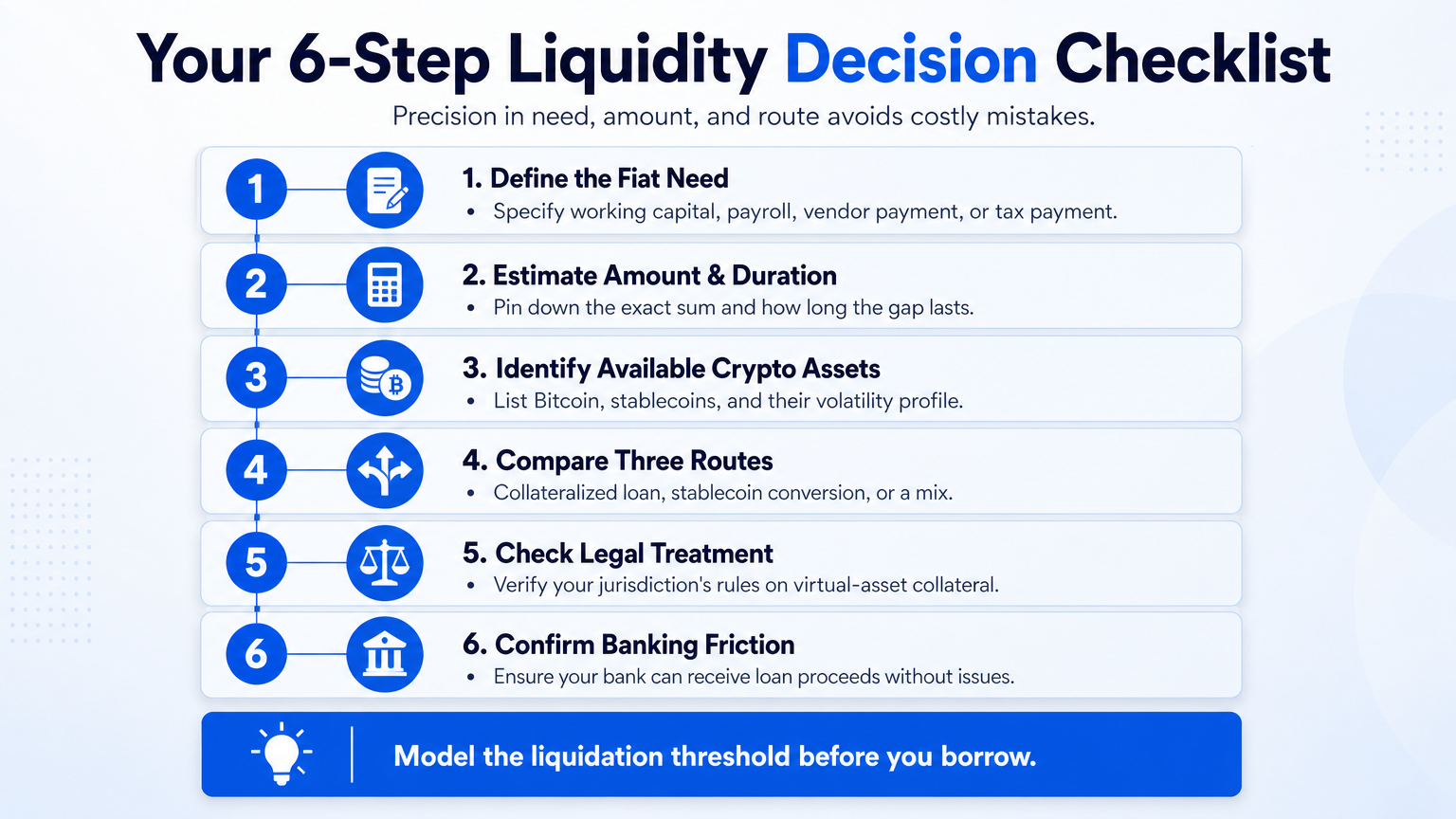
The announcement changes the benchmark. The question is no longer "is borrowing against Bitcoin possible?" It is "which route serves this specific fiat need best?" Use this checklist:
Liquidity Decision Checklist
- Define the fiat need precisely: working capital, payroll, vendor payment, or tax payment.
- Estimate the amount and the duration of the gap.
- Identify which crypto assets are available and their volatility profile.
- Compare three routes: a collateralized loan against BTC (bank or specialist), conversion of stablecoins via an on/off-ramp, or a combination.
- Check your jurisdiction's legal treatment of virtual-asset collateral.
- Verify your banking partner can receive fiat from a loan proceeds account without friction.
Assess Your Financial Partner's Crypto-Fiat Fluency
A traditional bank offering a Bitcoin loan is not the same as a bank that runs crypto-native operations. Ask your current financial partner:
- Can they handle domestic and international wires alongside crypto on/off-ramps?
- Do they support multi-currency accounts without a physical presence?
- How fast are their crypto-to-fiat conversions?
If the answer is "no" or "slow," the loan product solves only one narrow problem. Fiat-crypto management is the broader daily job. For teams paying distributed contributors, crypto payroll adds its own complexity and error-risk.
Get Your On/Off-Ramp House in Order
The decision rule: if the fiat need is short-term and small, conversion beats borrowing; if it is large and the asset has appreciated, borrowing may preserve the position. A startup paying a $10,000 vendor invoice can convert USDC to fiat in minutes on a neo-bank platform. One holding Bitcoin with a low cost basis and a six-month capital need may prefer a crypto collateral loan—assuming they can absorb liquidation risk.
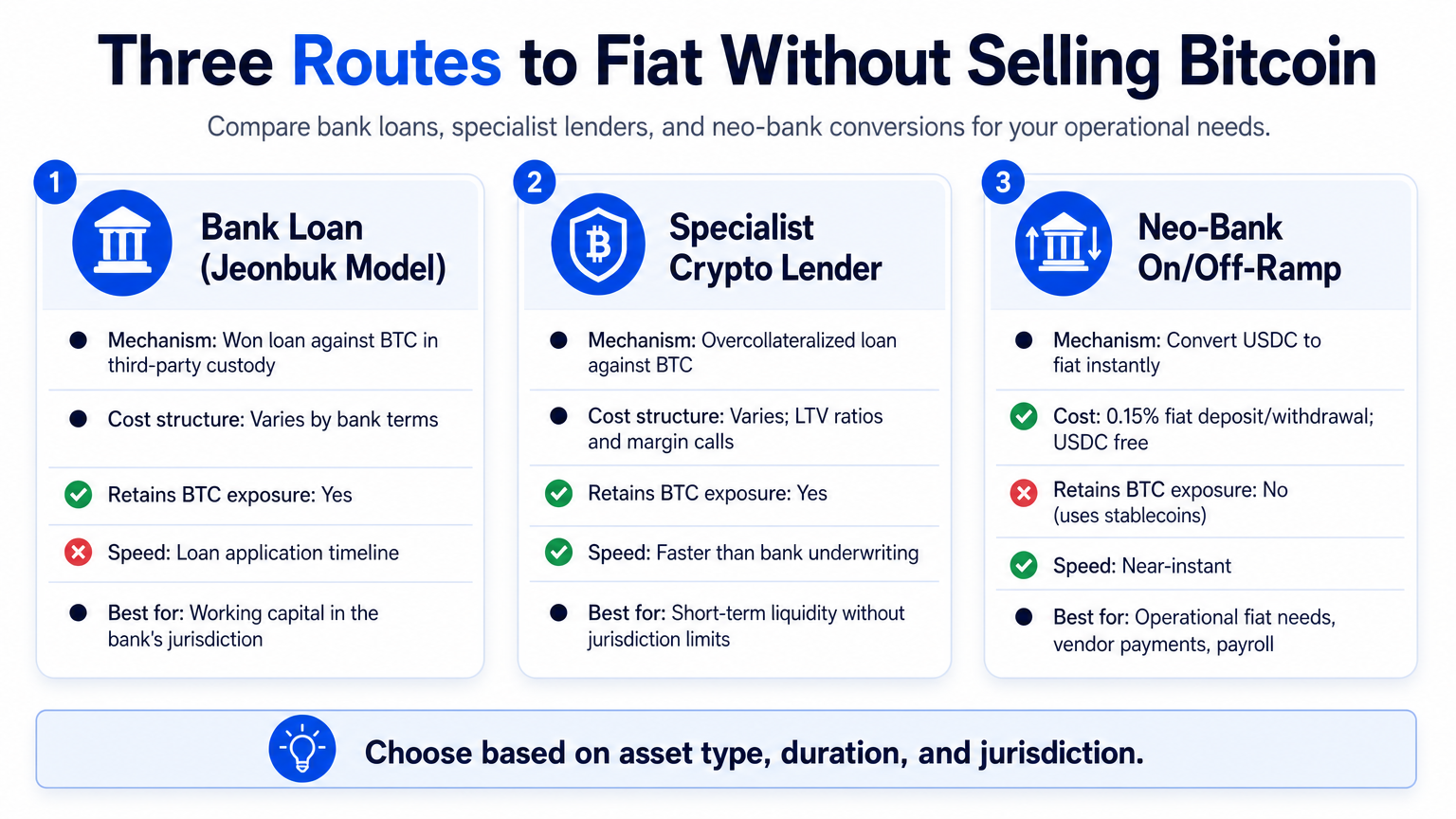
| Route to fiat | Mechanism | Cost structure | Retains BTC exposure | Speed | Best for |
|---|---|---|---|---|---|
| Jeonbuk-style bank loan | Won loan against BTC in third-party custody | Varies by bank terms | Yes | Loan application timeline | Working capital in the bank's jurisdiction |
| Specialist crypto lender (e.g., SALT, Ledn) | Overcollateralized loan against BTC | Varies; LTV ratios and margin calls | Yes | Faster than bank underwriting | Short-term liquidity without jurisdiction limits |
| Neo-bank on/off-ramp (e.g., OneSafe) | Convert USDC to fiat instantly | 0.15% fiat deposit/withdrawal fee; USDC free | No (uses stablecoins) | Near-instant | Operational fiat needs, vendor payments, payroll |
What to Watch Next in Crypto Banking
Other Banks Will Move—But Not Overnight
Jeonbuk's launch required a change to South Korean civil enforcement rules before a single loan could be written. Other jurisdictions lack that legal foundation. Banks in the U.S. and Europe may watch closely, but adoption will lag behind the news cycle.
Regulatory Signals That Could Accelerate or Freeze the Trend
Stablecoin regulation is the adjacent story to watch. The Tether regulatory test is already shaping payment norms, and any change to how stablecoins are treated on bank balance sheets will ripple into how banks think about crypto collateral generally. If a regulator clarifies that certain digital assets can be held as eligible collateral, more bank products will follow.
The Stablecoin Sleeper: Everyday Payments as the Next Frontier
Remittix's PayFi push is a reminder that global business crypto banking may ultimately be defined less by loans and more by payments. Mastercard's stablecoin platform is already pushing in that direction. Collateralized loans serve companies that hold appreciated assets and need fiat. Stablecoin payment rails serve every business that wants to move value without touching a volatile token. The revenue pool is larger, so the payment side may outpace the credit side.
Why is a Korean bank lending against Bitcoin a big deal for global businesses?
Because it converts a proof of concept into a legal template. A regulated South Korean bank accepted Bitcoin as collateral for corporate credit, validating the asset class in a way no crypto-native lender could. The structural precedent—third-party custody, clear liquidation procedure, corporate lending against crypto—is now a reference point for banks elsewhere.
How can my company access fiat without liquidating crypto?
Two legitimate routes: a crypto collateral loan (post Bitcoin, receive fiat, keep upside exposure) or converting stablecoins for operational flows. Specialist lenders like SALT and Ledn have done this for years; Jeonbuk brings a bank balance sheet. If your treasury holds USDC, converting it to fiat is a pegged conversion with near-zero price impact, not a taxable asset sale. The right approach depends on the amount, duration, and which assets you can post without triggering a margin call.
What role does a neo-bank play when traditional banks start offering crypto loans?
The neo-bank becomes the operational layer the loan sits on top of. Jeonbuk originates credit; it doesn't run vendor payments across currencies or convert USDC for contractors. A crypto-friendly platform like OneSafe handles that daily fiat-crypto management. As banks add crypto loans, the value of a unified operational account—speaking both fiat and crypto—rises, because finance leads don't want a loan stranded in a bank system that can't move the money where it's needed.
What should finance leads in startups and DAOs do differently after this announcement?
Treat this as a signal to build the infrastructure first and evaluate credit second. Practical steps:
- Map your liquidity stack. Know your monthly fiat needs, which crypto assets are available, and what a 30% Bitcoin drawdown would do to your collateral position.
- Open and test hybrid accounts before you need a loan. Onboarding to a neo-banking platform for startups typically takes a week or less.
- For DAOs, clarify who can legally sign for a loan or hold a custodial account. Jeonbuk's product assumes a corporate borrower. A DAO without legal personality will need a wrapper entity.
- Monitor liquidation mechanics. The risk in any crypto collateral loan is not the interest rate; it's the liquidation threshold and the speed of the margin call. Model the worst case before you sign.
Key Takeaways
- Jeonbuk Bank's October 15, 2026 launch of Bitcoin-backed won loans proves regulated banks can structure jeonbuk bank crypto lending with third-party custody and court-enforced recovery.
- Borrowing against Bitcoin is not the only way to fund fiat operations—converting stablecoins through an on/off-ramp is faster and cheaper for small, short-term needs.
- A neo-bank like OneSafe and a bank like Jeonbuk serve different functions: the bank provides credit, the neo-bank provides the multi-currency operating rails that move the funds.
- Finance leads should model liquidation thresholds before signing any crypto collateral loan, not after—the margin call is the risk that matters.
- Watch stablecoin regulation and payment rails next; they may reshape crypto banking faster than collateralized credit does.
For businesses that need crypto-friendly financial rails today rather than a speculative credit product tomorrow, get started with OneSafe here.